
Verwandte Artikel zu The Spartan Dagger
Inhaltsangabe
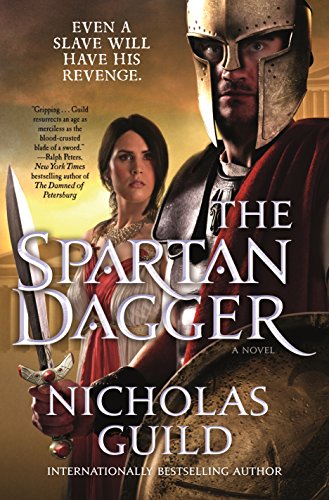
Ancient Sparta comes to life in The Spartan Dagger, Nicholas Guild's vivid tale of murder and vengeance.
On a cold night, at the outskirts of a peasant village, two Spartan youths wait to perform an ancient rite of passage. A family--father, mother, and their son--approaches, unarmed and defenseless. The young men step into the moonlight and claim their manhood by killing the adults. The boy escapes.
The Spartans have no idea how terrible an enemy they have called forth. Nothing could have prepared them for the boy, Protos, whose name means “destined,” whose cunning and inborn skill with weapons renders his enemies almost defenseless, and whose heart knows no pity. The Spartans have oppressed his people for centuries, and to break their power is to free all those they hold in subjection. As Protos grows to manhood, he begins to understand that his private war against his parents’ murderers is also a struggle for liberation.
Die Inhaltsangabe kann sich auf eine andere Ausgabe dieses Titels beziehen.
Über die Autorin bzw. den Autor
NICHOLAS GUILD was born in Belmont, California, and attended Occidental College and the University of California, Berkeley. He taught at Clemson and Ohio State before turning full time to writing fiction. He has published a dozen novels, several of which were international bestsellers, including The Assyrian, Blood Star, and Angel. Guild now lives in Frederick, Maryland.
Auszug. © Genehmigter Nachdruck. Alle Rechte vorbehalten.
The Spartan Dagger
By Nicholas GuildTom Doherty Associates
Copyright © 2016 Nicholas Guild
All rights reserved.
ISBN: 978-0-7653-7651-0All rights reserved.
CHAPTER 1
It was the coldest autumn anyone could remember. Eurytus sat in the shadow of a rock face, tapping the flat of his dagger against his knee as he cursed not the cold but the moonlight. He hadn't eaten in two days and the moon was as bright as a new gold coin. The night sky was nearly cloudless.
The valley beneath them seemed a stark landscape, full of hard lines and deep shadow. A faint wind blew across it, but the naked branches of its few scattered trees hardly stirred. In daylight it probably would have appeared a different place, but at night, in the tarnished moonlight, it was the land of the dead.
His brother Teleklos was asleep and untroubled by such reflections.
"Go out and wet your blades," their father had told them. "A warrior kills, without remorse or pity. Become warriors."
A quarter of a century before, their father had wet his blade in Helot blood. Eurytus thought him very like Teleklos in temperament, endowed with a warrior's perfect confidence. In his middle forties he was still tall and slim, broad shouldered and powerful. With his black hair and pale blue eyes, which both his sons had inherited, he had the face of a bird of prey.
"To have both of you selected for the Krypteia is an honor for our house. We have too many Helots as it is. When you need food, steal it. Plunder them, even of their lives, and prove your manhood."
The difficulty was that the Helots also seemed to know about the Krypteia and after dark they mostly kept indoors. It was rare to catch anyone on the roads at night and to venture into their villages might be to disappear forever.
Three days ago they had almost surprised a herdsman, but he saw them in time to save himself, scampering away like a rabbit but leaving behind a reed flute and his dinner bag. They had shared a small loaf of bread and a piece of goat cheese wrapped in leaves.
They had been on the march ever since, farther and farther south, hoping that, a day and a half's march from Sparta, the Helots might feel themselves safe.
Eurytus knew it might prove necessary to enter a village. They could not return home until they had each made a kill — better to die the worst death than to face the dishonor of failure. But the mere thought of venturing in among the Helots made his skin tingle with fear.
And his fear shamed him. Fear was unworthy of a Spartan and yet it would come, unbidden. To be torn apart by a mob of slaves ...
At the ceremony it had seemed so simple. The Elders together had offered sacrifice of a kid at the shrine of Artemis and declared the annual war against the conquered peoples, thus absolving of blood guilt any who killed a slave — who was, in any case, the property of the state — and the ten young men who would go out in pairs to accomplish the rite had been selected from among the best of those who had just finished their military training. Eurytus, described by his instructors as the perfect soldier, brave, disciplined, and cunning, had known he was certain of a place, and Teleklos had been almost as deserving.
"You will enjoy yourselves," their father had said as Eurytus and Teleklos set out. "It is no different from a hunting party, except that you kill men instead of deer or wild boar — and, trust me, wild boar are more dangerous than the Helots. They are slaves in their souls."
So they had each been given a dagger and a leather bag full of water and had been sent off south over the hills.
But Eurytus knew this would be no deer hunt. Even a slave will fight for his life. And one man, or even two, cannot prevail against twenty, not armed with a blade no longer than a crow's wing.
The Krypteia was a test of stealth, no less than of courage. Hence the name: the Hidden. One concealed oneself during the day, for to be discovered was to hazard death, and at night one stole food and killed.
"We will have to go into a village," Teleklos announced, now apparently awake.
"It is a serious risk."
"Nevertheless, we have to eat. And when should a Spartan be afraid of risk?"
Teleklos grinned, as if issuing a challenge — and what else could it be? In the moonlight Eurytus could see his face clearly. It was like seeing his own reflection.
They were twins, in appearance as alike as two halves of the same apple yet, like the halves of an apple, not quite identical. The difference was a reflection of their temperaments, which were at odds. Eurytus had long recognized a streak of madness in his brother. Teleklos was not as gifted in intellect, but he was recklessly brave. Aside from skill with weapons, it was the only virtue he thought a Spartan needed. He was born to be a hero, yet would never command troops in battle.
They were near a road, really more of a footpath, a pale streak running north and south between two villages. The brothers had positioned themselves so that they had a clear view of its length, a distance a man might walk in little more than an hour.
"We will wait until the moon is directly overhead," Eurytus said finally. "If no one has come along by then, at least we can be sure the villagers will be deep asleep."
"They are asleep already. They sleep like cattle." Teleklos laughed quietly. "They are cattle."
When Eurytus didn't respond, Teleklos apparently felt encouraged.
"It will be easy," he went on. "We go into a hut, we kill everyone there before they have a chance to cry out. We steal some food, and then it's home again."
"Have you ever been inside a Helot village?"
"No." Teleklos shook his head. "And neither have you."
"True. But I have wit enough to realize that I have no idea what we might find there. The Helots are poor. Even from the outside we can see that their huts are small. For all we know, they probably sleep like dogs in a kennel — parents, grandparents, little children, uncles, cousins ... There might be ten or twelve in one room, covering the floor like rushes. We can't kill that many without someone living long enough to raise an alarm. We will wait."
"I'm hungry now."
"Nevertheless, we will wait."
This was met with sullen silence. Brave as he was, Teleklos had never learned to defy his brother. Instead, he hunched his shoulders and went back to sleep.
Let him sleep, Eurytus thought.
"I'm hungry now."
It had been exactly the same when they were eleven years old and their military instructors decided that the boys were becoming sluggish.
"A Spartan should be strong enough to fight on an empty belly," one of them had announced. "Too much food is turning you into women. Corinthians can be women. Athenians can be women and no one notices the difference. But Spartans have to be men. Learn to do with less."
After five or six days the boys learned they could not "do with less." Some tried to run away, to return to their parents, which, of course, was impossible. A few just curled up on the ground and couldn't be roused.
Teleklos's solution was more drastic — he wanted to attack the instructors' mess in the midst of their evening meal.
"Don't be a fool," Eurytus had told him. "What can you achieve except a sound thrashing and perhaps even expulsion? Then, if you're not a Spartan anymore, what are you?"
"I'm hungry."
"Wait."
"I'm hungry now!"
"Wait until tonight and we'll steal some food."
"How will we do that?"
"I'll think of something."
It was summer and the...
„Über diesen Titel“ kann sich auf eine andere Ausgabe dieses Titels beziehen.
Suchergebnisse für The Spartan Dagger

Beispielbild für diese ISBN
The Spartan Dagger: A Novel
Anbieter: Wonder Book, Frederick, MD, USA
Verkäuferbewertung 5 von 5 Sternen

Zustand: As New. Like New condition. Like New dust jacket. A near perfect copy that may have very minor cosmetic defects. Bestandsnummer des Verkäufers A15B-03587
Gebraucht kaufen
EUR 6,43
Versand gratis
Versand innerhalb von USA
Versand innerhalb von USA
Anzahl: 4 verfügbar
Beispielbild für diese ISBN
The Spartan Dagger : A Novel
Anbieter: Better World Books, Mishawaka, IN, USA
Verkäuferbewertung 5 von 5 Sternen
Zustand: Good. Former library copy. Pages intact with minimal writing/highlighting. The binding may be loose and creased. Dust jackets/supplements are not included. Includes library markings. Stock photo provided. Product includes identifying sticker. Better World Books: Buy Books. Do Good. Bestandsnummer des Verkäufers 13876461-6
Gebraucht kaufen
EUR 7,39
Versand gratis
Versand innerhalb von USA
Versand innerhalb von USA
Anzahl: 1 verfügbar
Beispielbild für diese ISBN
The Spartan Dagger : A Novel
Anbieter: Better World Books, Mishawaka, IN, USA
Verkäuferbewertung 5 von 5 Sternen
Zustand: Very Good. Former library copy. Pages intact with possible writing/highlighting. Binding strong with minor wear. Dust jackets/supplements may not be included. Includes library markings. Stock photo provided. Product includes identifying sticker. Better World Books: Buy Books. Do Good. Bestandsnummer des Verkäufers 14323571-75
Gebraucht kaufen
EUR 7,39
Versand gratis
Versand innerhalb von USA
Versand innerhalb von USA
Anzahl: 1 verfügbar
Beispielbild für diese ISBN
The Spartan Dagger
Anbieter: ThriftBooks-Atlanta, AUSTELL, GA, USA
Verkäuferbewertung 5 von 5 Sternen
Hardcover. Zustand: Fair. No Jacket. Missing dust jacket; Readable copy. Pages may have considerable notes/highlighting. ~ ThriftBooks: Read More, Spend Less. Bestandsnummer des Verkäufers G0765376512I5N01
Gebraucht kaufen
EUR 7,43
Versand gratis
Versand innerhalb von USA
Versand innerhalb von USA
Anzahl: 1 verfügbar
Beispielbild für diese ISBN
The Spartan Dagger
Anbieter: ThriftBooks-Atlanta, AUSTELL, GA, USA
Verkäuferbewertung 5 von 5 Sternen
Hardcover. Zustand: Very Good. No Jacket. Former library book; May have limited writing in cover pages. Pages are unmarked. ~ ThriftBooks: Read More, Spend Less. Bestandsnummer des Verkäufers G0765376512I4N10
Gebraucht kaufen
EUR 7,43
Versand gratis
Versand innerhalb von USA
Versand innerhalb von USA
Anzahl: 1 verfügbar
Beispielbild für diese ISBN
The Spartan Dagger
Anbieter: ThriftBooks-Dallas, Dallas, TX, USA
Verkäuferbewertung 5 von 5 Sternen
Hardcover. Zustand: Very Good. No Jacket. May have limited writing in cover pages. Pages are unmarked. ~ ThriftBooks: Read More, Spend Less. Bestandsnummer des Verkäufers G0765376512I4N00
Gebraucht kaufen
EUR 7,43
Versand gratis
Versand innerhalb von USA
Versand innerhalb von USA
Anzahl: 1 verfügbar
Beispielbild für diese ISBN
The Spartan Dagger: A Novel
Anbieter: HPB-Emerald, Dallas, TX, USA
Verkäuferbewertung 5 von 5 Sternen
hardcover. Zustand: Very Good. Connecting readers with great books since 1972! Used books may not include companion materials, and may have some shelf wear or limited writing. We ship orders daily and Customer Service is our top priority! Bestandsnummer des Verkäufers S_472790549
Gebraucht kaufen
EUR 8,03
EUR 3,35 Versand
Versand innerhalb von USA
Versand innerhalb von USA
Anzahl: 1 verfügbar
Beispielbild für diese ISBN
The Spartan Dagger: A Novel
Anbieter: HPB Inc., Dallas, TX, USA
Verkäuferbewertung 5 von 5 Sternen
Hardcover. Zustand: Very Good. Connecting readers with great books since 1972! Used books may not include companion materials, and may have some shelf wear or limited writing. We ship orders daily and Customer Service is our top priority! Bestandsnummer des Verkäufers S_449539310
Gebraucht kaufen
EUR 8,03
EUR 3,35 Versand
Versand innerhalb von USA
Versand innerhalb von USA
Anzahl: 1 verfügbar
Beispielbild für diese ISBN
The Spartan Dagger: A Novel
Anbieter: Celt Books, Kenner, LA, USA
Verkäuferbewertung 5 von 5 Sternen
Hardcover. Zustand: New. Zustand des Schutzumschlags: New. 1st Edition. The Spartan Dagger: A Novel. Bestandsnummer des Verkäufers 012568
Beispielbild für diese ISBN
The Spartan Dagger - A Novel
Verlag:
Stated first edition, December 2016. Published as a Forge Book by Tom Doherty Associates, New York., 2016
ISBN 10: 0765376512
ISBN 13: 9780765376510
Gebraucht
Hardcover
Erstausgabe
Anbieter: Jerry Merkel, XENIA, OH, USA
Verkäuferbewertung 5 von 5 Sternen
Hardcover. Zustand: Near Fine. Zustand des Schutzumschlags: Near Fine. 1st Edition. Very good to fine with very good to fine dust jacket. A few very light stains on page edges. Dust jacket is very lightly bumped at spine tips and corners. 380 pages. Bestandsnummer des Verkäufers 24022
Gebraucht kaufen
EUR 13,79
EUR 4,91 Versand
Versand innerhalb von USA
Versand innerhalb von USA
Anzahl: 1 verfügbar