
Verwandte Artikel zu Are You Paid What You're Worth?: The Complete Guide...
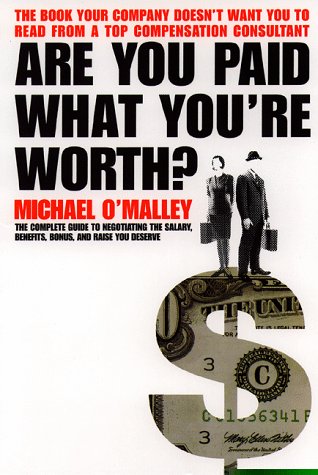
Are You Paid What You're Worth?: The Complete Guide to Calculating and Negotiating the Salary, Benefits, Bonus and Raise You Deserve - Softcover
Inhaltsangabe
Explains the workings of the compensation systems and provides formulas to determine competitive worth
Die Inhaltsangabe kann sich auf eine andere Ausgabe dieses Titels beziehen.
Über die Autorin bzw. den Autor
Michael O'Malley, a Ph.D. in psychology, is a practicing management and compensation consultant with over fifteen years of experience. Currently employed at a major consulting firm, O'Malley has designed compensation programs and benefits plans for more than one hundred major corporations, including PepsiCo, AT&T, Fisher-Price, and Aetna. He lives with his wife in New Haven, Connecticut.
Aus dem Klappentext
of downsizing, paycuts, and shrinking health-care contributions, employees on all rungs of the corporate ladder are increasingly baffled by company pay structures, benefits packages, and bonus plans. What might look like a nice raise on the surface often translates into a virtual pay cut when all the components are figured in. And what's more, until now, employers have had a monopoly on the knowledge of how these systems actually work, leaving employees virtually defenseless.
Now, in Are You Paid What You're Worth?, long-time corporate insider and compensation consultant Michael O'Malley exposes the inner workings of compensation systems and provides a specific formula that allows anyone--from the cubicle-dweller up to the CEO--to determine his or her own competitive worth. Packed with practical tips and strategies, and spiced with real-life examples from big-name companies, Are You Paid What You're Worth? arms you wi
Auszug. © Genehmigter Nachdruck. Alle Rechte vorbehalten.
Comparative Standards: How You Measure Up to Everybody Else
There are two types of comparative standards that involve comparisons between what you get paid and what others get paid. In one instance, you compare yourself to others around you within the company: to those persons' efforts, abilities, contributions, responsibilities, etc., and to their likely salaries. It is wholly natural to make these social comparisons to see how you measure up against others. You make a judgment of fairness based on what you do and offer the company and receive in compensation, and what others do and offer and receive in compensation. If these comparisons do not match up, if there is a disconnect between what you do and what you get, versus what others do and get, you will perceive the system as unfair. And you, for one, may feel undercompensated because you believe you offer as much or more to the company than others but get paid less. You will often hear companies refer to this as an issue of internal equity.
The other comparative standard involves comparing yourself to others who perform similar work outside of your company. Companies refer to this as external equity. Having a pay system that is externally equitable means that no matter which company you approach in your geographic area (often within the same industry), that company would pay about what you currently get paid for the performance of similar job duties and responsibilities. Inequity exists to the extent to which your company pays less, or more, than similar companies. I assume you won't complain if you are earning "too much." Let's take a closer look at internal and external equity before we move on.
Internal Equity: How You Stack Up with Your Colleagues at Work
This is the most obvious, straightforward way of recognizing fairness: by comparing yourself to others who work near you. When you look at the sum total of what those around you bring to the table and see what they earn, compared to what you bring to the table and what you earn, does it make sense?
Now you know why companies don't like people talking about what they earn. In some companies, such discussions are "dismissable offenses." Polite conversation about what everyone earns is often forbidden because it leads to questions of fairness and, potentially, to employee dissatisfaction. In trying to make life fair, most attempts fall short. And it isn't because your human resources department doesn't try. Achieving internal equity is a basic tenet of any self-respecting human resources department.
There are many complicating factors that create internal inequities. First, you can't earn more than your boss. Even companies that have "flattened" the organizational hierarchy and claim workforce parity have extreme difficulty in violating this axiom of corporate life. The problem, of course, is that your boss may not have kept up with the times, particularly in areas that are rapidly changing. Your boss may not have a clue, but he or she pulls in a higher salary. I have met heads of information technology departments (of big companies!), for example, who wouldn't know a PC if it fell on them. Now I can appreciate managerial acumen but shouldn't a person in a supervisory position know something about the area in which he or she supervises? Nevertheless, these people are paid more than their underlings.
There aren't a lot of great options about how to avoid this, but let me alert you to what is futile. Don't curse and denounce hierarchy. Every complex social system has a "pecking order." Some ordering of authority will always be found and is quite "natural." Indeed, I believe organizations would be better off if they acknowledged this fact rather than touting concepts that are often meaningless like "flattening the organization" and "empowerment" (and simultaneously acknowledge that the way power is distributed within a company has very little to do with the way work is done).
Also, don't discuss your boss's incompetence with your boss's boss or seek to have him or her removed. Incompetent people have an uncanny staying power. And if you thought your life was unbearable before you complained about your boss . . .
Fundamentally, the problem with bad bosses is that they never get anywhere. And whereas they may never have been told they are mediocre performers, their pay is likely to reflect that fact. Insofar as your boss's pay acts as a ceiling to your own, that's a problem! Conventional wisdom may suggest that having a boss with inferior skills who may someday be replaced (by you, perhaps) is desirable, but the contrary is true. Find a boss whose talents you respect and who appears to be psychologically balanced. He or she is more likely:
(1) to get better pay raises
(2) to get promoted
(3) to help you refine your own skills
(4) to help you get promoted
All of this is good news for your earnings. It is like a bicycle race, a good boss who is on the move can pull you along in his or her draft.
A second complicating factor to maintaining internal equity is inequities created by new hires. Have you ever noticed that whenever new people are hired, they earn more than you for the same work? It happens. What also frequently happens over time is that as new people are hired in, the pay between organizational levels begins to blur. With people coming and going, the nice distinction in pay between levels is often tough to maintain. Companies refer to this as "pay compression." This is when the compensation paid at one level in the organization abuts the compensation of another level--two different sets of jobs are paid similarly, which threatens to violate the rule that employees higher in the organizational hierarchy should be paid more. It is hard to control internal equity with people coming and going all of the time.
Of course, you can play the same game and hop to a new job. That is, you can be the new hire. Indeed, workers are more mobile than ever before and quite readily exercise the "move" option. It is estimated that the average employee will make seven to nine job or company changes and will have three different career tracks during his or her work life.
But let's assume that you like where you are. Having people come in at greater pay can work to your advantage if:
(1) The pay differential is noticeable.
(2) It seems to be a recurring problem; the position appears to be impossible to fill except at greater pay than your own.
Under these conditions, there is likely to be a reassessment of your job and pay that may lead to a pay adjustment. That is, if the problem of paying new employees more than the old occurs frequently enough, your pay will likely be bumped up as well. Again, such situations are a source of angst for most human resources departments who strive for fairness. But they have to notice the problem first and not all of them do.
I know what you're thinking. How can you bring it to their attention if you don't know for sure what others earn? You don't have to know in order to raise a "concern" with your boss about your salary compared to the "newcomers." One top-performing employee I met raised the subject of undercompensation vis-Ó-vis newly hired employees with his superior by suggesting...
„Über diesen Titel“ kann sich auf eine andere Ausgabe dieses Titels beziehen.
Suchergebnisse für Are You Paid What You're Worth?: The Complete Guide...

Beispielbild für diese ISBN
Are You Paid What You're Worth?
Anbieter: More Than Words, Waltham, MA, USA
Verkäuferbewertung 5 von 5 Sternen

Zustand: Very Good. A bright, square, and overall a nice copy. Bestandsnummer des Verkäufers BOS-P-11j-01459
Gebraucht kaufen
EUR 1,15
EUR 3,51 Versand
Versand innerhalb von USA
Versand innerhalb von USA
Anzahl: 1 verfügbar
Beispielbild für diese ISBN
Are You Paid What You're Worth: A Complete Guide to Calculating and Negotioating the Salary, Benefits, Bonus, and Raise You Deserve
Anbieter: World of Books (was SecondSale), Montgomery, IL, USA
Verkäuferbewertung 5 von 5 Sternen
Paperback. Zustand: Good. Bestandsnummer des Verkäufers 00104412863
Gebraucht kaufen
EUR 4,66
Versand gratis
Versand innerhalb von USA
Versand innerhalb von USA
Anzahl: 1 verfügbar
Beispielbild für diese ISBN
Are You Paid What You're Worth: A Complete Guide to Calculating and Negotioating the Salary, Benefits, Bonus, and Raise You Deserve
Anbieter: World of Books (was SecondSale), Montgomery, IL, USA
Verkäuferbewertung 5 von 5 Sternen
Paperback. Zustand: Very Good. Bestandsnummer des Verkäufers 00101595206
Gebraucht kaufen
EUR 4,66
Versand gratis
Versand innerhalb von USA
Versand innerhalb von USA
Anzahl: 1 verfügbar
Foto des Verkäufers
Are You Paid What You're Worth?
Anbieter: Bay State Book Company, North Smithfield, RI, USA
Verkäuferbewertung 5 von 5 Sternen
Zustand: good. The book is in good condition with all pages and cover intact, including the dust jacket if originally issued. The spine may show light wear. Pages may contain some notes or highlighting, and there might be a "From the library of" label. Boxed set packaging, shrink wrap, or included media like CDs may be missing. Bestandsnummer des Verkäufers BSM.17Q20
Gebraucht kaufen
EUR 4,67
Versand gratis
Versand innerhalb von USA
Versand innerhalb von USA
Anzahl: 1 verfügbar
Beispielbild für diese ISBN
Are You Paid What You're Worth?
Anbieter: ThriftBooks-Reno, Reno, NV, USA
Verkäuferbewertung 5 von 5 Sternen
Paperback. Zustand: Very Good. No Jacket. May have limited writing in cover pages. Pages are unmarked. ~ ThriftBooks: Read More, Spend Less. Bestandsnummer des Verkäufers G0767901312I4N00
Gebraucht kaufen
EUR 6,22
Versand gratis
Versand innerhalb von USA
Versand innerhalb von USA
Anzahl: 1 verfügbar
Beispielbild für diese ISBN
Are You Paid What You're Worth?
Anbieter: ThriftBooks-Atlanta, AUSTELL, GA, USA
Verkäuferbewertung 5 von 5 Sternen
Paperback. Zustand: Very Good. No Jacket. May have limited writing in cover pages. Pages are unmarked. ~ ThriftBooks: Read More, Spend Less. Bestandsnummer des Verkäufers G0767901312I4N00
Gebraucht kaufen
EUR 6,23
Versand gratis
Versand innerhalb von USA
Versand innerhalb von USA
Anzahl: 1 verfügbar
Beispielbild für diese ISBN
Are You Paid What You're Worth?
Anbieter: ThriftBooks-Dallas, Dallas, TX, USA
Verkäuferbewertung 5 von 5 Sternen
Paperback. Zustand: Very Good. No Jacket. May have limited writing in cover pages. Pages are unmarked. ~ ThriftBooks: Read More, Spend Less. Bestandsnummer des Verkäufers G0767901312I4N00
Gebraucht kaufen
EUR 6,23
Versand gratis
Versand innerhalb von USA
Versand innerhalb von USA
Anzahl: 1 verfügbar
Beispielbild für diese ISBN
Are You Paid What You're Worth: A Complete Guide to Calculating and Negotioating the Salary, Benefits, Bonus, and Raise You Deserve
Anbieter: World of Books Inc, Montgomery, IL, USA
Verkäuferbewertung 4 von 5 Sternen

Paperback. Zustand: Good. Bestandsnummer des Verkäufers CIN0767901312G
Gebraucht kaufen
EUR 6,47
Versand gratis
Versand innerhalb von USA
Versand innerhalb von USA
Anzahl: 1 verfügbar
Beispielbild für diese ISBN
Are You Paid What You're Worth: A Complete Guide to Calculating and Negotioating the Salary, Benefits, Bonus, and Raise You Deserve
Anbieter: World of Books Inc, Montgomery, IL, USA
Verkäuferbewertung 4 von 5 Sternen
Paperback. Zustand: Very Good. Bestandsnummer des Verkäufers CIN0767901312VG
Gebraucht kaufen
EUR 6,47
Versand gratis
Versand innerhalb von USA
Versand innerhalb von USA
Anzahl: 1 verfügbar
Beispielbild für diese ISBN
Are You Paid What You re Worth?
Anbieter: medimops, Berlin, Deutschland
Verkäuferbewertung 5 von 5 Sternen
Zustand: good. Befriedigend/Good: Durchschnittlich erhaltenes Buch bzw. Schutzumschlag mit Gebrauchsspuren, aber vollständigen Seiten. / Describes the average WORN book or dust jacket that has all the pages present. Bestandsnummer des Verkäufers M00767901312-G
Gebraucht kaufen
EUR 4,84
EUR 10,00 Versand
Versand von Deutschland nach USA
Versand von Deutschland nach USA
Anzahl: 1 verfügbar