
Verwandte Artikel zu Tomcat in Love
Inhaltsangabe
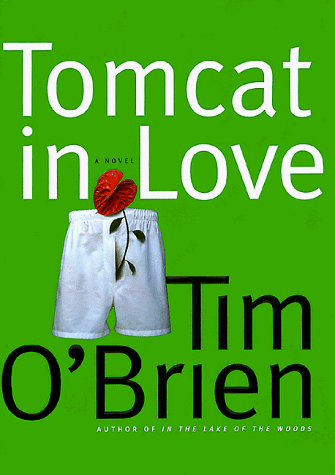
The National Book Award-winning author presents a sharply comic novel about a philandering college teacher whose attraction to a married woman threatens to interfere with his plans for revenge against his ex-wife. 125,000 first printing. $175,000 ad/promo. Tour.
Die Inhaltsangabe kann sich auf eine andere Ausgabe dieses Titels beziehen.
Über die Autorin bzw. den Autor
Tim O'Brien received the 1979 National Book Award in Fiction for Going After Cacciato. His novel The Things They Carried won France's prestigious Prix du Meilleur Livre Etranger and the Chicago Tribune Heartland Prize; it was also a finalist for the Pulitzer Prize and the National Book Critics Circle Award. His most recent novel, In the Lake of the Woods, was a national bestseller, received the James Fenimore Cooper Prize from the Society of American Historians, and was selected as the best work of fiction of 1994 by Time magazine.
Aus dem Klappentext
ny, brilliantly inventive novel about a man torn between two obsessions: the desperate need to win back his former wife and a craving to test his erotic charms on every woman he meets.
He is 6'6" tall, a cross between Ichabod Crane and Abe Lincoln. He is a professor of linguistics, bewitched by language, deluded about his ability to win the hearts of women with his erudition and physical appeal. He is Thomas H. Chippering, a.k.a. Tomcat, a masterly addition to the pantheon of unforgettable characters in American fiction.
And in his private dictionary of love, three entries stand out.
Tampa. Just the word makes Tom Chippering's blood curdle. That's where his ex-wife, the faithless Lorna Sue, now lives with a suntanned tycoon whose name Chippering refuses to utter.
Revenge. If Chippering can't get Lorna Sue back, at least he can wreak havoc with her new marriage. (How about some strategically placed lingerie in the tycoon
Auszug. © Genehmigter Nachdruck. Alle Rechte vorbehalten.
Faith
I begin with the ridiculous, in June 1952, middle-century Minnesota, on that silvery-hot morning when Herbie Zylstra and I nailed two plywood boards together and called it an airplane. "What we need," said Herbie, "is an engine."
The word engine--its meanings beyond mere meaning--began to open up for me. I went into the house and found my father.
"I'll need an engine," I told him.
"Engine?" he said.
"For an airplane."
My father thought about it. "Makes sense," he said. "One airplane engine, coming up."
"When?"
"Soon enough," said my father. "Pronto."
Was this a promise?
Was this duplicity?
Herbie and I waited all summer. We painted our airplane green. We cleared a runway in the backyard, moving the big white birdbath, digging up two of my mother's rhododendrons. We eyed our plane. "What if it crashes?" I said.
Herbie made a scoffing noise. "Parachutes," he said. (A couple of his front teeth were missing, which caused bubbles to form when he laughed at me.) "Anyway, don't be stupid. We'll drop bombs on people. Bomb my house."
So we filled mason jars with gasoline. Through July and August, in the soft, grave density of that prairie summer, we practiced our bombing runs, getting the feel of it, the lift, the swoop. Herbie was eight, I was seven. We made the sounds an engine would make. In our heads, where the world was, we bombed Mrs. Catchitt's garage, the church across the street, Jerry Powell and his cousin Ernest and other people we feared or despised. Mostly, though, we bombed Herbie's house. The place was huge and bright yellow, a half block away, full of cousins and uncles and nuns and priests and leathery old grandmothers. A scary house, I thought, and Herbie thought so too. He liked yelling "Die!" as he banked into a dive; he said things about his mother, about black bones and fires in the attic.
For me, the bombing was fine. It seemed useful, vaguely productive, but the best part was flight itself, or the anticipation of flight, and over those summer days the word engine did important engine work in my thoughts. I did not envision machinery. I envisioned thrust: a force pressing upward and outward, even beyond. This notion had its objective component--properties both firm and man-made--but on a higher level, as pure idea, the engine that my father would be bringing home did not operate on mechanical principles. I knew nothing, for example, of propellers and gears and such. My engine would somehow contain flight. Like a box, I imagined, which when opened would release the magical qualities of levitation into the plywood boards of my airplane.
At night, in bed, I would find myself murmuring that powerful, empowering word: engine. I loved its sound. I loved everything it meant, everything it did not mean but should.
Summer ended, autumn came, and what my father finally brought home was a turtle. A mud turtle--small and black. My father had a proud look on his face as he stooped down and placed it on our backyard runway.
"That thing's a turtle," Herbie said.
"Toby," said my father. "I think his name is Toby."
"Well, God, I know that," Herbie said. "Every turtle on earth, they're all named Toby. It's still just a stupid old turtle."
"A pretty good one," my father said.
Herbie's face seemed to curdle in the bright sunlight. He scooped up the turtle, searched for its head, then dropped it upside down on the runway. I remember backing away, feeling a web of tensions far too complex for me: disappointment, partly, and confusion, but mostly I was afraid for my father. Herbie could be vicious at times, very loud, very demonstrative, easily unnerved by the wrongs of the world.
"Oh, boy," he muttered.
He took a few slow steps, then ran.
If anything was said between my father and me, I cannot remember it. What I do remember--vividly--is feeling stupid. The words turtle and engine seemed to do loops in the backyard sunlight. There had to be some sort of meaningful connection, a turtleness inside engineness, or the other way around, but right then I could not locate the logic.
The backyard was silent. I remember my father's pale-blue eyes, how he gazed at something just beyond the birdbath. "Well," he said, then stopped and carefully folded his hands. "Sorry, Tommy. Best I could do." Then he turned and went into the house.
Afterward, I stood studying Toby. I poked at him with my foot. "Hey, you," I murmured, but it was a very stupid turtle, more object than animal. It showed no interest in my foot, or my voice, or anything else in the physical universe. Turtle, I kept thinking, and even now, in my middle age, those twin syllables still claw at me. The quick t's on my tongue: turtle. Even after four decades I cannot encounter that word without a gate creaking open inside me. Turtle for the world--turtle for you--will never be turtle for me.
Nor this: corn.
Nor this: Pontiac.
Have you ever loved a man, then lost him, then learned he lives on Fiji with a new lover? Is Fiji still Fiji? Coconuts and palm trees?
At sixteen, in a windy autumn cornfield, I made first love on the hood of my father's green Pontiac. I remember the steel against my skin. I remember darkness, too, and a sharp wind, and rustlings in the corn. I was terrified. Pontiac means: Will this improve? And that Indian-head ornament on the hood--did the bastard bite my feet? Did I hear a chuckle? Peeping Tom, ogler, eyewitness, sly critic: the word Indian embraces all of these meanings and many more.
The world shrieks and sinks talons into our hearts. This we call memory.
In the backyard that afternoon, alone with Toby, I felt a helplessness that went beyond engines or turtles. It had to do with treachery. Even back then, in a dark, preknowledge way, I understood that language was involved, its frailties and mutabilities, its potential for betrayal. My airplane, after all, was not an airplane. No engine on earth would make it fly. And over the years I have come to realize that Herbie and I had willfully deceived ourselves, renaming things, reinventing the world, which was both pretending and a kind of lying.
But there were also the words my father had used: "One airplane engine, coming up."
His intent, I know, was benign. To encourage. To engage. And yet for me, as a seven-year-old, the language he had chosen took on the power of a binding commitment, one I kept pestering him to honor, and through July and August, as summer heated up, my father must have felt trapped by a promise he neither had intended nor could possibly keep.
"Right. I'm working on it," he'd say, whenever I brought up the subject.
He'd say, "Pretty soon, partner." He'd say, "No sweat." He'd say, "Be patient. I've placed the order."
But a turtle?
Why not broccoli?
* * *
The next morning was a Sunday. Maybe an hour after Mass, Herbie walked into my backyard.
"Your dad's a liar," he said.
"Yeah, sort of," I told him, "but not usually," then I tried to mount a defense. I talked about Toby, what a fine turtle he was, how I could get him to stick his head out from under the shell by putting a pan of water in front of him. I talked about using Toby as a bomb. "It'll be neat," I said. "Drop him on the mailman."
Herbie...
„Über diesen Titel“ kann sich auf eine andere Ausgabe dieses Titels beziehen.
Suchergebnisse für Tomcat in Love

Beispielbild für diese ISBN
Tomcat in Love
Anbieter: More Than Words, Waltham, MA, USA
Verkäuferbewertung 5 von 5 Sternen

Zustand: Good. . . All orders guaranteed and ship within 24 hours. Before placing your order for please contact us for confirmation on the book's binding. Check out our other listings to add to your order for discounted shipping. Bestandsnummer des Verkäufers WAL-P-2c-02150
Gebraucht kaufen
EUR 1,24
EUR 3,56 Versand
Versand innerhalb von USA
Versand innerhalb von USA
Anzahl: 1 verfügbar
Beispielbild für diese ISBN
Tomcat in Love
Anbieter: World of Books (was SecondSale), Montgomery, IL, USA
Verkäuferbewertung 5 von 5 Sternen
Hardback. Zustand: Good. A CLASIC FROM THE NEW YORK TIMES BESTSELING AUTHOR OF THE THINGS THEY CARIEDIn this wildly funny, brilliantly inventive novel, Tim O'Brien has created the ultimate character for our times. Thomas Chippering, a 6'6 professor of linguistics, is a man torn between two obsessions: the desperate need to win back his former wife, the faithless Lorna Sue, and a craving to test his erotic charms on every woman he meets. But there are complications, including Lorna Sue's brother, Herbie, with whom she has an all-too-close relationship, and the considerable charms of Chippering's new love, the attractive, and of course already married, Mrs. Robert Kooshof, who may at last satisfy Chippering's longing for intimacy. In Tomcat in Love, Tim O'Brien takes on the battle of the sexes with astonishing results. By turns hilarious, outrageous, romantic, and deeply moving, this is one of the most talked about novels in years: a novel for this and every age. Bestandsnummer des Verkäufers 00085492858
Gebraucht kaufen
EUR 4,89
Versand gratis
Versand innerhalb von USA
Versand innerhalb von USA
Anzahl: 4 verfügbar
Beispielbild für diese ISBN
Tomcat in Love
Anbieter: World of Books (was SecondSale), Montgomery, IL, USA
Verkäuferbewertung 5 von 5 Sternen
Hardback. Zustand: Very Good. A CLASIC FROM THE NEW YORK TIMES BESTSELING AUTHOR OF THE THINGS THEY CARIEDIn this wildly funny, brilliantly inventive novel, Tim O'Brien has created the ultimate character for our times. Thomas Chippering, a 6'6 professor of linguistics, is a man torn between two obsessions: the desperate need to win back his former wife, the faithless Lorna Sue, and a craving to test his erotic charms on every woman he meets. But there are complications, including Lorna Sue's brother, Herbie, with whom she has an all-too-close relationship, and the considerable charms of Chippering's new love, the attractive, and of course already married, Mrs. Robert Kooshof, who may at last satisfy Chippering's longing for intimacy. In Tomcat in Love, Tim O'Brien takes on the battle of the sexes with astonishing results. By turns hilarious, outrageous, romantic, and deeply moving, this is one of the most talked about novels in years: a novel for this and every age. Bestandsnummer des Verkäufers 00085037738
Gebraucht kaufen
EUR 4,89
Versand gratis
Versand innerhalb von USA
Versand innerhalb von USA
Anzahl: 3 verfügbar
Beispielbild für diese ISBN
Tomcat in Love
Anbieter: World of Books (was SecondSale), Montgomery, IL, USA
Verkäuferbewertung 5 von 5 Sternen
Hardback. Zustand: Fair. A CLASIC FROM THE NEW YORK TIMES BESTSELING AUTHOR OF THE THINGS THEY CARIEDIn this wildly funny, brilliantly inventive novel, Tim O'Brien has created the ultimate character for our times. Thomas Chippering, a 6'6 professor of linguistics, is a man torn between two obsessions: the desperate need to win back his former wife, the faithless Lorna Sue, and a craving to test his erotic charms on every woman he meets. But there are complications, including Lorna Sue's brother, Herbie, with whom she has an all-too-close relationship, and the considerable charms of Chippering's new love, the attractive, and of course already married, Mrs. Robert Kooshof, who may at last satisfy Chippering's longing for intimacy. In Tomcat in Love, Tim O'Brien takes on the battle of the sexes with astonishing results. By turns hilarious, outrageous, romantic, and deeply moving, this is one of the most talked about novels in years: a novel for this and every age. Bestandsnummer des Verkäufers 00096737936
Gebraucht kaufen
EUR 4,89
Versand gratis
Versand innerhalb von USA
Versand innerhalb von USA
Anzahl: 2 verfügbar
Beispielbild für diese ISBN
Tomcat in Love
Verlag:
Broadway (edition First Edition), 1998
ISBN 10: 0767902025
ISBN 13: 9780767902021
Gebraucht
Hardcover
Erstausgabe
Anbieter: BooksRun, Philadelphia, PA, USA
Verkäuferbewertung 5 von 5 Sternen
Hardcover. Zustand: Very Good. First Edition. With dust jacket. It's a well-cared-for item that has seen limited use. The item may show minor signs of wear. All the text is legible, with all pages included. It may have slight markings and/or highlighting. Bestandsnummer des Verkäufers 0767902025-11-1-29
Gebraucht kaufen
EUR 5,58
Versand gratis
Versand innerhalb von USA
Versand innerhalb von USA
Anzahl: 1 verfügbar
Beispielbild für diese ISBN
Tomcat in Love
Anbieter: Once Upon A Time Books, Siloam Springs, AR, USA
Verkäuferbewertung 4 von 5 Sternen

Hardcover. Zustand: Acceptable. This is a used book. It may contain highlighting/underlining and/or the book may show heavier signs of wear . It may also be ex-library or without dustjacket. This is a used book. It may contain highlighting/underlining and/or the book may show heavier signs of wear . It may also be ex-library or without dustjacket. Bestandsnummer des Verkäufers mon0000864532
Gebraucht kaufen
EUR 2,07
EUR 3,52 Versand
Versand innerhalb von USA
Versand innerhalb von USA
Anzahl: 1 verfügbar
Beispielbild für diese ISBN
Tomcat in Love
Anbieter: Once Upon A Time Books, Siloam Springs, AR, USA
Verkäuferbewertung 4 von 5 Sternen
Hardcover. Zustand: Good. This is a used book in good condition and may show some signs of use or wear . This is a used book in good condition and may show some signs of use or wear . Bestandsnummer des Verkäufers mon0001311105
Gebraucht kaufen
EUR 2,07
EUR 3,52 Versand
Versand innerhalb von USA
Versand innerhalb von USA
Anzahl: 1 verfügbar
Beispielbild für diese ISBN
Tomcat in Love
Anbieter: Wonder Book, Frederick, MD, USA
Verkäuferbewertung 5 von 5 Sternen
Zustand: Very Good. Very Good condition. Very Good dust jacket. In protective mylar cover. A copy that may have a few cosmetic defects. May also contain light spine creasing or a few markings such as an owner's name, short gifter's inscription or light stamp. Bestandsnummer des Verkäufers V14B-04200
Gebraucht kaufen
EUR 6,42
Versand gratis
Versand innerhalb von USA
Versand innerhalb von USA
Anzahl: 1 verfügbar
Beispielbild für diese ISBN
Tomcat in Love
Anbieter: Wonder Book, Frederick, MD, USA
Verkäuferbewertung 5 von 5 Sternen
Zustand: Good. Good condition. Good dust jacket. A copy that has been read but remains intact. May contain markings such as bookplates, stamps, limited notes and highlighting, or a few light stains. Bestandsnummer des Verkäufers J07D-01642
Gebraucht kaufen
EUR 6,42
Versand gratis
Versand innerhalb von USA
Versand innerhalb von USA
Anzahl: 1 verfügbar
Beispielbild für diese ISBN
Tomcat in Love
Anbieter: World of Books Inc, Montgomery, IL, USA
Verkäuferbewertung 4 von 5 Sternen
Hardback. Zustand: Good. A CLASIC FROM THE NEW YORK TIMES BESTSELING AUTHOR OF THE THINGS THEY CARIEDIn this wildly funny, brilliantly inventive novel, Tim O'Brien has created the ultimate character for our times. Thomas Chippering, a 6'6 professor of linguistics, is a man torn between two obsessions: the desperate need to win back his former wife, the faithless Lorna Sue, and a craving to test his erotic charms on every woman he meets. But there are complications, including Lorna Sue's brother, Herbie, with whom she has an all-too-close relationship, and the considerable charms of Chippering's new love, the attractive, and of course already married, Mrs. Robert Kooshof, who may at last satisfy Chippering's longing for intimacy. In Tomcat in Love, Tim O'Brien takes on the battle of the sexes with astonishing results. By turns hilarious, outrageous, romantic, and deeply moving, this is one of the most talked about novels in years: a novel for this and every age. Bestandsnummer des Verkäufers CIN0767902025G
Gebraucht kaufen
EUR 6,73
Versand gratis
Versand innerhalb von USA
Versand innerhalb von USA
Anzahl: 4 verfügbar