
Verwandte Artikel zu Somewhere: The Life of Jerome Robbins
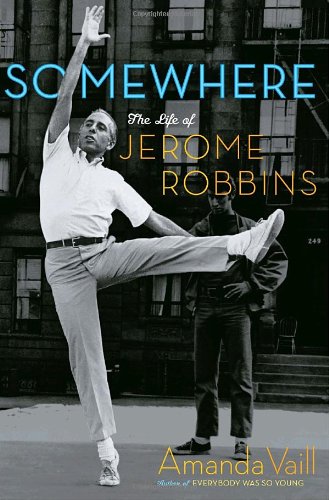
Inhaltsangabe
A definitive portrait of the acclaimed Broadway choreographer draws on his personal records to offer insight into his achievements with such productions as The King and I, Peter Pan, and West Side Story; his identity as a homosexual; and his cooperation with the McCarthy committee during the 1950s. 35,000 first printing.
Die Inhaltsangabe kann sich auf eine andere Ausgabe dieses Titels beziehen.
Über die Autorin bzw. den Autor
AMANDA VAILL is the author of Everybody Was So Young, the bestselling biography of Lost Generation icons Gerald and Sara Murphy, which was nominated for a National Book Critics Circle Award. A publisher and editor for more than twenty years, she has written on arts and culture for New York, Esquire, Ballet Review, Architectural Digest, Town & Country, and other publications. She lives in New York City.
Auszug. © Genehmigter Nachdruck. Alle Rechte vorbehalten.
Prologue
In the end, he came home.
Four days earlier, on July 25, 1998, he had suffered a catastrophic stroke and was rushed to New York—Presbyterian Hospital, where a CAT scan revealed that the entire right hemisphere of his brain had been flooded with massive amounts of blood. His doctors had wanted to put him in intensive care, but it was clear they could do nothing more for him there. So the terms of his living will had been invoked and he had been brought back to the house he had lived in for thirty years and to the circle of family, friends, and lovers who had gathered to say good-bye.
Now he lay in his third-floor bedroom, the once quicksilver body still, the sharp eyes unseeing, the voice–which could warm you or raise blisters on your skin–silent. His breathing was ragged: sometimes he seemed not
to be breathing at all, and then suddenly he would take deep, gasping breaths, as if he were desperately trying to fill his lungs with oxygen. “Is he afraid?” his sister had asked when she arrived at the house from her home in Vermont; when she was reassured that no, he wasn’t, she said, “I am.”
Downstairs, in the office that was the center of a million–dollar–per–year theatrical business, the telephones rang with concerned calls from associates, colleagues, friends, but upstairs it was quiet except for the rounded cadences of Bach’s French Suites on the bedroom CD player. He always liked to have music playing, particularly if it was something he was working on, and in recent weeks, although he’d been far too frail and forgetful to work, he had been listening to this Bach recording—as if he drew comfort or certainty from Bach’s clear phrasing or from the confident structure that always brought him back to where he had started.
On his bedside table a photograph of a beautiful woman, a dancer stricken with polio at the height of her fame, smiled at him from the antique frame in which he had placed it; on the desk beyond the foot of the bed another photograph, of the young man he had loved and nursed through his final illness, gazed across the room at him. On chairs ranged around the bed sat his sister, two former lovers, his assistants, an old friend and confidant, and the friend’s young wife, a physician; it was she who made sure that someone was always holding his hand. The minutes ticked by. Then suddenly his dog, an affable cream–colored mixed breed who had adopted him some years before on the steps of the Metropolitan Museum, jumped on the bed and started to lick his cheek. And just as suddenly he opened his eyes and rose up in bed, seeming to take in the faces grouped around him, looking at each one in turn.
“You’re fine,” said his friend’s wife, squeezing his hand. “You’re fine.” There was a silence. He subsided on his pillow, his eyes turned to the ceiling. The dog barked twice. “All right,” his friend’s wife said now, soothingly.
“You’re free.” The dog let out a long, keening cry. It was over.
The next day the New York Times—like other newspapers on two continents—would carry his obituary on the front page: “Jerome Robbins, 79, Is Dead: Giant of Ballet and Broadway.” The lights on Broadway’s theaters would be dimmed for a moment and the flags at Lincoln Center lowered to half-mast, as the world remembered a man who had put an indelible stamp on American theater and dance with ballets like Fancy Free and The Cage and Afternoon of a Faun and Dances at a Gathering and musicals like On the Town and Peter Pan and West Side Story and Fiddler on the Roof; a “theatrical genius” (in the words of the actor Montgomery Clift) who had won five Tony Awards, four Donaldson Awards (precursor to the Tonys), two Academy Awards, and an Emmy and had been awarded the National Medal for the Arts and the Kennedy Center Honors, as well as being made a chevalier of the French Legion of Honor.
For their part, some who had worked with and known him would recall a martinet who “could be monstrous…toward performers” and whose “dancers hated him”; others, “a father, teacher, and eternal friend” who was “generous,” “a wonderful person, a lot of laughs.” For Jerome Robbins was a man of contradictions: a nonobservant Jew whose most successful theatrical work was that paean to Jewish folkways Fiddler on the Roof; a college dropout who learned Russian so he could read Chekhov and Tolstoy; an entertainer who could be paralyzed with shyness in gatherings where he knew no one. If, in his professional, creative life, “he was always right”—as the lighting designer Jennifer Tipton would put it—in private he could be conflicted, vulnerable, and torn by self–doubt. “Where does the talent come from, I wonder,” he wrote in his diary once, “when I have felt such a hoax?”
When he wrote those lines he was involved in a romantic relationship that afforded him a refuge from loneliness and self-doubt—a relationship that felt, he said, “like home.” Robbins spent much of his life searching for such a haven of love and acceptance, and that same place was arguably also the goal of much of his best work, from West Side Story to Dances at a Gathering. He was always coming close to it; perhaps, when he opened his eyes for those few seconds just before his death, he found he’d got there.
1
“It was all lovely ”
Although it is gone now, there was once a village called Rozhanka, which stood in the vast, flat plain that stretches between Poland and Russia, the land that is now Lithuania and Belarus. In the old days these miles of pasture and cropland, punctuated by patches of forest and the onion domes of churches, belonged to the kings of Poland, but by 1888,when Herschel Rabinowitz was born, they had come under the rule of the czar of all the Russias.
Almost equidistant from the bustling towns of Vilna and Bialystok, Rozhanka was a rural backwater of less than a thousand residents, two-thirds of them Jews, who lived in wooden houses, some with only earthen floors, that were built around the central marketplace and along the village’s four streets—Mill Street, Bridge Street, the Szczuczyn Road, and the Connected Street. There were butchers and bakers, blacksmiths and tailors, cobblers and carpenters; there were two flour mills near the river, an eighteenth-century stone church for the gentiles, and a wooden synagogue of somewhat later date for the Jews. In addition, because the synagogue had no furnace and could not be used in the winters, there were two bet midrashim, the houses of worship and study where the faithful gathered for prayers and earnest yeshiva students came to learn and read the holy books.
There was a mikvah, a ritual bath for women’s monthly cleansing; a cheder, the one-room school where the little boys sat on wooden benches and learned their lessons over the squawking of the rebbe’s wife’s chickens; and a bustling market where farmers brought their produce and livestock, merchants sold pots and pans and crockery and cloth, and villagers came to poke and pinch and buy and sell and exchange news and gossip. And there were Sabbath evenings when candles were lit in all the houses and braided bread was laid on the tables and prayers were said over the meal. Rozhanka was a place out of time—“an unforgettable place,” as the writer Sholem Aleichem said of another shtetl in the Jewish Pale of Settlement, which he called...
„Über diesen Titel“ kann sich auf eine andere Ausgabe dieses Titels beziehen.
Suchergebnisse für Somewhere: The Life of Jerome Robbins

Beispielbild für diese ISBN
Somewhere The Life of Jerome R
Anbieter: World of Books (was SecondSale), Montgomery, IL, USA
Verkäuferbewertung 5 von 5 Sternen

Zustand: Good. Item in good condition. Textbooks may not include supplemental items i.e. CDs, access codes etc. Bestandsnummer des Verkäufers 00108973084
Gebraucht kaufen
EUR 5,29
Versand gratis
Versand innerhalb von USA
Versand innerhalb von USA
Anzahl: 1 verfügbar
Beispielbild für diese ISBN
Somewhere: The Life of Jerome Robbins
Anbieter: Bookmonger.Ltd, HILLSIDE, NJ, USA
Verkäuferbewertung 5 von 5 Sternen
hardcover. Zustand: Good. Crease on cover*. Bestandsnummer des Verkäufers mon0000723058
Gebraucht kaufen
EUR 2,66
EUR 3,43 Versand
Versand innerhalb von USA
Versand innerhalb von USA
Anzahl: 1 verfügbar
Beispielbild für diese ISBN
Somewhere: The Life of Jerome Robbins
Anbieter: Gulf Coast Books, Cypress, TX, USA
Verkäuferbewertung 5 von 5 Sternen
hardcover. Zustand: Good. Bestandsnummer des Verkäufers 0767904206-3-37407026
Gebraucht kaufen
EUR 6,17
Versand gratis
Versand innerhalb von USA
Versand innerhalb von USA
Anzahl: 1 verfügbar
Beispielbild für diese ISBN
Somewhere: The Life of Jerome Robbins
Anbieter: ThriftBooks-Dallas, Dallas, TX, USA
Verkäuferbewertung 5 von 5 Sternen
Hardcover. Zustand: Very Good. No Jacket. Former library book; May have limited writing in cover pages. Pages are unmarked. ~ ThriftBooks: Read More, Spend Less. Bestandsnummer des Verkäufers G0767904206I4N10
Gebraucht kaufen
EUR 6,18
Versand gratis
Versand innerhalb von USA
Versand innerhalb von USA
Anzahl: 1 verfügbar
Beispielbild für diese ISBN
Somewhere: The Life of Jerome Robbins
Anbieter: ThriftBooks-Atlanta, AUSTELL, GA, USA
Verkäuferbewertung 5 von 5 Sternen
Hardcover. Zustand: Very Good. No Jacket. May have limited writing in cover pages. Pages are unmarked. ~ ThriftBooks: Read More, Spend Less. Bestandsnummer des Verkäufers G0767904206I4N00
Gebraucht kaufen
EUR 6,18
Versand gratis
Versand innerhalb von USA
Versand innerhalb von USA
Anzahl: 1 verfügbar
Beispielbild für diese ISBN
Somewhere: The Life of Jerome Robbins
Anbieter: ThriftBooks-Dallas, Dallas, TX, USA
Verkäuferbewertung 5 von 5 Sternen
Hardcover. Zustand: Very Good. No Jacket. May have limited writing in cover pages. Pages are unmarked. ~ ThriftBooks: Read More, Spend Less. Bestandsnummer des Verkäufers G0767904206I4N00
Gebraucht kaufen
EUR 6,18
Versand gratis
Versand innerhalb von USA
Versand innerhalb von USA
Anzahl: 1 verfügbar
Beispielbild für diese ISBN
Somewhere: The Life of Jerome Robbins
Anbieter: ThriftBooks-Dallas, Dallas, TX, USA
Verkäuferbewertung 5 von 5 Sternen
Hardcover. Zustand: Good. No Jacket. Former library book; Pages can have notes/highlighting. Spine may show signs of wear. ~ ThriftBooks: Read More, Spend Less. Bestandsnummer des Verkäufers G0767904206I3N10
Gebraucht kaufen
EUR 6,18
Versand gratis
Versand innerhalb von USA
Versand innerhalb von USA
Anzahl: 1 verfügbar
Beispielbild für diese ISBN
Somewhere: The Life of Jerome Robbins
Anbieter: ThriftBooks-Phoenix, Phoenix, AZ, USA
Verkäuferbewertung 5 von 5 Sternen
Hardcover. Zustand: Good. No Jacket. Former library book; Pages can have notes/highlighting. Spine may show signs of wear. ~ ThriftBooks: Read More, Spend Less. Bestandsnummer des Verkäufers G0767904206I3N10
Gebraucht kaufen
EUR 6,18
Versand gratis
Versand innerhalb von USA
Versand innerhalb von USA
Anzahl: 1 verfügbar
Beispielbild für diese ISBN
Somewhere: The Life of Jerome Robbins
Anbieter: ThriftBooks-Atlanta, AUSTELL, GA, USA
Verkäuferbewertung 5 von 5 Sternen
Hardcover. Zustand: Very Good. No Jacket. Former library book; May have limited writing in cover pages. Pages are unmarked. ~ ThriftBooks: Read More, Spend Less. Bestandsnummer des Verkäufers G0767904206I4N10
Gebraucht kaufen
EUR 6,18
Versand gratis
Versand innerhalb von USA
Versand innerhalb von USA
Anzahl: 1 verfügbar
Beispielbild für diese ISBN
Somewhere: The Life of Jerome Robbins
Anbieter: Half Price Books Inc., Dallas, TX, USA
Verkäuferbewertung 5 von 5 Sternen
Hardcover. Zustand: Very Good. Connecting readers with great books since 1972! Used books may not include companion materials, and may have some shelf wear or limited writing. We ship orders daily and Customer Service is our top priority! Bestandsnummer des Verkäufers S_466986383
Gebraucht kaufen
EUR 3,53
EUR 3,21 Versand
Versand innerhalb von USA
Versand innerhalb von USA
Anzahl: 1 verfügbar