
Verwandte Artikel zu The Hunt for Zero Point: Inside the Classified World...
Inhaltsangabe
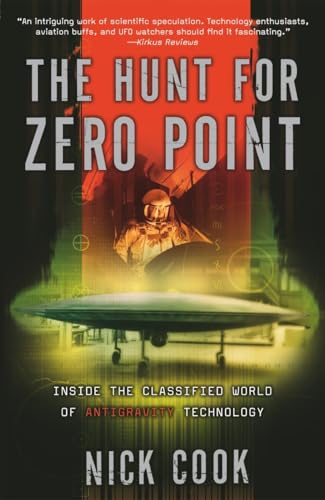
An investigation into classified government projects to build gravity-defying aircraft, sometimes responsible for UFO reports, documents 1940s research into anti-gravity technology and traces its origins in the Third Reich through developments in Europe and the U.S. Reprint.
Die Inhaltsangabe kann sich auf eine andere Ausgabe dieses Titels beziehen.
Über die Autorin bzw. den Autor
For more than a decade, NICK COOK has served as aviation editor of Jane's Defense Weekly, the world's leading military-affairs journal. His articles have also appeared in newspapers worldwide. He lives in London.
Von der hinteren Coverseite
This riveting work of investigative reporting and history exposes classified government projects to build gravity-defying aircraft--which have an uncanny resemblance to flying saucers.
The atomic bomb was not the only project to occupy government scientists in the 1940s. Antigravity technology, originally spearheaded by scientists in Nazi Germany, was another high priority, one that still may be in effect today. Now for the first time, a reporter with an unprecedented access to key sources in the intelligence and military communities reveals suppressed evidence that tells the story of a quest for a discovery that could prove as powerful as the A-bomb.
"The Hunt for Zero Point explores the scientific speculation that a "zero point" of gravity exists in the universe and can be replicated here on Earth. The pressure to be the first nation to harness gravity is immense, as it means having the ability to build military planes of unlimited speed and range, along with the most deadly weaponry the world has ever seen. The ideal shape for a gravity-defying vehicle happens to be a perfect disk, making antigravity tests a possible explanation for the numerous UFO sightings of the past 50 years.
Chronicling the origins of antigravity research in the world's most advanced research facility, which was operated by the Third Reich during World War II, "The Hunt for Zero Point traces U.S. involvement in the project, beginning with the recruitment of former Nazi scientists after the war. Drawn from interviews with those involved with the research and who visited labs in Europe and the United States, "The Hunt for Zero Point journeys to the heart of the twentieth century's most puzzlingunexplained phenomena.
"From the Hardcover edition.
Auszug. © Genehmigter Nachdruck. Alle Rechte vorbehalten.
Chapter 1
From the heavy-handed style of the prose and the faint handwritten "1956" scrawled in pencil along the top of the first page, the photocopied pages had obviously come from some long-forgotten schlock popular science journal.
I had stepped away from my desk only for a few moments and somehow in the interim the article had appeared. The headline ran: "The G-Engines Are Coming!"
I glanced around the office, wondering who had put it there and if this was someone's idea of a joke. The copier had cut off the top of the first page and the title of the publication with it, but it was the drawing above the headline that was the giveaway. It depicted an aircraft, if you could call it that, hovering a few feet above a dry lakebed, a ladder extending from the fuselage and a crewmember making his way down the steps dressed in a U.S.-style flight suit and flying helmet--standard garb for that era. The aircraft had no wings and no visible means of propulsion.
I gave the office another quick scan. The magazine's operations were set on the first floor. The whole building was open-plan. To my left, the business editor was head-down over a proof-page checking copy. To her right was the naval editor, a guy who was good for a windup, but who was currently deep into a phone conversation and looked like he had been for hours.
I was reminded of a technology piece I'd penned a couple of years earlier about the search for scientific breakthroughs in U.S. aerospace and defense research. In a journal not noted for its exploration of the fringes of paranormality, nor for its humor, I'd inserted a tongue-in-cheek reference to gravity--or rather to antigravity, a subject beloved of science-fiction writers.
"For some U.S. aerospace engineers," I'd said, "an antigravity propulsion system remains the ultimate quantum leap in aircraft design." The implication was that antigravity was the aerospace equivalent of the holy grail: something longed for, dreamed about, but beyond reach--and likely always to remain so.
Somehow the reference had escaped the sub-editors and, as a result, amongst my peers, other aerospace and defense writers on the circuit, I'd taken some flak for it. For Jane's, the publishing empire founded on one man's obsession with the detailed specifications of ships and aircraft almost a century earlier, technology wasn't something you joked about.
The magazine I wrote--and still write--for, Jane's Defence Weekly, documented the day-to-day dealings of the multibillion-dollar defense business. JDW, as we called it, is but one of a portfolio of products detailing the ins and outs of the global aerospace and defense industry. If you want to know about the thrust-to-weight ratio of a Chinese combat aircraft engine or the pulse repetition frequency of a particular radar system, somewhere in the Jane's portfolio of products there is a publication that has the answers. In short, Jane's was, and always has been, about facts. Its motto is: Authoritative, Accurate, Impartial.
It was a huge commercial intelligence-gathering operation; and provided they had the money, anyone could buy into its vast knowledge base.
I cast a glance at the bank of sub-editors' work-stations over in the far corner of the office, but nobody appeared remotely interested in what was happening at my desk. If the subs had nothing to do with it, and usually they were the first to know about a piece of piss-taking that was going down in the office, I figured whoever had put it there was from one of the dozens of other departments in the building and on a different floor. Perhaps my anonymous benefactor had felt embarrassed about passing it on to me?
I studied the piece again.
The strapline below the headline proclaimed: "By far the most potent source of energy is gravity. Using it as power, future aircraft will attain the speed of light." It was written by one Michael Gladych and began: "Nuclear-powered aircraft are yet to be built, but there are research projects already under way that will make the super-planes obsolete before they are test-flown. For in the United States and Canada, research centers, scientists, designers and engineers are perfecting a way to control gravity--a force infinitely more powerful than the mighty atom. The result of their labors will be antigravity engines working without fuel--weightless airliners and space ships able to travel at 170,000 miles per second."
On any other day, that would have been the moment I'd have consigned it for recycling. But something in the following paragraph caught my eye.
The gravity research, it said, had been supported by the Glenn L. Martin Aircraft Company, Bell Aircraft, Lear "and several other American aircraft manufacturers who would not spend millions of dollars on science fiction." It quoted Lawrence D. Bell, the founder of the plane-maker that was first to beat the sound barrier. "We're already working on nuclear fuels and equipment to cancel out gravity." George S. Trimble, head of Advanced Programs and "Vice President in charge of the G-Project at Martin Aircraft," added that the conquest of gravity "could be done in about the time it took to build the first atom bomb."
A little further on, it quoted "William P. Lear, the chairman of Lear Inc., makers of autopilots and other electronic controls." It would be another decade before Bill Lear went on to design and build the first of the sleek business jets that still carry his name. But in 1956, according to Gladych, Lear had his mind on other things.
"All matter within the ship would be influenced by the ship's gravitation only," Lear apparently said of the wondrous G-craft. "This way, no matter how fast you accelerated or changed course, your body would not feel it any more than it now feels the tremendous speed and acceleration of the earth." The G-ship, Gladych explained, could take off like a cannon shell, come to a stop with equal abruptness and the passengers wouldn't even need seat belts. This ability to accelerate rapidly, the author continued, would make it ideal as a space vehicle capable of acceleration to a speed approaching that of light.
There were some oblique references to Einstein, some highly dubious "facts" about the nature of subatomic physics and some speculation about how various kinds of "antigravity engines" might work.
But the one thing I kept returning to were those quotes. Had Gladych made them up or had Lawrence Bell, George S. Trimble and William "Bill" Lear really said what he had quoted them as saying?
Outside, the rain beat against the double-glazed windows, drowning the sound of the traffic that crawled along the London to Brighton road and the unrelenting hum of the air conditioning that regulated the temperature inside.
The office was located in the last suburb of the Greater London metropolis; next stop the congested joys of the M25 ring road and the M23 to Gatwick Airport. The building was a vast redbrick two-story bunker amid between-the-wars gray brickwork and pebbledash. The rain acted like a muslin filter, washing out what little ambient color Coulsdon possessed. In the rain, it was easy to imagine that nothing much had changed here for decades.
As aviation editor of JDW, my beat was global and it was pretty much unstructured. If I needed to cover the latest air-to-surface weapons developments in the U.S.A., I could do it, with relatively few questions asked. My editor, an old pro, with a history as long as your arm in publishing, gave each of us, the so-called "specialists" (the aviation, naval and land systems editors), plenty of rope. His only proviso was that we filed our expenses within two of weeks...
„Über diesen Titel“ kann sich auf eine andere Ausgabe dieses Titels beziehen.
Suchergebnisse für The Hunt for Zero Point: Inside the Classified World...

Beispielbild für diese ISBN
The Hunt for Zero Point: Inside the Classified World of Antigravity Technology
Verlag:
Crown Publishing Group (NY), 2003
ISBN 10: 0767906284
ISBN 13: 9780767906289
Gebraucht
Paperback
Anbieter: ThriftBooks-Atlanta, AUSTELL, GA, USA
Verkäuferbewertung 5 von 5 Sternen

Paperback. Zustand: Fair. No Jacket. Readable copy. Pages may have considerable notes/highlighting. ~ ThriftBooks: Read More, Spend Less. Bestandsnummer des Verkäufers G0767906284I5N00
Gebraucht kaufen
EUR 6,18
Versand gratis
Versand innerhalb von USA
Versand innerhalb von USA
Anzahl: 1 verfügbar
Beispielbild für diese ISBN
The Hunt for Zero Point: Inside the Classified World of Antigravity Technology
Verlag:
Crown Publishing Group (NY), 2003
ISBN 10: 0767906284
ISBN 13: 9780767906289
Gebraucht
Paperback
Anbieter: ThriftBooks-Phoenix, Phoenix, AZ, USA
Verkäuferbewertung 5 von 5 Sternen
Paperback. Zustand: Fair. No Jacket. Readable copy. Pages may have considerable notes/highlighting. ~ ThriftBooks: Read More, Spend Less. Bestandsnummer des Verkäufers G0767906284I5N00
Gebraucht kaufen
EUR 6,18
Versand gratis
Versand innerhalb von USA
Versand innerhalb von USA
Anzahl: 1 verfügbar
Beispielbild für diese ISBN
The Hunt for Zero Point: Inside the Classified World of Antigravity Technology
Verlag:
Crown Publishing Group (NY), 2003
ISBN 10: 0767906284
ISBN 13: 9780767906289
Gebraucht
Paperback
Anbieter: ThriftBooks-Dallas, Dallas, TX, USA
Verkäuferbewertung 5 von 5 Sternen
Paperback. Zustand: Good. No Jacket. Pages can have notes/highlighting. Spine may show signs of wear. ~ ThriftBooks: Read More, Spend Less. Bestandsnummer des Verkäufers G0767906284I3N00
Gebraucht kaufen
EUR 6,18
Versand gratis
Versand innerhalb von USA
Versand innerhalb von USA
Anzahl: 1 verfügbar
Beispielbild für diese ISBN
The Hunt for Zero Point: Inside the Classified World of Antigravity Technology
Verlag:
Crown Publishing Group (NY), 2003
ISBN 10: 0767906284
ISBN 13: 9780767906289
Gebraucht
Paperback
Anbieter: ThriftBooks-Dallas, Dallas, TX, USA
Verkäuferbewertung 5 von 5 Sternen
Paperback. Zustand: Fair. No Jacket. Readable copy. Pages may have considerable notes/highlighting. ~ ThriftBooks: Read More, Spend Less. Bestandsnummer des Verkäufers G0767906284I5N00
Gebraucht kaufen
EUR 6,18
Versand gratis
Versand innerhalb von USA
Versand innerhalb von USA
Anzahl: 1 verfügbar
Beispielbild für diese ISBN
The Hunt for Zero Point: Inside the Classified World of Antigravity Technology
Verlag:
Crown Publishing Group (NY), 2003
ISBN 10: 0767906284
ISBN 13: 9780767906289
Gebraucht
Paperback
Anbieter: ThriftBooks-Atlanta, AUSTELL, GA, USA
Verkäuferbewertung 5 von 5 Sternen
Paperback. Zustand: Good. No Jacket. Former library book; Pages can have notes/highlighting. Spine may show signs of wear. ~ ThriftBooks: Read More, Spend Less. Bestandsnummer des Verkäufers G0767906284I3N10
Gebraucht kaufen
EUR 6,18
Versand gratis
Versand innerhalb von USA
Versand innerhalb von USA
Anzahl: 1 verfügbar
Beispielbild für diese ISBN
The Hunt for Zero Point: Inside the Classified World of Antigravity Technology
Verlag:
Crown Publishing Group (NY), 2003
ISBN 10: 0767906284
ISBN 13: 9780767906289
Gebraucht
Paperback
Anbieter: ThriftBooks-Reno, Reno, NV, USA
Verkäuferbewertung 5 von 5 Sternen
Paperback. Zustand: Fair. No Jacket. Readable copy. Pages may have considerable notes/highlighting. ~ ThriftBooks: Read More, Spend Less. Bestandsnummer des Verkäufers G0767906284I5N00
Gebraucht kaufen
EUR 6,18
Versand gratis
Versand innerhalb von USA
Versand innerhalb von USA
Anzahl: 1 verfügbar
Beispielbild für diese ISBN
The Hunt for Zero Point: Inside the Classified World of Antigravity Technology
Anbieter: GCCebooks, Salinas, CA, USA
Verkäuferbewertung 4 von 5 Sternen

Paperback. Zustand: Acceptable. Reprint. The cover and pages show excessive wear and/or damage. Book edges have stains. There are some folded pages. There are curled pages. The cover is damaged. The book has a curled and creased cover. The spine is creased. There is damage on the corners of the cover. Books spine shows some sort of damage. Bestandsnummer des Verkäufers 3UAP3I002KZS
Gebraucht kaufen
EUR 6,18
EUR 3,51 Versand
Versand innerhalb von USA
Versand innerhalb von USA
Anzahl: 1 verfügbar
Beispielbild für diese ISBN
The Hunt for Zero Point: Inside the Classified World of Antigravity Technology
Anbieter: Deadstock Gear, Fort Oglethorpe, GA, USA
Verkäuferbewertung 5 von 5 Sternen
Bestandsnummer des Verkäufers 09-07-2026-Bulk-Shelf 6/F022
Gebraucht kaufen
EUR 8,15
EUR 2,64 Versand
Versand innerhalb von USA
Versand innerhalb von USA
Anzahl: 1 verfügbar
Beispielbild für diese ISBN
The Hunt for Zero Point: Inside the Classified World of Antigravity Technology
Anbieter: HPB-Diamond, Dallas, TX, USA
Verkäuferbewertung 5 von 5 Sternen
Paperback. Zustand: Very Good. Connecting readers with great books since 1972! Used books may not include companion materials, and may have some shelf wear or limited writing. We ship orders daily and Customer Service is our top priority! Bestandsnummer des Verkäufers S_486443446
Gebraucht kaufen
EUR 7,68
EUR 3,30 Versand
Versand innerhalb von USA
Versand innerhalb von USA
Anzahl: 1 verfügbar
Foto des Verkäufers
The Hunt for Zero Point: Inside the Classified World of Antigravity Technology
Anbieter: Big River Books, Powder Springs, GA, USA
Verkäuferbewertung 5 von 5 Sternen
Zustand: good. This book is in good condition. The cover has minor creases or bends. The binding is tight and pages are intact. Some pages may have writing or highlighting. Bestandsnummer des Verkäufers BRV.0767906284.G
Gebraucht kaufen
EUR 8,87
EUR 3,51 Versand
Versand innerhalb von USA
Versand innerhalb von USA
Anzahl: 1 verfügbar