
Verwandte Artikel zu The Best a Man Can Get
Inhaltsangabe
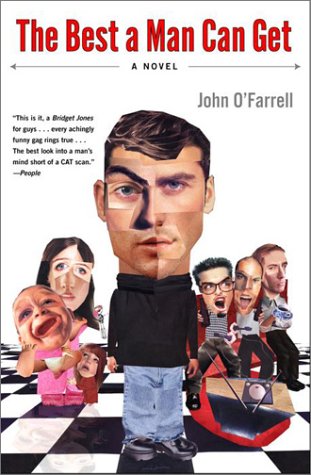
Michael Adams, a composer of advertising jingles, escapes the trials and tribulations of marriage and fatherhood by telling his wife he has to travel for business and living a double life in an apartment with three other young men, spending his days lying in bed and playing a computer and musical trivia games, while his wife struggles to cope on her own. A first novel. Reprint.
Die Inhaltsangabe kann sich auf eine andere Ausgabe dieses Titels beziehen.
Über die Autorin bzw. den Autor
John O’Farrell has been a writer for the satirical television show Spitting Image and on the film Chicken Run and is a regular columnist for The Independent (London). His nonfiction book on the futility of being a Labour Party supporter, Things Can Only Get Better, was a #1 Sunday Times bestseller in Great Britain. He lives in Clapham, England, with his wife and two children–when he isn’t “working.”
Aus dem Klappentext
A hilarious and touching debut novel in the seriocomic Nick Hornby tradition that demonstrates why marriage, fatherhood, and maturity don t always arrive on a synchronized schedule.
Michael Adams is a composer of advertising jingles who shares a flat with three other men in their late twenties. Days are spent lying in bed, playing computer and musical trivia games, and occasionally doing a spot of work. And, when he feels like it, he crosses the river and goes back to his unsuspecting wife and children.
For Michael is living a double life. He escapes from the exhausting misery of babies by telling his wife he has to pull an all-nighter at work or travel away on business. And while she is valiantly coping on her own, he is just a few miles away in his male paradise, doing all the stupid, pointless, gloriously enjoyable stuff that most men with small children can only dream about. He thinks he can lead this double life indefinitely, until the inevitable slip exposes him and threatens to blow his marriage to kingdom come.
The Best a Man Can Get is a darkly comic confessional that peers deeply (and amusingly) into the soul of the contemporary male, divided between the pull of family and the dream of escape. Graced by a flawless eye for detail and impeccable timing, it offers a generous allotment of both belly laughs and shocks of recognition for men and women alike.
John O Farrell has finally given readers the sparkling and candid novel that fatherhood needs and deserves.
Auszug. © Genehmigter Nachdruck. Alle Rechte vorbehalten.
1
The Best a Man Can Get
I FOUND IT HARD working really long hours when I was my own boss. The boss kept giving me the afternoon off. Sometimes he gave me the morning off as well. Sometimes he’d say, “Look, you’ve worked pretty hard today, why don’t you take a well-earned rest tomorrow.” If I overslept he never rang me to ask where I was; if I was late to my desk he always happened to turn up at exactly the same time; whatever excuse I came up with, he always believed it. Being my own boss was great. Being my own employee was a disaster, but I never thought about that side of the equation.
On this particular day I was woken by the sound of children. I knew from experience that this meant it was either just before nine o’clock in the morning, when children started arriving at the school over the road, or around quarter past eleven—mid-morning playtime. I rolled over to look at the clock and the little numbers on my radio alarm informed me that it was 1:24. Lunchtime. I had slept for fourteen solid hours, an all-time record.
I called it my radio alarm, though in reality it served only as a large and cumbersome clock. I had given up using the radio-alarm function long before, after I’d kept waking up with early morning erections to the news that famine was spreading in the Sudan or that Princess Anne had just had her wisdom teeth out. It’s amazing how quickly an erection can disappear. Anyway, alarm clocks are for people who have something more important to do than sleeping, and this was a concept that I struggled to grasp. Some days I would wake up, decide that it wasn’t worth getting dressed and then just stay in bed until, well, bedtime. But it wasn’t apathetic, what’s-the-point-of-getting-up lying in bed, it was positive, quality-of-life lying in bed. I had resolved that leisure time should involve genuine leisure. If it had been up to me there would have been nothing at the Balham Leisure Centre except rows of beds with all the Sunday papers scattered at the bottom of the duvet.
My bedroom had evolved so that the need to get out of bed was kept to an absolute minimum. Instead of a bedside table there was a fridge, inside which milk, bread and butter were kept. On top of the fridge was a kettle, which fought for space with a tray of mugs, a box of tea bags, a selection of breakfast cereals, a toaster and an overloaded plug adapter. I clicked on the kettle and popped some bread in the toaster. I reached across for that day’s newspaper and was slightly surprised as a set of keys slid off the top and clinked onto the floor. Then I remembered that I hadn’t slept for fourteen solid hours after all; there had been a vague but annoying conversation very early that morning. As far as I could remember, it had gone something like this:
“ ’Scuse me, mate?”
“Uh?” I replied from under the duvet.
“Excuse me, mate. It’s me. Paper boy,” said the cracking voice of the nervous-sounding teenager.
“What do you want?”
“My mum says I’m not allowed to deliver the paper to the end of your bed anymore.”
“Why not?” I groaned, without emerging.
“She says it’s weird. I had to stop her ringing Child Line.”
“What time is it?”
“Seven o’clock. I told her you paid me an extra couple of quid a week to bring it up here and everything, but she said it’s weird and that I’m only allowed to push it through the letter box, like I do for everyone else. I’ll leave your front door keys here.”
If anything had been said after that I didn’t remember it. That must have been the moment when I went back to sleep. The clink of the keys brought it back like some half-remembered dream. And as I flicked through the stories of war, violent crime and environmental disaster, I felt a growing sense of depression. Today was the last day I would ever have my newspaper delivered to the end of my bed.
Lightly browned toast popped up and the bubbling kettle clicked itself off. The butter and milk were kept on the top shelf of the fridge so they could be reached without leaving the bed. When I’d first bought the fridge and placed it in my room I had sunk to my knees in mortified disbelief. The fridge door opened the wrong way—I couldn’t reach the handle from the bed. I tried putting the fridge upside down, but it looked a bit stupid. I tried putting it on the other side of the bed, but then I had to move my keyboard and mixing desk and all the other bits of musical equipment that were packed into my bedroom-cum-recording studio. After several hours spent dragging furniture into different positions around the room, I finally found a location for the bed that would comfortably allow me to take things from the fridge, make breakfast, reach my phone and watch telly without having to do anything as strenuous as standing up. If Boots had marketed a do-it-yourself catheter kit, I would have been the first customer.
The only thing more self-indulgent than breakfast in bed is having breakfast in bed at lunchtime. There’s a decadence to it that makes lightly buttered toast taste like the food of the gods. I sipped my tea and, with one of several remote controls, switched on the telly just in time to see the beginning of one of my favorite films, Billy Wilder’s The Apartment. I’ll just watch the first few minutes, I thought to myself as I fluffed up the pillows. Just the bit where he’s working in that huge insurance office with hundreds of other people doing exactly the same monotonous job. Forty minutes later my mobile phone jolted me out of my hypnotized trance. I switched the television to mute and removed the mobile from its charger.
“Hello, Michael, it’s Hugo Harrison here—from DD and G. I’m just ringing in case you’d forgotten that you said you’d probably be able to get your piece of music to us by the end of today.”
“Forgotten? Are you joking? I’ve been working on it all week. I’m in the studio right now.”
“Do you think you’ll be able to deliver it when you said?”
“Hugo, have I ever missed a deadline? I’m just doing a remix, so you’ll probably get it around four or five o’clock.”
“Right.” Hugo sounded disappointed. “There’s no chance that we might get it before then, because we’re sort of hanging around waiting to do the dub.”
“Well, I’ll try. To be honest, I was going to go out and get a bite of lunch, but I’ll work through if you need it urgently.”
“Thanks, Michael. Bloody brilliant. Speak to you later, then.”
And I turned off my mobile, lay back in bed and then watched The Apartment all the way through.
What I hadn’t told Hugo from DD&G was that I had in fact completed my composition four days earlier, but when someone pays you a thousand pounds for a piece of work, you can’t give it to them two days after they commission it. They have to feel they’re getting their money’s worth. They might have imagined that they wanted it as soon as possible, but I knew that they’d appreciate and enjoy it far more if they thought it had taken me all week.
The slogan the agency were going to put over my composition was “The saloon car that thinks it’s a sports car.” So I did a ploddy easy-listening intro which switched into a screeching electric-guitar sound. Saloon car, sports car. Easy-listening for the humdrum lives of all those thirty-something saloon-car drivers and electric guitar for the racy, exciting lives that...
„Über diesen Titel“ kann sich auf eine andere Ausgabe dieses Titels beziehen.
Suchergebnisse für The Best a Man Can Get

Beispielbild für diese ISBN
The Best a Man Can Get: A Novel
Anbieter: ThriftBooks-Dallas, Dallas, TX, USA
Verkäuferbewertung 5 von 5 Sternen

Paperback. Zustand: Very Good. No Jacket. May have limited writing in cover pages. Pages are unmarked. ~ ThriftBooks: Read More, Spend Less. Bestandsnummer des Verkäufers G0767907140I4N00
Gebraucht kaufen
EUR 6,20
Versand gratis
Versand innerhalb von USA
Versand innerhalb von USA
Anzahl: 1 verfügbar
Beispielbild für diese ISBN
The Best a Man Can Get: A Novel
Anbieter: ThriftBooks-Atlanta, AUSTELL, GA, USA
Verkäuferbewertung 5 von 5 Sternen
Paperback. Zustand: Fair. No Jacket. Readable copy. Pages may have considerable notes/highlighting. ~ ThriftBooks: Read More, Spend Less. Bestandsnummer des Verkäufers G0767907140I5N00
Gebraucht kaufen
EUR 6,20
Versand gratis
Versand innerhalb von USA
Versand innerhalb von USA
Anzahl: 1 verfügbar
Beispielbild für diese ISBN
The Best a Man Can Get: A Novel
Anbieter: ThriftBooks-Dallas, Dallas, TX, USA
Verkäuferbewertung 5 von 5 Sternen
Paperback. Zustand: Good. No Jacket. Pages can have notes/highlighting. Spine may show signs of wear. ~ ThriftBooks: Read More, Spend Less. Bestandsnummer des Verkäufers G0767907140I3N00
Gebraucht kaufen
EUR 6,20
Versand gratis
Versand innerhalb von USA
Versand innerhalb von USA
Anzahl: 1 verfügbar
Beispielbild für diese ISBN
The Best a Man Can Get
Anbieter: Better World Books, Mishawaka, IN, USA
Verkäuferbewertung 5 von 5 Sternen
Zustand: Good. Reprint. Former library copy. Pages intact with minimal writing/highlighting. The binding may be loose and creased. Dust jackets/supplements are not included. Includes library markings. Stock photo provided. Product includes identifying sticker. Better World Books: Buy Books. Do Good. Bestandsnummer des Verkäufers 46746451-6
Gebraucht kaufen
EUR 6,20
Versand gratis
Versand innerhalb von USA
Versand innerhalb von USA
Anzahl: 1 verfügbar
Beispielbild für diese ISBN
The Best a Man Can Get: A Novel
Anbieter: Wonder Book, Frederick, MD, USA
Verkäuferbewertung 5 von 5 Sternen
Zustand: Good. Good condition. A copy that has been read but remains intact. May contain markings such as bookplates, stamps, limited notes and highlighting, or a few light stains. Bestandsnummer des Verkäufers T00H-03399
Gebraucht kaufen
EUR 6,43
Versand gratis
Versand innerhalb von USA
Versand innerhalb von USA
Anzahl: 1 verfügbar
Beispielbild für diese ISBN
The Best a Man Can Get
Anbieter: WorldofBooks, Goring-By-Sea, WS, Vereinigtes Königreich
Verkäuferbewertung 5 von 5 Sternen
Paperback. Zustand: Very Good. The book has been read, but is in excellent condition. Pages are intact and not marred by notes or highlighting. The spine remains undamaged. Bestandsnummer des Verkäufers GOR007751736
Gebraucht kaufen
EUR 3,41
EUR 6,63 Versand
Versand von Vereinigtes Königreich nach USA
Versand von Vereinigtes Königreich nach USA
Anzahl: 1 verfügbar