
Verwandte Artikel zu Slack: Getting Past Burnout, Busywork, and the Myth...
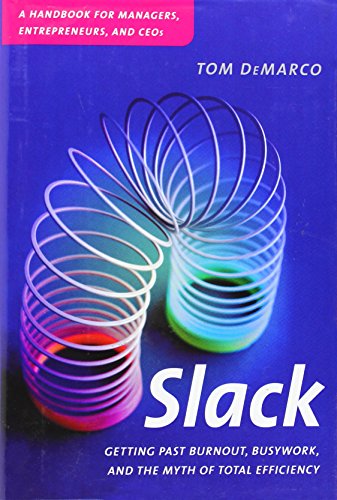
Slack: Getting Past Burnout, Busywork, and the Myth of Total Efficiency. A Handbook for Managers, Entrepreneurs, and CEOs - Hardcover
Inhaltsangabe
Argues that the "lean and mean" corporate model of workaholism and downsizing is proving counterproductive, explaining how companies can implement downtime, promote flexibility, and foster creativity as part of realizing increased revenues.
Die Inhaltsangabe kann sich auf eine andere Ausgabe dieses Titels beziehen.
Über die Autorin bzw. den Autor
Tom DeMarco is a principal of the Atlantic Systems Guild, a New York--and London-based consulting practice. His clients include Hewlett Packard, Apple, IBM, Bell Laboratories, and many others. He is also the author of seven books on management and technical development methods, including The Deadline, a business novel, and Peopleware. In 1999, Tom was awarded the Wayne Stevens Prize for lifetime contribution to software engineering methods, and he continues to work in areas of organizational change, project management, and litigation. He divides his time between New York City and Camden, Maine.
Aus dem Klappentext
To most companies, efficiency means profits and growth. But what if your efficient company the one with the reduced headcount and the stretch goals is actually slowing down and losing money? What if your employees are burning out doing the work of two or more people, leaving them no time for planning, prioritizing, or even lunch? What if you re losing employees faster than you can hire them? What if your superefficient company is suddenly falling behind?
Tom DeMarco, a leading management consultant to both Fortune 500 and up-and-coming companies, has discovered a counterintuitive principle that explains why efficiency improvement can sometimes make a company slow. If your real organizational goal is to become fast (responsive and agile), then he proposes that what you need is not more efficiency, but more slack.
What is slack ? Slack is the degree of freedom in a company that allows it to change. It could be something as simple as adding an assistant to a department, letting high-priced talent spend less time at the photo copier and more time making key decisions. Slack could also appear in the way a company treats employees: instead of loading them up with overwork, a company designed with slack allows its people room to breathe, increase effectiveness, and reinvent themselves.
In thirty three short chapters filled with creative learning tools and charts, you and your company can learn how to:
?make sense of the Efficiency/Flexibility quandary
?run directly toward risk instead of away from it
?strengthen the creative role of middle management
?make change and growth work together for even greater profits
A innovative approach that works for new- and old-economy companies alike, this revolutionary handbook will debunk commonly held assumptions about real-world management, and give you and your company a brand-new model for achieving and maintaining true effectiveness and a healthier bottom line.
Auszug. © Genehmigter Nachdruck. Alle Rechte vorbehalten.
1
Madmen in the Halls
THE LEGACY of the nineties has been a dangerous corporate delusion: the idea that organizations are effective only to the extent that all their workers are totally and eternally busy. Anyone who’s not overworked (sweating, staying late, racing from one task to the next, working Saturdays, unable to squeeze time for even the briefest meeting till two weeks after next) is looked on with suspicion. People with a little idle time on their hands may not even be safe. As one of my friends at Digital Equipment Corporation told me during the company’s darkest days, “There are madmen in the halls, looking for someone to ax.” Of course, the ones they were looking to ax were the folks who weren’t all that busy.
Crisis of Confidence
Your company may not now have actual ax-wielding crazies roaming the halls, but their specter is almost certainly still with you. This is the remnant of the crisis of confidence we’ve just come through. Consider: As this is being written, American and western European business is in a period of extraordinary prosperity. The rest of the world is a basket case and we are healthier than we’ve ever been. And yet just a few short years ago, we were all in an agony of doubt. How could we survive, we wondered, against the competition of the ravenous third world, willing to work for peanuts and liable to undersell us in any market anywhere? How could we stay even with the superbly educated Japanese, or those clever and hungry workers coming out from behind the Iron Curtain, or the Taiwanese and Koreans with their superhuman work ethic and their awesome skills? Acting on our doubts, we went through a purge of excess capacity (i.e., people with homes and families). We trimmed as though our very survival depended on trimming.
Wasn’t it reasonable to put our house in order in this fashion? Maybe it was in the short run. It probably contributed at least somewhat to our present strength. Yet the lasting side effect of the purge–the notion that busyness is the essence of business–can only do us long-term harm.
The Price of “Putting Our House in Order”
During the last ten years we have downsized, “right-sized,” laid off, and fired people’s butts. We have cut payrolls, closed plants, sold off divisions, and generally scared all our remaining employees to death. We nodded in approval as characters like Chainsaw Al (at one time the worst CEO in America) did their dirty work. We bid up the stocks of companies like AT&T who led the trend, i.e., led the retreat.
The principal target of the cuts has been that bugaboo of organizational efficiency: middle management. We asked ourselves, “What are they, after all, those middle managers? What are they but fat? What do they really exist for other than to be cut out in the interest of efficiency?” And so we cut. We surgically removed the middle layers of our organizations, flattening the charts and widening the scope of management at each level.
Was that a good thing to do? I have my doubts.
Maybe middle management exists for some reason above and beyond filling the space between the top and the bottom of the hierarchy. Part of my purpose in this book is to examine what’s supposed to happen in the middle of a healthy organization, the critical role of middle management.
The main activity of those managers is reinvention. It is the middle of the organization where reinvention takes place. This is where the dynamic of today’s organizational functioning is examined, taken apart, analyzed, resynthesized, and assembled back into new organizational models that allow us to move forward.
What got cut out of the most aggressively purged organizations is the capacity to change. The so-called restructurings have, in most cases, optimized the present steady state, only at the expense of the future.
Does It Matter?
Well, so what? Some companies have always been prone to trade away the future to make the present look a little more rosy. In the short term they prosper, and in the long term they don’t. What’s different this time? The difference is that today even the companies that didn’t cut the heart out of their effective change centers have made it more difficult for those centers to operate. Change and reinvention require a commodity that is absent in our time as it never has been before. That commodity–the catalytic ingredient of all change–is slack. Slack is the time when reinvention happens. It is time when you are not 100 percent busy doing the operational business of your firm. Slack is the time when you are 0 percent busy.
Slack at all levels is necessary to make the organization work effectively and to grow. It is the lubricant of change. Good companies excel in the creative use of slack. And bad ones can only obsess about removing it.
2
Busyness
IMAGINE that you took on an assignment to direct a film about happenings inside a hugely successful company. How would you portray the company? How, in particular, would you make it look successful? One tempting answer is to convey its great success by showing everyone who works there to be immensely busy all the time. After all, you might reason, how would the company have become so successful if its people weren’t putting in substantial extra effort?
My own experience consulting inside some highly successful companies (Microsoft, Apple, Hewlett-Packard, IBM, Dupont, to name a few) cannot corroborate a relationship between busyness and success. Very successful companies have never struck me as particularly busy; in fact, they are, as a group, rather laid-back. Energy is evident in the workplace, but it’s not the energy tinged with fear that comes from being slightly behind on everything. The companies I have come to admire most show little obvious sense of hurry. They are more like an extended family, embarked upon a project whose goal is only partly expressed in getting something done; the other part of the goal is that all involved learn and grow and enjoy themselves along the way.
Work, particularly knowledge work, can be extremely enjoyable. That’s why so many of us become addicted to it. If you take sensual pleasure in your work, and those around you are doing the same thing, if it’s clearly okay in your corporate culture to enjoy what you’re doing, chances are that yours is a company headed toward success. Sign up for the stock plan.
The Busy Worker
Extreme busyness is injurious to the real work of the organization. I will make that point as carefully as I can in the chapters to follow, stressing the effect in particular on management. But first, I ask you to consider how busyness may hurt the effectiveness of even the lowest-level workers.
Take, for example, the secretary. (You remember secretaries, don’t you? A once-common element of corporate life.) A secretary’s job may involve document preparation, appointment scheduling, coordinating, and generally facilitating the smooth functioning of one manager’s work life–let’s say yours. We’ll call her Sylvia.
A good secretary is a treasure, as anyone who has ever worked with one knows, and Sylvia is definitely a treasure. With Sylvia around, everything goes more smoothly. When you’re away from the office–it never looks this way officially, but whom are we kidding?–Sylvia is effectively in charge. She is the one who coordinates and distributes work to be done. If she ever left, it would set you and your organization back a few months, at least.
But now into this happy scenario drop a consultant with a charter to reduce cost, the “corporate restructuring agent.” Whoa, he says, what’s this? A secretary? And what’s she up to this very...
„Über diesen Titel“ kann sich auf eine andere Ausgabe dieses Titels beziehen.
Suchergebnisse für Slack: Getting Past Burnout, Busywork, and the Myth...

Beispielbild für diese ISBN
Slack: Getting Past Burnout, Busywork, and the Myth of Total Efficiency
Anbieter: World of Books (was SecondSale), Montgomery, IL, USA
Verkäuferbewertung 5 von 5 Sternen

Zustand: Very Good. Item in very good condition! Textbooks may not include supplemental items i.e. CDs, access codes etc. Bestandsnummer des Verkäufers 00094076312
Gebraucht kaufen
EUR 3,77
Versand gratis
Versand innerhalb von USA
Versand innerhalb von USA
Anzahl: 2 verfügbar
Beispielbild für diese ISBN
Slack: Getting Past Burnout, Busywork, and the Myth of Total Efficiency
Anbieter: Your Online Bookstore, Houston, TX, USA
Verkäuferbewertung 5 von 5 Sternen
Hardcover. Zustand: Good. Bestandsnummer des Verkäufers 076790768X-3-24837172
Gebraucht kaufen
EUR 3,78
Versand gratis
Versand innerhalb von USA
Versand innerhalb von USA
Anzahl: 1 verfügbar
Beispielbild für diese ISBN
Slack: Getting Past Burnout, Busywork, and the Myth of Total Efficiency
Anbieter: Once Upon A Time Books, Siloam Springs, AR, USA
Verkäuferbewertung 4 von 5 Sternen

hardcover. Zustand: Good. This is a used book in good condition and may show some signs of use or wear . This is a used book in good condition and may show some signs of use or wear . Bestandsnummer des Verkäufers mon0003398011
Gebraucht kaufen
EUR 2,06
EUR 3,47 Versand
Versand innerhalb von USA
Versand innerhalb von USA
Anzahl: 1 verfügbar
Beispielbild für diese ISBN
Slack: Getting Past Burnout, Busywork, and the Myth of Total Efficiency
Anbieter: World of Books Inc, Montgomery, IL, USA
Verkäuferbewertung 4 von 5 Sternen
Hardback. Zustand: Very Good. If your company's goal is to become fast, responsive, and agile, more efficiency is not the answer--you need more slack. Why is it that today's superefficient organizations are ailing? Tom DeMarco, a leading management consultant to both Fortune 500 and up-and-coming companies, reveals a counterintuitive principle that explains why efficiency efforts can slow a company down. That principle is the value of slack, the degree of freedom in a company that allows it to change. Implementing slack could be as simple as adding an assistant to a department and letting high-priced talent spend less time at the photocopier and more time making key decisions, or it could mean designing workloads that allow people room to think, innovate, and reinvent themselves. It means embracing risk, eliminating fear, and knowing when to go slow. Slack allows for change, fosters creativity, promotes quality, and, above all, produces growth. With an approach that works for new- and old-economy companies alike, this revolutionary handbook debunks commonly held assumptions about real-world management, and gives you and your company a brand-new model for achieving and maintaining true effectiveness. Bestandsnummer des Verkäufers CIN076790768XVG
Gebraucht kaufen
EUR 5,58
Versand gratis
Versand innerhalb von USA
Versand innerhalb von USA
Anzahl: 2 verfügbar
Beispielbild für diese ISBN
Slack: Getting Past Burnout, Busywork, and the Myth of Total Efficiency
Verlag:
Broadway (edition First Edition), 2001
ISBN 10: 076790768X
ISBN 13: 9780767907682
Gebraucht
Hardcover
Erstausgabe
Anbieter: BooksRun, Philadelphia, PA, USA
Verkäuferbewertung 5 von 5 Sternen
Hardcover. Zustand: Very Good. First Edition. With dust jacket. It's a well-cared-for item that has seen limited use. The item may show minor signs of wear. All the text is legible, with all pages included. It may have slight markings and/or highlighting. Bestandsnummer des Verkäufers 076790768X-11-1-29
Gebraucht kaufen
EUR 5,62
Versand gratis
Versand innerhalb von USA
Versand innerhalb von USA
Anzahl: 1 verfügbar
Beispielbild für diese ISBN
Slack : Getting Past Burnout, Busywork, and the Myth of Total Efficiency
Verlag:
Broadway Books, 2001
ISBN 10: 076790768X
ISBN 13: 9780767907682
Gebraucht
Hardcover
Erstausgabe
Anbieter: Better World Books: West, Reno, NV, USA
Verkäuferbewertung 5 von 5 Sternen
Zustand: Good. 1st. Former library copy. Pages intact with minimal writing/highlighting. The binding may be loose and creased. Dust jackets/supplements are not included. Includes library markings. Stock photo provided. Product includes identifying sticker. Better World Books: Buy Books. Do Good. Bestandsnummer des Verkäufers GRP83338183
Gebraucht kaufen
EUR 6,25
Versand gratis
Versand innerhalb von USA
Versand innerhalb von USA
Anzahl: 2 verfügbar
Beispielbild für diese ISBN
Slack: Getting Past Burnout, Busywork, and the Myth of Total Efficiency
Anbieter: Wonder Book, Frederick, MD, USA
Verkäuferbewertung 5 von 5 Sternen
Zustand: Good. Good condition. Very Good dust jacket. A copy that has been read but remains intact. May contain markings such as bookplates, stamps, limited notes and highlighting, or a few light stains. Bestandsnummer des Verkäufers P15G-01281
Gebraucht kaufen
EUR 6,32
Versand gratis
Versand innerhalb von USA
Versand innerhalb von USA
Anzahl: 1 verfügbar
Beispielbild für diese ISBN
Slack: Getting Past Burnout, Busywork, and the Myth of Total Efficiency
Anbieter: Wonder Book, Frederick, MD, USA
Verkäuferbewertung 5 von 5 Sternen
Zustand: Very Good. Very Good condition. Very Good dust jacket. A copy that may have a few cosmetic defects. May also contain light spine creasing or a few markings such as an owner's name, short gifter's inscription or light stamp. Bestandsnummer des Verkäufers L18B-02848
Gebraucht kaufen
EUR 6,32
Versand gratis
Versand innerhalb von USA
Versand innerhalb von USA
Anzahl: 1 verfügbar
Beispielbild für diese ISBN
Slack: Getting Past Burnout, Busywork, and the Myth of Total Efficiency
Anbieter: ThriftBooks-Dallas, Dallas, TX, USA
Verkäuferbewertung 5 von 5 Sternen
Hardcover. Zustand: Very Good. No Jacket. May have limited writing in cover pages. Pages are unmarked. ~ ThriftBooks: Read More, Spend Less. Bestandsnummer des Verkäufers G076790768XI4N00
Gebraucht kaufen
EUR 7,15
Versand gratis
Versand innerhalb von USA
Versand innerhalb von USA
Anzahl: 1 verfügbar
Beispielbild für diese ISBN
Slack: Getting Past Burnout, Busywork, and the Myth of Total Efficiency
Anbieter: ThriftBooks-Atlanta, AUSTELL, GA, USA
Verkäuferbewertung 5 von 5 Sternen
Hardcover. Zustand: Very Good. No Jacket. May have limited writing in cover pages. Pages are unmarked. ~ ThriftBooks: Read More, Spend Less. Bestandsnummer des Verkäufers G076790768XI4N00
Gebraucht kaufen
EUR 7,15
Versand gratis
Versand innerhalb von USA
Versand innerhalb von USA
Anzahl: 1 verfügbar