
Verwandte Artikel zu So You Wanna Be a Rock & Roll Star: How I Machine-Gunned...
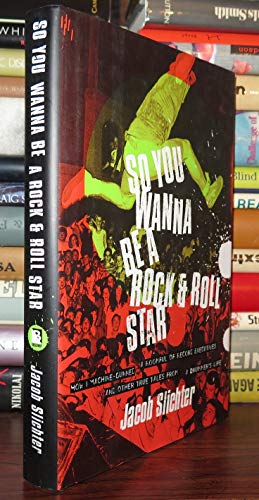
So You Wanna Be a Rock & Roll Star: How I Machine-Gunned a Roomful of Record Executives and Other True Tales from a Drummer's Life - Hardcover
Inhaltsangabe
The drummer for Semisonic recounts how the band struggled as a trio of misfits before being catapulted into stardom, describes the survival skills they developed, and offers insight into the challenges of the music industry and living a celebrity life.
Die Inhaltsangabe kann sich auf eine andere Ausgabe dieses Titels beziehen.
Über die Autorin bzw. den Autor
JACOB SLICHTER is a native of Champaign, Illinois, and graduated from Harvard with a degree in Afro-American studies and history. He has read his road diaries (originally published on the Semisonic website) on NPR'sMorning Edition. With his multiplatinum-selling band Semisonic he has appeared on the Jay Leno, David Letterman, Conan O'Brien, and Craig Kilborn shows.
Aus dem Klappentext
A hilarious inside look at the real business of popular music by the drummer of Semisonic that does for rock and roll what Jim Bouton's Ball Four did for baseball.
After years of working day jobs and making music in his basement, Jacob Slichter wondered if his dreams of rock stardom were a vain illusion. Then he was recruited by two of his successful musician friends to form a band that became Semisonic. Who could forget the smash single Closing Time, a runaway hit in 1998 that thrust Jake and his bandmates into the international spotlight and helped them sell over two million albums worldwide? But along the road to fame and success came bewilderment and personal chaos: How will we ever get a record deal? Which record company is the best? The worst? Do I really have to wear these ridiculous boots? Why isn t radio playing our song? What if I have a panic attack right here on stage? What should I write on this fan s CD? Am I famous? Why isn t the video director getting more shots of me? Did I say the wrong thing during that interview? Help!
So You Wanna Be a Rock & Roll Star is a telling and witty look at what happens just before and during one's time in the spotlight. Jake takes readers on a step-by-step journey of his evolution from fledgling drummer to globetrotting performer and proves to be the perfect guide feisty and humbled to the inner workings of the music industry and instant celebrity. So You Wanna Be a Rock & Roll Star speaks to all of us who dream again and again of rock superstardom and shows how one kid can go from picking up a pair of drumsticks to picking up a platinum record.
Auszug. © Genehmigter Nachdruck. Alle Rechte vorbehalten.
Chapter I
Jump Start
It's never snowed in Minnesota during the month of July. The boundary waters up north, however, have tasted light accumulations in August and June, and as for the months in between, keep those winter boots handy. From autumn to spring, Minnesota is a frozen soundscape of snowplows, snow shovels, windshield scrapers, and auto ignitions laboring to turn over. Once, to get into my ice-entombed car, I needed a rubber mallet, seventy-five feet of extension cord, and a blow dryer. The long brutal winters, however, are sometimes credited with fostering Minneapolis's vital music scene. Without such horrible weather keeping them inside with their guitars, the theory goes, the world might never have heard of Bob Dylan, Prince, the Suburbs, the Replacements, Husker Du, Babes in Toyland, the Time, Soul Asylum, or the Jayhawks.
It takes more than blizzards and musicians to sustain this thriving scene. It takes fans, and the fans in the Twin Cities are famous for pushing their cars out of snowdrifts, driving down to Minneapolis's prized rock club, First Avenue, and lining up around the block in subzero temperatures on a weekday night to get through the doors before the tickets sell out. Those fans and the bands they love make a potent combination. I'll never forget watching Soul Asylum rule the stage while the body heat from the crowd of 2,000 thawed my frozen jaw. With their amplifiers turned up past the breaking point, the band spilled back and forth across the stage and brought the crowd seesawing with them, as if we were all on the deck of a ship. Singer Dave Pirner whipped his long hair in circles and screamed, "I want somebody to shove! I need somebody to shove! I want somebody to shove me!" An overexcited fan launched a cup of beer from twenty rows back, and it soared over the crowd and exploded on Karl Mueller's bass guitar. Pirner pointed into the crowd and shouted into the mike. "We're gonna find out who fuckin' threw that, and when we do, we're gonna kick your ass. And everyone here's gonna help us do it!" The crowd roared its approval.
I was a musician in my early thirties, still living under the cloud of disappointment that had followed me since graduating six years earlier from Harvard, a place for which I was poorly prepared and which in every regard had annihilated my self-confidence. I had intended to major in music, but after completing a year of study at the Berklee College of Music, for which Harvard's music department had promised me credit, I received a cold letter from the chairman of the department rescinding this promise and inviting me to find another course of study. I wandered from major to major, eventually settling on Afro-American studies, where I quietly explored my interests in race, politics, music, and literature. I entertained visions of graduate school, but such daydreaming was brought to an abrupt end when I opened the envelope containing the miserable grade given to my senior thesis, and the accompanying terse comments on its shabbiness. I graduated with a lackluster record and threw my diploma in a storage box. So much for plan B; back to plan A--rock stardom.
I proceeded with a move to San Francisco. I worked at various day jobs--selling synthesizers and drum machines at Guitar Center, making copies and filing them for executives at Chevron, and then administering the office of Saint Gregory's Episcopal Church--and wrote songs at night, recording them in my bedroom. Alas, songwriting vexed me. The emotions that I longed to put into words and music proved beyond my reach whenever I laid my fingers on a guitar, piano keyboard, or pen. I wanted to address themes of social justice through the poetry of personal reflection. What I ended up with were a stack of legal pads filled with half-finished lyrics, manuscript paper with half-finished melodies, and a cassette of the twelve songs I managed to write in five years. The extent of my public performances was also minimal, spanning a period of three months during which my friend Hal Movius and I performed on the stages of the Paradise Lounge and the Hotel Utah. On these five or six occasions, we were applauded thoughtfully by a few strangers and enthusiastically by twenty members of Saint Gregory's Church.
I left San Francisco with little to show for my musical aspirations and hoped the legendary scene in Minneapolis would be the launch pad for a career that had not yet gotten off the ground. I knew a number of musicians in town, but for the most part I continued to do what I had done in San Francisco--work a day job and write and record songs in my basement studio at night, playing the drums, keyboards, and making use of my fledgling skills on guitar. The rare feat of finishing a song was cause for celebration. I'd listen to the recording for days, triumphant at first and then mortified by its shortcomings--my sugary melodies and lyrics, my inept guitar playing, and most of all my quavering baritone voice. As I lay in bed at night, I'd hear another page tearing off of my life's shortening calendar. I was running out of time, hair, and dignity. The mantle of failure weighed on me, no place more than at my day job downtown, where I attended to the photocopying and envelope-stuffing needs of executives who sold retirement plans.
"So, Jake, I hear you're a musician. What kind of music do you play?"
"It's . . . hard to describe."
"I see. Where do you play?"
"I have a studio in my basement."
"Good for you. I need five hundred copies of this report stapled and collated by the end of the day."
By contrast, my closest friends in town had no day jobs; they had a record deal with A&M Records. Dan Wilson, a friend of mine from college, his brother Matt, John Munson, and Elaine Harris were the members of Trip Shakespeare, a rock band whose dark psychedelic sound entranced fans around the country, and especially in the Midwest, where they performed for capacity crowds at the Metro in Chicago, the Shadow in Kansas City, and First Avenue in Minneapolis. To dine out with Dan, John, Matt, or Elaine was an exciting chance to be seen with a rock star who needed an unlisted phone number. It was also an occasion to silently compare career stats between them and me: one record deal to none, four albums to none, tens of thousands of fans to none.
Dan was the closest of these friends. I had met him during our freshman week at Harvard, when he heard me playing the drums in a dormitory common room. He stuck his head in the door and said, "I'll be back with my bass." (He played bass in college and later switched to guitar.) We jammed for several hours that day and in the following weeks. Our musical tastes ran in different directions--I stuck to soul and funk, while Dan was more excited by English rock and punk--so it wasn't until our senior year that we played in a band together.
It was with Dan that I moved to San Francisco, following the trail of his girlfriend, Diane. Dan and I shared an apartment, where I saw his exhausting focus firsthand. A Phi Beta Kappa, he had graduated Harvard summa cum laude and won the Louis Sudler Prize in the Arts, awarded to the senior who demonstrates outstanding artistic achievement, which in Dan's case was not in music but painting. In San Francisco, he carried on a double artistic life, painting and songwriting, in addition to working various day jobs. Even his days off began with a double shot of espresso and then proceeded with a furious pace of activity that was unsettling to watch, especially given my meager output. The sound of his pen scrawling across the pages of his journal could keep me from reading. (Today, the snap of his fingers on a computer keyboard can make one twitch.) In conversation, his eyes focused into an intent gaze and...
„Über diesen Titel“ kann sich auf eine andere Ausgabe dieses Titels beziehen.
Suchergebnisse für So You Wanna Be a Rock & Roll Star: How I Machine-Gunned...

Beispielbild für diese ISBN
So You Wanna Be a Rock & Roll Star: How I Machine-Gunned a Roomful Of Record Executives and Other True Tales from a Drummer's Life
Anbieter: Half Price Books Inc., Dallas, TX, USA
Verkäuferbewertung 5 von 5 Sternen

hardcover. Zustand: Very Good. Connecting readers with great books since 1972! Used books may not include companion materials, and may have some shelf wear or limited writing. We ship orders daily and Customer Service is our top priority! Bestandsnummer des Verkäufers S_478559404
Gebraucht kaufen
EUR 4,30
EUR 3,27 Versand
Versand innerhalb von USA
Versand innerhalb von USA
Anzahl: 1 verfügbar
Beispielbild für diese ISBN
So You Wanna Be a Rock and Roll Star : How I Machine-Gunned a Roomful of Record Executives and Other True Tales from a Drummer's Life
Anbieter: Better World Books, Mishawaka, IN, USA
Verkäuferbewertung 5 von 5 Sternen
Zustand: Good. Former library copy. Pages intact with minimal writing/highlighting. The binding may be loose and creased. Dust jackets/supplements are not included. Includes library markings. Stock photo provided. Product includes identifying sticker. Better World Books: Buy Books. Do Good. Bestandsnummer des Verkäufers 4729882-6
Gebraucht kaufen
EUR 7,61
Versand gratis
Versand innerhalb von USA
Versand innerhalb von USA
Anzahl: 1 verfügbar
Beispielbild für diese ISBN
So You Wanna Be a Rock and Roll Star : How I Machine-Gunned a Roomful of Record Executives and Other True Tales from a Drummer's Life
Anbieter: Better World Books, Mishawaka, IN, USA
Verkäuferbewertung 5 von 5 Sternen
Zustand: Very Good. Pages intact with possible writing/highlighting. Binding strong with minor wear. Dust jackets/supplements may not be included. Stock photo provided. Product includes identifying sticker. Better World Books: Buy Books. Do Good. Bestandsnummer des Verkäufers 5368854-75
Gebraucht kaufen
EUR 7,61
Versand gratis
Versand innerhalb von USA
Versand innerhalb von USA
Anzahl: 1 verfügbar
Beispielbild für diese ISBN
So You Wanna Be a Rock and Roll Star : How I Machine-Gunned a Roomful of Record Executives and Other True Tales from a Drummer's Life
Anbieter: Better World Books: West, Reno, NV, USA
Verkäuferbewertung 5 von 5 Sternen
Zustand: Very Good. Former library copy. Pages intact with possible writing/highlighting. Binding strong with minor wear. Dust jackets/supplements may not be included. Includes library markings. Stock photo provided. Product includes identifying sticker. Better World Books: Buy Books. Do Good. Bestandsnummer des Verkäufers 13632052-75
Gebraucht kaufen
EUR 7,61
Versand gratis
Versand innerhalb von USA
Versand innerhalb von USA
Anzahl: 1 verfügbar
Beispielbild für diese ISBN
So You Wanna Be a Rock & Roll Star: How I Machine-Gunned a Roomful Of Record Executives and Other True Tales from a Drummer's Life
Anbieter: HPB-Emerald, Dallas, TX, USA
Verkäuferbewertung 5 von 5 Sternen
hardcover. Zustand: Very Good. Connecting readers with great books since 1972! Used books may not include companion materials, and may have some shelf wear or limited writing. We ship orders daily and Customer Service is our top priority! Bestandsnummer des Verkäufers S_460091886
Gebraucht kaufen
EUR 4,47
EUR 3,27 Versand
Versand innerhalb von USA
Versand innerhalb von USA
Anzahl: 1 verfügbar
Beispielbild für diese ISBN
So You Wanna Be a Rock & Roll Star: How I Machine-Gunned a Roomful Of Record Executives and Other True Tales from a Drummer's Life
Anbieter: Books Liquidation, Sacramento, CA, USA
Verkäuferbewertung 4 von 5 Sternen

hardcover. Zustand: Good. Bestandsnummer des Verkäufers 53IN3G0036E1
Gebraucht kaufen
EUR 4,48
EUR 3,48 Versand
Versand innerhalb von USA
Versand innerhalb von USA
Anzahl: 1 verfügbar
Beispielbild für diese ISBN
So You Wanna Be a Rock & Roll Star: How I Machine-Gunned a Roomful Of Record Executives and Other True Tales from a Drummer's Life
Anbieter: ThriftBooks-Atlanta, AUSTELL, GA, USA
Verkäuferbewertung 5 von 5 Sternen
Hardcover. Zustand: Very Good. No Jacket. May have limited writing in cover pages. Pages are unmarked. ~ ThriftBooks: Read More, Spend Less. Bestandsnummer des Verkäufers G0767914708I4N00
Gebraucht kaufen
EUR 8,05
Versand gratis
Versand innerhalb von USA
Versand innerhalb von USA
Anzahl: 1 verfügbar
Beispielbild für diese ISBN
So You Wanna Be a Rock & Roll Star: How I Machine-Gunned a Roomful Of Record Executives and Other True Tales from a Drummer's Life
Verlag:
Broadway Books, 2004
ISBN 10: 0767914708
ISBN 13: 9780767914703
Gebraucht
Hardcover
Erstausgabe
Anbieter: The Maryland Book Bank, Baltimore, MD, USA
Verkäuferbewertung 5 von 5 Sternen
hardcover. Zustand: Very Good. First Edition. Used - Very Good. Bestandsnummer des Verkäufers 4-X-4-0261
Gebraucht kaufen
EUR 4,47
EUR 4,09 Versand
Versand innerhalb von USA
Versand innerhalb von USA
Anzahl: 1 verfügbar
Beispielbild für diese ISBN
SO YOU WANNA BE A ROCK & ROLL STAR: How I Machine-Gunned a Roomful of Record Executives & Other True Tales from a Drummer's Life
Verlag:
Broadway Books, NY, 2004
ISBN 10: 0767914708
ISBN 13: 9780767914703
Gebraucht
Hardcover
Erstausgabe
Anbieter: Archer's Used and Rare Books, Kent, OH, USA
Verkäuferbewertung 5 von 5 Sternen
Hardcover. Zustand: Fine. Zustand des Schutzumschlags: Fine. 1st edition. Fine/Fine Dust Jacket is in as new condition, apart from normal shop shelf wear - contains no tears or chips or other damage. Quantity Available: 1. Category: Music; Rock; ISBN: 0767914708. ISBN/EAN: 9780767914703. Pictures of this item not already displayed here available upon request. Inventory No: 18271. Bestandsnummer des Verkäufers 18271
Gebraucht kaufen
EUR 5,81
EUR 4,79 Versand
Versand innerhalb von USA
Versand innerhalb von USA
Anzahl: 1 verfügbar
Beispielbild für diese ISBN
So You Wanna Be a Rock & Roll Star: How I Machine-Gunned a Roomful Of Record Executives and Other True Tales from a Drummer's Life Slichter, Jacob
Anbieter: MI Re-Tale, Dacula, GA, USA
Verkäuferbewertung 5 von 5 Sternen
Hardcover. Zustand: Very Good. Very nice book. DJ has very light edge wear. Bestandsnummer des Verkäufers CN-EO1G-UK7O
Gebraucht kaufen
EUR 8,07
EUR 4,61 Versand
Versand innerhalb von USA
Versand innerhalb von USA
Anzahl: 1 verfügbar