
Verwandte Artikel zu The Friar And The Cipher: Roger Bacon And The Unsolved...
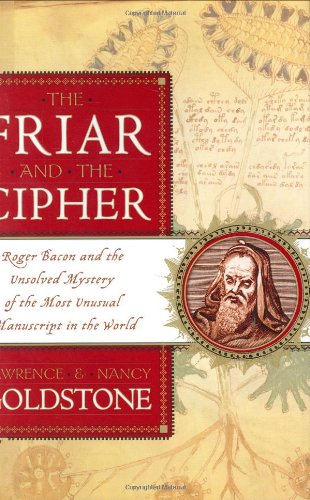
The Friar And The Cipher: Roger Bacon And The Unsolved Mystery Of The Most Unusual Manuscript in the World - Hardcover
Inhaltsangabe
An accessible study of the baffling mystery of the Voynich Manuscript, discovered in 1912, examines the theory that Roger Bacon, the noted thirteenth-century astronomer, was the author of the book, which is written in an indecipherable language and code that remains unsolved and contains odd illustrations of plants, astrological diagrams, and more. 25,000 first printing.
Die Inhaltsangabe kann sich auf eine andere Ausgabe dieses Titels beziehen.
Über die Autorin bzw. den Autor
LAWRENCE and NANCY GOLDSTONE are a husband-and-wife writing team and authors of Out of the Flames, a Booksense 76 Selection. They have also written three books on their book-collecting pursuits: Used and Rare, Slightly Chipped, and Warmly Inscribed.
Auszug. © Genehmigter Nachdruck. Alle Rechte vorbehalten.
CHAPTER ONE
Turmoil and Opportunity:
Roger Bacon's England
ROGER BACON WAS BORN IN SOMERSET, in southwest England, about one hundred miles west of London. There are no surviving records of his birth—the evidence for the date comes from Bacon himself. In a work known to have been written in 1268 he said: "I have labored much in sciences and languages, and I have up to now devoted forty years to them." What he apparently meant by this was that he had started what today would be the equivalent of an undergraduate arts course in 1228. Since the average thirteenth-century boy started college at about fourteen, this puts the year of his birth at 1214. He lived to be eighty, so his lifetime spanned nearly the whole of the thirteenth century.
Bacon came from a family of wealthy minor nobles. His father held no title and was probably a product of the new and burgeoning merchant class, men who worked their way into higher society by accumulating cash, which was then used to purchase land and a manor house. The most successful of these could buy castles and conduct themselves as genuine nobility, knighting their sons, but Bacon's family did not seem to fall into this category. He had at least one older brother, to whom he refers in his writings, but neither was ever granted a title by the king.
Bacon remained throughout his life a product of the England of his childhood, an England in the midst of great change and rife with civil unrest that would soon erupt into full-scale war. The year after Bacon was born, the hapless King John was forced to sign Magna Carta and thus introduce the first glimmer of representative government into Europe. It was the very weakness of John and, later, his son Henry that created a vacuum into which political, social, educational, and, most significantly, scientific innovation rushed in. The most basic assumptions were challenged, the most fundamental truths rejected. So unfortunate was John as a ruler that he did not need to be known as John I, as no other king in the ensuing eight hundred years of English history was ever given the same name.
John was the fourth son of the tall, intense, mercurial Henry II, under whose lusty hand the kingdom had grown to encompass not only England but most of France—Normandy, Brittany, Anjou, Touraine, Toulouse, and, with his marriage to the vivacious, wily Eleanor, the Aquitaine on the Atlantic coast. The official kingdom of France, on the other hand, was limited to Paris and its environs.
Henry's two eldest sons, Henry and Richard (called Lionheart for his military prowess) were also tall and physically imposing. John was short and unattractive. Richard still referred to John as a child when he was well into his twenties. There was a third older brother, Geoffrey, who was much cleverer than John, although this in itself was not particularly noteworthy.
With all those older sons, Henry assumed that John was never going to see the English throne, so when the boy was nineteen, he tried to get him a kingdom of his own by sending him off to conquer Ireland. John left with lots of friends, three hundred mercenaries, several barrels of silver pennies with which to pay them, and the promise of a fancy gold crown fitted out with peacock feathers when he won. In no time at all, John and his friends had spent all of the pennies on themselves, causing the mercenaries to desert. He so alienated the Irish nobility that, in a place known for internecine warfare, John managed to get all the aristocrats in Ireland to band together and agree to reject him. Richard, by contrast, had subdued the powerful rebellious barons of southern France by the age of fifteen.
Richard eventually became king (Henry and Geoffrey died young) but left almost immediately on crusade, where he was captured and held for ransom by the Holy Roman Emperor. As everyone who has ever seen The Adventures of Robin Hood knows, during his absence, John attempted to usurp the English throne by treachery. (In truth, it was Eleanor, not Errol Flynn, who stopped him.) When John heard that his older brother had been freed and was on his way home, he turned tail and headed for France. John was so insignificant in Richard's mind that Richard forgave him and let him come home.
Just a short time later, however, Richard died while staking out a minor castle for siege. He had disdained armor while parading around the periphery and was shot in the neck with an arrow. The boy whom his father had nicknamed "Lackland" for want of a realm was crowned King John of England at Westminster Abbey on May 25, 1199. Within five years of becoming king, he had lost most of his father's French possessions to the French king, Philip Augustus, earning him a new nickname, "Softsword," among his own nobility.
Losing to the French turned out to be just the preliminary. In 1205, John, by virtue of an extremely dubious royal edict, found himself taking on the great Pope Innocent III. It was not really a fair fight.
Innocent III was one of the seminal figures in the history of the Church. Born into an ancient aristocratic Roman family, he proved a brilliant student in both law and theology. He enjoyed a meteoric rise through the curia and was elevated to the Throne of St. Peter while still in his thirties. Innocent inherited an institution in disarray. In the century preceding his reign, the papacy had sunk to an object of ridicule, ignored by secular monarchs. One of his predecessors had been compelled to ride backward on an ass through the countryside, and another had been obliged to flee Rome disguised as a pilgrim. By a combination of force of personality and the threat of withholding sacraments, Innocent almost single-handedly turned Rome from the political nonentity that it had become into a potent pseudostate, the most important political power in Europe. "By me kings reign and princes decree justice," he observed.
In 1205, the archbishop of Canterbury died. In Henry II's time, the English bishops would "elect" a new archbishop, although this was in fact a royal appointee. (As usual, Henry had taken custom one step further—he had not only assumed the right to elect his own man, Thomas ˆ Becket, as archbishop, but had assumed the right to have him killed as well when Becket disagreed with him.) John naturally expected to have the same privilege as his father, but he bungled the election and Innocent claimed the right of appointment for himself. He chose the highly qualified Stephen Langton, who was at the time teaching at the University of Paris.
John was outraged at this attempt to usurp his authority and refused to let the new appointee enter the country. So began a war of wills between king and pope. Innocent placed England under interdict, which meant that English priests were forbidden to perform any of the sacraments. Suddenly, no one in England could get married, buried, or baptized. John retaliated by seizing the property of those priests who obeyed Innocent's order. To get it back, they had to swear loyalty to the crown and pay a hefty fee. They even had to pay to get their "housekeepers" (read, mistresses) back. Innocent countered by excommunicating John. The English high clergy packed up and headed to France, and by 1212 there was only one bishop left in all of England.
Still John refused to yield, so Innocent sent a message to Philip Augustus, the king of France. If Rome deposed John, the excommunicate, would Philip Augustus like to take over in his place? Philip Augustus did, in fact, want to take over England. Langton, who still had not gained entry to the country of which he was nominally the archbishop, was given letters from Innocent announcing that John had been deposed in favor of Philip Augustus. The French massed an army at the...
„Über diesen Titel“ kann sich auf eine andere Ausgabe dieses Titels beziehen.
Suchergebnisse für The Friar And The Cipher: Roger Bacon And The Unsolved...

Beispielbild für diese ISBN
The Friar and the Cipher: Roger Bacon and the Unsolved Mystery of the Most Unusual Manuscript in the World
Anbieter: World of Books (was SecondSale), Montgomery, IL, USA
Verkäuferbewertung 5 von 5 Sternen

Zustand: Good. Item in good condition. Textbooks may not include supplemental items i.e. CDs, access codes etc. Bestandsnummer des Verkäufers 00100941688
Gebraucht kaufen
EUR 3,79
Versand gratis
Versand innerhalb von USA
Versand innerhalb von USA
Anzahl: 2 verfügbar
Foto des Verkäufers
The Friar and the Cipher: Roger Bacon and the Unsolved Mystery of the Most Unusual Manuscript in the World
Anbieter: 3Brothers Bookstore, Egg harbor township, NJ, USA
Verkäuferbewertung 5 von 5 Sternen
Zustand: very_good. Cover may have light wear, pages in very good condition and binding is sturdy; may have other light shelf wear or creases. May have notes or highlighting. Bestandsnummer des Verkäufers EVV.0767914732.VG
Gebraucht kaufen
EUR 3,80
Versand gratis
Versand innerhalb von USA
Versand innerhalb von USA
Anzahl: 1 verfügbar
Foto des Verkäufers
The Friar and the Cipher: Roger Bacon and the Unsolved Mystery of the Most Unusual Manuscript in the World
Anbieter: Greenworld Books, Arlington, TX, USA
Verkäuferbewertung 5 von 5 Sternen
Zustand: very_good. Fast Free Shipping â" Very Good condition book with a firm cover and clean pages. Shows normal use and some light wear or limited notes markings. A solid, nice copy to enjoy. Bestandsnummer des Verkäufers GWV.0767914732.VG
Gebraucht kaufen
EUR 4,55
Versand gratis
Versand innerhalb von USA
Versand innerhalb von USA
Anzahl: 2 verfügbar
Foto des Verkäufers
The Friar and the Cipher: Roger Bacon and the Unsolved Mystery of the Most Unusual Manuscript in the World
Anbieter: Greenworld Books, Arlington, TX, USA
Verkäuferbewertung 5 von 5 Sternen
Zustand: good. Fast Free Shipping â" Good condition. It may show normal signs of use, such as light writing, highlighting, or library markings, but all pages are intact and the book is fully readable. A solid, complete copy that's ready to enjoy. Bestandsnummer des Verkäufers GWV.0767914732.G
Gebraucht kaufen
EUR 4,55
Versand gratis
Versand innerhalb von USA
Versand innerhalb von USA
Anzahl: 3 verfügbar
Beispielbild für diese ISBN
The Friar and the Cipher: Roger Bacon and the Unsolved Mystery of the Most Unusual Manuscript in the World
Anbieter: World of Books Inc, Montgomery, IL, USA
Verkäuferbewertung 4 von 5 Sternen

Hardback. Zustand: Good. Bestandsnummer des Verkäufers CIN0767914732G
Gebraucht kaufen
EUR 5,58
Versand gratis
Versand innerhalb von USA
Versand innerhalb von USA
Anzahl: 2 verfügbar
Beispielbild für diese ISBN
The Friar and the Cipher: Roger Bacon and the Unsolved Mystery of the Most Unusual Manuscript in the World
Anbieter: Wonder Book, Frederick, MD, USA
Verkäuferbewertung 5 von 5 Sternen
Zustand: Good. Good condition. Very Good dust jacket. A copy that has been read but remains intact. May contain markings such as bookplates, stamps, limited notes and highlighting, or a few light stains. Bestandsnummer des Verkäufers F17B-03776
Gebraucht kaufen
EUR 6,23
Versand gratis
Versand innerhalb von USA
Versand innerhalb von USA
Anzahl: 1 verfügbar
Beispielbild für diese ISBN
The Friar and the Cipher: Roger Bacon and the Unsolved Mystery of the Most Unusual Manuscript in the World
Anbieter: Wonder Book, Frederick, MD, USA
Verkäuferbewertung 5 von 5 Sternen
Zustand: As New. Like New condition. Like New dust jacket. A near perfect copy that may have very minor cosmetic defects. Bestandsnummer des Verkäufers E14K-01000
Gebraucht kaufen
EUR 6,23
Versand gratis
Versand innerhalb von USA
Versand innerhalb von USA
Anzahl: 1 verfügbar
Beispielbild für diese ISBN
The Friar and the Cipher : The Unsolved Mystery of the Most Unusual Manuscript in the World
Verlag:
Knopf Doubleday Publishing Group, 2005
ISBN 10: 0767914732
ISBN 13: 9780767914734
Gebraucht
Hardcover
Erstausgabe
Anbieter: Better World Books, Mishawaka, IN, USA
Verkäuferbewertung 5 von 5 Sternen
Zustand: Good. First Edition. Former library copy. Pages intact with minimal writing/highlighting. The binding may be loose and creased. Dust jackets/supplements are not included. Includes library markings. Stock photo provided. Product includes identifying sticker. Better World Books: Buy Books. Do Good. Bestandsnummer des Verkäufers GRP89548194
Gebraucht kaufen
EUR 6,55
Versand gratis
Versand innerhalb von USA
Versand innerhalb von USA
Anzahl: 3 verfügbar
Beispielbild für diese ISBN
The Friar and the Cipher: Roger Bacon and the Unsolved Mystery of the Most Unusual Manuscript in the World
Anbieter: ThriftBooks-Phoenix, Phoenix, AZ, USA
Verkäuferbewertung 5 von 5 Sternen
Hardcover. Zustand: Very Good. No Jacket. Former library book; May have limited writing in cover pages. Pages are unmarked. ~ ThriftBooks: Read More, Spend Less. Bestandsnummer des Verkäufers G0767914732I4N10
Gebraucht kaufen
EUR 6,60
Versand gratis
Versand innerhalb von USA
Versand innerhalb von USA
Anzahl: 1 verfügbar
Beispielbild für diese ISBN
The Friar and the Cipher: Roger Bacon and the Unsolved Mystery of the Most Unusual Manuscript in the World
Anbieter: ThriftBooks-Phoenix, Phoenix, AZ, USA
Verkäuferbewertung 5 von 5 Sternen
Hardcover. Zustand: Very Good. No Jacket. May have limited writing in cover pages. Pages are unmarked. ~ ThriftBooks: Read More, Spend Less. Bestandsnummer des Verkäufers G0767914732I4N00
Gebraucht kaufen
EUR 6,60
Versand gratis
Versand innerhalb von USA
Versand innerhalb von USA
Anzahl: 1 verfügbar