
Verwandte Artikel zu Could It Be Autism?: A Parent's Guide to the First...
Inhaltsangabe
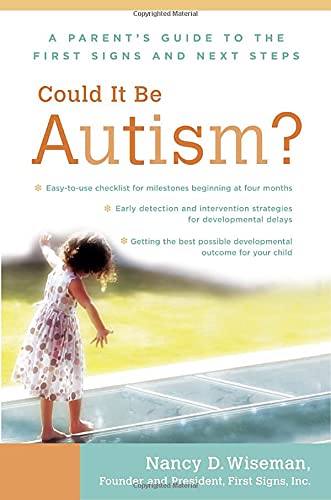
A practical handbook designed to assist parents in detecting the early signs of autism and other related disorders--including Asperger's Syndrome and Rett Syndrome--explains why early intervention can improve a child's chances for a successful life and provides vital information on screening tests, the diagnostic process, creating an effective treatment plan, and more. 40,000 first printing.
Die Inhaltsangabe kann sich auf eine andere Ausgabe dieses Titels beziehen.
Über die Autorin bzw. den Autor
Nancy Wiseman is the founder and president of First Signs, Inc., a national nonprofit organization dedicated to educating parents and pediatric professionals about the early warning signs of autism and other developmental disorders. First Signs provides professionals with tools and training and parents with education and support to help young children stay on a healthy developmental path. Nancy is the mother of Sarah, who was diagnosed with autism at the age of two. Today—at age nine—Sarah stands as a powerful and positive example of the impact that early identification and intensive intervention can have on young children with developmental delays and disorders. This little girl, once so profoundly delayed, has made remarkable progress, much like the organization she inspired seven years ago.
Auszug. © Genehmigter Nachdruck. Alle Rechte vorbehalten.
Chapter One
You Make a Difference
You are a parent, not a doctor or a scientist.
But, when it comes to your child, you are an expert. You know that little face and whether it lights up when you walk into a room. You know your baby's babbling, burbling voice and would be the first to notice if it suddenly fell silent. You know how your toddler behaves when he sees a new toy, meets a new child, goes to a birthday party, or visits a shopping mall. You know what makes her cry and what makes her laugh. And, while your pediatrician has seen hundreds of sore throats and infected ears, you've seen a few things too. You've seen children playing in parks and squabbling at family dinners. You've seen babies playing peek-a-boo and preschoolers playing house. And you wouldn't be a parent if you had not compared your child to those children--if you had not noticed how your child resembles them and differs from them.
Of course, not every difference is a disorder. Far from it. But if your instincts are telling you something is wrong--that something about your child is quite different from other children or that something essential about your child has changed or become increasingly troubling, your instincts are probably right.
You Know When Something Is Wrong
As part of my work with First Signs, I've spent a lot of time talking with doctors and researchers about the differences between young children with developmental delays and those without them. Time and time again they tell me about one crucial difference. Children with developmental delays have parents who are persistently worried about them. So, if you are worried about how your child is developing, how he or she is learning and behaving, you should take your worry seriously. It could be a warning sign.
Parents have been diagnosing their children from early on. They know it, they feel it. They say to me all the time, "I just know something's just not right . . . the way he does this or the way he does that . . ." And they're right, usually.
Anne Holmes, director of outreach services at Eden Family of Services, Princeton, N.J.
All parents worry about their children sometimes. All occasionally need some reassurance that the quirks they see are just that. One survey found that 70 percent of parents in pediatric waiting rooms had questions about their children's development or behavior. When something really is wrong, though, the worry does not go away. The child's differences don't go away, either. Usually they just become more apparent, more troubling.
Some parents whose children are eventually diagnosed with autism and or other developmental disorders realize that their children are different as babies. A few notice specific, clear-cut problems; many others have nagging, vague concerns that are harder to express.
From the day I brought him home from the hospital, I knew there was something going on. He couldn't feed, he couldn't suck a bottle. And, as a toddler, he couldn't give kisses. He would go to kiss me and would just bang his face into my mouth.
Kathy Bauer of Pennsylvania, mother of Andy, diagnosed with speech apraxia at age three
She was five or six months old when I first started feeling something wasn't right. But I couldn't put my finger on it. I felt like I was bonding to her, but she wasn't bonding to me.
Becky Wilson of Oregon, mother of Zoë, diagnosed at age four with developmental language disorder and "regulatory disorder with autistic behaviors"
Other parents see signs accumulate over time or appear suddenly, often between the first and second year of a child's life.
When Evan was fifteen months old I noticed he wasn't behaving like other children of his age. . . . He wasn't interacting with the world like other kids.
Susan Sutherland of Massachusetts, mother of Evan, diagnosed with PDD-NOS around age three
When doctors ask the right questions, worried parents almost always speak up. And, once their child is diagnosed with a problem, even those parents who do not express their worries at first usually say that they knew "something was wrong." Often they "just burst into tears" when their fears are confirmed, one researcher says. "They will say, 'I was worried about my child, but I thought I was just being an anxious parent.' "
Studies show that parents of all educational, cultural, and economic backgrounds are able to recognize developmental warning signs. Where do parents get this amazing power of prediction? From observing their child and the children around them.
Pediatricians see a child for about fifteen minutes during a "well" visit. Parents see their children every day, all day, in all sorts of settings. They also see other children, alone and in groups, in the grocery store, at church, even in the pediatric waiting room. They see siblings, cousins, playmates, and neighbors. Everywhere they go, they compare and notice how their child is like other children and how he or she is different.
I remember when my daughter was eighteen months old, you'd say, "Go close the door," and she'd go close the door. My son had no receptive language. If you said, "Go close the door," he'd just stand there.
Brenda Eaton of Pennsylvania, mother of Brendan, diagnosed with autism at age three
If you're around children all the time, you realize the way they can communicate without even saying a word. He didn't have that at a year or eighteen months.
Ellen Weitzen of New Jersey, mother of Chris, diagnosed with autism at age three
One clinical professor I know used to train young pediatricians to recognize developmental disorders. Sometimes she would send her trainees to day care centers and schools so that they could see what parents see all the time--children playing, talking, and learning together. She told me about one trainee who was not convinced that a five-year-old with a technically normal but lower than average IQ needed special help. The young doctor was sent to a day care center, where he observed typical four- and five-year-olds at play. That did the trick. He quickly saw that the child with the apparently okay test scores was lagging far behind in speech. The child was not okay at all.
Finding a Professional Partner
Still, you may believe that what you know about your child pales in comparison to what seasoned pediatricians, family physicians, and nurse practitioners know about the science of development. If you've taken your child to every routine checkup and gotten a clean bill of health, you may feel that's reassurance enough. Unfortunately, that's not the case. While most health professionals do a good job of assessing physical development and try to measure cognitive growth, far too few know how to assess social and emotional development or how to interpret the early behavioral signs of disorders like autism. Some well-meaning doctors ask about these topics, but use the wrong questions. Others rely on their own, too-brief observations. And, unfortunately, far too few children with developmental delays and disorders get the early, intensive help that could put them on a healthier path.
The good news is that you can do something about this. You already know a lot about your child. You are about to learn a lot more about how to assess your child's social and emotional development and how to get prompt help if it's needed. To take full advantage of the advice in this book, though, you also need at least one professional partner. For most parents, that partner will initially be a pediatrician or family physician.
Parents might know something is wrong, but we don't know what, and it's really up to the...
„Über diesen Titel“ kann sich auf eine andere Ausgabe dieses Titels beziehen.
Suchergebnisse für Could It Be Autism?: A Parent's Guide to the First...

Beispielbild für diese ISBN
Could It Be Autism?: A Parent's Guide to the First Signs and Next Steps
Anbieter: BooksRun, Philadelphia, PA, USA
Verkäuferbewertung 5 von 5 Sternen

Hardcover. Zustand: Very Good. 1. With dust jacket. It's a well-cared-for item that has seen limited use. The item may show minor signs of wear. All the text is legible, with all pages included. It may have slight markings and/or highlighting. Bestandsnummer des Verkäufers 0767919726-11-1-29
Gebraucht kaufen
EUR 4,76
Versand gratis
Versand innerhalb von USA
Versand innerhalb von USA
Anzahl: 1 verfügbar
Beispielbild für diese ISBN
Could It Be Autism?: A Parent's Guide to the First Signs and Next Steps
Anbieter: World of Books (was SecondSale), Montgomery, IL, USA
Verkäuferbewertung 5 von 5 Sternen
Hardback. Zustand: Good. Bestandsnummer des Verkäufers 00084412384
Gebraucht kaufen
EUR 4,77
Versand gratis
Versand innerhalb von USA
Versand innerhalb von USA
Anzahl: 3 verfügbar
Beispielbild für diese ISBN
Could It Be Autism? : A Parent's Guide to the First Signs and Next Steps
Verlag:
Potter/Ten Speed/Harmony/Rodale, 2006
ISBN 10: 0767919726
ISBN 13: 9780767919722
Gebraucht
Hardcover
Anbieter: Better World Books, Mishawaka, IN, USA
Verkäuferbewertung 5 von 5 Sternen
Zustand: Very Good. Former library copy. Pages intact with possible writing/highlighting. Binding strong with minor wear. Dust jackets/supplements may not be included. Includes library markings. Stock photo provided. Product includes identifying sticker. Better World Books: Buy Books. Do Good. Bestandsnummer des Verkäufers GRP102388618
Gebraucht kaufen
EUR 6,55
Versand gratis
Versand innerhalb von USA
Versand innerhalb von USA
Anzahl: 1 verfügbar
Beispielbild für diese ISBN
Could It Be Autism? : A Parent's Guide to the First Signs and Next Steps
Verlag:
Potter/Ten Speed/Harmony/Rodale, 2006
ISBN 10: 0767919726
ISBN 13: 9780767919722
Gebraucht
Hardcover
Anbieter: Better World Books, Mishawaka, IN, USA
Verkäuferbewertung 5 von 5 Sternen
Zustand: Good. Former library copy. Pages intact with minimal writing/highlighting. The binding may be loose and creased. Dust jackets/supplements are not included. Includes library markings. Stock photo provided. Product includes identifying sticker. Better World Books: Buy Books. Do Good. Bestandsnummer des Verkäufers 863802-6
Gebraucht kaufen
EUR 6,55
Versand gratis
Versand innerhalb von USA
Versand innerhalb von USA
Anzahl: 1 verfügbar
Beispielbild für diese ISBN
Could It Be Autism?: A Parent's Guide to the First Signs and Next Steps
Anbieter: World of Books Inc, Montgomery, IL, USA
Verkäuferbewertung 4 von 5 Sternen

Hardback. Zustand: Good. Bestandsnummer des Verkäufers CIN0767919726G
Gebraucht kaufen
EUR 6,60
Versand gratis
Versand innerhalb von USA
Versand innerhalb von USA
Anzahl: 3 verfügbar
Beispielbild für diese ISBN
Could It Be Autism?: A Parent's Guide to the First Signs and Next Steps
Anbieter: HPB-Diamond, Dallas, TX, USA
Verkäuferbewertung 5 von 5 Sternen
hardcover. Zustand: Very Good. Connecting readers with great books since 1972! Used books may not include companion materials, and may have some shelf wear or limited writing. We ship orders daily and Customer Service is our top priority! Bestandsnummer des Verkäufers S_471330063
Gebraucht kaufen
EUR 5,26
EUR 3,34 Versand
Versand innerhalb von USA
Versand innerhalb von USA
Anzahl: 1 verfügbar
Beispielbild für diese ISBN
Could It Be Autism?: A Parent's Guide to the First Signs and Next Steps
Anbieter: HPB Inc., Dallas, TX, USA
Verkäuferbewertung 5 von 5 Sternen
hardcover. Zustand: Very Good. Connecting readers with great books since 1972! Used books may not include companion materials, and may have some shelf wear or limited writing. We ship orders daily and Customer Service is our top priority! Bestandsnummer des Verkäufers S_487346001
Gebraucht kaufen
EUR 5,49
EUR 3,34 Versand
Versand innerhalb von USA
Versand innerhalb von USA
Anzahl: 1 verfügbar
Foto des Verkäufers
Could It Be Autism?: A Parent's Guide to the First Signs and Next Steps
Anbieter: Cycle Books LA, South el monte, CA, USA
Verkäuferbewertung 5 von 5 Sternen
Zustand: new. Bestandsnummer des Verkäufers AMTV.0767919726.N
Beispielbild für diese ISBN
Could It Be Autism?: A Parent's Guide to the First Signs and Next Steps
Anbieter: Russell Books, Victoria, BC, Kanada
Verkäuferbewertung 5 von 5 Sternen
hardcover. Zustand: Very Good. 1st Edition. Bestandsnummer des Verkäufers FORT584532
Gebraucht kaufen
EUR 9,16
EUR 17,79 Versand
Versand von Kanada nach USA
Versand von Kanada nach USA
Anzahl: 1 verfügbar
Beispielbild für diese ISBN
Could It Be Autism?: A Parent's Guide to the First Signs and Next Steps
Anbieter: BennettBooksLtd, Los Angeles, CA, USA
Verkäuferbewertung 5 von 5 Sternen
hardcover. Zustand: New. In shrink wrap. Looks like an interesting title! Bestandsnummer des Verkäufers Q-0767919726
Neu kaufen
EUR 69,38
EUR 6,19 Versand
Versand innerhalb von USA
Versand innerhalb von USA
Anzahl: 1 verfügbar