
Verwandte Artikel zu Descartes's Secret Notebook: A True Tale of Mathematics,...
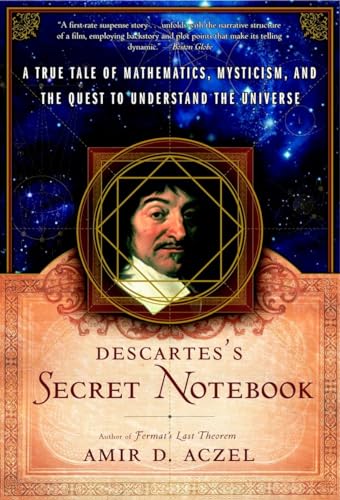
Descartes's Secret Notebook: A True Tale of Mathematics, Mysticism, and the Quest to Understand the Universe - Softcover
Inhaltsangabe
René Descartes (1596–1650) is one of the towering and central figures in Western philosophy and mathematics. His apothegm “Cogito, ergo sum” marked the birth of the mind-body problem, while his creation of so-called Cartesian coordinates have made our physical and intellectual conquest of physical space possible.
But Descartes had a mysterious and mystical side, as well. Almost certainly a member of the occult brotherhood of the Rosicrucians, he kept a secret notebook, now lost, most of which was written in code. After Descartes’s death, Gottfried Leibniz, inventor of calculus and one of the greatest mathematicians in history, moved to Paris in search of this notebook—and eventually found it in the possession of Claude Clerselier, a friend of Descartes. Leibniz called on Clerselier and was allowed to copy only a couple of pages—which, though written in code, he amazingly deciphered there on the spot. Leibniz’s hastily scribbled notes are all we have today of Descartes’s notebook, which has disappeared.
Why did Descartes keep a secret notebook, and what were its contents? The answers to these questions lead Amir Aczel and the reader on an exciting, swashbuckling journey, and offer a fascinating look at one of the great figures of Western culture.
Die Inhaltsangabe kann sich auf eine andere Ausgabe dieses Titels beziehen.
Über die Autorin bzw. den Autor
AMIR D. ACZEL is the author of many research articles on mathematics, two textbooks, and nine nonfiction books, including the international bestseller Fermat's Last Theorem, which was nominated for a Los Angeles Times Book Award. Aczel has appeared on over thirty television programs, including nationwide appearances on CNN, CNBC, and Nightline, and on over a hundred radio programs, including NPR's Weekend Edition and Morning Edition. Aczel is a Fellow of the John Simon Guggenheim Memorial Foundation.
Von der hinteren Coverseite
Rene Descartes (1596--1650) is one of the towering and central figures in Western philosophy and mathematics. His apothegm "Cogito, ergo sum" marked the birth of the mind-body problem, while his creation of so-called Cartesian coordinates has made our intellectual conquest of physical space possible.
But Descartes had a mysterious and mystical side, as well. Almost certainly a member of the occult brotherhood of the Rosicrucians, he kept a secret notebook, now lost, most of which was written in code. After Descartes's death, Gottfried Leibniz, inventor of calculus and one of the greatest mathematicians of all time, moved to Paris in search of this notebook-and eventually found it in the possession of Claude Clerselier, a friend of Descartes's. Liebniz called on Clerselier and was allowed to copy only a couple of pages-which, though written in code, he amazingly deciphered there on the spot. Liebniz's hastily scribbled notes are all we have today of Descartes's notebook.
Why did Descartes keep a secret notebook, and what were its contents? The answers to these questions will lead the reader on an exciting, swashbuckling journey, and offer a fascinating look at one of the great figures of Western culture.
Auszug. © Genehmigter Nachdruck. Alle Rechte vorbehalten.
Chapter 1
The Gardens of Touraine
JUST BEFORE RENE DESCARTES WAS born, on March 31, 1596, his mother, Jeanne Brochard, took an action that may well have altered the course of Western civilization. For like Julius Caesar crossing the Rubicon in 49 B.C., Jeanne Brochard crossed the Creuse River, which lay between her family home, in the region of Poitou, and the small town of La Haye, which lies in the region of Touraine, in western central France.
The Descartes family had originated in Poitou and had lived for many years in the town of Chatellerault, about twenty-five kilometers south of La Haye. Descartes' parents, Joachim Descartes and Jeanne Brochard, who were married on January 15, 1589, owned a stately mansion in the center of Chatellerault, at 126 rue Carrou-Bernard (today's rue Bourbon).
Joachim Descartes was the councillor of the Parliament of Brittany, and this important job kept him away in distant Rennes. Jeanne needed her mother's help in birthing the baby, and this is why she traveled north and across the river to Touraine to give birth to René Descartes in her mother's house in La Haye. Sometime later, once she had recovered, she returned to Chatellerault. Despite this accident of birth, throughout his life, Rene's friends would often call him Rene le Poitevin--Rene of Poitou.
The regions of Poitou and Touraine include pastoral farmlands that have been cultivated since antiquity. There are low hills, many of which are forested, and rich flatlands, irrigated by rivers that cut through this fertile land. Cows and sheep graze here, and many kinds of crops are grown. La Haye is a small town of stone houses with gray roofs. At the time of Descartes, the population of the town numbered about 750 people.
Chatellerault is a larger, more genteel town than La Haye, with wide avenues and an elegant city square, and it serves as the hub of rural life in the region. Because this part of France is so fertile and rich in water and agricultural resources, the people who live here are well off. North of La Haye one can still visit the beautiful chateaus of the Loire Valley, as well as forests and game reserves, which existed at the time of Descartes. The chateaus, many of them restored to their original state, with lavish fifteenth- and sixteenth-century furnishings and surrounded by sculpted gardens, give us a feel for the life of the rich at the time of Descartes.
While the regions of Poitou and Touraine are similar in their topography, scenery, and the way the towns and villages are laid out, there was one important difference between them. While Poitou was mainly Protestant, Touraine was mostly Catholic. We know that in the fifteen years from 1576 to 1591, there were only seventy-two Protestant baptisms in La Haye. This significant religious difference between the two regions would affect the life of René Descartes. For this accident of birth--being born, and later also raised, in a strongly Catholic region while his family hailed from a Protestant one--would exert a significant impact on René's personality, thus influencing his actions throughout his life and determining the course of development of his philosophical and scientific ideas and the way he divulged them to the world.
Descartes lived in a century that knew severe tensions, including wars, between Catholics and Protestants. The fact that he was born in a Catholic region and would be raised by a devout Catholic governess, while many of his family's friends and associates in Poitou were Protestants, contributed to Descartes' natural secretiveness. It also made him, as an adult, much more concerned about the Catholic Inquisition than perhaps he should have been, and not worried enough about the persecution he could face from Protestants. Consequently, Descartes would refrain from publishing elements of his science and philosophy for fear of the Inquisition, and yet would readily settle in Protestant countries, where academics and theologians would viciously attack his work in part because they knew he was a Catholic.
René Descartes was baptized a Catholic in Saint George's Chapel in La Haye, a twelfth-century Norman church, on April 3, 1596. His baptismal certificate reads:
This day was baptized René, son of the noble man Joachym Descartes, councillor of the King and his Parliament of Brittany, and of damsel Jeanne Brochard. His godparents, noble Michel Ferrand, councillor of the King, lieutenant general of Chatellerault, and noble René Brochard, councillor of the King, judge magistrate at Poitiers, and dame Jeanne Proust, wife of monsieur Sain, controller of weights and measures for the King at Chatellerault.
[signed]
Ferrand Jehanne Proust Rene Brochard
Michel Ferrand, René Descartes' godfather, was his great-uncle--Joachim Descartes' uncle on his mother's side. Rene Brochard was the baby's grandfather, Jeanne Brochard's father. Jeanne's mother, René Descartes' grandmother, was Jeanne Sain. Her brother's wife was Jeanne (Jehanne) Proust.
***
The name La Haye comes from the French word haie, meaning hedge. Originally the town was named Haia, and in the eleventh century, as the language evolved, the spelling was changed to Haya. In Descartes' time it was called La Haye-en-Touraine. In 1802, the town's name was changed to La Haye-Descartes, in honor of the philosopher, and in 1967, "La Haye" was altogether dropped and the town is now known as Descartes.
There was once a castle in the area, and the wealthiest and most powerful citizens of La Haye lived in it. As the feudal system disintegrated, the castle was abandoned and the people moved down to the town, where they could live more comfortably. But life in this area remained difficult. People suffered both from wars and from disease. The plague ravaged La Haye and its surroundings several times in the late sixteenth and early seventeenth centuries. In 1607, the town was placed under quarantine after a recurrence of the plague killed many people in the area.
In early times, the hedges denoted by the French name Haia (or Haya or Haie) stood for thorny hedges that were planted by the townspeople in an effort to defend themselves and their property from marauding bands of brigands and highwaymen that pillaged and looted the countryside. But as times improved after the duke of Anjou took control of the area in September 1596--six months after the birth of Rene Descartes--the hedges implied by the name of the town came to mean hedges of beautiful gardens. To this day, this part of France is known for its exquisite gardens and areas of great natural beauty.
Late in life, just before he left on his final journey to Stockholm, Descartes wrote to his dearest friend, Princess Elizabeth: "A man who was born in the gardens of Touraine, shouldn't he avoid going to live in the land of the bears, between rocks and ice?" Descartes may well have been thinking of the garden of his own childhood home, his grandmother's house in La Haye, when he wrote these words to Elizabeth. Descartes' childhood home is an attractive two-story country house with four large rooms, although it is not nearly as impressive as the family mansion in Chatellerault. But it is surrounded by an exuberant garden, now restored to its original state, with flowers under the generous canopy of graceful trees. One can imagine the young boy enjoying many hours of undisturbed thinking and playing in this tranquil garden.
***
A year after René was born, shortly after giving birth to her fourth child, Jeanne Brochard died. The newborn survived for three more days, and then died too. Some of Descartes' biographers have written that Rene's personality was deeply affected by the loss of his mother, and have even...
„Über diesen Titel“ kann sich auf eine andere Ausgabe dieses Titels beziehen.
Suchergebnisse für Descartes's Secret Notebook: A True Tale of Mathematics,...

Beispielbild für diese ISBN
Descartes's Secret Notebook: A True Tale of Mathematics, Mysticism, and the Quest to Understand the Universe
Anbieter: World of Books (was SecondSale), Montgomery, IL, USA
Verkäuferbewertung 5 von 5 Sternen

Zustand: Very Good. Item in very good condition! Textbooks may not include supplemental items i.e. CDs, access codes etc. Bestandsnummer des Verkäufers 00085287300
Gebraucht kaufen
EUR 3,99
Versand gratis
Versand innerhalb von USA
Versand innerhalb von USA
Anzahl: 1 verfügbar
Beispielbild für diese ISBN
Descartes's Secret Notebook: A True Tale of Mathematics, Mysticism, and the Quest to Understand the Universe
Anbieter: World of Books (was SecondSale), Montgomery, IL, USA
Verkäuferbewertung 5 von 5 Sternen
Zustand: Good. Item in good condition. Textbooks may not include supplemental items i.e. CDs, access codes etc. Bestandsnummer des Verkäufers 00088398657
Gebraucht kaufen
EUR 3,99
Versand gratis
Versand innerhalb von USA
Versand innerhalb von USA
Anzahl: 4 verfügbar
Foto des Verkäufers
Descartes's Secret Notebook: A True Tale of Mathematics, Mysticism, and the Quest to Understand the Universe
Anbieter: Zoom Books Company, Lynden, WA, USA
Verkäuferbewertung 5 von 5 Sternen
Zustand: very_good. Book is in very good condition and may include minimal underlining highlighting. The book can also include "From the library of" labels. May not contain miscellaneous items toys, dvds, etc. . We offer 100% money back guarantee and 24 7 customer service. Bestandsnummer des Verkäufers ZBV.0767920341.VG
Gebraucht kaufen
EUR 4,00
Versand gratis
Versand innerhalb von USA
Versand innerhalb von USA
Anzahl: 1 verfügbar
Beispielbild für diese ISBN
Descartes's Secret Notebook: A True Tale of Mathematics, Mysticism, and the Quest to Understand the Universe
Anbieter: More Than Words, Waltham, MA, USA
Verkäuferbewertung 5 von 5 Sternen
Zustand: Good. A sound copy with only light wear. Overall a solid copy at a great price! Bestandsnummer des Verkäufers BOS-U-12b-01394
Gebraucht kaufen
EUR 1,50
EUR 3,51 Versand
Versand innerhalb von USA
Versand innerhalb von USA
Anzahl: 1 verfügbar
Beispielbild für diese ISBN
Descartes's Secret Notebook: A True Tale of Mathematics, Mysticism, and the Quest to Understand the Universe
Anbieter: The Maryland Book Bank, Baltimore, MD, USA
Verkäuferbewertung 5 von 5 Sternen
paperback. Zustand: Very Good. First Edition. Used - Very Good. Bestandsnummer des Verkäufers 4-CCC-3-0172
Gebraucht kaufen
EUR 1,68
EUR 4,12 Versand
Versand innerhalb von USA
Versand innerhalb von USA
Anzahl: 1 verfügbar
Beispielbild für diese ISBN
Descartes's Secret Notebook: A True Tale of Mathematics, Mysticism, and the Quest to Understand the Universe
ISBN 10: 0767920341
ISBN 13: 9780767920346
Gebraucht
Paperback
Anbieter: World of Books Inc, Montgomery, IL, USA
Verkäuferbewertung 4 von 5 Sternen

Paperback. Zustand: Good. Rene Descartes (1596-1650) is one of the towering and central figures in Western philosophy and mathematics. His apothegm "Cogito, ergo sum" marked the birth of the mind-body problem, while his creation of so-called Cartesian coordinates have made our physical and intellectual conquest of physical space possible. But Descartes had a mysterious and mystical side, as well. Almost certainly a member of the occult brotherhood of the Rosicrucians, he kept a secret notebook, now lost, most of which was written in code. After Descartes's death, Gottfried Leibniz, inventor of calculus and one of the greatest mathematicians in history, moved to Paris in search of this notebook-and eventually found it in the possession of Claude Clerselier, a friend of Descartes. Leibniz called on Clerselier and was allowed to copy only a couple of pages-which, though written in code, he amazingly deciphered there on the spot. Leibniz's hastily scribbled notes are all we have today of Descartes's notebook, which has disappeared. Why did Descartes keep a secret notebook, and what were its contents? The answers to these questions lead Amir Aczel and the reader on an exciting, swashbuckling journey, and offer a fascinating look at one of the great figures of Western culture. Bestandsnummer des Verkäufers CIN0767920341G
Gebraucht kaufen
EUR 5,80
Versand gratis
Versand innerhalb von USA
Versand innerhalb von USA
Anzahl: 4 verfügbar
Beispielbild für diese ISBN
Descartes's Secret Notebook: A True Tale of Mathematics, Mysticism, and the Quest to Understand the Universe
ISBN 10: 0767920341
ISBN 13: 9780767920346
Gebraucht
Paperback
Anbieter: World of Books Inc, Montgomery, IL, USA
Verkäuferbewertung 4 von 5 Sternen
Paperback. Zustand: Very Good. Rene Descartes (1596-1650) is one of the towering and central figures in Western philosophy and mathematics. His apothegm "Cogito, ergo sum" marked the birth of the mind-body problem, while his creation of so-called Cartesian coordinates have made our physical and intellectual conquest of physical space possible. But Descartes had a mysterious and mystical side, as well. Almost certainly a member of the occult brotherhood of the Rosicrucians, he kept a secret notebook, now lost, most of which was written in code. After Descartes's death, Gottfried Leibniz, inventor of calculus and one of the greatest mathematicians in history, moved to Paris in search of this notebook-and eventually found it in the possession of Claude Clerselier, a friend of Descartes. Leibniz called on Clerselier and was allowed to copy only a couple of pages-which, though written in code, he amazingly deciphered there on the spot. Leibniz's hastily scribbled notes are all we have today of Descartes's notebook, which has disappeared. Why did Descartes keep a secret notebook, and what were its contents? The answers to these questions lead Amir Aczel and the reader on an exciting, swashbuckling journey, and offer a fascinating look at one of the great figures of Western culture. Bestandsnummer des Verkäufers CIN0767920341VG
Gebraucht kaufen
EUR 5,80
Versand gratis
Versand innerhalb von USA
Versand innerhalb von USA
Anzahl: 1 verfügbar
Beispielbild für diese ISBN
Descartes's Secret Notebook: A True Tale of Mathematics, Mysticism, and the Quest to Understand the Universe
Anbieter: Half Price Books Inc., Dallas, TX, USA
Verkäuferbewertung 5 von 5 Sternen
paperback. Zustand: Very Good. Connecting readers with great books since 1972! Used books may not include companion materials, and may have some shelf wear or limited writing. We ship orders daily and Customer Service is our top priority! Bestandsnummer des Verkäufers S_461041702
Gebraucht kaufen
EUR 2,72
EUR 3,30 Versand
Versand innerhalb von USA
Versand innerhalb von USA
Anzahl: 1 verfügbar
Beispielbild für diese ISBN
Descartes's Secret Notebook: A True Tale of Mathematics, Mysticism, and the Quest to Understand the Universe
Anbieter: Wonder Book, Frederick, MD, USA
Verkäuferbewertung 5 von 5 Sternen
Zustand: Very Good. Very Good condition. With remainder mark. A copy that may have a few cosmetic defects. May also contain light spine creasing or a few markings such as an owner's name, short gifter's inscription or light stamp. Bestandsnummer des Verkäufers H07A-01887
Gebraucht kaufen
EUR 6,33
Versand gratis
Versand innerhalb von USA
Versand innerhalb von USA
Anzahl: 1 verfügbar
Beispielbild für diese ISBN
Descartes's Secret Notebook : A True Tale of Mathematics, Mysticism, and the Quest to Understand the Universe
Verlag:
Crown Publishing Group, The, 2006
ISBN 10: 0767920341
ISBN 13: 9780767920346
Gebraucht
Softcover
Anbieter: Better World Books, Mishawaka, IN, USA
Verkäuferbewertung 5 von 5 Sternen
Zustand: Good. Pages intact with minimal writing/highlighting. The binding may be loose and creased. Dust jackets/supplements are not included. Stock photo provided. Product includes identifying sticker. Better World Books: Buy Books. Do Good. Bestandsnummer des Verkäufers 4240946-6
Gebraucht kaufen
EUR 6,47
Versand gratis
Versand innerhalb von USA
Versand innerhalb von USA
Anzahl: 1 verfügbar