
Verwandte Artikel zu Apocalypse 2012: A Scientific Investigation into Civilizatio...
Inhaltsangabe
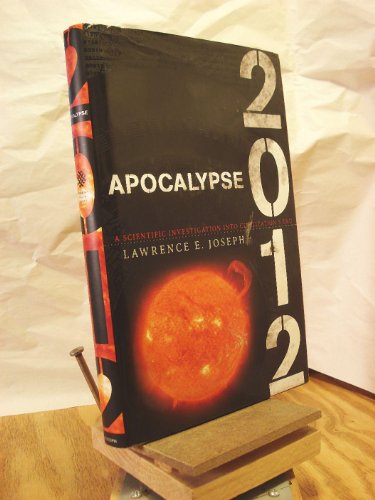
Draws on the latest scientific research and theories, as well as writings of a variety of ancient civilizations, to explore the belief that the year 2012 has been pinpointed as a cataclysmic year in human history, offering an authoritative study that assesses how close the planet and humankind are to extinction. 50,000 first printing.
Die Inhaltsangabe kann sich auf eine andere Ausgabe dieses Titels beziehen.
Über die Autorin bzw. den Autor
LAWRENCE E. JOSEPH, a journalist and science consultant, has written extensively on the environment, politics, and the business world for publications including Salon.com, The New York Times, and Audubon. He is currently chairman of the board of the Aerospace Consulting Corporation in Albuquerque, New Mexico.
Auszug. © Genehmigter Nachdruck. Alle Rechte vorbehalten.
1
WHY 2012, EXACTLY?
Two hours’ tromp through the tarantula/crocodile jungle where a recent Survivor series was set, past an ancient Mayan ball court where both losers and winners were sacrificed (that certainly would have boosted Survivor’s ratings) and then a steamy clamber up the hundred steep and crumbling steps of the 1,800–year–old ruin known as the Great Pyramid, the centerpiece of Mundo Perdido (Lost World), the oldest section of the Tikal ruins, was rewarded with the following: “The problem has got to be with your server. Call tech support and tell them to reconfigure… ,” explained one twenty–something to the other.
Rip out their beating hearts, toss their lifeless carcasses down the stone steps, and chalk it all up as a human sacrifice to Bill Gates. Deep in the Guatemalan jungle, atop an ancient sacred temple, and these geeks still couldn’t get their minds out of their computers.
I had gone to Tikal, where some of the most ancient Mayan prophecies originated, to get a feel for what, up until then, was just a mass of factoids—for example, that in the Mayan calendar the current age, known as the Fourth Age, began on August 13, 3114 BCE, which in the Mayan calendar is represented as 0.0.0.0.1 (Day One) and will end on December 21, 2012 ce, or 13.0.0.0.0 (Day Last). I could repeat that fact and many others accurately enough but, like twelfth–grade calculus (the derivative of n cubed is 3n squared, but what is a derivative, exactly?), I didn’t really understand what I was saying.
The problem was calendars, to me a blah staple of contemporary existence. Navigating life without them would of course be unthinkable, but that’s not going to happen, so why think about it? Apparently there once was a dispute between popes about how many days February and August should have, but that’s all been settled for half a millennium. And at the stroke of midnight beginning 2006, the official atomic clock–keeper somewhere added a second for the first time since 1999 because the Earth’s rotation is being slowed by the moon’s increasing gravitational pull, which might be an interesting development if we had enough time in our busy lives to figure out why.
Fundamentalists insist that it’s all in whatever their holy book might happen to be, but my visit to Mayan Guatemala was the first time I’ve ever been told that it's all not in their book but in their calendar, which is all I would ever need. The Maya love their calendars, see them as visual depictions of the passage of time, which is how life unfolds. They charted this unfolding with not one but twenty calendars, only fifteen of which have been released to the modern world; the remaining five are still kept secret by Mayan elders. Mayan calendars are pegged to the movements of the Sun, the Moon, and the visible planets, to harvest and insect cycles, and range in length from 260 days to 5,200 years and beyond.
In the Cholqij, the 260–day calendar that represents a woman’s pregnancy cycle, and also the number of days that the planet Venus rises in the morning each year, each day is represented by one of 20 symbols representing spiritual guides or deities, called Ajau. The number 20 is sacred to the Mayans because a person has 20 digits—10 fingers to reach to the sky and 10 toes to grasp the ground. They regard the number 10, so significant to our mathematics, as half a loaf at best.
According to Gerardo Kanek Barrios and Mercedes Barrios Longfellow in The Maya Cholqij: Gateway to Aligning with the Energies of the Earth, 2005, thirteen forces influence the 20 Ajau deities. The number 13 is derived from the fact that there are 13 major joints (1 neck, 2 shoulders, 2 elbows, 2 wrists, 2 hips, 2 knees and 2 ankles), which serve as nodal points of bodily and cosmic energy. Thirteen forces times 20 deities equals 260 uniquely specified days.
The Mayan prophecies for 2012 are the province of the Long Count calendar, also known as Winaq May Kin, which covers approximately 5,200 solar years, a period the Maya call a Sun. In the curious Mayan reckoning, a year has 360 days; the remaining 5.25 days (4 x .25 accounting for the leap day) are considered “out of time” and are traditionally devoted to thanksgiving for the previous year and celebration of the year to come. Thus 5,200 of these Mayan years translate to approximately 5,125 of our Gregorian years. Since human civilization arose, we have passed fully through three Suns, and now are completing the fourth Sun, which will end on 12/21/12.
The Mayan counting system is primarily vigesimal, meaning that it relies on powers of 20, rather than 10. In this system the first placeholder (the one farthest to the right) is reserved for units of one day; the second for units of 20 days; the third for units of 360 days, or one Mayan solar year; the fourth for units of 7,200 days, or twenty Mayan solar years; and the fifth for units of 144,000 days, or 400 Mayan solar years. Interestingly, the number 144,000 figures prominently in Revelation, though it refers to the number of people who will be saved and serve the Lord during the Tribulation, the period of tumult that precedes the Second Coming of Christ.
In 13.0.0.0.0, the Mayan way of expressing the 12/21/12 date, the number 13 refers to the number of baktuns, periods of 400 Mayan solar years/144,000-day periods. The number 13, as noted, is sacred in their cosmology. One Sun works out to be 13 times 144,000 days, or 1,872,000 days long, 5,200 of the 360–day Mayan solar years. On the day after a Sun is completed, the Long Count calendar starts all over. Thus, December 22, 2012, the day after apocalypse, if such a day does come, will once again be the Mayan date, 0.0.0.0.1.
TIME’S ARROWS AND CYCLES
How did these people become so time–obsessed, out in the jungles and the highlands? It’s not like the ancient Maya were catching planes or texting messages or even traveling anywhere.
“At first glance it might seem an exaggeration to attach so much importance to the sacred [Mayan] calendar. Yet anyone familiar with its role in the life of pre–Columbian Mesoamerica realizes that bound up with the calendar are many if not all of the more sophisticated aspects of the region’s early intellectual life: the awareness of a cyclicity in the movement of celestial bodies, the evolution of mathematical skills by which they could manipulate the numbers derived from those cycles, and the development of a system of hieroglyphics for recording the results…with it must have come most of the trappings of civilization—astronomy, mathematics, writing, urban planning,” writes Vincent H. Malmstrom of Dartmouth College.
We all know intuitively that time occurs in both lines, as though arrows were being shot, and cycles. Time’s arrow refers to the simple fact that each minute follows the next in a straight line to infinity, or until Time ends altogether. Time’s cycle refers to eternal continuums, such as day and night, winter, spring, summer, and fall, the waxing and waning of the Moon. Time’s cycles and arrows can also be seen as reflecting different attitudes toward history: “those who ignore it are doomed to repeat it” (cycle) versus “yesterday's news” (arrow). I’d always tended toward the latter camp, that history, though it made for good stories, was past. But after separating from my wife at roughly the same age, and with more or less the same height, weight, and features as my father did when he was separated from my mother, the “doomed to repeat it” scenario did ring a bell.
Cultures tend to have predilections for...
„Über diesen Titel“ kann sich auf eine andere Ausgabe dieses Titels beziehen.
Suchergebnisse für Apocalypse 2012: A Scientific Investigation into Civilizatio...

Beispielbild für diese ISBN
Apocalypse 2012: A Scientific Investigation into Civilization's End
Anbieter: World of Books (was SecondSale), Montgomery, IL, USA
Verkäuferbewertung 5 von 5 Sternen

Zustand: Very Good. Item in very good condition! Textbooks may not include supplemental items i.e. CDs, access codes etc. Bestandsnummer des Verkäufers 00078411479
Gebraucht kaufen
EUR 4,96
Versand gratis
Versand innerhalb von USA
Versand innerhalb von USA
Anzahl: 3 verfügbar
Beispielbild für diese ISBN
Apocalypse 2012: A Scientific Investigation into Civilization's End
Verlag:
Morgan Road Books (edition First Edition), 2007
ISBN 10: 0767924479
ISBN 13: 9780767924474
Gebraucht
Hardcover
Erstausgabe
Anbieter: BooksRun, Philadelphia, PA, USA
Verkäuferbewertung 5 von 5 Sternen
Hardcover. Zustand: Fair. First Edition. With dust jacket. The item might be beaten up but readable. May contain markings or highlighting, as well as stains, bent corners, or any other major defect, but the text is not obscured in any way. Bestandsnummer des Verkäufers 0767924479-7-1-29
Gebraucht kaufen
EUR 4,97
Versand gratis
Versand innerhalb von USA
Versand innerhalb von USA
Anzahl: 2 verfügbar
Beispielbild für diese ISBN
Apocalypse 2012: A Scientific Investigation into Civilization's End
Anbieter: ThriftBooks-Atlanta, AUSTELL, GA, USA
Verkäuferbewertung 5 von 5 Sternen
Hardcover. Zustand: Fair. No Jacket. Missing dust jacket; Readable copy. Pages may have considerable notes/highlighting. ~ ThriftBooks: Read More, Spend Less. Bestandsnummer des Verkäufers G0767924479I5N01
Gebraucht kaufen
EUR 5,82
Versand gratis
Versand innerhalb von USA
Versand innerhalb von USA
Anzahl: 1 verfügbar
Beispielbild für diese ISBN
Apocalypse 2012: A Scientific Investigation into Civilization's End
Anbieter: HPB-Red, Dallas, TX, USA
Verkäuferbewertung 5 von 5 Sternen
hardcover. Zustand: Very Good. Connecting readers with great books since 1972! Used textbooks may not include companion materials such as access codes, etc. May have some wear or limited writing/highlighting. We ship orders daily and Customer Service is our top priority! Bestandsnummer des Verkäufers S_462876370
Gebraucht kaufen
EUR 2,64
EUR 3,21 Versand
Versand innerhalb von USA
Versand innerhalb von USA
Anzahl: 1 verfügbar
Beispielbild für diese ISBN
Apocalypse 2012: A Scientific Investigation into Civilization's End
Anbieter: Once Upon A Time Books, Siloam Springs, AR, USA
Verkäuferbewertung 4 von 5 Sternen

Hardcover. Zustand: Good. This is a used book in good condition and may show some signs of use or wear . This is a used book in good condition and may show some signs of use or wear . Bestandsnummer des Verkäufers mon0003366751
Gebraucht kaufen
EUR 2,70
EUR 3,38 Versand
Versand innerhalb von USA
Versand innerhalb von USA
Anzahl: 1 verfügbar
Beispielbild für diese ISBN
Apocalypse 2012 : A Scientific Investigation into Civilization's End
Anbieter: Better World Books, Mishawaka, IN, USA
Verkäuferbewertung 5 von 5 Sternen
Zustand: Good. Pages intact with minimal writing/highlighting. The binding may be loose and creased. Dust jackets/supplements are not included. Stock photo provided. Product includes identifying sticker. Better World Books: Buy Books. Do Good. Bestandsnummer des Verkäufers 2471277-75
Gebraucht kaufen
EUR 6,09
Versand gratis
Versand innerhalb von USA
Versand innerhalb von USA
Anzahl: 1 verfügbar
Beispielbild für diese ISBN
Apocalypse 2012 : A Scientific Investigation into Civilization's End
Anbieter: Better World Books, Mishawaka, IN, USA
Verkäuferbewertung 5 von 5 Sternen
Zustand: Good. Former library copy. Pages intact with minimal writing/highlighting. The binding may be loose and creased. Dust jackets/supplements are not included. Includes library markings. Stock photo provided. Product includes identifying sticker. Better World Books: Buy Books. Do Good. Bestandsnummer des Verkäufers 2471278-75
Gebraucht kaufen
EUR 6,09
Versand gratis
Versand innerhalb von USA
Versand innerhalb von USA
Anzahl: 1 verfügbar
Beispielbild für diese ISBN
Apocalypse 2012: A Scientific Investigation into Civilization's End
Anbieter: Wonder Book, Frederick, MD, USA
Verkäuferbewertung 5 von 5 Sternen
Zustand: Very Good. Very Good condition. Very Good dust jacket. A copy that may have a few cosmetic defects. May also contain light spine creasing or a few markings such as an owner's name, short gifter's inscription or light stamp. Bestandsnummer des Verkäufers P07Q-01303
Gebraucht kaufen
EUR 6,16
Versand gratis
Versand innerhalb von USA
Versand innerhalb von USA
Anzahl: 1 verfügbar
Beispielbild für diese ISBN
Apocalypse 2012: A Scientific Investigation into Civilization's End
Anbieter: Wonder Book, Frederick, MD, USA
Verkäuferbewertung 5 von 5 Sternen
Zustand: As New. Like New condition. Like New dust jacket. A near perfect copy that may have very minor cosmetic defects. Bestandsnummer des Verkäufers X07D-01303
Gebraucht kaufen
EUR 6,16
Versand gratis
Versand innerhalb von USA
Versand innerhalb von USA
Anzahl: 1 verfügbar
Beispielbild für diese ISBN
Apocalypse 2012: A Scientific Investigation into Civilization's End
Verlag:
Morgan Road Books, 2007
ISBN 10: 0767924479
ISBN 13: 9780767924474
Gebraucht
Hardcover
Erstausgabe
Anbieter: The Maryland Book Bank, Baltimore, MD, USA
Verkäuferbewertung 5 von 5 Sternen
hardcover. Zustand: Very Good. First Edition. Used - Very Good. Bestandsnummer des Verkäufers 11-L-4-0157
Gebraucht kaufen
EUR 2,33
EUR 4,01 Versand
Versand innerhalb von USA
Versand innerhalb von USA
Anzahl: 1 verfügbar