
Verwandte Artikel zu Run Faster from the 5K to the Marathon: How to Be Your...
Inhaltsangabe
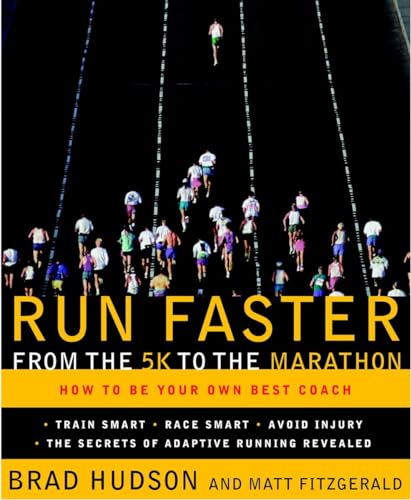
Learn how to run faster, unlock your potential, and reach peak performance with training advice from a former Olympic trials marathoner and coach to Olympians like Dathan Ritzenhein.
Hudson is the most innovative running coach to come along in a generation. Until now, only a handful of elite athletes have been able to benefit from his methods. Now Run Faster from the 5K to the Marathon shows all runners how to coach themselves as confidently and effectively as Brad coaches his world-class athletes. Becoming your own best coach is the ticket to running faster at any distance.
First you will learn to assess your abilities. Then you’ll learn how to devise a training program specifically geared to you. Filled with easy-to-follow sample training programs for distances ranging from the 5K to the marathon and abilities ranging from novice to advanced, Run Faster is the cutting-edge guide for optimal performance.
With Hudson’s guidance, you can train smarter and more effectively—and avoid injury. And you’ll soon be running faster than you ever thought possible!
Die Inhaltsangabe kann sich auf eine andere Ausgabe dieses Titels beziehen.
Über die Autorin bzw. den Autor
Brad Hudson is the founder and coach of the Performance Training Group, a team of elite runners. He lives in Eugene, Oregon.
Matt Fitzgerald has written many training guides for triathletes. He is a senior editor for Triathlete magazine and lives in San Diego, California.
Auszug. © Genehmigter Nachdruck. Alle Rechte vorbehalten.
Chapter 1
Adaptive Running
Every elite running coach has a training philosophy. Mine is called adaptive running. It is based on my belief that a responsive, evolving, creative approach to training is better than an approach that is too structured and formulaic. Simply put, there is no single training formula that works perfectly for every runner. Nor is it possible to predict exactly how a runner will respond to any particular training formula. What’s more, even when a certain formula works well for a runner, he or she changes as a result of using it, so the formula must also change to produce further improvement. For these reasons, a rigid, one-size-fits-all training program will never allow you to realize your full potential as a runner. It may get you started, but it will only take you so far. Adaptive running becomes the natural way to train when you recognize that training must be customized to you individually and adapted every day based on your response to recent training.
My experience in coaching and advising a pair of elite runners—who also happen to be a married couple—provides a good illustration of why an adaptive approach to running is necessary. A few years ago, Shayne Culpepper, a 5,000-meter specialist, asked me to help her qualify for the 2004 Olympics. Shayne fared so well off the program I created for her (which you can read about in chapter 4) that her husband, Alan Culpepper, also an elite runner, decided to copy parts of it. The problem was that Alan was a completely different type of runner from Shayne. Alan has muscles that contain a lot of slow-twitch fibers; he’s designed for endurance more than speed. Shayne, on the other hand, has a lot more fast-twitch fibers. Speed comes naturally to her. The training program I gave Shayne was specifically designed for a 5,000-meter runner with a lot of speed. It was not designed for a marathoner who’s all slow--twitch, like Alan. Consequently, when he borrowed some of Shayne’s training, Alan did not get the dramatic fitness and performance boost Shayne had gotten. Instead, he quickly became fatigued and his fitness stagnated. He tried to ignore these warning signs and push through, but the situation only worsened. Eventually, he went back to his old system, having set back his seasonal development by many weeks.
The moral of this story is twofold. First, it points to the fact that no two runners are the same. If you give two runners the same training program, they will get very different results, even if they are runners of similar ability. Alan’s initial mistake was to assume that what worked for Shayne would work for him. Second, my experience with Shayne and Alan Culpepper demonstrates that runners must train responsively, modifying their training based on how recent training has affected their bodies. Alan’s biggest mistake was to persist in training Shayne’s way even though it clearly wasn’t working for him. Alan is actually one of the smartest self-coached runners I know, so you can be sure that if he’s making these kinds of mistakes, most competitive runners are.
There are plenty of coaches and runners who understand that no two runners are the same, and that runners must adjust their training based on how they are currently feeling and performing. Yet very few coaches and runners view these realities as major considerations in the planning and execution of a training program. The typical running coach customizes the training plans he prescribes in terms of volume (miles per week), but that’s about the extent of it. The rest is formulaic. Likewise, the typical competitive runner modifies her training when an injury occurs or in cases of significant fatigue, but fails to modify her training in response to subtler “surprises” (e.g., feeling unexpectedly flat on the day of a planned key workout) in the way her body responds to planned training.
The difference between my training philosophy—adaptive running—and the more typical approach to training is that I view these two lessons (first, that no two runners are the same, and second, that every runner must train responsively) of Alan Culpepper’s experience as central to the planning and execution of training. I believe that there are many more factors besides the amount of running mileage a particular runner can handle that must be taken into account when creating an individually customized training plan. I also believe that planned training should be adjusted not only when major setbacks occur, but almost daily, based on a complete assessment of the runner’s immediate training needs. In other words, I believe that every workout should be planned in pencil, not ink.
Imagine a spectrum that ranges from one-size-fits-all training plans at one end and made-from-scratch plans for each runner at the other end. The typical approach to training is closer to the one-size-fits-all end of the spectrum. Adaptive running is closer to the made-from-scratch end of the spectrum. Of course, there isn’t a coach or runner in his right mind who believes that there is truly a single training plan that can work for every runner. Nor do I believe it makes any sense to reinvent the wheel of training for each runner. But there is a big difference between the amount of customization that the typical coach does in planning a runner’s training and the amount of customization I do for my runners and recommend for self-coached runners like you.
Now imagine another spectrum that ranges from strict adherence to planned training at one end to total spontaneity at the other end. The typical competitive runner trains in fairly strict adherence to the plan, and with fairly little spontaneity. If the training plan calls for 12 quarter-mile repeats in 80 seconds apiece on Thursday, then by God, he’s going to run 12 quarter-mile repeats in 80 seconds apiece on Thursday, even if he feels awful from the very first step of the workout. My approach to training encourages far more spontaneity—not arbitrary changes to the plan, but informed changes based on how the runner has responded to recent training. Naturally, there isn’t a runner on earth who is completely unwilling to deviate from planned workouts. I don’t advocate a make-it-up-as-you-go approach, but I do put far more emphasis on reaction and less emphasis on planning than the typical competitive runner does.
Every competitive runner trains with the objective of achieving peak-race goals. Conventional training and adaptive running are both oriented toward this objective. The difference, in my view, is that adaptive running is a more reliable way to get from point A to point B, because it entails planning the route that’s best for each individual’s starting place and is open to taking all kinds of helpful “detours” around unexpected obstacles along the way. In the following pages, I will give you a general overview of my adaptive running system. Subsequent chapters will provide detailed information on how to practice adaptive running in the way that works best for you.
Adaptive running is based on two rules and four principles. The purpose of the “Two Rules of Running” explained in the next section is to simplify the conceptual side of training as much as possible. These two rules are not specific to adaptive running but are truly universal: Every training system must adhere to them to be effective. In my experience, most runners fail to practice both rules as well as they should. I certainly broke them many times in my competitive days. The four principles of adaptive running discussed in the final section of this chapter represent my understanding of the best way to practice the...
„Über diesen Titel“ kann sich auf eine andere Ausgabe dieses Titels beziehen.
Suchergebnisse für Run Faster from the 5K to the Marathon: How to Be Your...

Beispielbild für diese ISBN
Run Faster from the 5K to the Marathon: How to Be Your Own Best Coach
Anbieter: New Legacy Books, Annandale, NJ, USA
Verkäuferbewertung 5 von 5 Sternen

Paperback. Zustand: Good. 1. Bestandsnummer des Verkäufers 5FSZKH001ABD
Gebraucht kaufen
EUR 1,10
EUR 2,22 Versand
Versand innerhalb von USA
Versand innerhalb von USA
Anzahl: 1 verfügbar
Foto des Verkäufers
Run Faster from the 5K to the Marathon: How to Be Your Own Best Coach
Anbieter: Dream Books Co., Denver, CO, USA
Verkäuferbewertung 5 von 5 Sternen
Zustand: acceptable. This copy has clearly been enjoyedâ"expect noticeable shelf wear and some minor creases to the cover. Binding is strong, and all pages are legible. May contain previous library markings or stamps. Bestandsnummer des Verkäufers 4EKGU900BKXI_ns
Gebraucht kaufen
EUR 3,90
Versand gratis
Versand innerhalb von USA
Versand innerhalb von USA
Anzahl: 1 verfügbar
Beispielbild für diese ISBN
Run Faster from the 5K to the Marathon: How to Be Your Own Best Coach
Anbieter: World of Books (was SecondSale), Montgomery, IL, USA
Verkäuferbewertung 5 von 5 Sternen
Paperback. Zustand: Good. Learn how to run faster, unlock your potential, and reach peak performance with this practical guide featuring training advice from a former Olympic trials marathoner and coach to Olympians. "Reading this book can help take you to the next level and keep pushing you up as far and fast as you want to go."--Sarah Toland, former NCAA All-American, USA National Cross-Country Team member, and Olympic Trials qualifier for the 5,000 and 10,000 Brad Hudson is the most innovative running coach to come along in a generation. Until now, only a handful of elite athletes have been able to benefit from his methods. With Run Faster from the 5K to the Marathon, Hudson shows all runners how to coach themselves as confidently and effectively as he coaches his world-class athletes. Becoming your own best coach is the ticket to running faster at any distance. First, you will learn to assess your abilities. Then you'll learn how to devise a training program specifically geared to you. Filled with easy-to-follow sample training programs for distances ranging from the 5K to the marathon and abilities ranging from novice to advanced, this is the cutting-edge guide for optimal performance. With Hudson's guidance, you can train smarter and more effectively--and avoid injury. And you'll soon be running faster than you ever thought possible! Bestandsnummer des Verkäufers 00102152591
Gebraucht kaufen
EUR 3,96
Versand gratis
Versand innerhalb von USA
Versand innerhalb von USA
Anzahl: 15 verfügbar
Beispielbild für diese ISBN
Run Faster from the 5K to the Marathon: How to Be Your Own Best Coach
Anbieter: World of Books (was SecondSale), Montgomery, IL, USA
Verkäuferbewertung 5 von 5 Sternen
Paperback. Zustand: Very Good. Learn how to run faster, unlock your potential, and reach peak performance with this practical guide featuring training advice from a former Olympic trials marathoner and coach to Olympians. "Reading this book can help take you to the next level and keep pushing you up as far and fast as you want to go."--Sarah Toland, former NCAA All-American, USA National Cross-Country Team member, and Olympic Trials qualifier for the 5,000 and 10,000 Brad Hudson is the most innovative running coach to come along in a generation. Until now, only a handful of elite athletes have been able to benefit from his methods. With Run Faster from the 5K to the Marathon, Hudson shows all runners how to coach themselves as confidently and effectively as he coaches his world-class athletes. Becoming your own best coach is the ticket to running faster at any distance. First, you will learn to assess your abilities. Then you'll learn how to devise a training program specifically geared to you. Filled with easy-to-follow sample training programs for distances ranging from the 5K to the marathon and abilities ranging from novice to advanced, this is the cutting-edge guide for optimal performance. With Hudson's guidance, you can train smarter and more effectively--and avoid injury. And you'll soon be running faster than you ever thought possible! Bestandsnummer des Verkäufers 00104335999
Gebraucht kaufen
EUR 3,96
Versand gratis
Versand innerhalb von USA
Versand innerhalb von USA
Anzahl: 3 verfügbar
Beispielbild für diese ISBN
Run Faster from the 5K to the
Anbieter: World of Books (was SecondSale), Montgomery, IL, USA
Verkäuferbewertung 5 von 5 Sternen
Zustand: Acceptable. Item in acceptable condition! Textbooks may not include supplemental items i.e. CDs, access codes etc. Bestandsnummer des Verkäufers 00102434840
Gebraucht kaufen
EUR 3,96
Versand gratis
Versand innerhalb von USA
Versand innerhalb von USA
Anzahl: 2 verfügbar
Foto des Verkäufers
Run Faster from the 5K to the Marathon: How to Be Your Own Best Coach
Anbieter: Zoom Books East, Glendale Heights, IL, USA
Verkäuferbewertung 5 von 5 Sternen
Zustand: acceptable. Book is in acceptable condition and shows signs of wear. Book may also include underlining highlighting. The book can also include "From the library of" labels. May not contain miscellaneous items toys, dvds, etc. . We offer 100% money back guarantee and 24 7 customer service. Bestandsnummer des Verkäufers ZEV.0767928229.A
Gebraucht kaufen
EUR 4,06
Versand gratis
Versand innerhalb von USA
Versand innerhalb von USA
Anzahl: 1 verfügbar
Foto des Verkäufers
Run Faster from the 5K to the Marathon: How to Be Your Own Best Coach
Anbieter: Zoom Books Company, Lynden, WA, USA
Verkäuferbewertung 5 von 5 Sternen
Zustand: very_good. Book is in very good condition and may include minimal underlining highlighting. The book can also include "From the library of" labels. May not contain miscellaneous items toys, dvds, etc. . We offer 100% money back guarantee and 24 7 customer service. Bestandsnummer des Verkäufers ZBV.0767928229.VG
Gebraucht kaufen
EUR 4,64
Versand gratis
Versand innerhalb von USA
Versand innerhalb von USA
Anzahl: 1 verfügbar
Foto des Verkäufers
Run Faster from the 5K to the Marathon: How to Be Your Own Best Coach
Anbieter: Greenworld Books, Arlington, TX, USA
Verkäuferbewertung 5 von 5 Sternen
Zustand: good. Fast Free Shipping â" Good condition. It may show normal signs of use, such as light writing, highlighting, or library markings, but all pages are intact and the book is fully readable. A solid, complete copy that's ready to enjoy. Bestandsnummer des Verkäufers GWV.0767928229.G
Gebraucht kaufen
EUR 5,27
Versand gratis
Versand innerhalb von USA
Versand innerhalb von USA
Anzahl: 1 verfügbar
Beispielbild für diese ISBN
Run Faster from the 5K to the Marathon: How to Be Your Own Best Coach
Anbieter: Duru Media, Tallahassee, FL, USA
Verkäuferbewertung 5 von 5 Sternen
paperback. Zustand: Very Good. Bestandsnummer des Verkäufers 01KZEA04HXDS5HN
Gebraucht kaufen
EUR 3,05
EUR 2,68 Versand
Versand innerhalb von USA
Versand innerhalb von USA
Anzahl: 1 verfügbar
Beispielbild für diese ISBN
Run Faster from the 5K to the Marathon: How to Be Your Own Best Coach
Anbieter: Book Gurus, Tallahassee, FL, USA
Verkäuferbewertung 5 von 5 Sternen
paperback. Zustand: Very Good. Bestandsnummer des Verkäufers 01KY3JNFBH438QM
Gebraucht kaufen
EUR 3,05
EUR 2,68 Versand
Versand innerhalb von USA
Versand innerhalb von USA
Anzahl: 1 verfügbar