
Verwandte Artikel zu House of Cards: A Tale of Hubris and Wretched Excess...
Inhaltsangabe
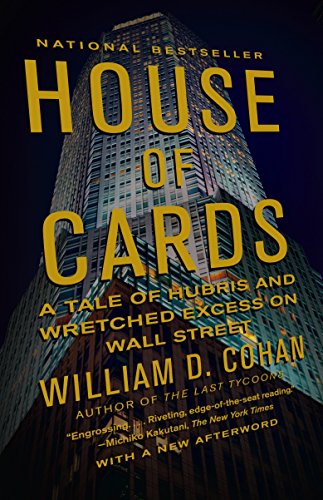
A blistering narrative account of the negligence and greed that pushed all of Wall Street into chaos and the country into a financial crisis.
At the beginning of March 2008, the monetary fabric of Bear Stearns, one of the world’s oldest and largest investment banks, began unraveling. After ten days, the bank no longer existed, its assets sold under duress to rival JPMorgan Chase. The effects would be felt nationwide, as the country suddenly found itself in the grip of the worst financial mess since the Great Depression. William Cohan exposes the corporate arrogance, power struggles, and deadly combination of greed and inattention, which led to the collapse of not only Bear Stearns but the very foundations of Wall Street.
Die Inhaltsangabe kann sich auf eine andere Ausgabe dieses Titels beziehen.
Über die Autorin bzw. den Autor
WILLIAM D. COHAN, a former senior Wall Street investment banker, is the bestselling author of The Last Tycoons and the winner of the 2007 FT/Goldman Sachs Business Book of the Year Award. He is an online columnist for The New York Times, and writes frequently for Vanity Fair, Fortune, ArtNews, The Financial Times, the Washington Post and the Daily Beast. He also appears frequently on CNN, Bloomberg TV and CNBC, and also on numerous NPR shows.
Auszug. © Genehmigter Nachdruck. Alle Rechte vorbehalten.
The first murmurings of impending doom for the financial world originated 2,500 miles from Wall Street in an unassuming office suite just north of Orlando, Florida. There, hard by the train tracks, Bennet Sedacca announced to the world at 10:15 on the morning of March 5, 2008, that venerable Bear Stearns & Co., the nation's fifth--largest investment bank, was in trouble, big trouble. "Yep," Sedacca wrote on the Minyanville Web site, which is dedicated to helping investors comprehend the financial world. "The great credit unwind is upon us. Credit default swaps on all brokers, particularly Lehman and Bear Stearns, are blowing out, big time."
Sedacca, the forty--eight--year--old president of Atlantic Advisors, a $3.5 billion investment management company and hedge fund, had been watching his Bloomberg screens on a daily basis as the cost of insuring the short--term obligations–known in Wall Street argot as "credit default swaps"–of both Lehman and Bear Stearns had increased steadily since the summer of 2007 and then more rapidly in February 2008. Now he was calling the end of the credit party that had been raging on Wall Street for six years. "I've been talking about it for years," Sedacca said later. "But I started to notice it that fall. Because if you think about it, if you have all this nuclear waste on your balance sheet, what are you supposed to do? You're supposed to cut your dividends, you're supposed to raise equity, and you're supposed to shrink your balance sheet. And they did just the opposite. They took on more leverage. Lehman went from twenty--five to thirty--five times leveraged in one year. And then they announce a big stock buyback at $65 a share and they sell stock at $38 a share. I mean, they don't know what they're doing. And yet they get rewarded for doing that. It makes me sick."
Sedacca had witnessed firsthand a few blowups in his day. He worked at the investment bank Drexel Burnham Lambert–the former home of junk--bond king Michael Milken–when it was liquidated in 1990 and lost virtually overnight the stock he had in the firm as it plunged from $110 per share to zero (Drexel was a private company but the stock had been valued for internal purposes). "It was enough that it stunned," he explained. "It was more than a twenty--nine--year--old would want to lose." Many of his Drexel colleagues had taken out loans from Citibank to buy the Drexel stock and were left with their bank loans and worthless stock. "I know people with millions and millions of dollars of debt and the stock was at zero," he said. They either paid off the loans or declared personal bankruptcy. "That's what happens when everyone turns off your funding," he added.
He then moved on to Kidder Peabody and watched that 130--year--old firm disintegrate, too. As a result of these experiences and those at other Wall Street firms, he had developed a healthy skepticism of both debt and the ways of Wall Street. Starting in the summer of 2007, he began to feel certain that the mountain of debt building across many sectors of the American economy would not come to a good end. He started betting against credit. "I've watched enough screens long enough to know something was wrong," he said.
The problem at Bear Stearns and Lehman Brothers, Sedacca informed his clients and Minyanville readers, was that both firms had huge inventories on their balance sheets of securities backed by home mortgages. The rate of default on these mortgages, while still small, was growing at the same time that the value of the underlying collateral for the mortgage–people's homes–was falling rapidly. Sedacca could not help noticing that the effects of this double whammy were beginning to show up in other, smaller companies involved in the mortgage industry. He could watch the noose tighten in the credit markets. "Look at what is happening to Thornburg Mortgage," he wrote, referring to the publicly traded home mortgage lender, which specialized in making what were known as "Alt--A" mortgages, those greater than $417,000, to wealthy borrowers. Thornburg had been "overwhelmed" by margin calls from its lenders. "It supposedly only has a 0.44% default rate on its [$24.7 billion] mortgage portfolio that it services but the bonds it owns are getting pounded. Result? Margin call. The worst part is that the company went to sell some bonds to settle the margin calls but couldn't. The ultimate Roach Motel."
That Thornburg, based in Sante Fe, New Mexico, appeared to be hitting the wall was somewhat surprising considering its customers' low default rate and high credit quality. The problem at Thornburg was not that its customers could no longer pay the interest and principal on their mortgages; the problem was that the company could no longer fund its business on a day--to--day basis. Thornburg had a liquidity problem because its lenders no longer liked the collateral–those jumbo mortgages–Thornburg used to obtain financing.
Unlike a bank, which is able to use the cash from its depositors to fund most of its operations, financial institutions such as Thornburg as well as pure investment banks such as Lehman Brothers and Bear Stearns had no depositors' money to use. Instead they funded their operations in a few ways: either by occasionally issuing long--term securities, such as debt or preferred stock, or most often by obtaining short--term, often overnight, borrowings in the unsecured commercial paper market or in the overnight "repo" market, where the borrowings are secured by the various securities and other assets on their balance sheets. These fairly routine borrowings have been repeated day after day for some thirty years and worked splendidly–until there was perceived to be a problem with either the securities or the institutions backing them up, and then the funding evaporated like rain in the Sahara. The dirty little secret of what used to be known as Wall Street securities firms–Goldman Sachs, Morgan Stanley, Merrill Lynch, Lehman Brothers, and Bear Stearns–was that every one of them funded their business in this way to varying degress, and every one of them was always just twenty--four hours away from a funding crisis. The key to day--to--day survival was the skill with which Wall Street executives managed their firms' ongoing reputation in the marketplace.
Thornburg financed its operations very similarly to the way investment banks did. But in mid--February 2008, Thornburg was having a very difficult time managing its perception in the marketplace because its short--term borrowings were backed by the mortgages it held on its balance sheet. Some of these mortgages were prime mortgages, money lent to the lowest--risk borrowers, and some were those Alt--A mortgages, which were marginally riskier than prime mortgages and offered investors higher yields. At Thornburg, 99.56 percent of these mortgages were performing just fine.
But that did not matter. What mattered was that the perception of these mortgage--related assets in the market was deteriorating rapidly. That perception spelled potential doom for firms such as Thornburg, Bear Stearns, and Lehman Brothers, which financed their businesses in the overnight repo market using mortgage--related assets as collateral.
For Thornburg the trouble began on February 14, halfway around the world, when UBS, the largest Swiss bank, reported a fourth--quarter 2007 loss of $11.3 billion after writing off $13.7 billion of investments in U.S. mortgages. Amid this huge write--off, UBS said it had lost $2 billion on Alt--A mortgages and, worse, that it had an additional exposure of $26.6 billion to them. In a letter to shareholders before he lost his job on April 1, Marcel Ospel, UBS's longtime chairman, wrote that the year 2007 had been "one of the most difficult in our history" because of "the sudden and serious deterioration...
„Über diesen Titel“ kann sich auf eine andere Ausgabe dieses Titels beziehen.
Suchergebnisse für House of Cards: A Tale of Hubris and Wretched Excess...

Beispielbild für diese ISBN
House of Cards: A Tale of Hubris and Wretched Excess on Wall Street
Anbieter: World of Books (was SecondSale), Montgomery, IL, USA
Verkäuferbewertung 5 von 5 Sternen

Paperback. Zustand: Fair. In March 2008, Bear Stearns, a swashbuckling eighty-four-year-old financial institution, was forced to sell itself to JPMorgan Chase for an outrageously low price in a deal brokered by Treasury Secretary Henry Paulson, who was desperately trying to prevent the impending catastrophic market crash. But mere months before, an industry-wide boom had the Bear clocking a record high stock price. How did a giant investment bank with $18 billion in cash on hand disappear in a mere ten days? In this tour de force, Cohan provides a minute-by-minute account of the events that brought America's second Gilded Age to an end. Filled with intimate portraits of the major players, high-end gossip, and smart financial analysis, House of Cards recounts in delicious narrative form the dramatic events behind the fall of Bear Stearns and what it revealed about the financial world's progression from irrational boom to cataclysmic bust. House of Cards is the Rosetta Stone for understanding the dramatic and the unprecedented events that have reshaped Wall Street and global finance in the past two years. Bestandsnummer des Verkäufers 00094479295
Gebraucht kaufen
EUR 3,78
Versand gratis
Versand innerhalb von USA
Versand innerhalb von USA
Anzahl: 6 verfügbar
Beispielbild für diese ISBN
House of Cards: A Tale of Hubris and Wretched Excess on Wall Street
Anbieter: World of Books (was SecondSale), Montgomery, IL, USA
Verkäuferbewertung 5 von 5 Sternen
Paperback. Zustand: Good. In March 2008, Bear Stearns, a swashbuckling eighty-four-year-old financial institution, was forced to sell itself to JPMorgan Chase for an outrageously low price in a deal brokered by Treasury Secretary Henry Paulson, who was desperately trying to prevent the impending catastrophic market crash. But mere months before, an industry-wide boom had the Bear clocking a record high stock price. How did a giant investment bank with $18 billion in cash on hand disappear in a mere ten days? In this tour de force, Cohan provides a minute-by-minute account of the events that brought America's second Gilded Age to an end. Filled with intimate portraits of the major players, high-end gossip, and smart financial analysis, House of Cards recounts in delicious narrative form the dramatic events behind the fall of Bear Stearns and what it revealed about the financial world's progression from irrational boom to cataclysmic bust. House of Cards is the Rosetta Stone for understanding the dramatic and the unprecedented events that have reshaped Wall Street and global finance in the past two years. Bestandsnummer des Verkäufers 00059778820
Gebraucht kaufen
EUR 3,78
Versand gratis
Versand innerhalb von USA
Versand innerhalb von USA
Anzahl: Mehr als 20 verfügbar
Beispielbild für diese ISBN
House of Cards: A Tale of Hubris and Wretched Excess on Wall Street
Anbieter: World of Books (was SecondSale), Montgomery, IL, USA
Verkäuferbewertung 5 von 5 Sternen
Paperback. Zustand: Very Good. In March 2008, Bear Stearns, a swashbuckling eighty-four-year-old financial institution, was forced to sell itself to JPMorgan Chase for an outrageously low price in a deal brokered by Treasury Secretary Henry Paulson, who was desperately trying to prevent the impending catastrophic market crash. But mere months before, an industry-wide boom had the Bear clocking a record high stock price. How did a giant investment bank with $18 billion in cash on hand disappear in a mere ten days? In this tour de force, Cohan provides a minute-by-minute account of the events that brought America's second Gilded Age to an end. Filled with intimate portraits of the major players, high-end gossip, and smart financial analysis, House of Cards recounts in delicious narrative form the dramatic events behind the fall of Bear Stearns and what it revealed about the financial world's progression from irrational boom to cataclysmic bust. House of Cards is the Rosetta Stone for understanding the dramatic and the unprecedented events that have reshaped Wall Street and global finance in the past two years. Bestandsnummer des Verkäufers 00107492239
Gebraucht kaufen
EUR 3,78
Versand gratis
Versand innerhalb von USA
Versand innerhalb von USA
Anzahl: 1 verfügbar
Foto des Verkäufers
House of Cards: A Tale of Hubris and Wretched Excess on Wall Street
Verlag:
Knopf Doubleday Publishing Group, 2010
ISBN 10: 0767930894
ISBN 13: 9780767930895
Gebraucht
Softcover
Anbieter: Dream Books Co., Denver, CO, USA
Verkäuferbewertung 5 von 5 Sternen
Zustand: good. Gently used with minimal wear on the corners and cover. A few pages may contain light highlighting or writing, but the text remains fully legible. Dust jacket may be missing, and supplemental materials like CDs or codes may not be included. May be ex-library with library markings. Ships promptly! Bestandsnummer des Verkäufers DBV.0767930894.G
Gebraucht kaufen
EUR 3,79
Versand gratis
Versand innerhalb von USA
Versand innerhalb von USA
Anzahl: 1 verfügbar
Beispielbild für diese ISBN
House of Cards: A Tale of Hubris and Wretched Excess on Wall Street
Verlag:
Knopf Doubleday Publishing Group, 2010
ISBN 10: 0767930894
ISBN 13: 9780767930895
Gebraucht
paperback
Anbieter: Gulf Coast Books, Cypress, TX, USA
Verkäuferbewertung 5 von 5 Sternen
paperback. Zustand: Fair. Bestandsnummer des Verkäufers 0767930894-4-34728497
Gebraucht kaufen
EUR 3,83
Versand gratis
Versand innerhalb von USA
Versand innerhalb von USA
Anzahl: 1 verfügbar
Beispielbild für diese ISBN
House of Cards: A Tale of Hubris and Wretched Excess on Wall Street
Anbieter: Your Online Bookstore, Houston, TX, USA
Verkäuferbewertung 5 von 5 Sternen
Paperback. Zustand: Good. Bestandsnummer des Verkäufers 0767930894-3-21530621
Gebraucht kaufen
EUR 3,90
Versand gratis
Versand innerhalb von USA
Versand innerhalb von USA
Anzahl: 1 verfügbar
Foto des Verkäufers
House of Cards: A Tale of Hubris and Wretched Excess on Wall Street
Verlag:
Knopf Doubleday Publishing Group, 2010
ISBN 10: 0767930894
ISBN 13: 9780767930895
Gebraucht
Softcover
Anbieter: 3Brothers Bookstore, Egg harbor township, NJ, USA
Verkäuferbewertung 5 von 5 Sternen
Zustand: good. Books may contain some notes and highlighting. Supplements such as Access Codes, Cd's Dust Jackets, etc. are not guaranteed with used book purchases. Bestandsnummer des Verkäufers EVV.0767930894.G
Gebraucht kaufen
EUR 3,91
Versand gratis
Versand innerhalb von USA
Versand innerhalb von USA
Anzahl: 1 verfügbar
Foto des Verkäufers
House of Cards: A Tale of Hubris and Wretched Excess on Wall Street
Verlag:
Knopf Doubleday Publishing Group, 2010
ISBN 10: 0767930894
ISBN 13: 9780767930895
Gebraucht
Softcover
Anbieter: Zoom Books East, Glendale Heights, IL, USA
Verkäuferbewertung 5 von 5 Sternen
Zustand: good. Book is in good condition and may include underlining highlighting and minimal wear. The book can also include "From the library of" labels. May not contain miscellaneous items toys, dvds, etc. . We offer 100% money back guarantee and 24 7 customer service. Bestandsnummer des Verkäufers ZEV.0767930894.G
Gebraucht kaufen
EUR 4,05
Versand gratis
Versand innerhalb von USA
Versand innerhalb von USA
Anzahl: 3 verfügbar
Foto des Verkäufers
House of Cards: A Tale of Hubris and Wretched Excess on Wall Street
Verlag:
Knopf Doubleday Publishing Group, 2010
ISBN 10: 0767930894
ISBN 13: 9780767930895
Gebraucht
Softcover
Anbieter: 2nd Life Books, Burlington, NJ, USA
Verkäuferbewertung 5 von 5 Sternen
Zustand: very_good. Used book in very good condition. May have some minor wear. May NOT include discs, or access code or other supplemental material. Ships directly from Amazon and is eligible for Prime or super saver FREE shipping. We ship Monday-Saturday and respond to inquiries within 24 hours. Bestandsnummer des Verkäufers BXM.DHXI
Gebraucht kaufen
EUR 0,89
EUR 3,56 Versand
Versand innerhalb von USA
Versand innerhalb von USA
Anzahl: 1 verfügbar
Foto des Verkäufers
House of Cards: A Tale of Hubris and Wretched Excess on Wall Street
Verlag:
Knopf Doubleday Publishing Group, 2010
ISBN 10: 0767930894
ISBN 13: 9780767930895
Gebraucht
Softcover
Anbieter: ZBK Books, Carlstadt, NJ, USA
Verkäuferbewertung 5 von 5 Sternen
Zustand: good. Fast & Free Shipping â" Good condition. It may show normal signs of use, such as light writing, highlighting, or library markings, but all pages are intact and the book is fully readable. A solid, complete copy that's ready to enjoy. Bestandsnummer des Verkäufers ZWV.0767930894.G
Gebraucht kaufen
EUR 4,57
Versand gratis
Versand innerhalb von USA
Versand innerhalb von USA
Anzahl: 1 verfügbar