
Verwandte Artikel zu Management in Ten Words: Practical Advice from the...
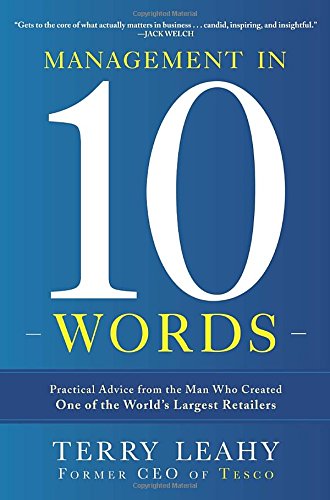
Management in Ten Words: Practical Advice from the Man Who Created One of the World's Largest Retailers - Hardcover
Inhaltsangabe
From one of the world’s most admired business leaders, here is a remarkable book
that will forever change the way you think about management.
The meteoric rise of UK supermarket chain Tesco from humble beginnings to its current status as one of the largest retailers in the world can be largely credited to one man—its recently departed CEO, Terry Leahy. Leahy’s unflagging drive and commitment to progress, his no-nonsense approach to leadership, and his visionary perspective on the manager’s role made him a transformative figure not only within his company but within the culture at large—he was voted Business Person of the Year by
the Sunday Times in 2010.
But what’s Leahy’s secret? How did a workingclass kid whose first job with Tesco was stocking shelves rise to become his company’s most dynamic leader—quadrupling the firm’s profits and creating a new job every twenty minutes for more than ten years? How did he steer a midlevel supermarket chain to such success that it now accounts for one-seventh of all British spending on consumer goods, with truly global reach and thriving departments in everything from mobile-phone operation to financial services?
The answer can be found in ten deceptively simple words—words such as truth, loyalty, courage, andbalance. Everyone thinks they understand what these words mean. But what Leahy learned in his fourteen years as the world’s greatest turnaround artist was that there is far more to actually practicing these time-honored values than most people know.
Management in 10 Words is Terry Leahy’s unflinchingly honest, deeply insightful account of the most valuable, hard-won lessons of his career. For any leader who aspires to be truly exceptional, this book is a must-read.
Die Inhaltsangabe kann sich auf eine andere Ausgabe dieses Titels beziehen.
Über die Autorin bzw. den Autor
SIR TERRY LEAHY was educated at St. Edward’s College, Liverpool, and then went on to the University of Manchester Institute of Science and Technology, where he gained his BSc (Hons) in management sciences. He joined Tesco when he was twenty-three, became the company’s first marketing director, and was responsible for the introduction of the highly successful Tesco Clubcard. As CEO he oversaw Tesco’s expansion into everything from electrical goods to insurance, built a £1 billion clothing business, and was one of the first to see the potential of the Internet for selling groceries. He was knighted in 2002 for his services to food retailing and has received many industry honors and awards, including theSunday Times Business Person of the Year in 2010 and a Lifetime Achievement Award fromRetail Week in 2011.
Since Sir Terry stepped down as CEO of Tesco in February 2011, he has been in constant demand as a public speaker. He is also a senior adviser to Clayton, Dubilier & Rice, the U.S. private equity firm. In addition, he invests in entrepreneurial businesses and is involved with various charities.
Auszug. © Genehmigter Nachdruck. Alle Rechte vorbehalten.
Management in Ten Words
Practical Advice from the Man Who Created One of the World's Largest Retailers
By Leahy TerryRandom House, Inc.
Copyright © 2012 Leahy Terry
All rights reserved.
ISBN: 978-0-7704-3569-1All rights reserved.
Excerpt
1 Truth
Organisations are terrible at confronting the truth. It is so much easier to define your version of reality, and judge success and failure according to that. But my experience is that truth is crucial both to create and to sustain success.
Confronting the truth is painful. To confess even to yourself, let alone others, that your job is not as great as it might be, that an investment is not paying off, that your company is slipping or that you could do better at work--any admission of imperfection or inadequacy is hard. And once the words have passed your lips, all sorts of questions raise their ugly little heads. Why has this happened? What did you do wrong to make this happen? And what are you going to do about it? Change jobs, sack people, restructure the company? All that spells change for you and, most likely, for someone else. Change is difficult. Change thanks to a mistake you made is doubly hard.
So the easy option is not to confront the truth, but to let things potter along as they are. Of course, if it is a car or house you are unhappy with, well, that’s something that you can take in your stride. But if it is a job that is going nowhere, or a company or team at work that is steadily slipping, that’s something that can erode your confidence and gnaw away at your soul. The sense of purposelessness, knowing you could do better, leaving work each day not sure of what you have achieved--all this is demoralising, depressing, crushing even.
Almost worse is when you sense that everyone in the organisation is thinking the same thing: that the latest strategy is not going to work, the so-called ‘performance indicators’ are meaningless, and that the organisation has lost its way. But, inevitably, no one is saying so. The longer the silence lasts, the harder it becomes to confront the truth and face the consequences. As a result, the more likely it is that nothing is done--until it is all too late.
The world over, organisations of all kinds are terrible at confronting the truth. It is so much easier to define your version of reality, and judge success and failure according to that. Management screens and filters out what it doesn’t want to hear. To acknowledge a problem would mean having to take an awkward decision or face an unpleasant meeting that would make you unloved and unpopular, and who wants to be that? Worse, truth can expose failure--the f-word, feared by everyone. Slowly and imperceptibly, the ‘bunker mentality’ descends, blinding management to reality. Those on the board convince themselves that there isn’t really a problem, or that the problem everyone is talking about has been concocted by those who are analysing, commenting and often criticising the organisation: journalists, pressure groups, politicians, customers. Whatever is happening, the board persuades itself, it certainly isn’t the fault of management. Then, inexorably, the world closes in and the problems grow. By now management knows it has to be seen to be doing something and to be in charge of ‘events’, so it indulges in frenetic (and often pointless) activity and initiatives.
Paradoxically, the more successful a business becomes, the easier it is to justify not seeking out the truth and taking difficult decisions. If all the indicators are pointing to success--your share price, sales, membership, and so on--why fill the world with gloom and doom? Why bother changing things when you are doing so well? Success breeds complacency, a sense that the world in which you became successful will not change, so neither should you.
The truth is not something you usually associate with retailing. It’s a word you normally connect with the law or religion--perhaps too big and worthy to grace the shopping aisles. But my experience is that truth is crucial both to create and to sustain success. And certainly, when I consider how Tesco was in the early 1990s, finding the truth was absolutely essential: it was the only way we would get out of the rut of being a middle-ranking UK supermarket.
A brief bit of history. Tesco began life when Jack Cohen used his gratuity from Army service in the First World War to set up a market stall in the melee of the East End of London. Cohen bought tea (at 9d--old pence--per pound, selling at 6d a half pound)1 from T E Stockwell. TES plus the CO of Cohen produced Tesco--although Cohen was the driving force. On one day alone, Cohen sold 450 pounds of tea from his barrow. Cohen had a natural flair for retail, an eye for a bargain and a strong belief that low price, and nothing else, was the secret of good business. Once he bought a consignment of Danish cream from a half-sunk ship and sent it to his shops with an order ‘Take off the labels, get a tin of Duraglit from the shelves to clean off the rust and sell these for 2d a tin’.2 Another time he bought a consignment of Polish cigarettes allegedly made of lettuce leaves which, according to one Tesco employee, ‘reminded me of nothing more than the old herbal cigarettes which we smoked behind the lavatory at school’.3 To ‘Slasher Jack’ (as he became known), quality played second fiddle to price: ‘Pile it high, sell it cheap’ was his motto, with ‘Always keep your hand over the money and be ready to run’ a favourite maxim.4
With Cohen’s forceful character, flair for business and sheer energy, Tesco grew. By the mid-1950s it had 150 stores. Its first supermarket opened in 1956, and in 1961 Cohen asked the comedian Sid James, star of the Carry-On films, to open the UK’s then largest supermarket, a Tesco in Leicester.5 By the time Cohen--then Sir Jack--retired in 1970 and handed over the reins to his sons-in-law, Tesco had over 800 stores.
But a bigger Tesco was not a better Tesco. Cohen had been Tesco--and therein lay the problem. His forceful, somewhat cowboy personality gave the chain its identity, complete with a reputation for flouting planning regulations and for board meetings that descended into verbal fisticuffs, or worse. But basing a company’s culture on the founder’s personality is not always a recipe for continued success. As Britain started to become richer and an ever-expanding middle class more affluent, Sir Jack’s Tesco began to look rather jaded. Soon, the competition was running rings round Tesco. Sainsbury was building new supermarkets in the south of England, while Asda was building big new stores and selling food at low prices in the north.
The fact that Tesco survived at all is thanks to Ian MacLaurin and his senior team, David Malpas (his Managing Director) and John Gildersleeve (a rising star). In the years immediately after Jack Cohen’s departure, the focus on price had dimmed, and too much faith had been placed in the Green Shield stamps marketing scheme. (Customers would be given stamps to reflect the value of their purchases, which they could then trade for more goods.) Rumours swirled around that a tobacco company had thought about buying Tesco, but had then decided that it might be bad for its brand! Ian took the bold step of abandoning Green Shield stamps, and returned to aggressive price cutting. At the same time, his team took the edge off the ‘pile it high and sell it cheap’ image by creating better own-label brands and a healthy-eating...
Organisations are terrible at confronting the truth. It is so much easier to define your version of reality, and judge success and failure according to that. But my experience is that truth is crucial both to create and to sustain success.
Confronting the truth is painful. To confess even to yourself, let alone others, that your job is not as great as it might be, that an investment is not paying off, that your company is slipping or that you could do better at work--any admission of imperfection or inadequacy is hard. And once the words have passed your lips, all sorts of questions raise their ugly little heads. Why has this happened? What did you do wrong to make this happen? And what are you going to do about it? Change jobs, sack people, restructure the company? All that spells change for you and, most likely, for someone else. Change is difficult. Change thanks to a mistake you made is doubly hard.
So the easy option is not to confront the truth, but to let things potter along as they are. Of course, if it is a car or house you are unhappy with, well, that’s something that you can take in your stride. But if it is a job that is going nowhere, or a company or team at work that is steadily slipping, that’s something that can erode your confidence and gnaw away at your soul. The sense of purposelessness, knowing you could do better, leaving work each day not sure of what you have achieved--all this is demoralising, depressing, crushing even.
Almost worse is when you sense that everyone in the organisation is thinking the same thing: that the latest strategy is not going to work, the so-called ‘performance indicators’ are meaningless, and that the organisation has lost its way. But, inevitably, no one is saying so. The longer the silence lasts, the harder it becomes to confront the truth and face the consequences. As a result, the more likely it is that nothing is done--until it is all too late.
The world over, organisations of all kinds are terrible at confronting the truth. It is so much easier to define your version of reality, and judge success and failure according to that. Management screens and filters out what it doesn’t want to hear. To acknowledge a problem would mean having to take an awkward decision or face an unpleasant meeting that would make you unloved and unpopular, and who wants to be that? Worse, truth can expose failure--the f-word, feared by everyone. Slowly and imperceptibly, the ‘bunker mentality’ descends, blinding management to reality. Those on the board convince themselves that there isn’t really a problem, or that the problem everyone is talking about has been concocted by those who are analysing, commenting and often criticising the organisation: journalists, pressure groups, politicians, customers. Whatever is happening, the board persuades itself, it certainly isn’t the fault of management. Then, inexorably, the world closes in and the problems grow. By now management knows it has to be seen to be doing something and to be in charge of ‘events’, so it indulges in frenetic (and often pointless) activity and initiatives.
Paradoxically, the more successful a business becomes, the easier it is to justify not seeking out the truth and taking difficult decisions. If all the indicators are pointing to success--your share price, sales, membership, and so on--why fill the world with gloom and doom? Why bother changing things when you are doing so well? Success breeds complacency, a sense that the world in which you became successful will not change, so neither should you.
The truth is not something you usually associate with retailing. It’s a word you normally connect with the law or religion--perhaps too big and worthy to grace the shopping aisles. But my experience is that truth is crucial both to create and to sustain success. And certainly, when I consider how Tesco was in the early 1990s, finding the truth was absolutely essential: it was the only way we would get out of the rut of being a middle-ranking UK supermarket.
A brief bit of history. Tesco began life when Jack Cohen used his gratuity from Army service in the First World War to set up a market stall in the melee of the East End of London. Cohen bought tea (at 9d--old pence--per pound, selling at 6d a half pound)1 from T E Stockwell. TES plus the CO of Cohen produced Tesco--although Cohen was the driving force. On one day alone, Cohen sold 450 pounds of tea from his barrow. Cohen had a natural flair for retail, an eye for a bargain and a strong belief that low price, and nothing else, was the secret of good business. Once he bought a consignment of Danish cream from a half-sunk ship and sent it to his shops with an order ‘Take off the labels, get a tin of Duraglit from the shelves to clean off the rust and sell these for 2d a tin’.2 Another time he bought a consignment of Polish cigarettes allegedly made of lettuce leaves which, according to one Tesco employee, ‘reminded me of nothing more than the old herbal cigarettes which we smoked behind the lavatory at school’.3 To ‘Slasher Jack’ (as he became known), quality played second fiddle to price: ‘Pile it high, sell it cheap’ was his motto, with ‘Always keep your hand over the money and be ready to run’ a favourite maxim.4
With Cohen’s forceful character, flair for business and sheer energy, Tesco grew. By the mid-1950s it had 150 stores. Its first supermarket opened in 1956, and in 1961 Cohen asked the comedian Sid James, star of the Carry-On films, to open the UK’s then largest supermarket, a Tesco in Leicester.5 By the time Cohen--then Sir Jack--retired in 1970 and handed over the reins to his sons-in-law, Tesco had over 800 stores.
But a bigger Tesco was not a better Tesco. Cohen had been Tesco--and therein lay the problem. His forceful, somewhat cowboy personality gave the chain its identity, complete with a reputation for flouting planning regulations and for board meetings that descended into verbal fisticuffs, or worse. But basing a company’s culture on the founder’s personality is not always a recipe for continued success. As Britain started to become richer and an ever-expanding middle class more affluent, Sir Jack’s Tesco began to look rather jaded. Soon, the competition was running rings round Tesco. Sainsbury was building new supermarkets in the south of England, while Asda was building big new stores and selling food at low prices in the north.
The fact that Tesco survived at all is thanks to Ian MacLaurin and his senior team, David Malpas (his Managing Director) and John Gildersleeve (a rising star). In the years immediately after Jack Cohen’s departure, the focus on price had dimmed, and too much faith had been placed in the Green Shield stamps marketing scheme. (Customers would be given stamps to reflect the value of their purchases, which they could then trade for more goods.) Rumours swirled around that a tobacco company had thought about buying Tesco, but had then decided that it might be bad for its brand! Ian took the bold step of abandoning Green Shield stamps, and returned to aggressive price cutting. At the same time, his team took the edge off the ‘pile it high and sell it cheap’ image by creating better own-label brands and a healthy-eating...
„Über diesen Titel“ kann sich auf eine andere Ausgabe dieses Titels beziehen.
Suchergebnisse für Management in Ten Words: Practical Advice from the...

Beispielbild für diese ISBN
Management in Ten Words: Practical Advice from the Man Who Created One of the World's Largest Retailers
Anbieter: Giant Giant, Reston, VA, USA
Verkäuferbewertung 5 von 5 Sternen

hardcover. Zustand: Very Good. Very Good condition.Crisp pages. Clean cover and pages. Book shows minimal shelf wear. No highlighting/marking. Not Satisfied? Contact us to get a refund. Bestandsnummer des Verkäufers BRG-38_4_693
Gebraucht kaufen
EUR 4,48
Versand gratis
Versand innerhalb von USA
Versand innerhalb von USA
Anzahl: 1 verfügbar
Beispielbild für diese ISBN
Management in Ten Words: Practical Advice from the Man Who Created One of the World's Largest Retailers
Anbieter: World of Books (was SecondSale), Montgomery, IL, USA
Verkäuferbewertung 5 von 5 Sternen
Zustand: Good. Item in good condition. Textbooks may not include supplemental items i.e. CDs, access codes etc. Bestandsnummer des Verkäufers 00107859970
Gebraucht kaufen
EUR 5,37
Versand gratis
Versand innerhalb von USA
Versand innerhalb von USA
Anzahl: 1 verfügbar
Beispielbild für diese ISBN
Management in Ten Words: Practical Advice from the Man Who Created One of the World's Largest Retailers
Anbieter: ThriftBooks-Dallas, Dallas, TX, USA
Verkäuferbewertung 5 von 5 Sternen
Hardcover. Zustand: As New. No Jacket. Pages are clean and are not marred by notes or folds of any kind. ~ ThriftBooks: Read More, Spend Less. Bestandsnummer des Verkäufers G0770435696I2N00
Gebraucht kaufen
EUR 6,50
Versand gratis
Versand innerhalb von USA
Versand innerhalb von USA
Anzahl: 1 verfügbar
Beispielbild für diese ISBN
Management in 10 Words : Practical Advice from the Man Who Created One of the World's Largest Retailers
Verlag:
Crown Publishing Group, The, 2012
ISBN 10: 0770435696
ISBN 13: 9780770435691
Gebraucht
Hardcover
Anbieter: Better World Books: West, Reno, NV, USA
Verkäuferbewertung 5 von 5 Sternen
Zustand: Very Good. Pages intact with possible writing/highlighting. Binding strong with minor wear. Dust jackets/supplements may not be included. Stock photo provided. Product includes identifying sticker. Better World Books: Buy Books. Do Good. Bestandsnummer des Verkäufers 866677-6
Gebraucht kaufen
EUR 6,58
Versand gratis
Versand innerhalb von USA
Versand innerhalb von USA
Anzahl: 1 verfügbar
Beispielbild für diese ISBN
Management in Ten Words: Practical Advice from the Man Who Created One of the World's Largest Retailers
Anbieter: medimops, Berlin, Deutschland
Verkäuferbewertung 5 von 5 Sternen
Zustand: good. Befriedigend/Good: Durchschnittlich erhaltenes Buch bzw. Schutzumschlag mit Gebrauchsspuren, aber vollständigen Seiten. / Describes the average WORN book or dust jacket that has all the pages present. Bestandsnummer des Verkäufers M00770435696-G
Gebraucht kaufen
EUR 11,77
EUR 10,00 Versand
Versand von Deutschland nach USA
Versand von Deutschland nach USA
Anzahl: 1 verfügbar
Beispielbild für diese ISBN
Management in Ten Words: Practical Advice from the Man Who Created One of the World's Largest Retailers
Anbieter: Phatpocket Limited, Waltham Abbey, HERTS, Vereinigtes Königreich
Verkäuferbewertung 5 von 5 Sternen
Zustand: Good. Your purchase helps support Sri Lankan Children's Charity 'The Rainbow Centre'. Ex-library, so some stamps and wear, but in good overall condition. Our donations to The Rainbow Centre have helped provide an education and a safe haven to hundreds of children who live in appalling conditions. Bestandsnummer des Verkäufers Z1-B-020-01974
Gebraucht kaufen
EUR 13,83
EUR 12,41 Versand
Versand von Vereinigtes Königreich nach USA
Versand von Vereinigtes Königreich nach USA
Anzahl: 1 verfügbar
Foto des Verkäufers
Management in Ten Words Practical Advice from the Man Who Created One of the World's Largest Retailers
Verlag:
Crown Business, New York, NY, 2012
ISBN 10: 0770435696
ISBN 13: 9780770435691
Gebraucht
Hardcover
Erstausgabe
Anbieter: True Oak Books, Highland, NY, USA
Verkäuferbewertung 5 von 5 Sternen
Hardcover. Zustand: Very Good. Zustand des Schutzumschlags: Very Good. First US Edition; First Printing. 6.33 X 1.11 X 9.52 inches; 312 pages; minor rubbing on DJ's front. Minor yellowing on pages. Very Good condition otherwise. No other noteworthy defects. No markings. ; - Your satisfaction is our priority. We offer free returns and respond promptly to all inquiries. Your item will be carefully cushioned in bubble wrap and securely boxed. All orders ship on the same or next business day. Buy with confidence. Bestandsnummer des Verkäufers HVD-58698-A-0
Gebraucht kaufen
EUR 26,89
Versand gratis
Versand innerhalb von USA
Versand innerhalb von USA
Anzahl: 1 verfügbar
Beispielbild für diese ISBN
Management in Ten Words: Practical Advice from the Man Who Created One of the World's Largest Retailers
Anbieter: Anybook.com, Lincoln, Vereinigtes Königreich
Verkäuferbewertung 5 von 5 Sternen
Zustand: Fair. This is an ex-library book and may have the usual library/used-book markings inside.This book has hardback covers. In fair condition, suitable as a study copy. No dust jacket. Please note the Image in this listing is a stock photo and may not match the covers of the actual item,550grams, ISBN:9780770435691. Bestandsnummer des Verkäufers 5767402
Gebraucht kaufen
EUR 15,45
EUR 15,86 Versand
Versand von Vereinigtes Königreich nach USA
Versand von Vereinigtes Königreich nach USA
Anzahl: 1 verfügbar
Beispielbild für diese ISBN
Management in Ten Words: Practical Advice from the Man Who Created One of the Worlds Largest Retailers
Anbieter: Greener Books, London, Vereinigtes Königreich
Verkäuferbewertung 4 von 5 Sternen

Hardcover. Zustand: Used; Good. **SHIPPED FROM UK** We believe you will be completely satisfied with our quick and reliable service. All orders are dispatched as swiftly as possible! Buy with confidence! Greener Books. Bestandsnummer des Verkäufers 1486802
Gebraucht kaufen
EUR 18,06
EUR 23,32 Versand
Versand von Vereinigtes Königreich nach USA
Versand von Vereinigtes Königreich nach USA
Anzahl: 1 verfügbar