
Inhaltsangabe
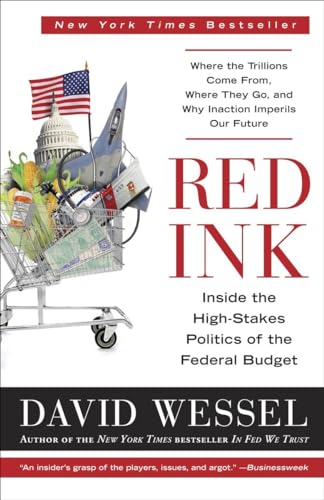
The Pulitzer-Prize-winning reporter, columnist, and bestselling author of In Fed We Trust, dissects the federal budget in this New York Times bestseller.
In a sweeping narrative about the people and the politics behind the budget--a topic that is fiercely debated today in the halls of Congress and the media, and yet is often misunderstood by the American public--Wessel looks at the 2011 fiscal year (which ended September 30) to see where all the money was actually spent, and why the budget process has grown wildly out of control. Through the eyes of key people, including Jacob Lew, White House director of the Office of Management and Budget; Douglas Elmendorf, director of the Congressional Budget Office; Blackstone founder and former Commerce Secretary Pete Peterson; and more, Wessel gives readers an inside look at the making of our unsustainable budget.
Die Inhaltsangabe kann sich auf eine andere Ausgabe dieses Titels beziehen.
Über die Autorin bzw. den Autor
David Wessel is a senior fellow in Economic Studies at Brookings and director of the Hutchins Center on Fiscal and Monetary Policy. Previously, he was the economics editor of The Wall Street Journal where he wrote "The Capital" column, a weekly look at forces shaping living standards around the world. Wessel joined The Wall Street Journal in 1983 after working at the Hartford Courant and the Boston Globe. He is a frequent guest on NPR's Morning Edition and has shared two Pulitzer Prizes. He and his wife live in Washington, D.C.
Auszug. © Genehmigter Nachdruck. Alle Rechte vorbehalten.
Chapter 1
Spending $400 Million an Hour
In the cold predawn darkness of Monday, February 13, 2012, Robert Friedlander walked into a Starbucks three blocks from the White House. As they had been instructed by e‑mail the night before, a half dozen reporters were waiting for him—one each from Dow Jones, Bloomberg, Reuters, Associated Press, Politico, and the Washington Post. With no ceremony and not much conversation, the young White House budget office aide slipped each of them a CD in a plain, square white envelope. The contents: President Barack Obama’s budget for the coming fiscal year. “It’s embargoed until 11:15,” he said. Friedlander’s inside-the-Beltway shorthand meant the reporters had about five hours to scour the documents before publishing stories on newswires and Web sites. At 11:15 a.m., the president was to begin speaking about the budget at a northern Virginia community college.
Every president since Warren Harding has been required by law to send an annual budget to Congress. It’s the only time that the chief executive of the United States has to make his promises add up. The modern version comes in three formats: free online, $27 for the CD, or $218 for the printed four-volume paperback set. The budget is one part rhetoric by the party in power that highlights—depending on the times—the government’s largesse or its tightfistedness. A second part details how the president would, if Congress went along, spend a sum equal to the value of all the goods and services produced by the 82 million people of Germany, the world’s fourth-largest economy. And in its modern form, a third part is dire prediction, a collection of uncomfortable, indisputable facts showing the unsustainable fiscal course the U.S. government is on.
The budget doesn’t record what might have been. The document Obama released in February did not, for instance, acknowledge intense summertime talks the president had with Republican House Speaker John Boehner that failed to end a stalemate over spending and taxes. And for all its excruciating detail, the president’s budget doesn’t ultimately settle anything; the Constitution gives Congress the power to tax and spend. But neither is “presbud”—as it’s known to insiders on congressional committees that decide how to spend taxpayers’ money—irrelevant. The budget is the starting point for an annual round of maneuvering that ranges from high-minded debate about national priorities and “hard choices” to big-money lobbying and small favors for home-state constituents. The details buried in it—which programs should live and which should die, which should get more and which should get less—often become law.
Ultimately, the federal government’s power comes in three forms: its physical force, both foreign and domestic; its ability to make and enforce rules that govern our lives; and its power to tax and spend. The budget—and this book—is about the third form. With far more precision than thirty-second sound bites or campaign stump speeches, the president’s budget and alternatives crafted by the opposition in Congress reflect contrasting visions for the size of government in America and the role it plays in the economy. How strong and generous a safety net should government provide to the poor? How much should taxpayers invest in medical research? How hard should government lean against market forces that are widening the gap between winners and losers in the economy? How much should spending be cut to rein in the deficit, and how much should taxes be raised if at all?
Anyone in Washington who is serious about trying to steer the government to the right or to the left understands the power and import of decisions on taxes and spending embodied in the budget. Among them are Jack Lew and Paul Ryan, both steeped in fiscal details big and small. The two illustrate the competing visions for government and the use of the budget as an important, perhaps the only important, way to achieve them. As director of the White House Office of Management and Budget, Lew, fifty-six, put the finishing touches on Obama’s February plan just as the president named him White House chief of staff. Ryan, forty-two, a Republican congressman from Wisconsin and the chairman of the House Budget Committee, promptly criticized the Obama budget—“broken promises, failed leadership and a diminished future,” he said—and set to work on an alternative.
Jacob “Jack” Lew got his start in politics in 1968, at age twelve, as a volunteer for anti–Vietnam War presidential candidate Eugene McCarthy. Lew has never run for office, but he has been at the elbow of influential Democrats from the late House Speaker Tip O’Neill and New York congresswoman Bella Abzug to Secretary of State Hillary Clinton and President Obama. An Orthodox Jew who avoids working on Friday nights and Saturdays except when duty calls, Lew is truly convinced of the government’s power to do good. When he took over the budget office, he replaced the portrait of Alexander Hamilton that had been hung by his predecessor, Peter Orszag, with paintings of his native New York City done by artists working for the government’s Works Progress Administration in the 1930s.
Lew is tall and lanky, his thick black hair just beginning to gray and his oval wire-rim glasses exactly what one would expect of a budget wonk. But Lew, who also was budget director for Bill Clinton, is the sort of wonk who can say sincerely: “I have a soft spot for Medicaid”—the government health insurance program for the poor funded jointly by state and federal governments—“because it’s the thing that’s easy for the political system to mischaracterize.
“For the most part, it’s a lot of people who don’t have insurance, who are poor. Slashing it would mean we’d be in a world where the most vulnerable were getting sicker and sicker and ultimately showing up in the hospital.”
Jack Lew believes in government. The budget is a means to that end. “The purpose of power is to get things done,” he once said. “Budgets aren’t books of numbers. They’re a tapestry, the fabric, of what we believe. The numbers tell a story, a self-portrait of what we are as a country.”
Paul Ryan is wiry, intense, energetic, and just as sincere as Lew—in the opposite direction. His quest: to limit the size of government, including spending less on Medicaid and almost everything else. His weapon of choice: the budget. In 2007, he vaulted over more senior congressmen to become the ranking Republican on the House Budget Committee, which is charged with crafting an annual budget blueprint for Congress. He became chairman in 2011 when Republicans took control of the House.
Like Jack Lew, Ryan came to politics young, as a college intern with the foreign policy adviser to Senator Robert Kasten from his home state of Wisconsin. Later he worked for a think tank organized by influential conservative Republicans Jack Kemp and Bill Bennett and for Sam Brownback, then a Republican senator from Kansas. Eleven days after turning twenty-eight, Ryan announced he was running for Congress from southeastern Wisconsin—and ended up with a stunning 57.2 percent of the vote in 1998, a stunning margin in a district that, as Ryan notes frequently, went for Democrats Bill Clinton, Al Gore, and Barack Obama. He has won even bigger majorities ever since.
With conviction and clarity that have conservatives salivating over him as a future presidential candidate, Ryan says, “I do believe government has a role in making sure we have a safety net to help people who...
„Über diesen Titel“ kann sich auf eine andere Ausgabe dieses Titels beziehen.
Weitere beliebte Ausgaben desselben Titels

Suchergebnisse für Red Ink: Inside the High-Stakes Politics of the Federal...

Beispielbild für diese ISBN
Red Ink: Inside the High-Stake
Anbieter: World of Books (was SecondSale), Montgomery, IL, USA
Verkäuferbewertung 5 von 5 Sternen

Zustand: Very Good. Item in very good condition! Textbooks may not include supplemental items i.e. CDs, access codes etc. Bestandsnummer des Verkäufers 00097730814
Gebraucht kaufen
EUR 3,34
Versand gratis
Versand innerhalb von USA
Versand innerhalb von USA
Anzahl: 1 verfügbar
Beispielbild für diese ISBN
Red Ink: Inside the High-Stakes Politics of the Federal Budget
Anbieter: Your Online Bookstore, Houston, TX, USA
Verkäuferbewertung 5 von 5 Sternen
Paperback. Zustand: Good. Bestandsnummer des Verkäufers 0770436161-3-26089317
Gebraucht kaufen
EUR 3,34
Versand gratis
Versand innerhalb von USA
Versand innerhalb von USA
Anzahl: 1 verfügbar
Beispielbild für diese ISBN
Red Ink: Inside the High-Stakes Politics of the Federal Budget
Anbieter: HPB Inc., Dallas, TX, USA
Verkäuferbewertung 5 von 5 Sternen
Paperback. Zustand: Very Good. Connecting readers with great books since 1972! Used books may not include companion materials, and may have some shelf wear or limited writing. We ship orders daily and Customer Service is our top priority! Bestandsnummer des Verkäufers S_340553764
Gebraucht kaufen
EUR 2,46
EUR 3,22 Versand
Versand innerhalb von USA
Versand innerhalb von USA
Anzahl: 1 verfügbar
Beispielbild für diese ISBN
Red Ink: Inside the High-Stakes Politics of the Federal Budget
Anbieter: ThriftBooks-Dallas, Dallas, TX, USA
Verkäuferbewertung 5 von 5 Sternen
Paperback. Zustand: Very Good. No Jacket. Former library book; May have limited writing in cover pages. Pages are unmarked. ~ ThriftBooks: Read More, Spend Less. Bestandsnummer des Verkäufers G0770436161I4N10
Gebraucht kaufen
EUR 5,85
Versand gratis
Versand innerhalb von USA
Versand innerhalb von USA
Anzahl: 1 verfügbar
Beispielbild für diese ISBN
Red Ink: Inside the High-Stakes Politics of the Federal Budget
Anbieter: ThriftBooks-Atlanta, AUSTELL, GA, USA
Verkäuferbewertung 5 von 5 Sternen
Paperback. Zustand: Good. No Jacket. Pages can have notes/highlighting. Spine may show signs of wear. ~ ThriftBooks: Read More, Spend Less. Bestandsnummer des Verkäufers G0770436161I3N00
Gebraucht kaufen
EUR 5,85
Versand gratis
Versand innerhalb von USA
Versand innerhalb von USA
Anzahl: 1 verfügbar
Beispielbild für diese ISBN
Red Ink: Inside the High-Stakes Politics of the Federal Budget
Anbieter: ThriftBooks-Atlanta, AUSTELL, GA, USA
Verkäuferbewertung 5 von 5 Sternen
Paperback. Zustand: Very Good. No Jacket. May have limited writing in cover pages. Pages are unmarked. ~ ThriftBooks: Read More, Spend Less. Bestandsnummer des Verkäufers G0770436161I4N00
Gebraucht kaufen
EUR 5,85
Versand gratis
Versand innerhalb von USA
Versand innerhalb von USA
Anzahl: 1 verfügbar
Beispielbild für diese ISBN
Red Ink : Inside the High-Stakes Politics of the Federal Budget
Verlag:
Crown Publishing Group, The, 2013
ISBN 10: 0770436161
ISBN 13: 9780770436162
Gebraucht
Softcover
Anbieter: Better World Books, Mishawaka, IN, USA
Verkäuferbewertung 5 von 5 Sternen
Zustand: Very Good. Pages intact with possible writing/highlighting. Binding strong with minor wear. Dust jackets/supplements may not be included. Stock photo provided. Product includes identifying sticker. Better World Books: Buy Books. Do Good. Bestandsnummer des Verkäufers 8073204-6
Gebraucht kaufen
EUR 6,08
Versand gratis
Versand innerhalb von USA
Versand innerhalb von USA
Anzahl: 1 verfügbar
Beispielbild für diese ISBN
Red Ink : Inside the High-Stakes Politics of the Federal Budget
Verlag:
Crown Publishing Group, The, 2013
ISBN 10: 0770436161
ISBN 13: 9780770436162
Gebraucht
Softcover
Anbieter: Better World Books: West, Reno, NV, USA
Verkäuferbewertung 5 von 5 Sternen
Zustand: Good. Former library copy. Pages intact with minimal writing/highlighting. The binding may be loose and creased. Dust jackets/supplements are not included. Includes library markings. Stock photo provided. Product includes identifying sticker. Better World Books: Buy Books. Do Good. Bestandsnummer des Verkäufers 8111891-6
Gebraucht kaufen
EUR 6,08
Versand gratis
Versand innerhalb von USA
Versand innerhalb von USA
Anzahl: 1 verfügbar
Beispielbild für diese ISBN
Red Ink : Inside the High-Stakes Politics of the Federal Budget
Verlag:
Crown Publishing Group, The, 2013
ISBN 10: 0770436161
ISBN 13: 9780770436162
Gebraucht
Softcover
Anbieter: Better World Books, Mishawaka, IN, USA
Verkäuferbewertung 5 von 5 Sternen
Zustand: Good. Pages intact with minimal writing/highlighting. The binding may be loose and creased. Dust jackets/supplements are not included. Stock photo provided. Product includes identifying sticker. Better World Books: Buy Books. Do Good. Bestandsnummer des Verkäufers 8374591-6
Gebraucht kaufen
EUR 6,08
Versand gratis
Versand innerhalb von USA
Versand innerhalb von USA
Anzahl: 1 verfügbar
Beispielbild für diese ISBN
Red Ink: Inside the High-Stakes Politics of the Federal Budget
Anbieter: HPB-Ruby, Dallas, TX, USA
Verkäuferbewertung 5 von 5 Sternen
Paperback. Zustand: Very Good. Connecting readers with great books since 1972! Used books may not include companion materials, and may have some shelf wear or limited writing. We ship orders daily and Customer Service is our top priority! Bestandsnummer des Verkäufers S_413593898
Gebraucht kaufen
EUR 3,10
EUR 3,22 Versand
Versand innerhalb von USA
Versand innerhalb von USA
Anzahl: 1 verfügbar