
Verwandte Artikel zu Capacitive Sensors: Design and Applications (IEEE Press...
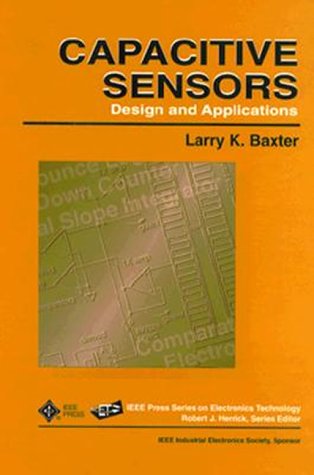
Capacitive Sensors: Design and Applications (IEEE Press Series on Electronics Technology) - Hardcover
Inhaltsangabe
A survey of the research, design, and production of capacitive sensors including theory, electrode configuration, and practical circuits. The basics outline sensor trends, electrostatics, and capacitive sensor and circuit basics, applying these essential elements to the design challenges of micrometers, proximity detectors, and motion encoders. Specific products such as the StudSensor, electret microphone, and Vernier caliper are examined for both efficiency and failure. Includes illustrations. Annotation c. by Book News, Inc., Portland, Or.
Die Inhaltsangabe kann sich auf eine andere Ausgabe dieses Titels beziehen.
Auszug. © Genehmigter Nachdruck. Alle Rechte vorbehalten.
Capacitive Sensors
Design and ApplicationsBy Larry K. BaxterInstitute of Electrical & Electronics Enginee
Copyright © 1996 Larry K. BaxterAll right reserved.
ISBN: 9780780311305
Chapter One
Introduction
Capacitive sensors electronically measure the capacitance between two or more conductors in a dielectric environment, usually air or a liquid. A similar technique is electric field measurement, where the electrostatic voltage field produced by conductors in a dielectric environment is picked up by a probe and a high impedance amplifier.
A high frequency excitation waveform is normally used, as the reactive impedance of small plates in air can be hundreds of megohms at audio frequencies. Excitation frequencies of 100 kHz or more reduce the impedance to a more easily handled kilohm range.
Some systems use the environment as a return path for capacitive currents; a person, for example, is coupled capacitively to the building or the earth with several hundred pF. More often, the return path is a wire.
The range of applications is extreme. At the small end, silicon integrated circuits use the capacitance between micromachined silicon cantilevers to measure micrometer displacements. The dimensions are on the order of 100 [micro]m, and the gap can be a [micro]m or less. At the large end, capacitive personnel and vehicle detectors have plate dimensions of several meters. Capacitive sensors have been used for video-rate signals in one of the early video disk storage technologies. At the sensitive end, one researcher [Jones, p. 589] reports on an instrument with movement sensitivity of [10.sup.-11] mm.
1.1 SENSOR TRENDS
1.1.1 Market
The world market for sensors [Control Engineering, 1993] is over $2.3 billion, growing at an annual rate of 10%. Consumer products, including imaging sensors, make up 64% of the market, with accelerometers accounting for 19% and a variety of specialized sensors completing the total.
Venture Development Corp., Natick, MA, (508)653-9000, in The U.S. Market for Proximity, Photoelectric, and Linear Displacement Sensors (1995), forecasts that market segment's size to grow from $429.6 million in 1995 to $548 million in 1999. U.S. consumption in 1999 is forecasted as
Magnetic 1.2% Ultrasonic 1.9% Capacitive 3.1% Magnetic-actuated 4.7% Inductive 42.2% Photoelectric 46.9%
1.1.2 Technology
Sensor technology is in the process of a slow migration from discrete "dumb" instruments, expensive and inflexible, to smart, self-calibrating, silicon-based units, and the measurement method of choice for silicon devices as well as for discrete instruments is moving from a variety of transducer technologies, such as magnetic, optical, and piezoelectric, to capacitive.
Capacitive sensors can be used for many different applications. Simple sensors are used for go-no go gaging such as liquid level in reservoirs, where their ability to detect the presence of a dielectric or conductor at a distance allows them to work through a nonconducting window. Similar devices (StudSensor) can find wood studs behind plaster walls. Very high analog accuracy and linearity can be achieved with two- or three-plate systems with careful construction, or multiple-plate geometries can be used with digital circuits to substitute digital precision for analog precision.
Capacitive sensors are also useful for measuring material properties. Materials have different values of dielectric constant as well as dielectric loss, and the values of both properties (particularly dielectric loss, or "loss tangent") change with temperature and frequency to give a material a characteristic signature which can be measured at a distance. Appendix 2 lists the dielectric properties of different materials vs. frequency.
1.1.3 Integration
Tools are available to fabricate many different types of sensors on silicon substrates, including micromachining which etches silicon wafers into sensor structures like diaphragms and cantilevered beams (Chapter 15). The decision to integrate a sensor can be done in stages, with the sensor and its electronics integrated together or separately, and usually is considered when the volume reaches 250,000 per year for total integration. Advantages of integration on silicon [Keister, 1992] are
Improved sensitivity
Differential sensors compensate parasitic effects
Temperature compensation
Easier A-D conversion
Batch fabrication for lower cost
Improved reliability
Size reduction
Less assembly required
Lower parasitic capacitances for smaller capacitive electrodes
Capacitive technology is particularly useful for integration, as it is temperature-stable and problems of parasitic capacitance, lead length, and high impedance nodes are more easily handled on a silicon chip than on a PC board.
1.1.4 Intelligence
Smart sensors increase their value to the system by handling low level tasks such as calibration, self-test, and compensation for environmental factors. The gage factor of smart sensors can be scaled automatically so that one sensor type can be used in many locations, and sensor-resident software may help with communications by managing its end of a sensor data bus.
1.1.5 Sensor bus
Most sensors use point-to-point connections to the host, with contact closure or TTL level digital signaling or 4-20 mA current loop or 1-5 V voltage signaling. As the sensors proliferate in an application, the difficulty of wiring and testing complex systems encourages a single-shared-wire bus connection. One effort to establish smart sensor bus standards is pursued by the IEEE Instrumentation and Measurement Society TC-9 committee [Ajluni, 1994]. This group is drafting "Microfabricated Pressure and Acceleration Technology." A joint IEEE and National Institute of Science and Technology group is developing guidelines for standardization of protocol and interface standards for system designers and manufacturers.
Another proposal for a smart sensor bus is Fieldbus, from the Smar Research Corp. of Brazil [Ajluni, 1994]. Fieldbus works with WorldFip and ISP protocols, and is defined for all layers of the ISO seven-layer communications structure.
1.2 APPLICATIONS OF CAPACITIVE SENSORS
Some different applications listed below show the variety of uses for capacitive sensors.
1.2.1 Proximity sensing
Personnel Safety shutoff when machine operator is too close. detection
Light switch A capacitive proximity sensor with 1 m range can be built into a light switch for residential use.
Vehicle Traffic lights use inductive loops for vehicle detection. Capacitive detection detectors can also do the job, with better response to slow-moving vehicles.
1.2.2 Measurement
Flow Many types of flow meters convert flow to pressure or displacement, using an orifice for volume flow or Coriolis effect force for mass flow [Jones, 1985]. Capacitive sensors can then measure the displacement directly, or pressure can be converted to a displacement with a diaphragm.
Pressure With gases or compressible solids a pressure change may be measured directly as a dielectric constant change or a...
„Über diesen Titel“ kann sich auf eine andere Ausgabe dieses Titels beziehen.
Suchergebnisse für Capacitive Sensors: Design and Applications (IEEE Press...

Beispielbild für diese ISBN
Capacitive Sensors: Design and Applications (IEEE Press Series on Electronics Technology)
Anbieter: ThriftBooks-Atlanta, AUSTELL, GA, USA
Verkäuferbewertung 5 von 5 Sternen

Hardcover. Zustand: Very Good. No Jacket. May have limited writing in cover pages. Pages are unmarked. ~ ThriftBooks: Read More, Spend Less. Bestandsnummer des Verkäufers G0780311302I4N00
Gebraucht kaufen
EUR 164,50
Versand gratis
Versand innerhalb von USA
Versand innerhalb von USA
Anzahl: 1 verfügbar
Foto des Verkäufers
Capacitive Sensors: Design and Applications (IEEE Press Series on Electronics Technology)
Anbieter: -OnTimeBooks-, Phoenix, AZ, USA
Verkäuferbewertung 5 von 5 Sternen
Zustand: good. A copy that has been read, remains in good condition. All pages are intact, and the cover is intact. The spine and cover show signs of wear. Pages can include notes and highlighting and show signs of wear, and the copy can include "From the library of" labels or previous owner inscriptions. 100% GUARANTEE! Shipped with delivery confirmation, if you're not satisfied with purchase please return item! Ships via media mail. Bestandsnummer des Verkäufers OTV.0780311302.G
Gebraucht kaufen
EUR 168,26
Versand gratis
Versand innerhalb von USA
Versand innerhalb von USA
Anzahl: 1 verfügbar
Foto des Verkäufers
Capacitive Sensors: Design and Applications (IEEE Press Series on Electronics Technology)
Anbieter: Greenworld Books, Arlington, TX, USA
Verkäuferbewertung 5 von 5 Sternen
Zustand: very_good. Fast Free Shipping â" Very Good condition book with a firm cover and clean pages. Shows normal use and some light wear or limited notes markings. A solid, nice copy to enjoy. Bestandsnummer des Verkäufers GWV.0780311302.VG
Gebraucht kaufen
EUR 168,53
Versand gratis
Versand innerhalb von USA
Versand innerhalb von USA
Anzahl: 1 verfügbar
Beispielbild für diese ISBN
Capacitive Sensors: Design and Applications (IEEE Press Series on Electronics Technology)
Anbieter: HPB-Red, Dallas, TX, USA
Verkäuferbewertung 5 von 5 Sternen
Hardcover. Zustand: Good. Connecting readers with great books since 1972! Used textbooks may not include companion materials such as access codes, etc. May have some wear or writing/highlighting. We ship orders daily and Customer Service is our top priority! Bestandsnummer des Verkäufers S_476299029
Gebraucht kaufen
EUR 165,56
EUR 3,34 Versand
Versand innerhalb von USA
Versand innerhalb von USA
Anzahl: 1 verfügbar