
Verwandte Artikel zu Mastering Virtual Teams: Strategies, Tools and Techniques...
Inhaltsangabe
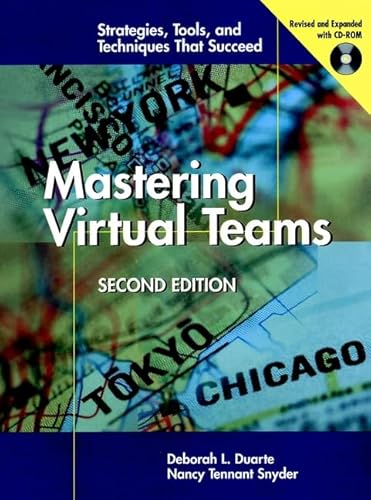
The original edition of "Mastering Virtual Teams" offered a first of its kind tool kit for leaders and members of virtual teams. Now, this revised and expanded second edition includes a CD-ROM packed with useful resources that allow virtual teams to access and use the book's many checklists, assessments, and other practical tools quickly and easily. The authors provide updated guidelines, strategies, and best practices for working cross-culturally and cross-functionally, across time and distance, to see a project through. The useful tools, exercises, and real-life examples show how anyone can master the unique dynamics of virtual team participation in an environment where the old rules no longer apply.
Die Inhaltsangabe kann sich auf eine andere Ausgabe dieses Titels beziehen.
Über die Autorin bzw. den Autor
DEBORAH L. DUARTE is assistant professor at George Washington University and an international consultant for clients that include The Gap, Freddie Mac, Nortel Networks, Johnson & Johnson, NASA, and Discovery Communications. NANCY TENNANT SNYDER is vice president, innovation and knowledge management, for Whirlpool Corporation and adjunct faculty member at the University of Michigan's MBA program.
Von der hinteren Coverseite
A Nuts–and–Bolts Guide to Virtual Teams––with a CD–ROM Full of Practical Resources
The original edition of Mastering Virtual Teams offered a first–of–its–kind tool kit for leaders and members of virtual teams. Now, this revised and expanded second edition includes a CD–ROM packed with useful resources that allow virtual teams to access and use the book′s many checklists, assessments, and other practical tools quickly and easily. The authors provide updated guidelines, strategies, and best practices for working cross–culturally and cross–functionally, across time and distance, to see a project through. The useful tools, exercises, and real–life examples show how anyone can master the unique dynamics of virtual team participation in an environment where the old rules no longer apply.
Praise for the First Edition
"Clear and practical guidance on one of the most pressing problems in every multinational enterprise––how to work across the boundaries of time, space, and culture. This book represents an important step forward in our fundamental understanding of succeeding in today′s global marketplace."
––David R. Whitwam, chairman and CEO, Whirlpool Corporation
"Most work in most organizations most of the time is done by teams. Many now need to be virtual. This book explains what, why, and how, with down–to–earth concepts and useful applications."
––Joseph White, dean, University of Michigan Business School
"This book is an important contribution to both practice and theory. The authors capture the full challenge of leading and working across traditional organizational boundaries and offer practical, sound guidance for leveraging maximum performance."
––Mark Linaugh, vice president, Time Inc.
"Duarte and Snyder are masterful at making an esoteric topic understandable. The exercises and tools are immediately applicable and work in any organization or culture."
––Nikki Adams, director of training, Seagate Technology
Aus dem Klappentext
No longer bound by the constraints of time and distance, today's managers are free to assemble the best talent they can find from wherever they can find it. But once these teams are in place, managers must also find ways to help the participants - who are often from widely different backgrounds - work smoothly together.
The acclaimed first edition of Mastering Virtual Teams was the first nuts-and-bolts guide for managers who must help people from different parts of the company, different countries, and different cultures work together effectively. In this newly revised second edition, the authors - both respected global management experts - have updated the contents to reflect the experience and feedback they have gained since the book was first published. In addition, they have included their insights and tools in a CD-ROM that offers new solutions to the unique challenges of working cross-culturally and cross-functionally.
Full of exercises, checklists, workshop agendas, competency assessments, and more, the CD-ROM works in tandem with the book to give hands-on guidance on how to facilitate virtual team meetings, track team results, and solve typical team problems. Readers can use the CD-ROM to tailor or customize the electronic tools for their own purpose or simple print them out and use them as is in their teams. The authors give step-by-step directions for putting these tools and techniques together and outline the skills that are critical for making them work. They show how to select technology that matches virtual teams' tasks, attitudes, and experience, and demonstrate ways to deal with the impact of culture on team performance, trust, and dynamics.
This unique book and CD-ROM combination provides managers and directors of global projects, internal and external trainers, and team leaders and members with a complete tool kit for accurately gauging and radically improving their virtual teams' effectiveness.
Auszug. © Genehmigter Nachdruck. Alle Rechte vorbehalten.
Chapter 1: Critical Success Factors
In today's business environment, organizations adapt quickly or die. Gaining competitive advantage in a global environment means continually reshaping the organization to maximize strengths, address threats, and increase speed.' The use of teams has become a common way of doing This. The formation of teams can draw talent quickly from different functions, locations, and organizations. The goal is to leverage intellectual capital and apply it as quickly as possible. The methods that organizations use to manage this process can mean the difference between success and failure.
Consider the example of a team in a global firm that produces durable goods. This product-development team, with members from around the world, had just completed the development of a new product. When the team unveiled the product to the senior staff of the organization, it included a description of the way the team worked. The presentation showed an icon of an airplane, with the entire team of twenty-two people traveling from country to country. The team members had continually moved from site to site for activities such as status reviews, design meetings, and prototyping sessions. The cost of the travel was tremendous, not only for hotels and airline tickets but also in terms of the human costs of being away from home and the lost work time and productivity.
Contrast this with the experiences of teams in organizations such as Hewlett Packard, the National Aeronautics and Space Administration (NASA), John Brown Engineers & Construction, DEC, and Rank Hovis.3 These organizations also form world-class teams to quickly address customer problems, develop products, and deliver services, but these teams often operate virtually, without the physical limitations of distance, time, and organizational boundaries. They use electronic collaboration technologies and other techniques to lower travel and facility costs, reduce project schedules, and improve decision-making time and communication.'' For many teams, traveling and having continual face-to-face meetings is not the most efficient or effective way of working.
Organizations that do not use virtual teams effectively may be fighting an uphill battle in a global, competitive, and rapidly changing environment. Organizations that will succeed in the next millennium have found new ways of working across boundaries through systems, processes, technology, and people.
Understanding how to work in or lead a virtual team is becoming a fundamental competence for people in many organizations. Virtual teams often are formed as a reaction to a business requirement or as a result of programs, such as telecommuting, that introduce new ways of working.
It is not uncommon to talk with people who lead or work in virtual teams who do not have a great deal of experience working on teams in a co-located environment. Most of the large consulting firms (Andersen Consulting is one primary example) do a large majority of their work virtually. Consultants who join these firms may never have the opportunity to work in or lead a traditional team in a co-located environment. They are immediately placed in situations that are more virtual than traditional. IBM has an entire unit in which employees telecommute, so new hires may never have a chance to work in a traditional office setting.
People who lead and work in virtual teams need to have special skills, including an understanding of human dynamics, knowledge of how to manage across functional areas and national cultures, and the ability to use communication technologies as their primary means of communicating and collaborating.
Types of Virtual Teams
There are many different configurations of virtual teams.' One of the central themes of this book is that the task affects how a virtual team is managed. Although virtual teams can undertake almost any kind of assignment, team leaders and members need to have a solid understanding of the type of virtual team they work in and the special challenges each type presents. What these teams have in common with all teams is that team members must communicate and collaborate to get work done and/or to produce a product. Virtual teams, unlike traditional ones, however, must accomplish this by working across distance, time, and/or organizational boundaries and by using technology to facilitate communication and collaboration. There are seven basic types of virtual teams:
Networked teams Parallel teams Project or product-development teams Work or production teams Service teams Management teams Action teams
Networked Teams
A networked virtual team consists of individuals who collaborate to achieve a common goal or purpose. Such teams frequently cross time, distance, and organizational boundaries. There typically is a lack of clear definition between a network team and the organization, in that membership frequently is diffuse and fluid, with team members rotating on and off the team as their expertise is needed. Team members may not even be aware of all the individuals, work teams, or organizations in the network.
Examples of this type of virtual team often are found in consulting firms and in high-technology organizations. For example, one group at Pricewaterhouse Coopers received a request from a client to quickly research and identify a set of best practices for managing the implementation of a large supply chain reengineering project. Although the consultants did not have all the answers themselves, they were able to tap into their network of external partners and internal and external databases and provide a set of best practices for the client by the end of the week.
Organizations that develop technological products also can use networked virtual teams. The National Aeronautics and Space Administration (NASA) uses a networked team for the Space Station Freedom Program. Team members come from over a dozen different nations and all NASA centers and include a large number of external suppliers, scientists, and corporate partners. Team members from different organizations come in and out of the network as their expertise is needed to make recommendations on the design and utilization of the Space Station.
Parallel Teams
Parallel virtual teams carry out special assignments, tasks, or functions that the regular organization does not want or is not equipped to perform...
„Über diesen Titel“ kann sich auf eine andere Ausgabe dieses Titels beziehen.
Suchergebnisse für Mastering Virtual Teams: Strategies, Tools and Techniques...

Foto des Verkäufers
Mastering Virtual Teams: Strategies, Tools, and Techniques That Succeed
Anbieter: -OnTimeBooks-, Phoenix, AZ, USA
Verkäuferbewertung 5 von 5 Sternen

Zustand: very_good. Gently read. May have name of previous ownership, or ex-library edition. Binding tight; spine straight and smooth, with no creasing; covers clean and crisp. Minimal signs of handling or shelving. 100% GUARANTEE! Shipped with delivery confirmation, if you're not satisfied with purchase please return item! Ships USPS Media Mail. Bestandsnummer des Verkäufers OTV.0787955892.VG
Gebraucht kaufen
EUR 6,29
Versand gratis
Versand innerhalb von USA
Versand innerhalb von USA
Anzahl: 1 verfügbar
Foto des Verkäufers
Mastering Virtual Teams: Strategies, Tools, and Techniques That Succeed
Anbieter: -OnTimeBooks-, Phoenix, AZ, USA
Verkäuferbewertung 5 von 5 Sternen
Zustand: good. A copy that has been read, remains in good condition. All pages are intact, and the cover is intact. The spine and cover show signs of wear. Pages can include notes and highlighting and show signs of wear, and the copy can include "From the library of" labels or previous owner inscriptions. 100% GUARANTEE! Shipped with delivery confirmation, if you're not satisfied with purchase please return item! Ships via media mail. Bestandsnummer des Verkäufers OTV.0787955892.G
Gebraucht kaufen
EUR 6,29
Versand gratis
Versand innerhalb von USA
Versand innerhalb von USA
Anzahl: 1 verfügbar
Beispielbild für diese ISBN
Mastering Virtual Teams: Strategies, Tools, and Techniques That Succeed
Anbieter: Wonder Book, Frederick, MD, USA
Verkäuferbewertung 5 von 5 Sternen
Zustand: Very Good. Very Good condition. Very Good dust jacket. A copy that may have a few cosmetic defects. May also contain light spine creasing or a few markings such as an owner's name, short gifter's inscription or light stamp. Bestandsnummer des Verkäufers P12B-03363
Gebraucht kaufen
EUR 6,43
Versand gratis
Versand innerhalb von USA
Versand innerhalb von USA
Anzahl: 1 verfügbar
Beispielbild für diese ISBN
Mastering Virtual Teams : Strategies, Tools, and Techniques That Succeed
Verlag:
Wiley & Sons, Incorporated, John, 2000
ISBN 10: 0787955892
ISBN 13: 9780787955892
Gebraucht
Hardcover
Anbieter: Better World Books, Mishawaka, IN, USA
Verkäuferbewertung 5 von 5 Sternen
Zustand: Good. 2nd Edition. Former library copy. Pages intact with minimal writing/highlighting. The binding may be loose and creased. Dust jackets/supplements are not included. Includes library markings. Stock photo provided. Product includes identifying sticker. Better World Books: Buy Books. Do Good. Bestandsnummer des Verkäufers GRP70456520
Gebraucht kaufen
EUR 6,51
Versand gratis
Versand innerhalb von USA
Versand innerhalb von USA
Anzahl: 1 verfügbar
Beispielbild für diese ISBN
Mastering Virtual Teams : Strategies, Tools, and Techniques That Succeed
Verlag:
Wiley & Sons, Incorporated, John, 2000
ISBN 10: 0787955892
ISBN 13: 9780787955892
Gebraucht
Hardcover
Anbieter: Better World Books: West, Reno, NV, USA
Verkäuferbewertung 5 von 5 Sternen
Zustand: Good. 2nd Edition. Former library copy. Pages intact with minimal writing/highlighting. The binding may be loose and creased. Dust jackets/supplements are not included. Includes library markings. Stock photo provided. Product includes identifying sticker. Better World Books: Buy Books. Do Good. Bestandsnummer des Verkäufers GRP70456520
Gebraucht kaufen
EUR 6,51
Versand gratis
Versand innerhalb von USA
Versand innerhalb von USA
Anzahl: 1 verfügbar
Foto des Verkäufers
Mastering Virtual Teams: Strategies, Tools, and Techniques That Succeed
Anbieter: ZBK Books, Carlstadt, NJ, USA
Verkäuferbewertung 5 von 5 Sternen
Zustand: very_good. Fast & Free Shipping â" Very Good condition book with a firm cover and clean pages. Shows normal use and some light wear or limited notes markings. A solid, nice copy to enjoy. Bestandsnummer des Verkäufers ZWV.0787955892.VG
Gebraucht kaufen
EUR 6,55
Versand gratis
Versand innerhalb von USA
Versand innerhalb von USA
Anzahl: 1 verfügbar
Beispielbild für diese ISBN
Mastering Virtual Teams: Strategies, Tools, and Techniques That Succeed
Anbieter: ThriftBooks-Atlanta, AUSTELL, GA, USA
Verkäuferbewertung 5 von 5 Sternen
Hardcover. Zustand: Very Good. No Jacket. May have limited writing in cover pages. Pages are unmarked. ~ ThriftBooks: Read More, Spend Less. Bestandsnummer des Verkäufers G0787955892I4N00
Gebraucht kaufen
EUR 7,25
Versand gratis
Versand innerhalb von USA
Versand innerhalb von USA
Anzahl: 1 verfügbar
Beispielbild für diese ISBN
Mastering Virtual Teams: Strategies, Tools, and Techniques That Succeed
Anbieter: The Maryland Book Bank, Baltimore, MD, USA
Verkäuferbewertung 5 von 5 Sternen
hardcover. Zustand: Very Good. 2nd Edition. Used - Very Good. Bestandsnummer des Verkäufers 6-O-6-0276
Gebraucht kaufen
EUR 3,58
EUR 4,19 Versand
Versand innerhalb von USA
Versand innerhalb von USA
Anzahl: 1 verfügbar
Beispielbild für diese ISBN
Mastering Virtual Teams: Strategies, Tools, and Techniques That Succeed
Anbieter: HPB-Red, Dallas, TX, USA
Verkäuferbewertung 5 von 5 Sternen
Hardcover. Zustand: Good. Connecting readers with great books since 1972! Used textbooks may not include companion materials such as access codes, etc. May have some wear or writing/highlighting. We ship orders daily and Customer Service is our top priority! Bestandsnummer des Verkäufers S_429144117
Gebraucht kaufen
EUR 4,60
EUR 3,35 Versand
Versand innerhalb von USA
Versand innerhalb von USA
Anzahl: 1 verfügbar
Foto des Verkäufers
Mastering Virtual Teams: Strategies, Tools, and Techniques That Succeed
Anbieter: Goodwill of Colorado, COLORADO SPRINGS, CO, USA
Verkäuferbewertung 5 von 5 Sternen
Zustand: very_good. Item may have minor cosmetic defects marks, wears, cuts, bends, crushes on the cover, spine, pages or dust cover. Shrink wrap, dust covers, or boxed set case may be missing. Item may contain remainder marks on outside edges, which should be noted in Product Details. Item may be missing bundled media. Bestandsnummer des Verkäufers COLV.0787955892.VG
Gebraucht kaufen
EUR 8,50
Versand gratis
Versand innerhalb von USA
Versand innerhalb von USA
Anzahl: 1 verfügbar