
Verwandte Artikel zu Pathways to Positive Development Among Diverse Youth:...
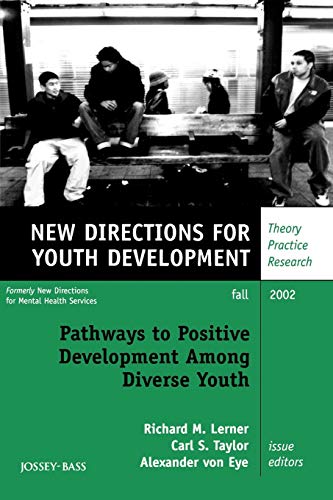
Pathways to Positive Development Among Diverse Youth: New Directions for Youth Development, No. 95: New Directions for Youth Development, Number 95 - Softcover
Inhaltsangabe
Positive youth development represents an emerging emphasis in developmental thinking that is focused on the incredible potential of adolescents to maintain healthy trajectories and develop resilience, even in the face of myriad negative influences. This volume discusses the theory, research, policy, and programs that take this strength-based, positive development approach to diverse youth. Examines theoretical ideas about the nature of positive youth development, and about the related concepts of thriving and well-being, as well as current and needed policy strategies, best practice in youth-serving programs, and promising community-based efforts to marshal the developmental assets of individuals and communities to enhance thriving among youth.
Die Inhaltsangabe kann sich auf eine andere Ausgabe dieses Titels beziehen.
Über die Autorin bzw. den Autor
RICHARD M. LERNER is the Bergstrom Chair in Applied Developmental Science in the Eliot-Pearson Department of Child Development at Tufts University.
CARL S. TAYLOR is professor in the Department of Family and Child Ecology at Michigan State University.
ALEXANDER VON EYE is professor in the Department of Psychology at Michigan State University.
Auszug. © Genehmigter Nachdruck. Alle Rechte vorbehalten.
Pathways to Positive Development Among Diverse Youth
New Directions for Youth Development, No. 95Jossey-Bass
Copyright © 2002 Richard M. Lerner, Carl S. Taylor and Alexander von EyeAll right reserved.
ISBN: 978-0-7879-6338-5
Chapter One
Issue Editors' Notes
ADAPTIVE REGULATION of behavior across the life span has been the focus of developmental research aimed at understanding how adolescents, amid the internal and contextual changes prototypic of this period of life, maintain positive, healthy trajectories. Current developmental systems theoretical models of adolescent development stress that individual differences in the positive or negative outcomes of adolescent regulatory behavior-of the processes that enable their resiliency-are produced by their history of person-context relations. These relations involve individual and contextual variables, seen as "fused" within a dynamic developmental system.
Recently, such models have been devised to understand the characteristics of change across life of racially, ethnically, and culturally diverse youth-specifically, the resiliency, or "adaptive mode," used by these adolescents and their family and community contexts to promote positive development. This emphasis on positive youth development constitutes a significant innovation in research, particularly within the adolescent period where young people are engaging in negative, unhealthy behaviors at a historically unprecedented level. The probability of engagement in adolescent problem behavior (for example, delinquency, violence, substance use, unsafe sex) is associated with poverty, and race is the single best predictor of poverty and its behavioral sequelae.
Yet amid such trends there are also numerous success stories of positive developmental outcomes among poor youth of color. For instance, there are many instances of positive, healthy development of African American male adolescents-arguably the group with the highest probability of experiencing the problematic behaviors associated with race and poverty in America. There is evidence that the bases of positive development of these youth-of their ability to "overcome the odds" against their positive development-lie in combinations of individual and ecological characteristics.
Given these data about the linkages among individual and ecological variables and positive development, this monograph discusses the theoretical, research, policy, and program dimensions of taking a strength-based, positive development approach to diverse youth. Theoretical ideas about the nature of positive youth development, and about the related concepts of thriving and well-being, are presented. In addition, there is discussion of current and needed policy strategies and of best practice in youth-serving programs and community-based efforts to marshal the developmental assets of individuals and communities to enhance thriving among young people. These issues of theory and application are illustrated by using data derived from several research centers seeking to better understand and enhance the lives of diverse youth.
First, findings are presented from an ongoing longitudinal study-termed "Overcoming the Odds" (OTO)-of the individual and ecological assets present among African American adolescent males living in poor, inner-city neighborhoods and involved either in a gang or a community-based, youth-serving organization. The goal of OTO is to identify the individual and contextual conditions that may protect African American male youth from actualizing risk (meaning, that may allow them to overcome the odds) and that in turn may promote positive (healthy, successful) development.
Data from OTO bear on key developmental systems theoretical ideas about the person-context relational character of human development and about the need for mutually beneficial alignment (that is, fostering resiliency, or promoting positive regulations) between individuals and institutions. Specifically, OTO is predicated on two instances of developmental systems models consistent with this perspective about the bases of positive youth development. The first is Margaret Beale Spencer's conception of ascertaining the "adaptive modes" used by children and youths of color to adjust to and prosper in their contexts; more generally OTO is predicated on her integrative approach to understanding, through her "phenomenological variant of ecological systems theory" (or PVEST) model, the role of multiple levels of the context on ethnic identity. The second is the work of Peter L. Benson and his colleagues at Search Institute on identifying individual and ecological developmental assets and on promoting positive development-and indeed, thriving-through integrating developmental assets across the adolescent years within the diverse communities of America. As such, reports from Spencer and her colleagues and from Benson are included in this issue.
The scholarship about positive youth development in the OTO project and in the work of Spencer and Benson is consistent as well with applied developmental research efforts to understand and deploy in systemic interventions the interrelated developmental and contextual bases of resilience among diverse young people. A leading center for such scholarship is led by Suniya S. Luthar, whose efforts have involved use of a person-context transactional model of developmental psychopathology to study risk and positive development among poor, inner-city youth and affluent adolescents living in wealthy suburban settings. She describes the nature and results of her program of work in this volume.
Finally, all research centers represented in this volume stress, within their respective ecological or developmental systems perspectives, the need to engage collaboratively all individuals and institutions within the community in the service of youth. The William T. Grant Foundation has championed a vision of such communitywide, asset-integrating efforts to support making progress in American society in fostering healthy developmental pathways for youth. Robert C. Granger, executive vice president of the foundation, describes a new conceptual model for understanding the range of interventions that may be used to create intentional change in the developmental system to promote positive youth development. He explains that these interventions encompass strategies seeking to enhance among people, organizations, communities, or systems either the will to institute efforts for such change or the capacity for furthering such change. The perspective and efforts of this foundation offer a capstone vision for the volume in regard to future directions for integrated research and practice activities seeking to enhance the life chances of all youth and to increase the probability of their leading lives marked by psychosocial and physical health and thriving.
In sum, this issue discusses how theory, research, and applications may fit our needs to create effective, appropriately scaled, and sustainable pathways for developing healthy and productive young people. All contributions to the volume share the vision that successful efforts to promote positive youth development rest on moving beyond prevention strategies, to research and practice intended to promote thriving and development through preparing youths to become fully engaged, active citizens. In such work, all sectors of society-and, most centrally, young people and their families-must be active, productive, and collaborative partners.
Richard M. Lerner Carl S....
„Über diesen Titel“ kann sich auf eine andere Ausgabe dieses Titels beziehen.
Suchergebnisse für Pathways to Positive Development Among Diverse Youth:...

Beispielbild für diese ISBN
Pathways to Positive Development Among Diverse Youth: New Directions for Youth Development, No. 95
Anbieter: Wonder Book, Frederick, MD, USA
Verkäuferbewertung 5 von 5 Sternen

Zustand: Very Good. Very Good condition. 2002 edition. Volume 95 A copy that may have a few cosmetic defects. May also contain light spine creasing or a few markings such as an owner's name, short gifter's inscription or light stamp. Bundled media such as CDs, DVDs, floppy disks or access codes may not be included. Bestandsnummer des Verkäufers S09B-05374
Gebraucht kaufen
EUR 6,33
Versand gratis
Versand innerhalb von USA
Versand innerhalb von USA
Anzahl: 1 verfügbar
Beispielbild für diese ISBN
Pathways to Positive Development Among Diverse Youth: New Directions for Youth Development, Number 95
Verlag:
John Wiley & Sons, Inc., 2002
ISBN 10: 0787963380
ISBN 13: 9780787963385
Gebraucht
Paperback
Anbieter: ThriftBooks-Dallas, Dallas, TX, USA
Verkäuferbewertung 5 von 5 Sternen
Paperback. Zustand: Good. No Jacket. Pages can have notes/highlighting. Spine may show signs of wear. ~ ThriftBooks: Read More, Spend Less. Bestandsnummer des Verkäufers G0787963380I3N00
Gebraucht kaufen
EUR 7,68
Versand gratis
Versand innerhalb von USA
Versand innerhalb von USA
Anzahl: 1 verfügbar
Beispielbild für diese ISBN
Pathways to Positive Development Among Diverse Youth: New Directions for Youth Development, Number 95
Verlag:
John Wiley & Sons, Inc., 2002
ISBN 10: 0787963380
ISBN 13: 9780787963385
Gebraucht
Paperback
Anbieter: ThriftBooks-Dallas, Dallas, TX, USA
Verkäuferbewertung 5 von 5 Sternen
Paperback. Zustand: As New. No Jacket. Pages are clean and are not marred by notes or folds of any kind. ~ ThriftBooks: Read More, Spend Less. Bestandsnummer des Verkäufers G0787963380I2N00
Gebraucht kaufen
EUR 7,68
Versand gratis
Versand innerhalb von USA
Versand innerhalb von USA
Anzahl: 1 verfügbar