
Verwandte Artikel zu The Symposium and the Phaedrus Plato's Erotic Dialogues:...
The Symposium and the Phaedrus Plato's Erotic Dialogues: Plato's Erotic Dialogues (S U N Y Series in Ancient Greek Philosophy) - Softcover
Buch 3 von 64: SUNY series in Ancient Greek Philosophy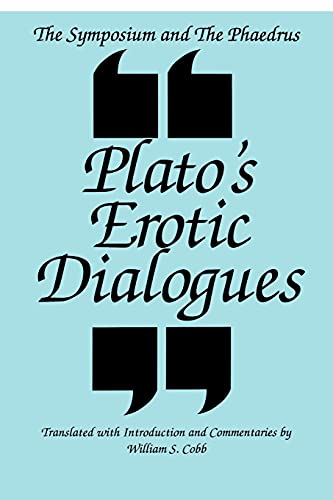
Inhaltsangabe
The Symposium and the Phaedrus are combined here because of their shared theme: a reflection on the nature of erotic love, the love that begins with sexual desire but can transcend that origin and reach even the heights of religious ecstasy. This reflection is carried out explicitly in the speeches and conversations in the dialogues, and implicitly in the dramatic depiction of actions and characters. Thus, the two dialogues deal with a theme of enduring interest and are interesting for both their literary and their philosophical character.
In addition to the introduction, the book contains substantial commentaries and thorough endnotes. Key Greek terms are discussed for readers who are unfamiliar with the language. A special feature is a discussion on the importance of the dramatic and literary aspects of the dialogues for interpreting their philosophical content.
The introductions deal with the nature of the dialogues themselves as philosophical texts and with Plato's philosophical assumptions and key concepts, as well as with the necessary background of Athenian society. The endnotes clarify any ambiguities and obscurities in the original text, identifying all references to people, places, gods, et cetera.
The commentaries are designed to open up the dialogues for the reader, showing the issues that have been debated by commentators and considering some of the responses to them. They are designed to stimulate further reflection.
Die Inhaltsangabe kann sich auf eine andere Ausgabe dieses Titels beziehen.
Über die Autorin bzw. den Autor
Plato was an ancient Greek philosopher born in Athens during the Classical period in Ancient Greece. In Athens, Plato founded the Academy, a philosophical school where he taught the philosophical doctrines that would later become known as Platonism. Plato (or Platon) was a pen name derived, apparently, from the nickname given to him by his wrestling coach - allegedly a reference to his physical broadness. According to Alexander of Miletus quoted by Diogenes of Sinope his actual name was Aristocles, son of Ariston, of the deme Collytus (Collytus being a district of Athens).Plato was an innovator of the written dialogue and dialectic forms in philosophy. He raised problems for what later became all the major areas of both theoretical philosophy and practical philosophy. His most famous contribution is the Theory of forms, which has been interpreted as advancing a solution to what is now known as the problem of universals. He is also the namesake of Platonic love and the Platonic solids.His own most decisive philosophical influences are usually thought to have been, along with Socrates, the pre-Socratics Pythagoras, Heraclitus, and Parmenides, although few of his predecessors' works remain extant and much of what we know about these figures today derives from Plato himself.[a]Along with his teacher, Socrates, and his student, Aristotle, Plato is a central figure in the history of philosophy.[b] Unlike the work of nearly all of his contemporaries, Plato's entire body of work is believed to have survived intact for over 2,400 years.[6] Although their popularity has fluctuated, Plato's works have consistently been read and studied. Through Neoplatonism Plato also greatly influenced both Christian and Islamic philosophy (through e.g. Al-Farabi). In modern times, Alfred North Whitehead famously said: "the safest general characterization of the European philosophical tradition is that it consists of a series of footnotes to Plato.
„Über diesen Titel“ kann sich auf eine andere Ausgabe dieses Titels beziehen.
Suchergebnisse für The Symposium and the Phaedrus Plato's Erotic Dialogues:...

Beispielbild für diese ISBN
The Symposium and the Phaedrus: Plato's Erotic Dialogues
Verlag:
State University of New York Press, 1993
ISBN 10: 0791416186
ISBN 13: 9780791416181
Gebraucht
Paperback
Anbieter: World of Books (was SecondSale), Montgomery, IL, USA
Verkäuferbewertung 5 von 5 Sternen

Paperback. Zustand: Good. The Symposium and the Phaedrus are combined here because of their shared theme: a reflection on the nature of erotic love, the love that begins with sexual desire but can transcend that origin and reach even the heights of religious ecstasy. This reflection is carried out explicitly in the speeches and conversations in the dialogues, and implicitly in the dramatic depiction of actions and characters. Thus, the two dialogues deal with a theme of enduring interest and are interesting for both their literary and their philosophical character.In addition to the introduction, the book contains substantial commentaries and thorough endnotes. Key Greek terms are discussed for readers who are unfamiliar with the language. A special feature is a discussion on the importance of the dramatic and literary aspects of the dialogues for interpreting their philosophical content.The introductions deal with the nature of the dialogues themselves as philosophical texts and with Plato's philosophical assumptions and key concepts, as well as with the necessary background of Athenian society. The endnotes clarify any ambiguities and obscurities in the original text, identifying all references to people, places, gods, et cetera.The commentaries are designed to open up the dialogues for the reader, showing the issues that have been debated by commentators and considering some of the responses to them. They are designed to stimulate further reflection. Bestandsnummer des Verkäufers CIN0791416186G
Gebraucht kaufen
EUR 5,74
Versand gratis
Versand innerhalb von USA
Versand innerhalb von USA
Anzahl: 1 verfügbar
Beispielbild für diese ISBN
The Symposium and the Phaedrus: Plato's Erotic Dialogues (Ancient Greek Philosophy)
Verlag:
State University of New York Press (edition ), 1993
ISBN 10: 0791416186
ISBN 13: 9780791416181
Gebraucht
Paperback
Anbieter: BooksRun, Philadelphia, PA, USA
Verkäuferbewertung 5 von 5 Sternen
Paperback. Zustand: Fair. The item might be beaten up but readable. May contain markings or highlighting, as well as stains, bent corners, or any other major defect, but the text is not obscured in any way. Bestandsnummer des Verkäufers 0791416186-7-1
Gebraucht kaufen
EUR 5,75
Versand gratis
Versand innerhalb von USA
Versand innerhalb von USA
Anzahl: 2 verfügbar
Beispielbild für diese ISBN
The Symposium and the Phaedrus Plato's Erotic Dialogues: Plato's Erotic Dialogues (S U N Y Series in Ancient Greek Philosophy)
Verlag:
State University of New York Pre, 1993
ISBN 10: 0791416186
ISBN 13: 9780791416181
Gebraucht
Paperback
Anbieter: Open Books, Chicago, IL, USA
Verkäuferbewertung 5 von 5 Sternen
Paperback. Zustand: Acceptable. Light edge wear. Contains a few pages with highlights. Otherwise, fine. Open Books is a nonprofit social venture that provides literacy experiences for thousands of readers each year through inspiring programs and creative capitalization of books. Bestandsnummer des Verkäufers mon0000854953
Gebraucht kaufen
EUR 2,72
EUR 3,58 Versand
Versand innerhalb von USA
Versand innerhalb von USA
Anzahl: 1 verfügbar
Foto des Verkäufers
The Symposium and the Phaedrus: Plato's Erotic Dialogues (Ancient Greek Philosophy)
Verlag:
State University of New York Press, 1993
ISBN 10: 0791416186
ISBN 13: 9780791416181
Gebraucht
Softcover
Anbieter: Goodwill Books, Hillsboro, OR, USA
Verkäuferbewertung 5 von 5 Sternen
Zustand: acceptable. Fairly worn, but readable and intact. If applicable: Dust jacket, disc or access code may not be included. Bestandsnummer des Verkäufers GICWV.0791416186.A
Gebraucht kaufen
EUR 2,72
EUR 3,58 Versand
Versand innerhalb von USA
Versand innerhalb von USA
Anzahl: 1 verfügbar
Beispielbild für diese ISBN
The Symposium and the Phaedrus: Plato's Erotic Dialogues
Verlag:
State University of New York Press, 1993
ISBN 10: 0791416186
ISBN 13: 9780791416181
Gebraucht
Paperback
Anbieter: ThriftBooks-Atlanta, AUSTELL, GA, USA
Verkäuferbewertung 5 von 5 Sternen
Paperback. Zustand: Very Good. No Jacket. May have limited writing in cover pages. Pages are unmarked. ~ ThriftBooks: Read More, Spend Less. Bestandsnummer des Verkäufers G0791416186I4N00
Gebraucht kaufen
EUR 6,35
Versand gratis
Versand innerhalb von USA
Versand innerhalb von USA
Anzahl: 1 verfügbar
Beispielbild für diese ISBN
The Symposium and the Phaedrus: Plato's Erotic Dialogues
Verlag:
State University of New York Press, 1993
ISBN 10: 0791416186
ISBN 13: 9780791416181
Gebraucht
Paperback
Anbieter: ThriftBooks-Atlanta, AUSTELL, GA, USA
Verkäuferbewertung 5 von 5 Sternen
Paperback. Zustand: Good. No Jacket. Pages can have notes/highlighting. Spine may show signs of wear. ~ ThriftBooks: Read More, Spend Less. Bestandsnummer des Verkäufers G0791416186I3N00
Gebraucht kaufen
EUR 6,35
Versand gratis
Versand innerhalb von USA
Versand innerhalb von USA
Anzahl: 1 verfügbar
Beispielbild für diese ISBN
The Symposium and the Phaedrus: Plato's Erotic Dialogues
Verlag:
State University of New York Press, 1993
ISBN 10: 0791416186
ISBN 13: 9780791416181
Gebraucht
Paperback
Anbieter: ThriftBooks-Atlanta, AUSTELL, GA, USA
Verkäuferbewertung 5 von 5 Sternen
Paperback. Zustand: Fair. No Jacket. Readable copy. Pages may have considerable notes/highlighting. ~ ThriftBooks: Read More, Spend Less. Bestandsnummer des Verkäufers G0791416186I5N00
Gebraucht kaufen
EUR 6,35
Versand gratis
Versand innerhalb von USA
Versand innerhalb von USA
Anzahl: 1 verfügbar
Beispielbild für diese ISBN
The Symposium and the Phaedrus: Plato's Erotic Dialogues
Verlag:
State University of New York Press, 1993
ISBN 10: 0791416186
ISBN 13: 9780791416181
Gebraucht
Paperback
Anbieter: ThriftBooks-Dallas, Dallas, TX, USA
Verkäuferbewertung 5 von 5 Sternen
Paperback. Zustand: Fair. No Jacket. Former library book; Readable copy. Pages may have considerable notes/highlighting. ~ ThriftBooks: Read More, Spend Less. Bestandsnummer des Verkäufers G0791416186I5N10
Gebraucht kaufen
EUR 6,35
Versand gratis
Versand innerhalb von USA
Versand innerhalb von USA
Anzahl: 1 verfügbar
Beispielbild für diese ISBN
The Symposium and the Phaedrus: Plato's Erotic Dialogues
Verlag:
State University of New York Press, 1993
ISBN 10: 0791416186
ISBN 13: 9780791416181
Gebraucht
Paperback
Anbieter: World of Books Inc, Montgomery, IL, USA
Verkäuferbewertung 4 von 5 Sternen

Paperback. Zustand: Good. The Symposium and the Phaedrus are combined here because of their shared theme: a reflection on the nature of erotic love, the love that begins with sexual desire but can transcend that origin and reach even the heights of religious ecstasy. This reflection is carried out explicitly in the speeches and conversations in the dialogues, and implicitly in the dramatic depiction of actions and characters. Thus, the two dialogues deal with a theme of enduring interest and are interesting for both their literary and their philosophical character.In addition to the introduction, the book contains substantial commentaries and thorough endnotes. Key Greek terms are discussed for readers who are unfamiliar with the language. A special feature is a discussion on the importance of the dramatic and literary aspects of the dialogues for interpreting their philosophical content.The introductions deal with the nature of the dialogues themselves as philosophical texts and with Plato's philosophical assumptions and key concepts, as well as with the necessary background of Athenian society. The endnotes clarify any ambiguities and obscurities in the original text, identifying all references to people, places, gods, et cetera.The commentaries are designed to open up the dialogues for the reader, showing the issues that have been debated by commentators and considering some of the responses to them. They are designed to stimulate further reflection. Bestandsnummer des Verkäufers CIN0791416186G
Gebraucht kaufen
EUR 7,59
Versand gratis
Versand innerhalb von USA
Versand innerhalb von USA
Anzahl: 1 verfügbar
Beispielbild für diese ISBN
The Symposium and the Phaedrus : Plato's Erotic Dialogues
Verlag:
State University of New York Press, 1993
ISBN 10: 0791416186
ISBN 13: 9780791416181
Gebraucht
Softcover
Anbieter: Better World Books: West, Reno, NV, USA
Verkäuferbewertung 5 von 5 Sternen
Zustand: Fine. Used book that is in almost brand-new condition. May contain a remainder mark. Better World Books: Buy Books. Do Good. Bestandsnummer des Verkäufers 14924872-75
Gebraucht kaufen
EUR 8,38
Versand gratis
Versand innerhalb von USA
Versand innerhalb von USA
Anzahl: 1 verfügbar