
Verwandte Artikel zu Alchemy of the Word: Cabala of the Renaissance (SUNY...
Alchemy of the Word: Cabala of the Renaissance (SUNY Series in Western Esoteric Traditions) - Softcover
Inhaltsangabe
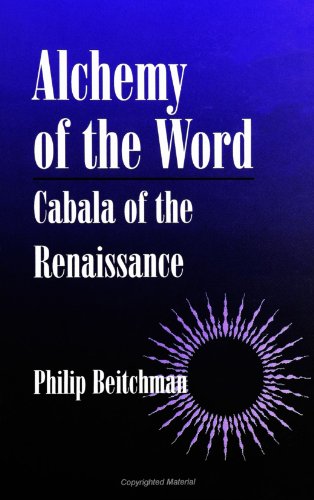
Alchemy of the Word is a study of the literary, philosophical, and cultural ramifications of Cabala during the Renaissance. Important intellectual figures from 1490 to 1690 are considered, including Agrippa, Dee, Spenser, Shakespeare, Browne, and Milton; Cabala's more recent impact is also discussed. Cabala, a hermeneutic style of Biblical commentary of Jewish origin, is based on the notion that, along with an inscribed Decalogue, Moses received a secret, oral supplement that provides a symbolic, allegorical, and moral qualification of the literal law of religion.
Building on the work of Gershom Scholem, Joseph Blau, Harold Bloom, François Secret, Michel de Certeau, and Arthur Waite, Beitchman takes a fresh look at the "mystical" text through the lens of postmodernist theory. In a model developed from Deleuze-Guattari's "nomadology" to explore issues related to the Zohar, he shows that Cabala was a deconstruction of Renaissance authority. Like deconstruction, Cabala presents familiar material from novel and sometimes provocative perspectives. It allows space for modifiability, tolerance and humanity, by widening the margins between the letter of the law and the demands of an existence whose rules were so rapidly changing.
An exercise in the literary analysis of "sacred texts" and an examination of the mystical element in literary works, Alchemy of the Word is also an experiment in new historicism. It shows how the reincarnation theories of F. M. Van Helmont, which impacted heavily on the seventeenth century English cabalistic circle of Henry More and Ann Conway, demonstrate at once the originality and boldness of Cabala, but also its desperation, constituting a theoretical parallel to the continental "acting out" of the Sabbatian heresy. Because of the debacle of the Sabbatian apostasy (conversion to Islam), Cabala subsequently declined in importance as a religious devotion, becoming either a matter of cults and heterodoxies or being sublimated into literary theory and practice.
Die Inhaltsangabe kann sich auf eine andere Ausgabe dieses Titels beziehen.
Über die Autorin bzw. den Autor
Philip Beitchman, author of I Am a Process With No Subject, has also translated books by Jean Baudrillard and Paul Virilio from French to English.
„Über diesen Titel“ kann sich auf eine andere Ausgabe dieses Titels beziehen.
Suchergebnisse für Alchemy of the Word: Cabala of the Renaissance (SUNY...

Foto des Verkäufers
Alchemy of the Word: Cabala of the Renaissance (Western Esoteric Traditions)
Verlag:
State University of New York Press, 1998
ISBN 10: 0791437388
ISBN 13: 9780791437384
Gebraucht
Soft cover
Anbieter: Zap Books, Van Nuys, CA, USA
Verkäuferbewertung 5 von 5 Sternen

Soft cover. Zustand: Good. Packed in a RIGID mailer. Pages: not written on, clean, bright, odor free. Cover: rubbing to edges and corner tips. See Photos! Ships from California. Ships same or next day (weekdays and Saturdays)! ABOUT: Alchemy of the Word is a study of the literary, philosophical, and cultural ramifications of Cabala during the Renaissance. Important intellectual figures from 1490 to 1690 are considered, including Agrippa, Dee, Spenser, Shakespeare, Browne, and Milton; Cabala's more recent impact is also discussed. Cabala, a hermeneutic style of Biblical commentary of Jewish origin, is based on the notion that, along with an inscribed Decalogue, Moses received a secret, oral supplement that provides a symbolic, allegorical, and moral qualification of the literal law of religion. Building on the work of Gershom Scholem, Joseph Blau, Harold Bloom, Francois Secret, Michel de Certeau, and Arthur Waite, Beitchman takes a fresh look at the "mystical" text through the lens of postmodernist theory. In a model developed from Deleuze-Guattari's "nomadology" to explore issues related to the Zohar, he shows that Cabala was a deconstruction of Renaissance authority. Like deconstruction, Cabala presents familiar material from novel and sometimes provocative perspectives. It allows space for modifiability, tolerance and humanity, by widening the margins between the letter of the law and the demands of an existence whose rules were so rapidly changing. Bestandsnummer des Verkäufers ABE-1762654149659
Gebraucht kaufen
EUR 14,67
EUR 3,55 Versand
Versand innerhalb von USA
Versand innerhalb von USA
Anzahl: 1 verfügbar
Foto des Verkäufers
Alchemy of the Word: Cabala of the Renaissance
Verlag:
Albany: SUNY Press, 1998, 1998
ISBN 10: 0791437388
ISBN 13: 9780791437384
Gebraucht
Soft cover
Erstausgabe
Anbieter: Atlantic Bookshop, Brooklyn, NY, USA
Verkäuferbewertung 5 von 5 Sternen
Soft cover. Zustand: Very Good. 1st Edition. 8vo, card covers, xiv, 364pp. First printing. VG+: a clean, bright, very sound copy with just a hint of soiling to the head. Bestandsnummer des Verkäufers ATLPBAotWCotR
Gebraucht kaufen
EUR 18,35
EUR 5,34 Versand
Versand innerhalb von USA
Versand innerhalb von USA
Anzahl: 1 verfügbar
Beispielbild für diese ISBN
Alchemy of the Word: Cabala of the Renaissance
Verlag:
State University Of New York Press, Albany, NY, 1998
ISBN 10: 0791437388
ISBN 13: 9780791437384
Gebraucht
Paperback
Erstausgabe
Anbieter: Black Cat Hill Books, Oregon City, OR, USA
Verkäuferbewertung 5 von 5 Sternen
Paperback. Zustand: Near Fine. First Edition Thus (1998) ; First Printing indicated by a complete numerical sequence. Very Near Fine in Wraps: shows only the most minute indications of use: just a hint of 'wrinkling near the outside edge of the front panel; else flawless; the binding is secure; the text is clean. Free of creases to the back-strip. Free of any creased or dog-eared pages in the text. Free of any underlining, hi-lighting or marginalia or marks in the text. Free of ownership names, dates, addresses, notations, inscriptions, stamps, or labels. A handsome, nearly-new copy, structurally sound and tightly bound, showing a single imperfection. Bright and clean. Corners sharp. Very close to 'As New'. NOT a Remainder, Book-Club, or Ex-Library. 8vo (8.9 x 5.9 x 0.85 inches) . Language: English. Weight: 17.5 ounces. Suny Series in Western Esoteric Traditions. The hardcover edition appears to have been published in 1998 also. University Press Paperback. ; Suny Series in Western Esoteric Traditions; 8vo 8" - 9" tall; xiv, 364 pages First Edition Thus [1989]; First Printing indicated; First Printing. Bestandsnummer des Verkäufers 59768
Gebraucht kaufen
EUR 22,94
EUR 5,57 Versand
Versand innerhalb von USA
Versand innerhalb von USA
Anzahl: 1 verfügbar
Foto des Verkäufers
Alchemy of the Word: Cabala of the Renaissance (Western Esoteric Traditions)
Verlag:
State University of New York Press, 1998
ISBN 10: 0791437388
ISBN 13: 9780791437384
Neu
Softcover
Anbieter: Solr Books, Lincolnwood, IL, USA
Verkäuferbewertung 5 von 5 Sternen
Zustand: new. Bestandsnummer des Verkäufers BCV.0791437388.N
Neu kaufen
EUR 22,40
EUR 7,11 Versand
Versand innerhalb von USA
Versand innerhalb von USA
Anzahl: 1 verfügbar
Beispielbild für diese ISBN
Alchemy of the Word: Cabala of the Renaissance (SUNY series in Western Esoteric Traditions)
Verlag:
State University of New York, New York, 1998
ISBN 10: 0791437388
ISBN 13: 9780791437384
Gebraucht
Soft cover
Anbieter: Used Esoteric Books, Fairfax, CA, USA
Verkäuferbewertung 5 von 5 Sternen
Soft cover. Zustand: Fine. David Appelbaum, editor. Softcover, 5.75 x 9, 364 pp. [==] Fine. Appears unread. Slight shelfwear. Bestandsnummer des Verkäufers 0489
Gebraucht kaufen
EUR 32,11
EUR 3,56 Versand
Versand innerhalb von USA
Versand innerhalb von USA
Anzahl: 1 verfügbar
Beispielbild für diese ISBN
Alchemy of the Word
Anbieter: PBShop.store US, Wood Dale, IL, USA
Verkäuferbewertung 5 von 5 Sternen
PAP. Zustand: New. New Book. Shipped from UK. Established seller since 2000. Bestandsnummer des Verkäufers CX-9780791437384
Beispielbild für diese ISBN
Alchemy of the Word
Anbieter: PBShop.store UK, Fairford, GLOS, Vereinigtes Königreich
Verkäuferbewertung 5 von 5 Sternen
PAP. Zustand: New. New Book. Shipped from UK. Established seller since 2000. Bestandsnummer des Verkäufers CX-9780791437384
Neu kaufen
EUR 32,88
EUR 5,98 Versand
Versand von Vereinigtes Königreich nach USA
Versand von Vereinigtes Königreich nach USA
Anzahl: 15 verfügbar
Foto des Verkäufers
Alchemy of the Word : Cabala of the Renaissance
Verlag:
State University of New York Press, 1998
ISBN 10: 0791437388
ISBN 13: 9780791437384
Neu
Softcover
Anbieter: GreatBookPrices, Columbia, MD, USA
Verkäuferbewertung 5 von 5 Sternen
Zustand: New. Bestandsnummer des Verkäufers 271366-n
Neu kaufen
EUR 37,86
EUR 2,35 Versand
Versand innerhalb von USA
Versand innerhalb von USA
Anzahl: Mehr als 20 verfügbar
Foto des Verkäufers
Alchemy of the Word : Cabala of the Renaissance
Verlag:
State University of New York Press, 1998
ISBN 10: 0791437388
ISBN 13: 9780791437384
Gebraucht
Softcover
Anbieter: GreatBookPrices, Columbia, MD, USA
Verkäuferbewertung 5 von 5 Sternen
Zustand: As New. Unread book in perfect condition. Bestandsnummer des Verkäufers 271366
Gebraucht kaufen
EUR 43,67
EUR 2,35 Versand
Versand innerhalb von USA
Versand innerhalb von USA
Anzahl: Mehr als 20 verfügbar
Foto des Verkäufers
Alchemy of the Word: Cabala of the Renaissance (Paperback or Softback)
Verlag:
State University of New York Press 4/9/1998, 1998
ISBN 10: 0791437388
ISBN 13: 9780791437384
Neu
Paperback or Softback
Anbieter: BargainBookStores, Grand Rapids, MI, USA
Verkäuferbewertung 5 von 5 Sternen
Paperback or Softback. Zustand: New. Alchemy of the Word: Cabala of the Renaissance. Book. Bestandsnummer des Verkäufers BBS-9780791437384