
Verwandte Artikel zu Inquiry, Forms, and Substances: A Study in Plato’s...
Inquiry, Forms, and Substances: A Study in Plato’s Metaphysics and Epistemology (Philosophical Studies Series, 62, Band 62) - Hardcover
Buch 40 von 134: Philosophical Studies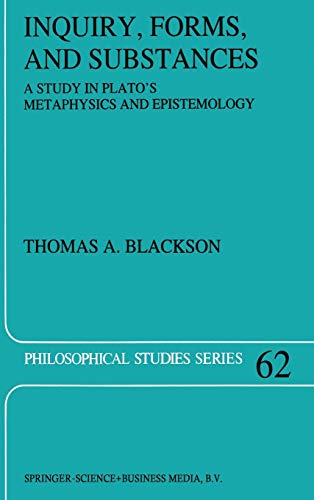
Inhaltsangabe
i. Introductory remarks 1 Plato, but not Socrates, concluded that the Forms are substances. Whether the Forms are substances is not an issue that Socrates had in mind. He did not deny it, but neither did he affirm it. If Socrates were asked a series of questions designed to determine whether he believed that the Forms are substances, he would admit that he had no opinion about this philosophical issue. Unlike Plato, Socrates was not a metaphysician. The same, of course, would not have always been true of Plato. Unlike Socrates, he was a metaphysician. At some point in his career, and at least by the time of the Phaedo and the Republic, Plato did what Socrates never thought to do. Plato considered the question and concluded that the Forms are substances. Although this development occurred more than two thousand years ago, time has not eclipsed its importance. It is one of the most seminal events in the history of the philosophy. With his defense of Socrates's method of intellectual inquiry, and the development of his Theory of Forms, Plato caused a now familiar cluster of metaphysical and epistemological issues to become central to philosophy.
Die Inhaltsangabe kann sich auf eine andere Ausgabe dieses Titels beziehen.
Suchergebnisse für Inquiry, Forms, and Substances: A Study in Plato’s...

Foto des Verkäufers
Inquiry, Forms, and Substances: A Study in Plato's Metaphysics and Epistemology
Anbieter: Bookbot, Prague, Tschechien
Verkäuferbewertung 5 von 5 Sternen

Hardcover. Zustand: As New. Leichte Kratzer / Abnutzungen / Druckstellen. i. Introductory remarks 1 Plato, but not Socrates, concluded that the Forms are substances. Whether the Forms are substances is not an issue that Socrates had in mind. He did not deny it, but neither did he affirm it. If Socrates were asked a series of questions designed to determine whether he believed that the Forms are substances, he would admit that he had no opinion about this philosophical issue. Unlike Plato, Socrates was not a metaphysician. The same, of course, would not have always been true of Plato. Unlike Socrates, he was a metaphysician. At some point in his career, and at least by the time of the Phaedo and the Republic, Plato did what Socrates never thought to do. Plato considered the question and concluded that the Forms are substances. Although this development occurred more than two thousand years ago, time has not eclipsed its importance. It is one of the most seminal events in the history of the philosophy. With his defense of Socrates's method of intellectual inquiry, and the development of his Theory of Forms, Plato caused a now familiar cluster of metaphysical and epistemological issues to become central to philosophy. Bestandsnummer des Verkäufers 1391984d-0e9b-43cd-8279-94818f595e80
Gebraucht kaufen
EUR 12,89
EUR 20,99 Versand
Versand von Tschechien nach USA
Versand von Tschechien nach USA
Anzahl: 1 verfügbar
Beispielbild für diese ISBN
Inquiry, Forms, and Substances : A Study in Plato's Metaphysics and Epistemology
Anbieter: Better World Books, Mishawaka, IN, USA
Verkäuferbewertung 5 von 5 Sternen
Zustand: Good. Former library copy. Pages intact with minimal writing/highlighting. The binding may be loose and creased. Dust jackets/supplements are not included. Includes library markings. Stock photo provided. Product includes identifying sticker. Better World Books: Buy Books. Do Good. Bestandsnummer des Verkäufers 68481199-6
Gebraucht kaufen
EUR 47,23
Versand gratis
Versand innerhalb von USA
Versand innerhalb von USA
Anzahl: 1 verfügbar
Beispielbild für diese ISBN
Inquiry, Forms, and Substances: A Study in Plato's Metaphysics and Epistemology (Philosophical Studies Series, 62)
Anbieter: Ria Christie Collections, Uxbridge, Vereinigtes Königreich
Verkäuferbewertung 5 von 5 Sternen
Zustand: New. In English. Bestandsnummer des Verkäufers ria9780792332756_new
Neu kaufen
EUR 116,40
EUR 13,17 Versand
Versand von Vereinigtes Königreich nach USA
Versand von Vereinigtes Königreich nach USA
Anzahl: Mehr als 20 verfügbar
Foto des Verkäufers
Inquiry, Forms, and Substances
Verlag:
Springer Netherlands Jan 1995, 1995
ISBN 10: 079233275X
ISBN 13: 9780792332756
Neu
Hardcover
Anbieter: BuchWeltWeit Ludwig Meier e.K., Bergisch Gladbach, Deutschland
Verkäuferbewertung 5 von 5 Sternen
Buch. Zustand: Neu. This item is printed on demand - it takes 3-4 days longer - Neuware -i. Introductory remarks 1 Plato, but not Socrates, concluded that the Forms are substances. Whether the Forms are substances is not an issue that Socrates had in mind. He did not deny it, but neither did he affirm it. If Socrates were asked a series of questions designed to determine whether he believed that the Forms are substances, he would admit that he had no opinion about this philosophical issue. Unlike Plato, Socrates was not a metaphysician. The same, of course, would not have always been true of Plato. Unlike Socrates, he was a metaphysician. At some point in his career, and at least by the time of the Phaedo and the Republic, Plato did what Socrates never thought to do. Plato considered the question and concluded that the Forms are substances. Although this development occurred more than two thousand years ago, time has not eclipsed its importance. It is one of the most seminal events in the history of the philosophy. With his defense of Socrates's method of intellectual inquiry, and the development of his Theory of Forms, Plato caused a now familiar cluster of metaphysical and epistemological issues to become central to philosophy. 240 pp. Englisch. Bestandsnummer des Verkäufers 9780792332756
Neu kaufen
EUR 106,99
EUR 23,00 Versand
Versand von Deutschland nach USA
Versand von Deutschland nach USA
Anzahl: 2 verfügbar
Beispielbild für diese ISBN
Inquiry, Forms and Substances
Anbieter: Kennys Bookshop and Art Galleries Ltd., Galway, GY, Irland
Verkäuferbewertung 5 von 5 Sternen
Zustand: New. Suitable for philosophers in general, graduate students, and advanced undergraduate students, this title offers an explanation of the origin of the Theory of Forms that is true both to the dialogues and to Plato's place in history. Series: Philosophical Studies Series. Num Pages: 237 pages, biography. BIC Classification: 1QDAG; HPCA. Category: (P) Professional & Vocational; (UP) Postgraduate, Research & Scholarly; (UU) Undergraduate. Dimension: 229 x 152 x 18. Weight in Grams: 504. . 1995. Hardback. . . . . Bestandsnummer des Verkäufers V9780792332756
Neu kaufen
EUR 130,04
EUR 9,50 Versand
Versand von Irland nach USA
Versand von Irland nach USA
Anzahl: 15 verfügbar
Foto des Verkäufers
Inquiry, Forms, and Substances
Print-on-DemandAnbieter: moluna, Greven, Deutschland
Verkäuferbewertung 5 von 5 Sternen
Gebunden. Zustand: New. Dieser Artikel ist ein Print on Demand Artikel und wird nach Ihrer Bestellung fuer Sie gedruckt. i. Introductory remarks 1 Plato, but not Socrates, concluded that the Forms are substances. Whether the Forms are substances is not an issue that Socrates had in mind. He did not deny it, but neither did he affirm it. If Socrates were asked a series of ques. Bestandsnummer des Verkäufers 5967332
Neu kaufen
EUR 92,27
EUR 48,99 Versand
Versand von Deutschland nach USA
Versand von Deutschland nach USA
Anzahl: Mehr als 20 verfügbar
Foto des Verkäufers
Inquiry, Forms, and Substances | A Study in Plato's Metaphysics and Epistemology
Print-on-DemandAnbieter: preigu, Osnabrück, Deutschland
Verkäuferbewertung 5 von 5 Sternen
Buch. Zustand: Neu. Inquiry, Forms, and Substances | A Study in Plato's Metaphysics and Epistemology | Thomas Blackson | Buch | Philosophical Studies Series | Einband - fest (Hardcover) | Englisch | 1995 | Springer | EAN 9780792332756 | Verantwortliche Person für die EU: Springer Nature Customer Service Center GmbH, Europaplatz 3, 69115 Heidelberg, productsafety[at]springernature[dot]com | Anbieter: preigu Print on Demand. Bestandsnummer des Verkäufers 107465712
Neu kaufen
EUR 95,70
EUR 70,00 Versand
Versand von Deutschland nach USA
Versand von Deutschland nach USA
Anzahl: 5 verfügbar
Beispielbild für diese ISBN
Inquiry, Forms, and Substances: A Study in Plato's Metaphysics and Epistemology
Anbieter: Revaluation Books, Exeter, Vereinigtes Königreich
Verkäuferbewertung 5 von 5 Sternen
Hardcover. Zustand: Brand New. 1st edition. 236 pages. 9.50x6.75x1.00 inches. In Stock. Bestandsnummer des Verkäufers x-079233275X
Neu kaufen
EUR 154,90
EUR 11,66 Versand
Versand von Vereinigtes Königreich nach USA
Versand von Vereinigtes Königreich nach USA
Anzahl: 2 verfügbar
Foto des Verkäufers
Inquiry, Forms, and Substances
Print-on-DemandAnbieter: buchversandmimpf2000, Emtmannsberg, BAYE, Deutschland
Verkäuferbewertung 5 von 5 Sternen
Buch. Zustand: Neu. This item is printed on demand - Print on Demand Titel. Neuware -i. Introductory remarks 1 Plato, but not Socrates, concluded that the Forms are substances. Whether the Forms are substances is not an issue that Socrates had in mind. He did not deny it, but neither did he affirm it. If Socrates were asked a series of questions designed to determine whether he believed that the Forms are substances, he would admit that he had no opinion about this philosophical issue. Unlike Plato, Socrates was not a metaphysician. The same, of course, would not have always been true of Plato. Unlike Socrates, he was a metaphysician. At some point in his career, and at least by the time of the Phaedo and the Republic, Plato did what Socrates never thought to do. Plato considered the question and concluded that the Forms are substances. Although this development occurred more than two thousand years ago, time has not eclipsed its importance. It is one of the most seminal events in the history of the philosophy. With his defense of Socrates's method of intellectual inquiry, and the development of his Theory of Forms, Plato caused a now familiar cluster of metaphysical and epistemological issues to become central to philosophy.Springer-Verlag KG, Sachsenplatz 4-6, 1201 Wien 240 pp. Englisch. Bestandsnummer des Verkäufers 9780792332756
Neu kaufen
EUR 106,99
EUR 60,00 Versand
Versand von Deutschland nach USA
Versand von Deutschland nach USA
Anzahl: 1 verfügbar
Beispielbild für diese ISBN
Inquiry, Forms and Substances
Anbieter: Kennys Bookstore, Olney, MD, USA
Verkäuferbewertung 5 von 5 Sternen
Zustand: New. Suitable for philosophers in general, graduate students, and advanced undergraduate students, this title offers an explanation of the origin of the Theory of Forms that is true both to the dialogues and to Plato's place in history. Series: Philosophical Studies Series. Num Pages: 237 pages, biography. BIC Classification: 1QDAG; HPCA. Category: (P) Professional & Vocational; (UP) Postgraduate, Research & Scholarly; (UU) Undergraduate. Dimension: 229 x 152 x 18. Weight in Grams: 504. . 1995. Hardback. . . . . Books ship from the US and Ireland. Bestandsnummer des Verkäufers V9780792332756
Neu kaufen
EUR 163,79
EUR 9,15 Versand
Versand innerhalb von USA
Versand innerhalb von USA
Anzahl: 15 verfügbar