
Verwandte Artikel zu Solution of Crack Problems: The Distributed Dislocation...
Solution of Crack Problems: The Distributed Dislocation Technique (Solid Mechanics and Its Applications, 44, Band 44) - Hardcover
Inhaltsangabe
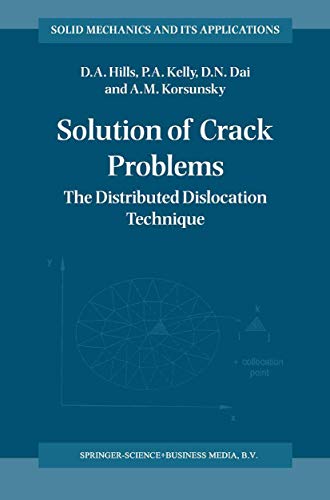
This book is concerned with the numerical solution of crack problems. The techniques to be developed are particularly appropriate when cracks are relatively short, and are growing in the neighbourhood of some stress raising feature, causing a relatively steep stress gradient. It is therefore practicable to represent the geometry in an idealised way, so that a precise solution may be obtained. This contrasts with, say, the finite element method in which the geometry is modelled exactly, but the subsequent solution is approximate, and computationally more taxing. The family of techniques presented in this book, based loosely on the pioneering work of Eshelby in the late 1950's, and developed by Erdogan, Keer, Mura and many others cited in the text, present an attractive alternative. The basic idea is to use the superposition of the stress field present in the unfiawed body, together with an unknown distribution of 'strain nuclei' (in this book, the strain nucleus employed is the dislocation), chosen so that the crack faces become traction-free. The solution used for the stress field for the nucleus is chosen so that other boundary conditions are satisfied. The technique is therefore efficient, and may be used to model the evolution of a developing crack in two or three dimensions. Solution techniques are described in some detail, and the book should be readily accessible to most engineers, whilst preserving the rigour demanded by the researcher who wishes to develop the method itself.
Die Inhaltsangabe kann sich auf eine andere Ausgabe dieses Titels beziehen.
Suchergebnisse für Solution of Crack Problems: The Distributed Dislocation...

Beispielbild für diese ISBN
Solution of Crack Problems: The Distributed Dislocation Technique
Anbieter: La bataille des livres, Pradinas, Frankreich
Verkäuferbewertung 5 von 5 Sternen

Zustand: Très bon. Solution of Crack Problems: The Distributed Dislocation Technique | D.A. Hills, P.A. Kelly, D.N. Dai, A.M. Korsunsky | Kluwer academic publisher, 1996. In-8° cartonné, 297p. Couverture propre. Dos solide. Intérieur frais sans soulignage ou annotation. Exemplaire de bibliothèque : petit code barre en pied de 1re de couv., cotation au dos, rares et discrets petits tampons à l'intérieur de l'ouvrage. Très bon état général [Ba38+] Pour les expéditions internationales, nous consulter au préalable pour l ajustement des frais de port qui seront peut-être revus à la baisse/ For international shipments, please contact us in advance to adjust shipping costs. |. Bestandsnummer des Verkäufers JT-IGIX-03XM
Gebraucht kaufen
EUR 80,00
EUR 65,00 Versand
Versand von Frankreich nach USA
Versand von Frankreich nach USA
Anzahl: 1 verfügbar
Beispielbild für diese ISBN
Solution of Crack Problems: The Distributed Dislocation Technique (Solid Mechanics and Its Applications, 44)
Anbieter: Phatpocket Limited, Waltham Abbey, HERTS, Vereinigtes Königreich
Verkäuferbewertung 5 von 5 Sternen
Zustand: Good. Used - Good. Your purchase helps support Sri Lankan Children's Charity 'The Rainbow Centre.' Ex-library, but has been well cared for. Our donations to The Rainbow Centre have helped provide an education and a safe haven to hundreds of children who live in appalling conditions. Bestandsnummer des Verkäufers Z1-R-005-00984
Gebraucht kaufen
EUR 132,74
EUR 12,54 Versand
Versand von Vereinigtes Königreich nach USA
Versand von Vereinigtes Königreich nach USA
Anzahl: 1 verfügbar
Foto des Verkäufers
Solution of Crack Problems
Verlag:
Springer Netherlands Feb 1996, 1996
ISBN 10: 0792338480
ISBN 13: 9780792338482
Neu
Hardcover
Anbieter: BuchWeltWeit Ludwig Meier e.K., Bergisch Gladbach, Deutschland
Verkäuferbewertung 5 von 5 Sternen
Buch. Zustand: Neu. This item is printed on demand - it takes 3-4 days longer - Neuware -This book is concerned with the numerical solution of crack problems. The techniques to be developed are particularly appropriate when cracks are relatively short, and are growing in the neighbourhood of some stress raising feature, causing a relatively steep stress gradient. It is therefore practicable to represent the geometry in an idealised way, so that a precise solution may be obtained. This contrasts with, say, the finite element method in which the geometry is modelled exactly, but the subsequent solution is approximate, and computationally more taxing. The family of techniques presented in this book, based loosely on the pioneering work of Eshelby in the late 1950's, and developed by Erdogan, Keer, Mura and many others cited in the text, present an attractive alternative. The basic idea is to use the superposition of the stress field present in the unfiawed body, together with an unknown distribution of 'strain nuclei' (in this book, the strain nucleus employed is the dislocation), chosen so that the crack faces become traction-free. The solution used for the stress field for the nucleus is chosen so that other boundary conditions are satisfied. The technique is therefore efficient, and may be used to model the evolution of a developing crack in two or three dimensions. Solution techniques are described in some detail, and the book should be readily accessible to most engineers, whilst preserving the rigour demanded by the researcher who wishes to develop the method itself. 324 pp. Englisch. Bestandsnummer des Verkäufers 9780792338482
Neu kaufen
EUR 160,49
EUR 23,00 Versand
Versand von Deutschland nach USA
Versand von Deutschland nach USA
Anzahl: 2 verfügbar
Foto des Verkäufers
Solution of Crack Problems
Print-on-DemandAnbieter: moluna, Greven, Deutschland
Verkäuferbewertung 5 von 5 Sternen
Gebunden. Zustand: New. Dieser Artikel ist ein Print on Demand Artikel und wird nach Ihrer Bestellung fuer Sie gedruckt. This book is concerned with the numerical solution of crack problems. The techniques to be developed are particularly appropriate when cracks are relatively short, and are growing in the neighbourhood of some stress raising feature, causing a relatively ste. Bestandsnummer des Verkäufers 5967655
Neu kaufen
EUR 136,16
EUR 48,99 Versand
Versand von Deutschland nach USA
Versand von Deutschland nach USA
Anzahl: Mehr als 20 verfügbar
Beispielbild für diese ISBN
Solution of Crack Problems : The Distributed Dislocation Technique
Anbieter: GreatBookPrices, Columbia, MD, USA
Verkäuferbewertung 5 von 5 Sternen
Zustand: New. Bestandsnummer des Verkäufers 2612104-n
Neu kaufen
EUR 190,90
EUR 2,35 Versand
Versand innerhalb von USA
Versand innerhalb von USA
Anzahl: 15 verfügbar
Beispielbild für diese ISBN
Solution of Crack Problems: The Distributed Dislocation Technique (Solid Mechanics and Its Applications, 44)
Anbieter: Ria Christie Collections, Uxbridge, Vereinigtes Königreich
Verkäuferbewertung 5 von 5 Sternen
Zustand: New. In English. Bestandsnummer des Verkäufers ria9780792338482_new
Neu kaufen
EUR 184,36
EUR 13,31 Versand
Versand von Vereinigtes Königreich nach USA
Versand von Vereinigtes Königreich nach USA
Anzahl: Mehr als 20 verfügbar
Foto des Verkäufers
Solution of Crack Problems : The Distributed Dislocation Technique
Anbieter: AHA-BUCH GmbH, Einbeck, Deutschland
Verkäuferbewertung 5 von 5 Sternen
Buch. Zustand: Neu. Druck auf Anfrage Neuware - Printed after ordering - This book is concerned with the numerical solution of crack problems. The techniques to be developed are particularly appropriate when cracks are relatively short, and are growing in the neighbourhood of some stress raising feature, causing a relatively steep stress gradient. It is therefore practicable to represent the geometry in an idealised way, so that a precise solution may be obtained. This contrasts with, say, the finite element method in which the geometry is modelled exactly, but the subsequent solution is approximate, and computationally more taxing. The family of techniques presented in this book, based loosely on the pioneering work of Eshelby in the late 1950's, and developed by Erdogan, Keer, Mura and many others cited in the text, present an attractive alternative. The basic idea is to use the superposition of the stress field present in the unfiawed body, together with an unknown distribution of 'strain nuclei' (in this book, the strain nucleus employed is the dislocation), chosen so that the crack faces become traction-free. The solution used for the stress field for the nucleus is chosen so that other boundary conditions are satisfied. The technique is therefore efficient, and may be used to model the evolution of a developing crack in two or three dimensions. Solution techniques are described in some detail, and the book should be readily accessible to most engineers, whilst preserving the rigour demanded by the researcher who wishes to develop the method itself. Bestandsnummer des Verkäufers 9780792338482
Neu kaufen
EUR 170,19
EUR 35,00 Versand
Versand von Deutschland nach USA
Versand von Deutschland nach USA
Anzahl: 1 verfügbar
Foto des Verkäufers
Solution of Crack Problems | The Distributed Dislocation Technique
Print-on-DemandAnbieter: preigu, Osnabrück, Deutschland
Verkäuferbewertung 5 von 5 Sternen
Buch. Zustand: Neu. Solution of Crack Problems | The Distributed Dislocation Technique | D. A. Hills (u. a.) | Buch | Solid Mechanics and Its Applications | xii | Englisch | 1996 | Springer | EAN 9780792338482 | Verantwortliche Person für die EU: Springer Verlag GmbH, Tiergartenstr. 17, 69121 Heidelberg, juergen[dot]hartmann[at]springer[dot]com | Anbieter: preigu Print on Demand. Bestandsnummer des Verkäufers 102452804
Neu kaufen
EUR 141,20
EUR 70,00 Versand
Versand von Deutschland nach USA
Versand von Deutschland nach USA
Anzahl: 5 verfügbar
Beispielbild für diese ISBN
Solution of Crack Problems
Anbieter: Kennys Bookshop and Art Galleries Ltd., Galway, GY, Irland
Verkäuferbewertung 5 von 5 Sternen
Zustand: New. This work describes numerical and semi-analytical techniques for determining stress intensity factors for cracks - the quantities which determine and control the fatigue life of engineering components. Series: Solid Mechanics and its Applications. Num Pages: 320 pages, biography. BIC Classification: TGMD5. Category: (P) Professional & Vocational; (XV) Technical / Manuals. Dimension: 234 x 156 x 19. Weight in Grams: 631. . 1996. Hardback. . . . . Bestandsnummer des Verkäufers V9780792338482
Neu kaufen
EUR 201,84
EUR 9,50 Versand
Versand von Irland nach USA
Versand von Irland nach USA
Anzahl: 15 verfügbar
Foto des Verkäufers
Solution of Crack Problems
Print-on-DemandAnbieter: buchversandmimpf2000, Emtmannsberg, BAYE, Deutschland
Verkäuferbewertung 5 von 5 Sternen
Buch. Zustand: Neu. This item is printed on demand - Print on Demand Titel. Neuware -This book is concerned with the numerical solution of crack problems. The techniques to be developed are particularly appropriate when cracks are relatively short, and are growing in the neighbourhood of some stress raising feature, causing a relatively steep stress gradient. It is therefore practicable to represent the geometry in an idealised way, so that a precise solution may be obtained. This contrasts with, say, the finite element method in which the geometry is modelled exactly, but the subsequent solution is approximate, and computationally more taxing. The family of techniques presented in this book, based loosely on the pioneering work of Eshelby in the late 1950's, and developed by Erdogan, Keer, Mura and many others cited in the text, present an attractive alternative. The basic idea is to use the superposition of the stress field present in the unfiawed body, together with an unknown distribution of 'strain nuclei' (in this book, the strain nucleus employed is the dislocation), chosen so that the crack faces become traction-free. The solution used for the stress field for the nucleus is chosen so that other boundary conditions are satisfied. The technique is therefore efficient, and may be used to model the evolution of a developing crack in two or three dimensions. Solution techniques are described in some detail, and the book should be readily accessible to most engineers, whilst preserving the rigour demanded by the researcher who wishes to develop the method itself.Springer-Verlag KG, Sachsenplatz 4-6, 1201 Wien 324 pp. Englisch. Bestandsnummer des Verkäufers 9780792338482
Neu kaufen
EUR 160,49
EUR 60,00 Versand
Versand von Deutschland nach USA
Versand von Deutschland nach USA
Anzahl: 1 verfügbar