
Verwandte Artikel zu Automated Deduction - A Basis for Applications Volume...
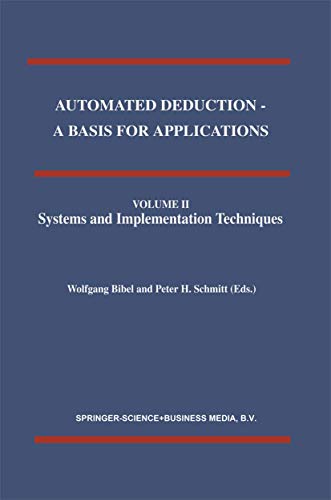
Automated Deduction - A Basis for Applications Volume I Foundations - Calculi and Methods Volume II Systems and Implementation Techniques Volume III Applications (Applied Logic Series, 9, Band 9) - Hardcover
Inhaltsangabe
1. BASIC CONCEPTS OF INTERACTIVE THEOREM PROVING Interactive Theorem Proving ultimately aims at the construction of powerful reasoning tools that let us (computer scientists) prove things we cannot prove without the tools, and the tools cannot prove without us. Interaction typi cally is needed, for example, to direct and control the reasoning, to speculate or generalize strategic lemmas, and sometimes simply because the conjec ture to be proved does not hold. In software verification, for example, correct versions of specifications and programs typically are obtained only after a number of failed proof attempts and subsequent error corrections. Different interactive theorem provers may actually look quite different: They may support different logics (first-or higher-order, logics of programs, type theory etc.), may be generic or special-purpose tools, or may be tar geted to different applications. Nevertheless, they share common concepts and paradigms (e.g. architectural design, tactics, tactical reasoning etc.). The aim of this chapter is to describe the common concepts, design principles, and basic requirements of interactive theorem provers, and to explore the band width of variations. Having a 'person in the loop', strongly influences the design of the proof tool: proofs must remain comprehensible, - proof rules must be high-level and human-oriented, - persistent proof presentation and visualization becomes very important.
Die Inhaltsangabe kann sich auf eine andere Ausgabe dieses Titels beziehen.
Suchergebnisse für Automated Deduction - A Basis for Applications Volume...

Foto des Verkäufers
Automated Deduction - A Basis for Applications Volume I Foundations - Calculi and Methods Volume II Systems and Implementation Techniques Volume III Applications
Print-on-DemandAnbieter: moluna, Greven, Deutschland
Verkäuferbewertung 5 von 5 Sternen

Zustand: New. Dieser Artikel ist ein Print on Demand Artikel und wird nach Ihrer Bestellung fuer Sie gedruckt. 1. BASIC CONCEPTS OF INTERACTIVE THEOREM PROVING Interactive Theorem Proving ultimately aims at the construction of powerful reasoning tools that let us (computer scientists) prove things we cannot prove without the tools, and the tools cannot prove without. Bestandsnummer des Verkäufers 5968510
Neu kaufen
EUR 180,07
EUR 48,99 Versand
Versand von Deutschland nach USA
Versand von Deutschland nach USA
Anzahl: Mehr als 20 verfügbar
Foto des Verkäufers
Automated Deduction - a Basis for Applications Volume I Foundations - Calculi and Methods Volume II Systems and Implementation Techniques Volume III Applications
Anbieter: GreatBookPrices, Columbia, MD, USA
Verkäuferbewertung 5 von 5 Sternen
Zustand: New. Bestandsnummer des Verkäufers 4901699-n
Neu kaufen
EUR 239,07
EUR 2,35 Versand
Versand innerhalb von USA
Versand innerhalb von USA
Anzahl: 15 verfügbar
Beispielbild für diese ISBN
Automated Deduction - A Basis for Applications Volume I Foundations - Calculi and Methods Volume II Systems and Implementation Techniques Volume III Applications (Applied Logic Series, 9)
Anbieter: Ria Christie Collections, Uxbridge, Vereinigtes Königreich
Verkäuferbewertung 5 von 5 Sternen
Zustand: New. In English. Bestandsnummer des Verkäufers ria9780792351306_new
Neu kaufen
EUR 255,49
EUR 13,45 Versand
Versand von Vereinigtes Königreich nach USA
Versand von Vereinigtes Königreich nach USA
Anzahl: Mehr als 20 verfügbar
Foto des Verkäufers
Automated Deduction - A Basis for Applications Volume I Foundations - Calculi and Methods Volume II Systems and Implementation Techniques Volume III Applications
Print-on-DemandAnbieter: buchversandmimpf2000, Emtmannsberg, BAYE, Deutschland
Verkäuferbewertung 5 von 5 Sternen
Buch. Zustand: Neu. This item is printed on demand - Print on Demand Titel. Neuware -1. BASIC CONCEPTS OF INTERACTIVE THEOREM PROVING Interactive Theorem Proving ultimately aims at the construction of powerful reasoning tools that let us (computer scientists) prove things we cannot prove without the tools, and the tools cannot prove without us. Interaction typi cally is needed, for example, to direct and control the reasoning, to speculate or generalize strategic lemmas, and sometimes simply because the conjec ture to be proved does not hold. In software verification, for example, correct versions of specifications and programs typically are obtained only after a number of failed proof attempts and subsequent error corrections. Different interactive theorem provers may actually look quite different: They may support different logics (first-or higher-order, logics of programs, type theory etc.), may be generic or special-purpose tools, or may be tar geted to different applications. Nevertheless, they share common concepts and paradigms (e.g. architectural design, tactics, tactical reasoning etc.). The aim of this chapter is to describe the common concepts, design principles, and basic requirements of interactive theorem provers, and to explore the band width of variations. Having a 'person in the loop', strongly influences the design of the proof tool: proofs must remain comprehensible, - proof rules must be high-level and human-oriented, - persistent proof presentation and visualization becomes very important.Springer-Verlag KG, Sachsenplatz 4-6, 1201 Wien 452 pp. Englisch. Bestandsnummer des Verkäufers 9780792351306
Neu kaufen
EUR 213,99
EUR 60,00 Versand
Versand von Deutschland nach USA
Versand von Deutschland nach USA
Anzahl: 1 verfügbar
Foto des Verkäufers
Automated Deduction - A Basis for Applications Volume I Foundations - Calculi and Methods Volume II Systems and Implementation Techniques Volume III Applications
Anbieter: AHA-BUCH GmbH, Einbeck, Deutschland
Verkäuferbewertung 5 von 5 Sternen
Buch. Zustand: Neu. Druck auf Anfrage Neuware - Printed after ordering - 1. BASIC CONCEPTS OF INTERACTIVE THEOREM PROVING Interactive Theorem Proving ultimately aims at the construction of powerful reasoning tools that let us (computer scientists) prove things we cannot prove without the tools, and the tools cannot prove without us. Interaction typi cally is needed, for example, to direct and control the reasoning, to speculate or generalize strategic lemmas, and sometimes simply because the conjec ture to be proved does not hold. In software verification, for example, correct versions of specifications and programs typically are obtained only after a number of failed proof attempts and subsequent error corrections. Different interactive theorem provers may actually look quite different: They may support different logics (first-or higher-order, logics of programs, type theory etc.), may be generic or special-purpose tools, or may be tar geted to different applications. Nevertheless, they share common concepts and paradigms (e.g. architectural design, tactics, tactical reasoning etc.). The aim of this chapter is to describe the common concepts, design principles, and basic requirements of interactive theorem provers, and to explore the band width of variations. Having a 'person in the loop', strongly influences the design of the proof tool: proofs must remain comprehensible, - proof rules must be high-level and human-oriented, - persistent proof presentation and visualization becomes very important. Bestandsnummer des Verkäufers 9780792351306
Neu kaufen
EUR 241,76
EUR 35,00 Versand
Versand von Deutschland nach USA
Versand von Deutschland nach USA
Anzahl: 1 verfügbar
Foto des Verkäufers
Automated Deduction - A Basis for Applications Volume I Foundations - Calculi and Methods Volume II Systems and Implementation Techniques Volume III Applications
Print-on-DemandAnbieter: BuchWeltWeit Ludwig Meier e.K., Bergisch Gladbach, Deutschland
Verkäuferbewertung 5 von 5 Sternen
Buch. Zustand: Neu. This item is printed on demand - it takes 3-4 days longer - Neuware -1. BASIC CONCEPTS OF INTERACTIVE THEOREM PROVING Interactive Theorem Proving ultimately aims at the construction of powerful reasoning tools that let us (computer scientists) prove things we cannot prove without the tools, and the tools cannot prove without us. Interaction typi cally is needed, for example, to direct and control the reasoning, to speculate or generalize strategic lemmas, and sometimes simply because the conjec ture to be proved does not hold. In software verification, for example, correct versions of specifications and programs typically are obtained only after a number of failed proof attempts and subsequent error corrections. Different interactive theorem provers may actually look quite different: They may support different logics (first-or higher-order, logics of programs, type theory etc.), may be generic or special-purpose tools, or may be tar geted to different applications. Nevertheless, they share common concepts and paradigms (e.g. architectural design, tactics, tactical reasoning etc.). The aim of this chapter is to describe the common concepts, design principles, and basic requirements of interactive theorem provers, and to explore the band width of variations. Having a 'person in the loop', strongly influences the design of the proof tool: proofs must remain comprehensible, - proof rules must be high-level and human-oriented, - persistent proof presentation and visualization becomes very important. 452 pp. Englisch. Bestandsnummer des Verkäufers 9780792351306
Neu kaufen
EUR 269,64
EUR 23,00 Versand
Versand von Deutschland nach USA
Versand von Deutschland nach USA
Anzahl: 2 verfügbar
Beispielbild für diese ISBN
Automated Deduction - A Basis for Applications Volume I Foundations - Calculi and Methods Volume II Systems and Implementation Techniques Volume III Applications
Anbieter: Books Puddle, Woodside, NY, USA
Verkäuferbewertung 4 von 5 Sternen

Zustand: New. pp. 452. Bestandsnummer des Verkäufers 26554718
Neu kaufen
EUR 307,22
EUR 3,55 Versand
Versand innerhalb von USA
Versand innerhalb von USA
Anzahl: 4 verfügbar
Beispielbild für diese ISBN
Automated Deduction - A Basis for Applications Volume I Foundations - Calculi and Methods Volume II Systems and Implementation Techniques Volume III Applications
Print-on-DemandAnbieter: Majestic Books, Hounslow, Vereinigtes Königreich
Verkäuferbewertung 4 von 5 Sternen
Zustand: New. Print on Demand pp. 452 52:B&W 6.14 x 9.21in or 234 x 156mm (Royal 8vo) Case Laminate on White w/Gloss Lam. Bestandsnummer des Verkäufers 8374529
Neu kaufen
EUR 327,68
EUR 7,74 Versand
Versand von Vereinigtes Königreich nach USA
Versand von Vereinigtes Königreich nach USA
Anzahl: 4 verfügbar
Beispielbild für diese ISBN
Automated Deduction - A Basis for Applications Volume I Foundations - Calculi and Methods Volume II Systems and Implementation Techniques Volume III Applications
Print-on-DemandAnbieter: Biblios, Frankfurt am main, HESSE, Deutschland
Verkäuferbewertung 4 von 5 Sternen
Zustand: New. PRINT ON DEMAND pp. 452. Bestandsnummer des Verkäufers 18554708
Neu kaufen
EUR 326,82
EUR 9,95 Versand
Versand von Deutschland nach USA
Versand von Deutschland nach USA
Anzahl: 4 verfügbar
Foto des Verkäufers
Automated Deduction - a Basis for Applications Volume I Foundations - Calculi and Methods Volume II Systems and Implementation Techniques Volume III Applications
Anbieter: GreatBookPrices, Columbia, MD, USA
Verkäuferbewertung 5 von 5 Sternen
Zustand: As New. Unread book in perfect condition. Bestandsnummer des Verkäufers 4901699
Gebraucht kaufen
EUR 415,06
EUR 2,35 Versand
Versand innerhalb von USA
Versand innerhalb von USA
Anzahl: 15 verfügbar