
Verwandte Artikel zu Chronology and Evolution of Mars: Proceedings of an...
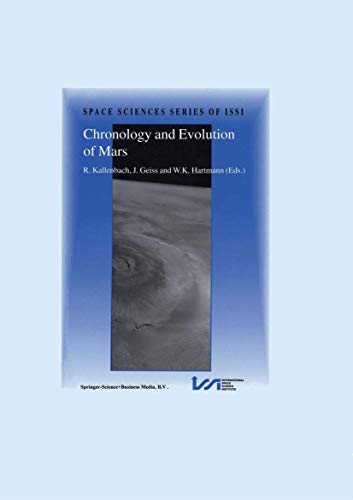
Chronology and Evolution of Mars: Proceedings of an ISSI Workshop, 10–14 April 2000, Bern, Switzerland (Space Sciences Series of ISSI, 12, Band 12) - Hardcover
Inhaltsangabe
Mars is about one-eighth the mass of the Earth and it may provide an analogue of what the Earth was like when it was at such an early stage of accretion. The fur ther growth of the Earth was sustained by major collisions with planetesimals and planets such as that which resulted in the formation ofthe Earth's moon (Hartmann and Davis, 1975; Cameron and Ward, 1976; Wetherill, 1986; Cameron and Benz, 1991). This late accretionary history, which lasted more than 50 Myr in the case of the Earth (Halliday, 2000a, b), appears to have been shorter and less catastrophic in the case of Mars (Harper et ai. , 1995; Lee and Halliday, 1997). In this article we review the basic differences between the bulk composition of Mars and the Earth and the manner in which this plays into our understanding of the timing and mechanisms of accretion and core formation. We highlight some of the evidence for early cessation of major collisional growth on Mars. Finally, we reevaluate the isotopic evidence that Mars differentiated quickly. Fundamental differences between the composition of Mars and that of other terrestrial planets are apparent from the planet's slightly lower density and from the compositions of Martian meteorites. The low density is partially explicable if there is a greater proportion of more volatile elements.
Die Inhaltsangabe kann sich auf eine andere Ausgabe dieses Titels beziehen.
Suchergebnisse für Chronology and Evolution of Mars: Proceedings of an...

Foto des Verkäufers
Chronology and evolution of Mars. Proceedings of an ISSI workshop, 10-14 April 2000, Bern, Switzerland.
Verlag:
Dordrecht, Kluwer Academic Publishers, 2001
ISBN 10: 0792370511
ISBN 13: 9780792370512
Gebraucht
Hardcover
Anbieter: Antiquariat Bookfarm, Löbnitz, Deutschland
Verkäuferbewertung 5 von 5 Sternen

Hardcover. Zustand: Gut. ix, 491 S. Ehem. Bibliotheksexemplar mit Signatur und Stempel. GUTER Zustand, ein paar Gebrauchsspuren. Ex-library with stamp and library-signature. GOOD condition, some traces of use. w04759 9780792370512 Sprache: Englisch Gewicht in Gramm: 1100. Bestandsnummer des Verkäufers 2429583
Gebraucht kaufen
EUR 47,99
EUR 40,00 Versand
Versand von Deutschland nach USA
Versand von Deutschland nach USA
Anzahl: 1 verfügbar
Beispielbild für diese ISBN
Chronology and Evolution of Mars: Proceedings of an ISSI Workshop, 10?14 April 2000, Bern, Switzerland (Space Sciences Series of ISSI (12))
Anbieter: suspiratio - online bücherstube lic.phil h.b., Basel, Schweiz
Verkäuferbewertung 4 von 5 Sternen

Hardcover. Zustand: Gut bis sehr gut. 1. Auflage. vignette auf vorblatt, gut, eher sehr gut, nur geringe lagerspuren, 498 seiten LAGER A-893. Bestandsnummer des Verkäufers A-648-Vtg
Gebraucht kaufen
EUR 48,00
EUR 45,00 Versand
Versand von Schweiz nach USA
Versand von Schweiz nach USA
Anzahl: 1 verfügbar
Foto des Verkäufers
Chronology and Evolution of Mars: Proceedings of an ISSI Workshop, 10â"14 April 2000, Bern, Switzerland (Space Sciences Series of ISSI, 12)
Anbieter: -OnTimeBooks-, Phoenix, AZ, USA
Verkäuferbewertung 5 von 5 Sternen
Zustand: very_good. Gently read. May have name of previous ownership, or ex-library edition. Binding tight; spine straight and smooth, with no creasing; covers clean and crisp. Minimal signs of handling or shelving. 100% GUARANTEE! Shipped with delivery confirmation, if you're not satisfied with purchase please return item! Ships USPS Media Mail. Bestandsnummer des Verkäufers OTV.0792370511.VG
Gebraucht kaufen
EUR 105,33
Versand gratis
Versand innerhalb von USA
Versand innerhalb von USA
Anzahl: 1 verfügbar
Foto des Verkäufers
Chronology and Evolution of Mars - Space Science Series of ISSI Volume 12 - Proceedings of an ISSI Workshop, 10-14 April, 2000, Bern, Switzerland - Reprinted from Space Science Reviews, Vol. 96, Nos. 1-4, 2001
ISBN 10: 0792370511
ISBN 13: 9780792370512
Gebraucht
Hardcover
Anbieter: CURIO, Cleethorpes, North East Lincolnshire, Vereinigtes Königreich
Verkäuferbewertung 5 von 5 Sternen
Hardcover. Zustand: Very Good. No Jacket. Hardback copy, no dustjacket as issued. 498pp. Colour and b/w charts and graphs throughout. Not library copy, no inscriptions. (45/4). Bestandsnummer des Verkäufers ABE-1588415364122
Gebraucht kaufen
EUR 72,10
EUR 35,00 Versand
Versand von Vereinigtes Königreich nach USA
Versand von Vereinigtes Königreich nach USA
Anzahl: 1 verfügbar
Foto des Verkäufers
Chronology and Evolution of Mars
Anbieter: moluna, Greven, Deutschland
Verkäuferbewertung 5 von 5 Sternen
Gebunden. Zustand: New. Bestandsnummer des Verkäufers 5969879
Neu kaufen
EUR 180,07
EUR 48,99 Versand
Versand von Deutschland nach USA
Versand von Deutschland nach USA
Anzahl: Mehr als 20 verfügbar
Foto des Verkäufers
Chronology and Evolution of Mars
Verlag:
Springer Netherlands Sep 2001, 2001
ISBN 10: 0792370511
ISBN 13: 9780792370512
Neu
Hardcover
Anbieter: BuchWeltWeit Ludwig Meier e.K., Bergisch Gladbach, Deutschland
Verkäuferbewertung 5 von 5 Sternen
Buch. Zustand: Neu. This item is printed on demand - it takes 3-4 days longer - Neuware -Mars is about one-eighth the mass of the Earth and it may provide an analogue of what the Earth was like when it was at such an early stage of accretion. The fur ther growth of the Earth was sustained by major collisions with planetesimals and planets such as that which resulted in the formation ofthe Earth's moon (Hartmann and Davis, 1975; Cameron and Ward, 1976; Wetherill, 1986; Cameron and Benz, 1991). This late accretionary history, which lasted more than 50 Myr in the case of the Earth (Halliday, 2000a, b), appears to have been shorter and less catastrophic in the case of Mars (Harper et ai. , 1995; Lee and Halliday, 1997). In this article we review the basic differences between the bulk composition of Mars and the Earth and the manner in which this plays into our understanding of the timing and mechanisms of accretion and core formation. We highlight some of the evidence for early cessation of major collisional growth on Mars. Finally, we reevaluate the isotopic evidence that Mars differentiated quickly. Fundamental differences between the composition of Mars and that of other terrestrial planets are apparent from the planet's slightly lower density and from the compositions of Martian meteorites. The low density is partially explicable if there is a greater proportion of more volatile elements. 512 pp. Englisch. Bestandsnummer des Verkäufers 9780792370512
Neu kaufen
EUR 213,99
EUR 23,00 Versand
Versand von Deutschland nach USA
Versand von Deutschland nach USA
Anzahl: 2 verfügbar
Foto des Verkäufers
Chronology and Evolution of Mars
Verlag:
Springer Netherlands, Springer Netherlands Sep 2001, 2001
ISBN 10: 0792370511
ISBN 13: 9780792370512
Neu
Hardcover
Anbieter: buchversandmimpf2000, Emtmannsberg, BAYE, Deutschland
Verkäuferbewertung 5 von 5 Sternen
Buch. Zustand: Neu. This item is printed on demand - Print on Demand Titel. Neuware -Mars is about one-eighth the mass of the Earth and it may provide an analogue of what the Earth was like when it was at such an early stage of accretion. The fur ther growth of the Earth was sustained by major collisions with planetesimals and planets such as that which resulted in the formation ofthe Earth's moon (Hartmann and Davis, 1975; Cameron and Ward, 1976; Wetherill, 1986; Cameron and Benz, 1991). This late accretionary history, which lasted more than 50 Myr in the case of the Earth (Halliday, 2000a, b), appears to have been shorter and less catastrophic in the case of Mars (Harper et ai. , 1995; Lee and Halliday, 1997). In this article we review the basic differences between the bulk composition of Mars and the Earth and the manner in which this plays into our understanding of the timing and mechanisms of accretion and core formation. We highlight some of the evidence for early cessation of major collisional growth on Mars. Finally, we reevaluate the isotopic evidence that Mars differentiated quickly. Fundamental differences between the composition of Mars and that of other terrestrial planets are apparent from the planet's slightly lower density and from the compositions of Martian meteorites. The low density is partially explicable if there is a greater proportion of more volatile elements.Springer Verlag GmbH, Tiergartenstr. 17, 69121 Heidelberg 512 pp. Englisch. Bestandsnummer des Verkäufers 9780792370512
Neu kaufen
EUR 213,99
EUR 60,00 Versand
Versand von Deutschland nach USA
Versand von Deutschland nach USA
Anzahl: 1 verfügbar
Beispielbild für diese ISBN
Chronology and Evolution of Mars
Anbieter: Books Puddle, New York, NY, USA
Verkäuferbewertung 4 von 5 Sternen
Zustand: New. pp. ix + 491, Map (Some Col.). Bestandsnummer des Verkäufers 262173823
Neu kaufen
EUR 285,50
EUR 3,44 Versand
Versand innerhalb von USA
Versand innerhalb von USA
Anzahl: 4 verfügbar
Beispielbild für diese ISBN
Chronology and Evolution of Mars
Print-on-DemandAnbieter: Majestic Books, Hounslow, Vereinigtes Königreich
Verkäuferbewertung 4 von 5 Sternen
Zustand: New. Print on Demand pp. ix + 491 Illus., Map (Some Col.). Bestandsnummer des Verkäufers 5674144
Neu kaufen
EUR 294,46
EUR 7,58 Versand
Versand von Vereinigtes Königreich nach USA
Versand von Vereinigtes Königreich nach USA
Anzahl: 4 verfügbar
Beispielbild für diese ISBN
Chronology and Evolution of Mars
Print-on-DemandAnbieter: Biblios, Frankfurt am main, HESSE, Deutschland
Verkäuferbewertung 4 von 5 Sternen
Zustand: New. PRINT ON DEMAND pp. ix + 491. Bestandsnummer des Verkäufers 182173813
Neu kaufen
EUR 302,26
EUR 9,95 Versand
Versand von Deutschland nach USA
Versand von Deutschland nach USA
Anzahl: 4 verfügbar