
Verwandte Artikel zu In the Language of Walter Benjamin
Inhaltsangabe
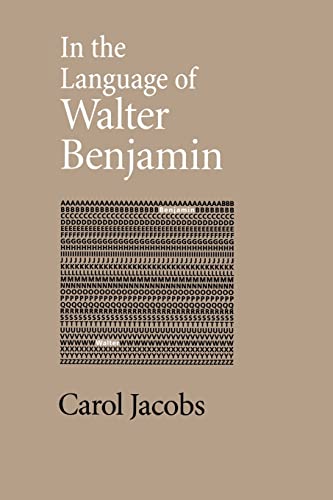
If Walter Benjamin (with an irony that belies his seemingly tragic life) is now recognized as one of the century's most important writers, reading him is no easy matter. Benjamin opens one of his most notable essays, "The Task of the Translator," with the words "No poem is intended for the reader, no image for the beholder, no symphony for the listener." How does one read an author who tells us that writing does not communicate very much to the reader? How does one learn to regard what comes to us from Benjamin as something other than direct expression?
Carol Jacobs' In the Language of Walter Benjamin is an attempt to come to terms with this predicament. It does so by teasing out such guidelines for criticism as Benjamin seems to offer in The Origin of German Tragic Drama. Jacobs reminds us of Benjamin's distinction between truth and knowledge. She above all insists on his method of philosophical contemplation as performance, on a performance that demands precise immersion in the minute details of subject matter.
In what follows, Jacobs practices this immersion in the details of Benjamin's performance as she reads some of his key works: the autobiographical Berlin Chronicle, the apparently biographical study of Proust, the fictional autobiographical story of "Myslowitz—Braunschweig—Marseille," and those essays on the theory of language so crucial to an understanding of Benjamin, "The Task of the Translator," "Doctrine of the Similar," and "On Language as Such and on the Language of Man."
"The essays that follow were written over the span of an academic lifetime. They are the intermittent attempts from the late sixties through the early nineties in which I have tried to understand Benjamin, or rather, to understand his work, to come to terms with it, though never as a totality. I would like to believe he taught me how to read in the practice of interrupting intention. The process of contemplation that these essays perform, then, is marked by an unceasing pausing for breath (sometimes for many years)."—Carol Jacobs, from In the Language of Walter Benjamin
Die Inhaltsangabe kann sich auf eine andere Ausgabe dieses Titels beziehen.
Über die Autorin bzw. den Autor
Carol Jacobs is a professor of comparative literature and English literature at the State University of New York at Buffalo. Her books include Telling Time: Lévi-Strauss, Ford, Lessing, Benjamin, de Man, Wordsworth, Rilke and Uncontainable Romanticism: Shelley, Brontë, Kleist.
„Über diesen Titel“ kann sich auf eine andere Ausgabe dieses Titels beziehen.
Suchergebnisse für In the Language of Walter Benjamin

Beispielbild für diese ISBN
In the Language of Walter Benjamin
Verlag:
Johns Hopkins University Press, 2000
ISBN 10: 0801866693
ISBN 13: 9780801866692
Gebraucht
Paperback
Anbieter: ThriftBooks-Atlanta, AUSTELL, GA, USA
Verkäuferbewertung 5 von 5 Sternen

Paperback. Zustand: Very Good. No Jacket. May have limited writing in cover pages. Pages are unmarked. ~ ThriftBooks: Read More, Spend Less. Bestandsnummer des Verkäufers G0801866693I4N00
Gebraucht kaufen
EUR 12,01
Versand gratis
Versand innerhalb von USA
Versand innerhalb von USA
Anzahl: 1 verfügbar
Beispielbild für diese ISBN
In the Language of Walter Benjamin
Verlag:
The Johns Hopkins University Pre, 2000
ISBN 10: 0801866693
ISBN 13: 9780801866692
Gebraucht
Paperback
Anbieter: Midtown Scholar Bookstore, Harrisburg, PA, USA
Verkäuferbewertung 5 von 5 Sternen
Paperback. Zustand: Good. Good paperback, bumped/creased with shelfwear; may have previous owner's name inside. Standard-sized. Bestandsnummer des Verkäufers mon0000283009
Gebraucht kaufen
EUR 11,01
EUR 5,35 Versand
Versand innerhalb von USA
Versand innerhalb von USA
Anzahl: 1 verfügbar
Foto des Verkäufers
In the Language of Walter Benjamin
Verlag:
Johns Hopkins University Press, 2000
ISBN 10: 0801866693
ISBN 13: 9780801866692
Gebraucht
paperback
Anbieter: WeBuyBooks, Rossendale, LANCS, Vereinigtes Königreich
Verkäuferbewertung 5 von 5 Sternen
paperback. Zustand: Good. Most items will be dispatched the same or the next working day. A copy that has been read but remains in clean condition. All of the pages are intact and the cover is intact and the spine may show signs of wear. The book may have minor markings which are not specifically mentioned. Bestandsnummer des Verkäufers rev2091829303
Gebraucht kaufen
EUR 21,06
EUR 6,24 Versand
Versand von Vereinigtes Königreich nach USA
Versand von Vereinigtes Königreich nach USA
Anzahl: 1 verfügbar
Beispielbild für diese ISBN
In the Language of Walter Benjamin
Verlag:
Johns Hopkins University Press, 2000
ISBN 10: 0801866693
ISBN 13: 9780801866692
Gebraucht
Paperback
Anbieter: WorldofBooks, Goring-By-Sea, WS, Vereinigtes Königreich
Verkäuferbewertung 5 von 5 Sternen
Paperback. Zustand: Very Good. The book has been read, but is in excellent condition. Pages are intact and not marred by notes or highlighting. The spine remains undamaged. Bestandsnummer des Verkäufers GOR015074760
Gebraucht kaufen
EUR 23,77
EUR 6,69 Versand
Versand von Vereinigtes Königreich nach USA
Versand von Vereinigtes Königreich nach USA
Anzahl: 1 verfügbar
Foto des Verkäufers
In the Language of Walter Benjamin
Verlag:
Johns Hopkins University Press, 2000
ISBN 10: 0801866693
ISBN 13: 9780801866692
Gebraucht
Softcover
Anbieter: GreatBookPrices, Columbia, MD, USA
Verkäuferbewertung 5 von 5 Sternen
Zustand: As New. Unread book in perfect condition. Bestandsnummer des Verkäufers 261755
Gebraucht kaufen
EUR 32,13
EUR 2,35 Versand
Versand innerhalb von USA
Versand innerhalb von USA
Anzahl: 1 verfügbar
Foto des Verkäufers
In the Language of Walter Benjamin
Verlag:
Johns Hopkins University Press, 2000
ISBN 10: 0801866693
ISBN 13: 9780801866692
Neu
Softcover
Anbieter: GreatBookPrices, Columbia, MD, USA
Verkäuferbewertung 5 von 5 Sternen
Zustand: New. Bestandsnummer des Verkäufers 261755-n
Neu kaufen
EUR 34,18
EUR 2,35 Versand
Versand innerhalb von USA
Versand innerhalb von USA
Anzahl: 1 verfügbar
Beispielbild für diese ISBN
In the Language of Walter Benjamin
Anbieter: PBShop.store US, Wood Dale, IL, USA
Verkäuferbewertung 5 von 5 Sternen
PAP. Zustand: New. New Book. Shipped from UK. Established seller since 2000. Bestandsnummer des Verkäufers WJ-9780801866692
Beispielbild für diese ISBN
In the Language of Walter Benjamin
Anbieter: PBShop.store UK, Fairford, GLOS, Vereinigtes Königreich
Verkäuferbewertung 5 von 5 Sternen
PAP. Zustand: New. New Book. Shipped from UK. Established seller since 2000. Bestandsnummer des Verkäufers WJ-9780801866692
Neu kaufen
EUR 33,77
EUR 4,97 Versand
Versand von Vereinigtes Königreich nach USA
Versand von Vereinigtes Königreich nach USA
Anzahl: 1 verfügbar
Beispielbild für diese ISBN
In the Language of Walter Benjamin
Verlag:
The Johns Hopkins University Press 2000-09-14, 2000
ISBN 10: 0801866693
ISBN 13: 9780801866692
Neu
Paperback
Anbieter: Chiron Media, Wallingford, Vereinigtes Königreich
Verkäuferbewertung 5 von 5 Sternen
Paperback. Zustand: New. Brand new book, sourced directly from publisher. Dispatch time is 3-4 days from our warehouse. Book will be sent in robust, secure packaging to ensure it reaches you securely. Bestandsnummer des Verkäufers 6666-WLY-9780801866692
Neu kaufen
EUR 36,98
EUR 5,96 Versand
Versand von Vereinigtes Königreich nach USA
Versand von Vereinigtes Königreich nach USA
Anzahl: 1 verfügbar
Foto des Verkäufers
In the Language of Walter Benjamin
Verlag:
Johns Hopkins University Press, US, 2000
ISBN 10: 0801866693
ISBN 13: 9780801866692
Neu
Paperback
Anbieter: Rarewaves.com USA, London, LONDO, Vereinigtes Königreich
Verkäuferbewertung 5 von 5 Sternen
Paperback. Zustand: New. If Walter Benjamin (with an irony that belies his seemingly tragic life) is now recognized as one of the century's most important writers, reading him is no easy matter. Benjamin opens one of his most notable essays, "The Task of the Translator", with the words "No poem is intended for the reader, no image for the beholder, no symphony for the listener". How does one read an author who tells us that writing does not communicate very much to the reader? How does one learn to regard what comes to us from Benjamin as something other than direct expression? Carol Jacobs' In the Language of Walter Benjamin is an attempt to come to terms with this predicament. It does so by teasing out such guidelines for criticism as Benjamin seems to offer in The Origin of German Tragic Drama. Jacobs reminds us of Benjamin's distinction between truth and knowledge. She above all insists on his method of philosophical contemplation as performance, on a performance that demands precise immersion in the minute details of subject matter. Bestandsnummer des Verkäufers LU-9780801866692
Neu kaufen
EUR 43,65
Versand gratis
Versand von Vereinigtes Königreich nach USA
Versand von Vereinigtes Königreich nach USA
Anzahl: Mehr als 20 verfügbar