
Verwandte Artikel zu Venetians in Constantinople: Nation, Identity, and...
Venetians in Constantinople: Nation, Identity, and Coexistence in the Early Modern Mediterranean (The Johns Hopkins University Studies in Historical and Political Science, Band 124) - Softcover
Buch 7 von 54: The Johns Hopkins University Studies in Historical and Political Science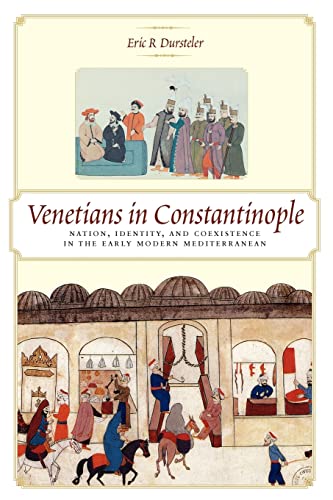
Inhaltsangabe
Historian Eric R Dursteler reconsiders identity in the early modern world to illuminate Veneto-Ottoman cultural interaction and coexistence, challenging the model of hostile relations and suggesting instead a more complex understanding of the intersection of cultures. Although dissonance and strife were certainly part of this relationship, he argues, coexistence and cooperation were more common.
Moving beyond the "clash of civilizations" model that surveys the relationship between Islam and Christianity from a geopolitical perch, Dursteler analyzes the lived reality by focusing on a localized microcosm: the Venetian merchant and diplomatic community in Muslim Constantinople.
While factors such as religion, culture, and political status could be integral elements in constructions of self and community, Dursteler finds early modern identity to be more than the sum total of its constitutent parts and reveals how the fluidity and malleability of identity in this time and place made coexistence among disparate cultures possible.
Die Inhaltsangabe kann sich auf eine andere Ausgabe dieses Titels beziehen.
Über die Autorin bzw. den Autor
Eric R Dursteler is an associate professor of history at Brigham Young University.
Von der hinteren Coverseite
Moving beyond the "clash of civilizations" model that surveys the relationship between Islam and Christianity from a geopolitical perch, historian Eric R Dursteler focuses on a localized microcosm: the Venetian merchant and diplomatic community in Muslim Constantinople. Although dissonance and strife were certainly part of this relationship, he argues, coexistence and cooperation were more common.
While such factors as religion, culture, and political status could be integral elements in constructions of self and community, Dursteler finds that the fluidity and malleability of identity in the early modern world made coexistence among disparate cultures possible.
"The introduction to this book is dazzling... The Venetian community in Constantinople provides an excellent site for exploration of issues of nation and identity... [Dursteler's] overall intention—to demonstrate cultural diversity in a place and era that has been commonly assumed to lack it—remains firmly at the fore, and he admirably fulfills his task."—American Historical Review
"This is a boundary-busting book... Dursteler is to be commended for this insightful and gracefully written work that delivers a powerful message in brief compass, and will help change the way we consider European-Ottoman relations in the early modern era and perhaps West and non-West relations in our own."—Renaissance Quarterly
"A significant contribution to new understandings of national, ethnic, and religious relations in the past, with clear explanations of common assumptions and frameworks for fluid identities and border-crossings."—Renaissance Studies
"A rich body of interesting and colorful information... An important contribution to our understanding of the complex Mediterranean world of the early modern period."—Sixteenth Century Journal
Eric R Dursteler is an associate professor of history at Brigham Young University.
Aus dem Klappentext
Moving beyond the clash of civilizations model that surveys the relationship between Islam and Christianity from a geopolitical perch, historian Eric R Dursteler focuses on a localized microcosm: the Venetian merchant and diplomatic community in Muslim Constantinople. Although dissonance and strife were certainly part of this relationship, he argues, coexistence and cooperation were more common.
While such factors as religion, culture, and political status could be integral elements in constructions of self and community, Dursteler finds that the fluidity and malleability of identity in the early modern world made coexistence among disparate cultures possible.
The introduction to this book is dazzling . . . The Venetian community in Constantinople provides an excellent site for exploration of issues of nation and identity . . . [Dursteler's] overall intention--to demonstrate cultural diversity in a place and era that has been commonly assumed to lack it--remains firmly at the fore, and he admirably fulfills his task.--American Historical Review
This is a boundary-busting book . . . Dursteler is to be commended for this insightful and gracefully written work that delivers a powerful message in brief compass, and will help change the way we consider European-Ottoman relations in the early modern era and perhaps West and non-West relations in our own.--Renaissance Quarterly
A significant contribution to new understandings of national, ethnic, and religious relations in the past, with clear explanations of common assumptions and frameworks for fluid identities and border-crossings.--Renaissance Studies
A rich body of interesting and colorful information . . . An important contribution to our understanding of the complex Mediterranean world of the early modern period.--Sixteenth Century Journal
Eric R Dursteler is an associate professor of history at Brigham Young University.
--David Jacoby "Sixteenth Century Journal"„Über diesen Titel“ kann sich auf eine andere Ausgabe dieses Titels beziehen.
Suchergebnisse für Venetians in Constantinople: Nation, Identity, and...

Beispielbild für diese ISBN
Venetians in Constantinople: Nation, Identity, and Coexistence in the Early Modern Mediterranean (The Johns Hopkins University Studies in Historical and Political Science, 124)
Verlag:
Johns Hopkins University Press, 2008
ISBN 10: 0801891051
ISBN 13: 9780801891052
Gebraucht
Paperback
Anbieter: HPB-Red, Dallas, TX, USA
Verkäuferbewertung 5 von 5 Sternen

Paperback. Zustand: Good. Connecting readers with great books since 1972! Used textbooks may not include companion materials such as access codes, etc. May have some wear or writing/highlighting. We ship orders daily and Customer Service is our top priority! Bestandsnummer des Verkäufers S_477195525
Gebraucht kaufen
EUR 4,55
EUR 3,31 Versand
Versand innerhalb von USA
Versand innerhalb von USA
Anzahl: 1 verfügbar
Beispielbild für diese ISBN
Venetians in Constantinople: Nation, Identity, and Coexistence in the Early Modern Mediterranean
Verlag:
Johns Hopkins University Press, 2008
ISBN 10: 0801891051
ISBN 13: 9780801891052
Gebraucht
Paperback
Anbieter: World of Books (was SecondSale), Montgomery, IL, USA
Verkäuferbewertung 5 von 5 Sternen
Paperback. Zustand: Good. Moving beyond the 'clash of civilizations' model that surveys the relationship between Islam and Christianity from a geopolitical perch, the author focuses on a localized microcosm: the Venetian merchant and diplomatic community in Muslim Constantinople. Bestandsnummer des Verkäufers 00104821309
Gebraucht kaufen
EUR 7,95
Versand gratis
Versand innerhalb von USA
Versand innerhalb von USA
Anzahl: 1 verfügbar
Beispielbild für diese ISBN
Venetians in Constantinople: Nation, Identity, and Coexistence in the Early Modern Mediterranean
Verlag:
Johns Hopkins University Press, 2008
ISBN 10: 0801891051
ISBN 13: 9780801891052
Gebraucht
Paperback
Anbieter: World of Books Inc, Montgomery, IL, USA
Verkäuferbewertung 4 von 5 Sternen

Paperback. Zustand: Good. Moving beyond the 'clash of civilizations' model that surveys the relationship between Islam and Christianity from a geopolitical perch, the author focuses on a localized microcosm: the Venetian merchant and diplomatic community in Muslim Constantinople. Bestandsnummer des Verkäufers CIN0801891051G
Gebraucht kaufen
EUR 9,76
Versand gratis
Versand innerhalb von USA
Versand innerhalb von USA
Anzahl: 1 verfügbar
Foto des Verkäufers
Venetians in Constantinople: Nation, Identity, and Coexistence in the Early Modern Mediterranean (The Johns Hopkins University Studies in Historical and Political Science)
Verlag:
Johns Hopkins University Press, 2008
ISBN 10: 0801891051
ISBN 13: 9780801891052
Gebraucht
Softcover
Anbieter: Goodwill of Greater Milwaukee and Chicago, Racine, WI, USA
Verkäuferbewertung 5 von 5 Sternen
Zustand: acceptable. Book is considered to be in acceptable condition. The actual cover image may not match the stock photo. Book may have one or more of the following defects: noticeable wear on the cover dust jacket or spine; curved, dog eared or creased page s ; writing or highlighting inside or on the edges; sticker s or other adhesive on cover; CD DVD may not be included; and book may be a former library copy. Bestandsnummer des Verkäufers SEWV.0801891051.A
Gebraucht kaufen
EUR 8,86
EUR 2,65 Versand
Versand innerhalb von USA
Versand innerhalb von USA
Anzahl: 1 verfügbar
Foto des Verkäufers
Venetians in Constantinople : Nation, Identity, and Coexistence in the Early Modern Mediterranean
Verlag:
Johns Hopkins University Press, 2008
ISBN 10: 0801891051
ISBN 13: 9780801891052
Gebraucht
Softcover
Anbieter: GreatBookPrices, Columbia, MD, USA
Verkäuferbewertung 5 von 5 Sternen
Zustand: As New. Unread book in perfect condition. Bestandsnummer des Verkäufers 5658616
Gebraucht kaufen
EUR 28,87
EUR 2,33 Versand
Versand innerhalb von USA
Versand innerhalb von USA
Anzahl: 1 verfügbar
Foto des Verkäufers
Venetians in Constantinople : Nation, Identity, and Coexistence in the Early Modern Mediterranean
Verlag:
Johns Hopkins University Press, 2008
ISBN 10: 0801891051
ISBN 13: 9780801891052
Neu
Softcover
Anbieter: GreatBookPrices, Columbia, MD, USA
Verkäuferbewertung 5 von 5 Sternen
Zustand: New. Bestandsnummer des Verkäufers 5658616-n
Neu kaufen
EUR 36,51
EUR 2,33 Versand
Versand innerhalb von USA
Versand innerhalb von USA
Anzahl: 1 verfügbar
Foto des Verkäufers
Venetians in Constantinople
Verlag:
Johns Hopkins University Press, US, 2008
ISBN 10: 0801891051
ISBN 13: 9780801891052
Neu
Paperback
Anbieter: Rarewaves.com USA, London, LONDO, Vereinigtes Königreich
Verkäuferbewertung 5 von 5 Sternen
Paperback. Zustand: New. The introduction to this book is dazzling .The Venetian community in Constantinople provides an excellent site for exploration of issues of nation and identity .[Dursteler's] overall intention-to demonstrate cultural diversity in a place and era that has been commonly assumed to lack it-remains firmly at the fore, and he admirably fulfills his task. Bestandsnummer des Verkäufers LU-9780801891052
Neu kaufen
EUR 38,92
Versand gratis
Versand von Vereinigtes Königreich nach USA
Versand von Vereinigtes Königreich nach USA
Anzahl: 1 verfügbar
Beispielbild für diese ISBN
Venetians in Constantinople: Nation, Identity, and Coexistence in the Early Modern Mediterranean (The Johns Hopkins University Studies in Historical and Political Science)
Verlag:
Johns Hopkins University Press, 2008
ISBN 10: 0801891051
ISBN 13: 9780801891052
Gebraucht
Soft cover
Anbieter: Antiquariaat Die Sammlung, Amsterdam Zuidoost, Niederlande
Verkäuferbewertung 4 von 5 Sternen
Soft cover. Zustand: Near Fine. 289 pages. Bestandsnummer des Verkäufers LK 4-4 064
Gebraucht kaufen
EUR 20,00
EUR 20,00 Versand
Versand von Niederlande nach USA
Versand von Niederlande nach USA
Anzahl: 1 verfügbar
Beispielbild für diese ISBN
Venetians in Constantinople
Print-on-DemandAnbieter: PBShop.store US, Wood Dale, IL, USA
Verkäuferbewertung 5 von 5 Sternen
PAP. Zustand: New. New Book. Shipped from UK. THIS BOOK IS PRINTED ON DEMAND. Established seller since 2000. Bestandsnummer des Verkäufers L0-9780801891052
Neu kaufen
EUR 40,45
Versand gratis
Versand innerhalb von USA
Versand innerhalb von USA
Anzahl: Mehr als 20 verfügbar
Beispielbild für diese ISBN
Venetians in Constantinople
Print-on-DemandAnbieter: PBShop.store UK, Fairford, GLOS, Vereinigtes Königreich
Verkäuferbewertung 5 von 5 Sternen
PAP. Zustand: New. New Book. Delivered from our UK warehouse in 4 to 14 business days. THIS BOOK IS PRINTED ON DEMAND. Established seller since 2000. Bestandsnummer des Verkäufers L0-9780801891052
Neu kaufen
EUR 36,90
EUR 4,87 Versand
Versand von Vereinigtes Königreich nach USA
Versand von Vereinigtes Königreich nach USA
Anzahl: Mehr als 20 verfügbar