
Verwandte Artikel zu Salt: A World History
Inhaltsangabe
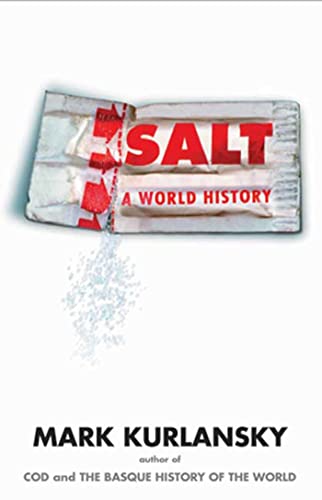
Homer called salt a divine substance. Plato described it as especially dear to the gods. Today we take salt for granted, a common, inexpensive substance that seasons food or clears ice from roads, a word used casually in expressions ("salt of the earth," take it with a grain of salt") without appreciating their deeper meaning. However, as Mark Kurlansky so brilliantly relates in his world- encompassing new book, salt―the only rock we eat―has shaped civilization from the very beginning. Its story is a glittering, often surprising part of the history of mankind.
Until about 100 years ago, when modern chemistry and geology revealed how prevalent it is, salt was one of the most sought-after commodities, and no wonder, for without it humans and animals could not live. Salt has often been considered so valuable that it served as currency, and it is still exchanged as such in places today. Demand for salt established the earliest trade routes, across unknown oceans and the remotest of deserts: the city of Jericho was founded almost 10,000 years ago as a salt trading center. Because of its worth, salt has provoked and financed some wars, and been a strategic element in others, such as the American Revolution and the Civil War. Salt taxes secured empires across Europe and Asia and have also inspired revolution (Gandhi's salt march in 1930 began the overthrow of British rule in India); indeed, salt has been central to the age-old debate about the rights of government to tax and control economies.
The story of salt encompasses fields as disparate as engineering, religion, and food, all of which Kurlansky richly explores. Few endeavors have inspired more ingenuity than salt making, from the natural gas furnaces of ancient China to the drilling techniques that led to the age of petroleum, and salt revenues have funded some of the greatest public works in history, including the Erie Canal, and even cities (Syracuse, New York). Salt's ability to preserve and to sustain life has made it a metaphorical symbol in all religions. Just as significantly, salt has shaped the history of foods like cheese, sauerkraut, olives, and more, and Kurlansky, an award-winning food writer, conveys how they have in turn molded civilization and eating habits the world over.
Salt is veined with colorful characters, from Li Bing, the Chinese bureaucrat who built the world's first dam in 250 BC, to Pattillo Higgins and Anthony Lucas who, ignoring the advice of geologists, drilled an east Texas salt dome in 1901 and discovered an oil reserve so large it gave birth to the age of petroleum. From the sinking salt towns of Cheshire in England to the celebrated salt mine on Avery Island in Louisiana; from the remotest islands in the Caribbean where roads are made of salt to rural Sichaun province, where the last home-made soya sauce is made, Mark Kurlansky has produced a kaleidoscope of history, a multi-layered masterpiece that blends economic, scientific, political, religious, and culinary records into a rich and memorable tale.
Die Inhaltsangabe kann sich auf eine andere Ausgabe dieses Titels beziehen.
Über die Autorin bzw. den Autor
Mark Kurlansky is well-known to readers through his popular books Cod: A Biography of the Fish That Changed the World, and, more recently, The Basque History of the World (both published by Walker & Company.). Salt is an appropriate bookend to these books: the story of a humble but ubiquitous substance inextricably interwoven with the history of mankind.
Rezensionen
In his latest work, Kurlansky (Cod, The Basque History of the World) is in command of every facet of his topic, and he conveys his knowledge in a readable, easy style. Deftly leading readers around the world and across cultures and centuries, he takes an inexpensive, mundane item and shows how it has influenced and affected wars, cultures, governments, religions, societies, economies, cooking (there are a few recipes), and foods. In addition, he provides information on the chemistry, geology, mining, refining, and production of salt, again across cultures, continents, and time periods. The 26 chapters flow in chronological order, and the cast of characters includes fishermen, kings, Native Americans, and even Gandhi. An entertaining, informative read, this is highly recommended for all collections. [For another book on the topic, see Pierre Laszlo's more esoteric Salt: Grain of Life, LJ 7/01; other recent micro-histories include Joseph Amato's Dust, Mort Rosenblum's Olive, and Tom Vanderbilt's The Sneaker Book. Ed.] Michael D. Cramer, Raleigh, N.
- Michael D. Cramer, Raleigh, NC
Copyright 2001 Reed Business Information, Inc.
Only Kurlansky, winner of the James Beard Award for Excellence in Food Writing for Cod: A Biography of the Fish that Changed the World, could woo readers toward such an off-beat topic. Yet salt, Kurlansky asserts, has "shaped civilization." Although now taken for granted, these square crystals are not only of practical use, but over the ages have symbolized fertility (it is, after all, the root of the word "salacious") and lasting covenants, and have been used in magical charms. Called a "divine substance" by Homer, salt is an essential part of the human body, was one of the first international commodities and was often used as currency throughout the developing world. Kurlansky traces the history of salt's influences from prehistoric China and ancient Africa (in Egypt they made mummies using salt) to Europe (in 12th-century Provence, France, salt merchants built "a system of solar evaporation ponds") and the Americas, through chapters with intriguing titles like "A Discourse on Salt, Cadavers and Pungent Sauces." The book is populated with characters as diverse as frozen-food giant Clarence Birdseye; Gandhi, who broke the British salt law that forbade salt production in India because it outdid the British salt trade; and New York City's sturgeon king, Barney Greengrass. Throughout his engaging, well-researched history, Kurlansky sprinkles witty asides and amusing anecdotes. A piquant blend of the historic, political, commercial, scientific and culinary, the book is sure to entertain as well as educate. Pierre Laszlo's Salt: Grain of Life (Forecasts, Aug. 6) got to the finish line first but doesn't compare to this artful narrative. 15 recipes, 4o illus., 7 maps.
Copyright 2001 Cahners Business Information, Inc.
*Starred Review* Kurlansky thinks big. First, there was Cod: A Biography of the Fish That Changed the World (1997), then The Basque History of the World (1999), and now, the world history of a subject bigger than one of the most important food commodities in the West, bigger than the oldest extant European culture--that culinary sine qua non, salt. Of course, salt is necessary for life itself; living bodies eliminate it, and without replenishment by ingestion, humans and other animals soon die, which is why animal trails lead to salt licks, and the first human paths did, too. Moreover, salt is a dandy preservative of meat, vegetables, and, as the ancient Egyptians knew, corpses. Homo faber figured out how to get salt out of brine, a discovery that increased the number of places people could prosper. Still, though salt is a very common substance, it is not always easily accessible, and weather and climate can make extraction from brine impractical. Hence, salt became the basis of wealth for communities, principalities, and empires, even after the invention of refrigeration and the diagnosis of hypertension. This is the big story Kurlansky unfolds in chapters that proceed from time immemorial to the present and cover such specific topics as "Salt's Salad Days" in ancient Rome; the "Nordic Dream" of enough salt for all Scandinavia's herring, not to mention lakrits (salted licorice); how, just as oil won the Big One, salt largely won the War between the States; and why, when Gandhi really got down to persuading the British out of India, he started with a "salt march." Tasty, very tasty! Ray Olson
Copyright © American Library Association. All rights reserved
„Über diesen Titel“ kann sich auf eine andere Ausgabe dieses Titels beziehen.
Suchergebnisse für Salt: A World History

Beispielbild für diese ISBN
Salt : A World History
Anbieter: Better World Books, Mishawaka, IN, USA
Verkäuferbewertung 5 von 5 Sternen

Zustand: Good. Pages intact with minimal writing/highlighting. The binding may be loose and creased. Dust jackets/supplements are not included. Stock photo provided. Product includes identifying sticker. Better World Books: Buy Books. Do Good. Bestandsnummer des Verkäufers 4227932-6
Gebraucht kaufen
EUR 17,80
Versand gratis
Versand innerhalb von USA
Versand innerhalb von USA
Anzahl: 1 verfügbar
Beispielbild für diese ISBN
Salt : a World History
Anbieter: Daedalus Books, Portland, OR, USA
Verkäuferbewertung 5 von 5 Sternen
Hardcover. Zustand: Very Good. Later Printing. A nice, solid copy.; B & W illustrations; 8vo; 484 pages. Bestandsnummer des Verkäufers 351065
Gebraucht kaufen
EUR 18,31
EUR 5,79 Versand
Versand innerhalb von USA
Versand innerhalb von USA
Anzahl: 1 verfügbar
Beispielbild für diese ISBN
Salt: A World History
Anbieter: Indianabookbuyer, Bloomington, IN, USA
Verkäuferbewertung 5 von 5 Sternen
Hardcover. Zustand: Very Good. Zustand des Schutzumschlags: Near Fine. hardcover, fine DJ, , clean, unmarked pages, good binding, Bestandsnummer des Verkäufers A1341 03152025
Gebraucht kaufen
EUR 24,43
EUR 5,12 Versand
Versand innerhalb von USA
Versand innerhalb von USA
Anzahl: 1 verfügbar
Foto des Verkäufers
Salt: A World History (Inscribed Copy)
Verlag:
Walker and Company, 2002
ISBN 10: 0802713734
ISBN 13: 9780802713735
Gebraucht
Hardcover
Signiert
Anbieter: M.S. Books, Salisbury, MD, USA
Verkäuferbewertung 5 von 5 Sternen
Hardcover. Zustand: Fine. Zustand des Schutzumschlags: Fine. Inscribed Copy of this lively history of one of humanity's most vital natural resources -- salt. Inscribed by Mark Kurlansky to a previous owner on the title page. 484 pages. Minimal sign of previous use. Signed by Author(s). Bestandsnummer des Verkäufers 017129
Gebraucht kaufen
EUR 45,90
EUR 4,46 Versand
Versand innerhalb von USA
Versand innerhalb von USA
Anzahl: 1 verfügbar
Beispielbild für diese ISBN
Salt; A World History
Anbieter: Last Exit Books, Charlottesville, VA, USA
Verkäuferbewertung 4 von 5 Sternen

Hardcover. 8vo. Published by Walker & Co, New York, 2001. 484 pgs. Signed by Mark Kurlansky on the title page. First Edition/First Printing. DJ has light shelf-wear present to the DJ extremities. Bound in cloth boards with titles present to the spine. Boards have light shelf-wear present to the extremities (UPC code tipped to the rear board). No ownership marks present. Text is clean and free of marks. Binding tight and solid. Best-selling author Mark Kurlansky turns his attention to a common household item with a long and intriguing history: salt. The only rock we eat, salt has shaped civilization from the very beginning, and its story is a glittering, often surprising part of the history of humankind. A substance so valuable it served as currency, salt has influenced the establishment of trade routes and cities, provoked and financed wars, secured empires, and inspired revolutions. Populated by colorful characters and filled with an unending series of fascinating details, Salt is a supremely entertaining, multi-layered masterpiece.; 8vo 8" - 9" tall. Bestandsnummer des Verkäufers 74442
Gebraucht kaufen
EUR 45,85
EUR 6,23 Versand
Versand innerhalb von USA
Versand innerhalb von USA
Anzahl: 1 verfügbar
Beispielbild für diese ISBN
Salt: A World History
Anbieter: Bookplate, Chestertown, MD, USA
Verkäuferbewertung 4 von 5 Sternen
Soft cover. Zustand: As New. Advanced Reading Copy from the uncorrected manuscript. Sixty pages total, not the entire ARC/Book. Signed to the title page by the author. Rare. TM/ARC/Galleys. Bestandsnummer des Verkäufers ABE-1770948424651
Gebraucht kaufen
EUR 45,90
EUR 7,58 Versand
Versand innerhalb von USA
Versand innerhalb von USA
Anzahl: 1 verfügbar
Foto des Verkäufers
Salt: A World History
Anbieter: The Anthropologists Closet, West Des Moines, IA, USA
Verkäuferbewertung 5 von 5 Sternen
Hardcover. Zustand: Like New. Zustand des Schutzumschlags: Like New. Like new hardcover in a like new dust jacket. Previous owners same on the front cover paste down hidden behind the book flap. 8vo. (6.12 x 1.5 x 9.25 inches) Clean text free of marks or underlining. Includes bibliography and an index. 484 pp. Fast shipping in a secure book box mailer with tracking. Homer called salt a divine substance. Plato described it as especially dear to the gods. Today we take it for granted; however, as Mark Kurlansky so brilliantly relates in this world-encompassing book, salt-the only rock we eat-has shaped civilization from the very beginning. Its story is a glittering, often surprising part of the history of humankind. Until about 100 years ago, when modern geology revealed how prevalent it is, salt was one of the most sought-after commodities, for without it humans and animals could not live. Salt has often been considered so valuable that it served as currency, and it is still exchanged as such in places today. Demand for salt established the earliest trade routes, across unknown oceans and the remotest of deserts: the city of Jericho was founded almost 10,000 years ago as a salt trading center. Because of its worth, salt has provoked and financed wars; it was, as well, a strategic element in the American Revolution and the Civil War, among other conflicts. Salt taxes secured empires across Europe and Asia and have also inspired revolution (Gandhi's salt march in 1930 began the overthrow of British rule in India); indeed, salt has been central to the age-old debate about the rights of government to tax and control economies. The story of salt encompasses fields as disparate as engineer-ing, religion, and food, all of which Kurlansky richly explores. Few endeavors have inspired more ingenuity than salt making, from the natural gas furnaces of ancient China to the drilling techniques that led to the age of petroleum, and salt revenues have funded some of the greatest public works in history, including the Erie Canal and the Great Wall of China. Salt's ability to preserve and to sustain life has made it a metaphorical symbol in all religions. Just as significantly, salt has shaped the history of foods like cheese, sauerkraut, olives mal more, and Kurlansky conveys, in his saga and through forty historic recipes how they have in turn molded civilization and eating habits the world over. Salt: A World History is veined with colorful characters, from Li Bing, the Chinese bureaucrat who built the world's first dam in 250 B.C., to Pattillo Higgins and Anthony Lucas who, ignoring the advice of geologists, drilled an east Texas salt dome in 1901 and discovered an oil reserve so large it gave birth to the age of petroleum. From the sinking salt towns of Cheshire in England to the ancient saltwork in southern San Francisco Bay; from the remotest islands in the Caribbean where roads are made of salt to rural Sichuan province where the last homemade soy sauce is produced, Mark Kurlansky has produced a kaleidoscope of history, a multilayered masterpiece that blends economic, scientific, political, religious, and culinary records into a rich and memorable tale. Bestandsnummer des Verkäufers 203630
Gebraucht kaufen
EUR 50,44
EUR 4,90 Versand
Versand innerhalb von USA
Versand innerhalb von USA
Anzahl: 1 verfügbar
Foto des Verkäufers
Salt: A World History
Anbieter: SZ Global, Toronto, ON, Kanada
Verkäuferbewertung 5 von 5 Sternen
Hardcover. Zustand: Collectible-Very Good. Kurlansky, author of 'Cod' and 'The Basque History of the World' takes an extraordinary look at an ordinary substance--salt, the only rock humans eat-- and how it has shaped civilization from the very beginning. 7 maps. 40 photos. 15 recipes. Bestandsnummer des Verkäufers 9780802713735
Gebraucht kaufen
EUR 88,49
EUR 34,05 Versand
Versand von Kanada nach USA
Versand von Kanada nach USA
Anzahl: 1 verfügbar
Beispielbild für diese ISBN
Salt: A World History
Anbieter: Griffin Books, Stamford, CT, USA
Verkäuferbewertung 5 von 5 Sternen
hardcover. Zustand: New. Brand new gift quality hardcover in jacket Please email for photos. Larger books or sets may require additional shipping charges. Books sent via US Postal. Bestandsnummer des Verkäufers 132633
Neu kaufen
EUR 123,92
EUR 5,35 Versand
Versand innerhalb von USA
Versand innerhalb von USA
Anzahl: 1 verfügbar
Beispielbild für diese ISBN
Salt: A World History
Anbieter: Wize Books USA, Davis, CA, USA
Verkäuferbewertung 5 von 5 Sternen
Hardcover. Zustand: New. Zustand des Schutzumschlags: New. New 1st edition Hardcover book and DJ. --Shrink Wrapped. Be Wize . Upgrade your book seller experience with Wize Books. We give you an honest price, ship next day (M-F), provide tracking, and 1st class customer service. We guarantee it! Make us your go-to bookseller. Bestandsnummer des Verkäufers I1346 1Nh 3 ? 02 140
Neu kaufen
EUR 133,10
EUR 4,79 Versand
Versand innerhalb von USA
Versand innerhalb von USA
Anzahl: 1 verfügbar