
Inhaltsangabe
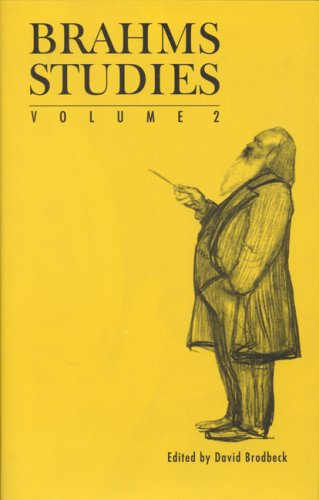
The eight essays in Brahms Studies 2 provide a rich sampling of contemporary Brahms research. In his examination of editions of Brahms’s music, George Bozarth questions the popular notion that most of the composer’s music already exists in reliable critical editions. Daniel Beller-McKenna reconsiders the younger Brahms’s involvement in musical politics at midcentury. The cantata Rinaldo is the centerpiece of Carol Hess’s consideration of Brahms’s music as autobiographical statement. Heather Platt’s exploration of the twentieth-century reception of Brahms’s Lieder reveals that advocates of Hugo Wolf’s aesthetics have shaped the discourse concerning the composer’s songs and calls for an approach more clearly based on Brahms’s aesthetics.
In his examination of the rise of the “great symphony” as a critical category that carried with it a nearly impossible standard to meet, Walter Frisch provides a rich context in which to understand Brahms’s well-known early struggle with the genre. Kenneth Hull suggests that Brahms used ironic allusions to Bach and Beethoven in the tragic Fourth Symphony in order to subvert the enduring assumption that a minor-key symphony will end triumphantly in the major mode. Peter H. Smith examines Brahms’s late style by concentrating on Neapolitan tonal relations in the Clarinet Sonata in F Minor. Finally, David Brodbeck delineates the complex evolution of Brahms’s reception of Mendels-sohn’s music.
Die Inhaltsangabe kann sich auf eine andere Ausgabe dieses Titels beziehen.
Über die Autorin bzw. den Autor
David Brodbeck is an associate professor at the University of Pittsburgh, where he chairs the Department of Music. He is a former president of the American Brahms Society and the author of Brahms: Symphony No. 1.
„Über diesen Titel“ kann sich auf eine andere Ausgabe dieses Titels beziehen.
Suchergebnisse für Brahms Studies

Beispielbild für diese ISBN
Brahms Studies, Volume 2
Verlag:
University of Nebraska Press, 1995
ISBN 10: 0803212879
ISBN 13: 9780803212879
Gebraucht
Hardcover
Anbieter: Grey Matter Books, Hadley, MA, USA
Verkäuferbewertung 4 von 5 Sternen

Hardcover. Zustand: Very Good. Zustand des Schutzumschlags: Very Good. Volume 2 ONLY. Text is unmarked; pages are bright, though the page edges are a bit age toned. There is a remainder mark on the bottom edge of the pages. Binding is sturdy. Dust jacket shows a little light wear around the corners and at the head and base of the spine; the dust jacket spine is faded. International/Priority shipping at cost. Bestandsnummer des Verkäufers 072741
Gebraucht kaufen
EUR 45,71
EUR 4,69 Versand
Versand innerhalb von USA
Versand innerhalb von USA
Anzahl: 1 verfügbar
Foto des Verkäufers
Brahms Studies Volume 2
Verlag:
University of Nebraska Press, 1998
ISBN 10: 0803212879
ISBN 13: 9780803212879
Gebraucht
Hardcover
Anbieter: Superbbooks, San Francisco, CA, USA
Verkäuferbewertung 5 von 5 Sternen

Hardcover. Zustand: Near Fine. PAGES And BINDING And DUST JACKET In EXCELLENT CONDITION. HARDBACK. As Shown. Published by Univ of Nebraska, 1998. Approximately 7 ½ X 11. 242 pages. (From the collection of, and signed by, a symphonic conductor/Princeton professor). Bestandsnummer des Verkäufers 007318
Gebraucht kaufen
EUR 83,51
EUR 4,27 Versand
Versand innerhalb von USA
Versand innerhalb von USA
Anzahl: 1 verfügbar