
Verwandte Artikel zu Scotty: James B. Reston and the Rise and Fall of American...
Inhaltsangabe
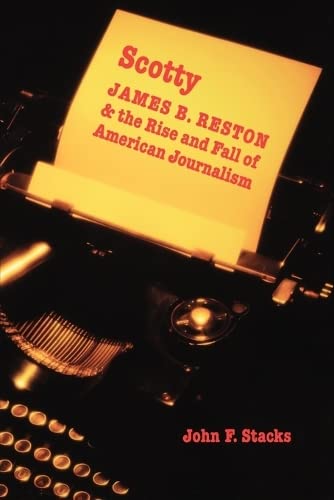
When President Kennedy finished a difficult meeting with Soviet leader Nikita Khrushchev, the first person he talked to was not one of his advisers, his vice president, or his wife. Walking out of the meeting, Kennedy spoke first with James B. Reston (1909–95). And so it was for president after president, from Truman through Eisenhower, JFK, LBJ, Nixon, Ford, and Carter.
Reston was the most powerful, most admired, and most influential newspaper columnist America had ever seen, the best journalist of his time and perhaps of any time. He tapped into his vast reserves of intelligence, energy, and ambition to rise steadily in the ranks of the New York Times and helped make it the greatest paper in the world. Eventually, however, some of Reston’s greatest virtues became liabilities, and proximity to power took its toll.
More than a brilliant biography, Scotty is a secret history—of one man’s life, of what went on behind closed Washington doors, of the stories that shaped our world and of those that never made the papers.
Die Inhaltsangabe kann sich auf eine andere Ausgabe dieses Titels beziehen.
Über die Autorin bzw. den Autor
John F. Stacks is a former deputy managing editor and chief of correspondents for Time magazine. For more than three decades he reported on Congress, the White House, and presidential politics, covering the national campaigns from 1968 through 1980. He is the author of three other books and lives in New York.
Auszug. © Genehmigter Nachdruck. Alle Rechte vorbehalten.
Scotty
James B. Reston and the Rise and Fall of American JournalismBy John F. StacksUniversity of Nebraska Press
Copyright © 2006 John F. StacksAll right reserved.
ISBN: 9780803293397
Chapter One
The Reporter and the President
JOHN FITZGERALD KENNEDY arrived in Vienna on June 3, 1961. As he drove through the streets, tens of thousands of Austrians lined the roadway to cheer the young American president. Kennedy had just come from a triumphal meeting in Paris with the crusty president of France, Charles de Gaulle. He was full of confidence and hope that his upcoming summit meeting with the leader of the Soviet Union would serve to ease tensions between the two nuclear superpowers. But Chairman Nikita Khrushchev surprised Kennedy. Taking advantage of Kennedy's youth and his recent embarrassment in the Bay of Pigs fiasco, in Cuba, Khrushchev spent the next two days denouncing American imperialism. And he demanded that the Soviet Union be given the right to control access to West Berlin in divided Germany, something he knew Kennedy could not concede.
In fact, the Vienna summit meeting went so badly from the American point of view that Kennedy asked for a final, private session with Khrushchev to try to salvage some mutual understanding between the two nations. With only their translators present, Kennedy began by reminding the Soviet leader that each country had the ability to destroy the other. He then asked Khrushchev to back off his demands on Berlin. The bombastic Khrushchev did no such thing, warning Kennedy that "force would be met by force," adding that "if the U.S. wants war, that's its problem." Kennedy was stunned.
"Then, Mr. Chairman, there will be war," Kennedy concluded. "It will be a cold winter."
The first person with whom Kennedy discussed this bleak, frightening encounter was not his secretary of state nor any member of his administration. Astonishingly, it was a journalist, James Barrett Reston, Washington bureau chief and columnist for the New York Times. By prior arrangement, Reston had slipped into the American embassy and was waiting, with curtains drawn to conceal his presence, to interview Kennedy. The president arrived ten minutes after leaving his last meeting with Khrushchev.
Reston, older than the young president, had recently been on the cover of Time magazine, which called him, quite accurately, the most powerful journalist in Washington. He had been covering the nation's capital since the early 1940s. Shorter than Kennedy, Reston generally dressed in a casually tweedy way, often with a bow tie and almost always with a briar pipe and a pouch of tobacco in his pocket. Reston had a full head of brown hair now graying slightly on the sides and a round, open face that invited confidence but disguised a good deal of cunning and ambition. He was quite accustomed to dealing with powerful men.
"How was it?" Reston asked casually.
"Worst thing in my life. He savaged me," Kennedy responded. The president seemed to Reston to be almost in shock, repeating himself and speaking with astonishing candor to the journalist. "Not the usual bullshit," Reston wrote in his notepad. "There is a look a man has when he has to tell the truth." Kennedy went on to say that to counter the battering by Khrushchev, which he attributed to the Soviet leader's underestimation of Kennedy's resolve, the United States would have to stand more firmly against the Soviets' demands in Berlin and against the mounting Communist insurgency in South Vietnam. Reston wrote later that he was "speechless" when Kennedy mentioned Vietnam, since that troubled country was at that point nowhere near the heart of the Cold War conflict and, in Reston's estimation, did not carry much weight in the superpower tug-of-war. Ever afterward, Kennedy's remark to Reston was seen by historians and by Reston himself as the moment marking the beginning of America's long slide into the tragedy of Vietnam.
From the perspective of our own time, that Reston was with Kennedy at this critical moment in American history is almost unimaginable. No reporter, no matter how famous his face or his byline, would have this sort of access today, would be trusted to hear an American president reacting honestly and without pretense to a frightening failure that could have presaged nuclear war - and then, without stated rules or restrictions, would be able to write carefully and subtly about that encounter. The relationship between journalists and politicians in America is today most often a distant and hostile one, marked by distrust and anger and cynicism.
James "Scotty" Reston was the best journalist of his time, and perhaps the best of any time. He was a reporter of amazing skill, able to relieve powerful men of their most important secrets. He was a writer of easy, graceful prose who revolutionized the style in which American newspapers are written. As a columnist, he was a shaper of public opinion, an explicator of the byzantine politics of Washington and the world. In his heyday, he was read by more Americans than any other single writer on public affairs. As a newspaper executive, he recruited men of enormous talent into the previously rather shabby career of journalism and inspired an entire later generation to join the trade. Together they raised the quality of journalism beyond what it had ever been. He was skeptical without ever lapsing into the current disease of American journalism: unrelieved cynicism.
Working at the reporter's trade is an odd way to make a living. The pay at the beginning is barely above minimum wage, and even at the end of a career, except at the very upper reaches of the craft, the compensation is barely enough to achieve entry into the middle class, no matter how loosely that category is defined. There is little status attached to the work; most people view reporters as parasites, taking their sustenance from tragedy, misfortune, misdeeds, and the public humiliation attendant to failure and illegality. Bad news is usually good news for the reporter, since the worse the tragedy, the more egregious the misbehavior, the more alarming the threat, the more avidly the story will be consumed.
There is nothing glamorous about most of the work. Almost as a matter of ritual inauguration, the neophyte reporter is sent to cover the police department, where the stories are raw, the cops are contemptuous, and unless there is a spectacular crime involving socially prominent people, the stories wind up deep inside the newspaper. There is not much pleasure in interviewing, say, the widow of a cabdriver shot by a robber, or the parents of a boy tragically drowned the night before, or, as I once did, a father numb with grief after his two little boys had been killed by a pack of feral dogs.
After a period of apprenticeship, the reporter moves indoors to cover the tedium of civic lunches and canned speeches. Then, with some luck, there might come the chance to write, even with a bit of the edge of discovery and outrage, about the chronically miserable public schools. The best reporters throw their energies into the beat, but often as not, nothing changes.
Covering election politics is frequently the next step up the career ladder. Here the reporter is often viewed as a pariah, seen by the candidate and the campaign as a potential debunker of the glowing self-portraits they wish to paint for the public. And rarely is the reporter seen as a pillar of the broader community. At a social gathering, admitting that one is a reporter is roughly like saying one is a mortician: necessary perhaps, but not welcome.
In the days when James B. Reston was entering the...
„Über diesen Titel“ kann sich auf eine andere Ausgabe dieses Titels beziehen.
Suchergebnisse für Scotty: James B. Reston and the Rise and Fall of American...

Beispielbild für diese ISBN
Scotty: James B. Reston and the Rise and Fall of American Journalism
Anbieter: ThriftBooks-Atlanta, AUSTELL, GA, USA
Verkäuferbewertung 5 von 5 Sternen

Paperback. Zustand: Very Good. No Jacket. May have limited writing in cover pages. Pages are unmarked. ~ ThriftBooks: Read More, Spend Less. Bestandsnummer des Verkäufers G0803293399I4N00
Gebraucht kaufen
EUR 10,59
Versand gratis
Versand innerhalb von USA
Versand innerhalb von USA
Anzahl: 1 verfügbar
Beispielbild für diese ISBN
Scotty: James B. Reston and the Rise and Fall of American Journalism
Anbieter: Midtown Scholar Bookstore, Harrisburg, PA, USA
Verkäuferbewertung 5 von 5 Sternen
Paperback. Zustand: Very Good. Very Good - Crisp, clean, unread book with some shelfwear/edgewear, may have a remainder mark - NICE Standard-sized. Bestandsnummer des Verkäufers M0803293399Z2
Gebraucht kaufen
EUR 5,96
EUR 5,27 Versand
Versand innerhalb von USA
Versand innerhalb von USA
Anzahl: 6 verfügbar
Beispielbild für diese ISBN
Scotty: James B. Reston and the Rise and Fall of American Journalism
Anbieter: Lakeside Books, Benton Harbor, MI, USA
Verkäuferbewertung 5 von 5 Sternen
Zustand: New. Brand New! Not Overstocks or Low Quality Book Club Editions! Direct From the Publisher! We're not a giant, faceless warehouse organization! We're a small town bookstore that loves books and loves it's customers! Buy from Lakeside Books! Bestandsnummer des Verkäufers OTF-S-9780803293397
Neu kaufen
EUR 16,10
EUR 3,51 Versand
Versand innerhalb von USA
Versand innerhalb von USA
Anzahl: Mehr als 20 verfügbar
Foto des Verkäufers
Scotty : James B. Reston And the Rise And Fall of American Journalism
Anbieter: GreatBookPrices, Columbia, MD, USA
Verkäuferbewertung 5 von 5 Sternen
Zustand: New. Bestandsnummer des Verkäufers 3514762-n
Neu kaufen
EUR 17,32
EUR 2,32 Versand
Versand innerhalb von USA
Versand innerhalb von USA
Anzahl: Mehr als 20 verfügbar
Foto des Verkäufers
Scotty : James B. Reston And the Rise And Fall of American Journalism
Anbieter: GreatBookPrices, Columbia, MD, USA
Verkäuferbewertung 5 von 5 Sternen
Zustand: As New. Unread book in perfect condition. Bestandsnummer des Verkäufers 3514762
Gebraucht kaufen
EUR 19,22
EUR 2,32 Versand
Versand innerhalb von USA
Versand innerhalb von USA
Anzahl: Mehr als 20 verfügbar
Beispielbild für diese ISBN
Scotty
Print-on-DemandAnbieter: Majestic Books, Hounslow, Vereinigtes Königreich
Verkäuferbewertung 4 von 5 Sternen

Zustand: New. Print on Demand pp. 374 Illus. Bestandsnummer des Verkäufers 55099681
Neu kaufen
EUR 31,01
EUR 7,56 Versand
Versand von Vereinigtes Königreich nach USA
Versand von Vereinigtes Königreich nach USA
Anzahl: 4 verfügbar
Beispielbild für diese ISBN
Scotty
Print-on-DemandAnbieter: Biblios, Frankfurt am main, HESSE, Deutschland
Verkäuferbewertung 4 von 5 Sternen
Zustand: New. PRINT ON DEMAND pp. 374. Bestandsnummer des Verkäufers 1854492916
Neu kaufen
EUR 30,99
EUR 9,95 Versand
Versand von Deutschland nach USA
Versand von Deutschland nach USA
Anzahl: 4 verfügbar
Beispielbild für diese ISBN
Scotty
Print-on-DemandAnbieter: Books Puddle, Woodside, NY, USA
Verkäuferbewertung 4 von 5 Sternen
Zustand: New. Print on Demand pp. 374. Bestandsnummer des Verkäufers 2654492926
Neu kaufen
EUR 37,71
EUR 3,51 Versand
Versand innerhalb von USA
Versand innerhalb von USA
Anzahl: 4 verfügbar
Foto des Verkäufers
Scotty : James B. Reston And the Rise And Fall of American Journalism
Anbieter: GreatBookPricesUK, Woodford Green, Vereinigtes Königreich
Verkäuferbewertung 5 von 5 Sternen
Zustand: As New. Unread book in perfect condition. Bestandsnummer des Verkäufers 3514762
Gebraucht kaufen
EUR 26,10
EUR 17,45 Versand
Versand von Vereinigtes Königreich nach USA
Versand von Vereinigtes Königreich nach USA
Anzahl: Mehr als 20 verfügbar
Foto des Verkäufers
Scotty : James B. Reston And the Rise And Fall of American Journalism
Anbieter: GreatBookPricesUK, Woodford Green, Vereinigtes Königreich
Verkäuferbewertung 5 von 5 Sternen
Zustand: New. Bestandsnummer des Verkäufers 3514762-n
Neu kaufen
EUR 26,50
EUR 17,45 Versand
Versand von Vereinigtes Königreich nach USA
Versand von Vereinigtes Königreich nach USA
Anzahl: Mehr als 20 verfügbar