
Verwandte Artikel zu Remote: Office Not Required
Inhaltsangabe
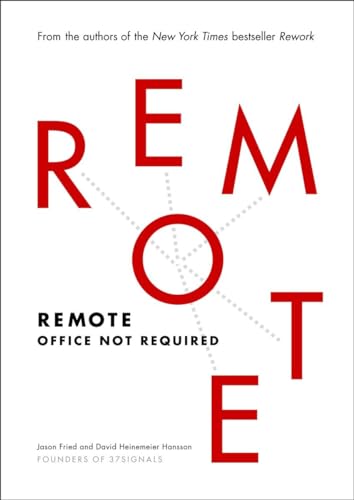
The classic guide to working from home and why we should embrace a virtual office, from the bestselling authors of Rework
“A paradigm-smashing, compulsively readable case for a radically remote workplace.”—Susan Cain, New York Times bestselling author of Quiet
Does working from home—or anywhere else but the office—make sense? In Remote, Jason Fried and David Heinemeier Hansson, the founders of Basecamp, bring new insight to the hotly debated argument. While providing a complete overview of remote work’s challenges, Jason and David persuasively argue that, often, the advantages of working “off-site” far outweigh the drawbacks.
In the past decade, the “under one roof” model of conducting work has been steadily declining, owing to technology that is rapidly creating virtual workspaces. Today the new paradigm is “move work to the workers, rather than workers to the workplace.” Companies see advantages in the way remote work increases their talent pool, reduces turnover, lessens their real estate footprint, and improves their ability to conduct business across multiple time zones. But what about the workers? Jason and David point out that remote work means working at the best job (not just one that is nearby) and achieving a harmonious work-life balance while increasing productivity.
And those are just some of the perks to be gained from leaving the office behind. Remote reveals a multitude of other benefits, along with in-the-trenches tips for easing your way out of the office door where you control how your workday will unfold.
Whether you’re a manager fretting over how to manage workers who “want out” or a worker who wants to achieve a lifestyle upgrade while still being a top performer professionally, this book is your indispensable guide.
Die Inhaltsangabe kann sich auf eine andere Ausgabe dieses Titels beziehen.
Über die Autorin bzw. den Autor
Jason Fried and David Heinemeier Hansson are the founders of Basecamp (previously 37signals), a trailblazing software company. They have been profiled in such publications as Time, Newsweek, and Wired. They're also contributors to Signals v. Noise, one of the Web's most popular blogs.
Auszug. © Genehmigter Nachdruck. Alle Rechte vorbehalten.
Chapter 1
The Time Is Right for Remote Work
Why work doesn’t happen at work
If you ask people where they go when they really need to get work done, very few will respond “the office.” If they do say the office, they’ll include a qualifier such as “super early in the morning before anyone gets in” or “I stay late at night after everyone’s left” or “I sneak in on the weekend.”
What they’re trying to tell you is that they can’t get work done at work. The office during the day has become the last place people want to be when they really want to get work done.
That’s because offices have become interruption factories. A busy office is like a food processor—it chops your day into tiny bits. Fifteen minutes here, ten minutes there, twenty here, five there. Each segment is filled with a conference call, a meeting, another meeting, or some other institutionalized unnecessary interruption.
It’s incredibly hard to get meaningful work done when your workday has been shredded into work moments.
Meaningful work, creative work, thoughtful work, important work—this type of effort takes stretches of uninterrupted time to get into the zone. But in the modern office such long stretches just can’t be found. Instead, it’s just one interruption after another.
The ability to be alone with your thoughts is, in fact, one of the key advantages of working remotely. When you work on your own, far away from the buzzing swarm at headquarters, you can settle into your own productive zone. You can actually get work done—the same work that you couldn’t get done at work!
Yes, working outside the office has its own set of challenges. And interruptions can come from different places, multiple angles. If you’re at home, maybe it’s the TV. If you’re at the local coffee shop, maybe it’s someone talking loudly a few tables away. But here’s the thing: those interruptions are things you can control. They’re passive. They don’t handcuff you. You can find a space that fits your work style. You can toss on some headphones and not be worried about a coworker loitering by your desk and tapping you on the shoulder. Neither do you have to be worried about being called into yet another unnecessary meeting. Your place, your zone, is yours alone.
Don’t believe us? Ask around. Or ask yourself: Where do you go when you really have to get work done? Your answer won’t be “the office in the afternoon.”
Stop commuting your life away
Let’s face it: nobody likes commuting. The alarm rings earlier, you arrive home that much later. You lose time, patience, possibly even your will to eat anything other than convenience food with plastic utensils. Maybe you skip the gym, miss your child’s bedtime, feel too tired for a meaningful conversation with your significant other. The list goes on.
Even your weekends get truncated by that wretched commute. All those chores you don’t have the will to complete after slugging it out with the highway collect into one mean list due on Saturday. By the time you’ve taken out the trash, picked up the dry cleaning, gone to the hardware store, and paid your bills, half the weekend is gone.
And the commute itself? Even the nicest car won’t make driving in traffic enjoyable, and forget feeling fresh after a trip on most urban trains and buses. Breathe in the smell of exhaust and body odor, breathe out your health and sanity.
Smart people in white coats have extensively studied commuting—this supposedly necessary part of our days—and the verdict is in: long commutes make you fat, stressed, and miserable. Even short commutes stab at your happiness.
According to the research, commuting is associated with an increased risk of obesity, insomnia, stress, neck and back pain, high blood pressure, and other stress-related ills such as heart attacks and depression, and even divorce.
But let’s say we ignore the overwhelming evidence that commuting doesn’t do a body good. Pretend it isn’t bad for the environment either. Let’s just do the math. Say you spend thirty minutes driving in rush hour every morning and another fifteen getting to your car and into the office. That’s 1.5 hours a day, 7.5 hours per week, or somewhere between 300 and 400 hours per year, give or take holidays and vacation. Four hundred hours is exactly the amount of programmer time we spent building Basecamp, our most popular product. Imagine what you could do with 400 extra hours a year. Commuting isn’t just bad for you, your relationships, and the environment—it’s bad for business. And it doesn’t have to be that way.
It’s the technology, stupid
If working remotely is such a great idea, why haven’t progressive companies been practicing it all along? It’s simple: they couldn’t. The technology just wasn’t there. Good luck, trying to collaborate with people in different cities, let alone halfway around the world, using a fax machine and FedEx.
Technology snuck up on us and made working remotely an obvious possibility. In particular, the Internet happened. Screen sharing using WebEx, coordinating to-do lists using Basecamp, real-time chatting using instant messages, downloading the latest files using Dropbox—these activities all flow from innovations pioneered in the last fifteen years. No wonder we’re still learning what’s possible.
But past generations have been bred on the idea that good work happens from 9am to 5pm, in offices and cubicles in tall buildings around the city. It’s no wonder that most who are employed inside that model haven’t considered other options, or resist the idea that it could be any different. But it can.
The future, quite literally, belongs to those who get it. Do you think today’s teenagers, raised on Facebook and texting, will be sentimental about the old days of all-hands-on-deck, Monday morning meetings? Ha!
The great thing about technology, and even working remotely, is that it’s all up to you. It’s not rocket science, and learning the tools that make it possible won’t take that long either. But it will take willpower to let go of nostalgia and get on board. Can you do that?
Escaping 9am–5pm
The big transition with a distributed workforce is going from synchronous to asynchronous collaboration. Not only do we not have to be in the same spot to work together, we also don’t have to work at the same time to work together.
This is one of those things that’s born out of necessity when collaborating with people in multiple time zones, but it benefits everyone, even those in the same city. Once you’ve structured your work technique and expectations to deal with someone seven hours ahead in Copenhagen, the rest of the home office in Chicago might as well work from 11am to 7pm or 7am to 3pm—it’s all the same.
The beauty of relaxing workday hours is that the policy accommodates everyone—from the early birds to the night owls to the family folks with kids who need to be picked up in the middle of the day. At 37signals, we try to keep a roughly forty-hour workweek, but how our employees distribute those hours across the clock and days just isn’t important.
A company that is efficiently built around remote work doesn’t even have to have a set schedule. This is especially important when it comes to creative work. If you can’t get into the zone, there’s rarely much that can force you into it. When face time isn’t a requirement, the best strategy is often to take some time away and...
„Über diesen Titel“ kann sich auf eine andere Ausgabe dieses Titels beziehen.
Suchergebnisse für Remote: Office Not Required

Beispielbild für diese ISBN
Remote: Office Not Required
Anbieter: World of Books (was SecondSale), Montgomery, IL, USA
Verkäuferbewertung 5 von 5 Sternen

Hardback. Zustand: Good. The classic guide to working from home and why we should embrace a virtual office, from the bestselling authors of Rework "A paradigm-smashing, compulsively readable case for a radically remote workplace."--Susan Cain, New York Times bestselling author of Quiet Does working from home--or anywhere else but the office--make sense? In Remote, Jason Fried and David Heinemeier Hansson, the founders of Basecamp, bring new insight to the hotly debated argument. While providing a complete overview of remote work's challenges, Jason and David persuasively argue that, often, the advantages of working "off-site" far outweigh the drawbacks. In the past decade, the "under one roof" model of conducting work has been steadily declining, owing to technology that is rapidly creating virtual workspaces. Today the new paradigm is "move work to the workers, rather than workers to the workplace." Companies see advantages in the way remote work increases their talent pool, reduces turnover, lessens their real estate footprint, and improves their ability to conduct business across multiple time zones. But what about the workers? Jason and David point out that remote work means working at the best job (not just one that is nearby) and achieving a harmonious work-life balance while increasing productivity. And those are just some of the perks to be gained from leaving the office behind. Remote reveals a multitude of other benefits, along with in-the-trenches tips for easing your way out of the office door where you control how your workday will unfold. Whether you're a manager fretting over how to manage workers who "want out" or a worker who wants to achieve a lifestyle upgrade while still being a top performer professionally, this book is your indispensable guide. Bestandsnummer des Verkäufers 00097131700
Gebraucht kaufen
EUR 4,05
Versand gratis
Versand innerhalb von USA
Versand innerhalb von USA
Anzahl: 17 verfügbar
Beispielbild für diese ISBN
Remote: Office Not Required
Anbieter: World of Books (was SecondSale), Montgomery, IL, USA
Verkäuferbewertung 5 von 5 Sternen
Hardback. Zustand: Very Good. The classic guide to working from home and why we should embrace a virtual office, from the bestselling authors of Rework "A paradigm-smashing, compulsively readable case for a radically remote workplace."--Susan Cain, New York Times bestselling author of Quiet Does working from home--or anywhere else but the office--make sense? In Remote, Jason Fried and David Heinemeier Hansson, the founders of Basecamp, bring new insight to the hotly debated argument. While providing a complete overview of remote work's challenges, Jason and David persuasively argue that, often, the advantages of working "off-site" far outweigh the drawbacks. In the past decade, the "under one roof" model of conducting work has been steadily declining, owing to technology that is rapidly creating virtual workspaces. Today the new paradigm is "move work to the workers, rather than workers to the workplace." Companies see advantages in the way remote work increases their talent pool, reduces turnover, lessens their real estate footprint, and improves their ability to conduct business across multiple time zones. But what about the workers? Jason and David point out that remote work means working at the best job (not just one that is nearby) and achieving a harmonious work-life balance while increasing productivity. And those are just some of the perks to be gained from leaving the office behind. Remote reveals a multitude of other benefits, along with in-the-trenches tips for easing your way out of the office door where you control how your workday will unfold. Whether you're a manager fretting over how to manage workers who "want out" or a worker who wants to achieve a lifestyle upgrade while still being a top performer professionally, this book is your indispensable guide. Bestandsnummer des Verkäufers 00099534266
Gebraucht kaufen
EUR 4,05
Versand gratis
Versand innerhalb von USA
Versand innerhalb von USA
Anzahl: 10 verfügbar
Beispielbild für diese ISBN
Remote: Office Not Required
Anbieter: World of Books (was SecondSale), Montgomery, IL, USA
Verkäuferbewertung 5 von 5 Sternen
Hardback. Zustand: Fair. The classic guide to working from home and why we should embrace a virtual office, from the bestselling authors of Rework "A paradigm-smashing, compulsively readable case for a radically remote workplace."--Susan Cain, New York Times bestselling author of Quiet Does working from home--or anywhere else but the office--make sense? In Remote, Jason Fried and David Heinemeier Hansson, the founders of Basecamp, bring new insight to the hotly debated argument. While providing a complete overview of remote work's challenges, Jason and David persuasively argue that, often, the advantages of working "off-site" far outweigh the drawbacks. In the past decade, the "under one roof" model of conducting work has been steadily declining, owing to technology that is rapidly creating virtual workspaces. Today the new paradigm is "move work to the workers, rather than workers to the workplace." Companies see advantages in the way remote work increases their talent pool, reduces turnover, lessens their real estate footprint, and improves their ability to conduct business across multiple time zones. But what about the workers? Jason and David point out that remote work means working at the best job (not just one that is nearby) and achieving a harmonious work-life balance while increasing productivity. And those are just some of the perks to be gained from leaving the office behind. Remote reveals a multitude of other benefits, along with in-the-trenches tips for easing your way out of the office door where you control how your workday will unfold. Whether you're a manager fretting over how to manage workers who "want out" or a worker who wants to achieve a lifestyle upgrade while still being a top performer professionally, this book is your indispensable guide. Bestandsnummer des Verkäufers 00098448659
Gebraucht kaufen
EUR 4,05
Versand gratis
Versand innerhalb von USA
Versand innerhalb von USA
Anzahl: 2 verfügbar
Foto des Verkäufers
Remote: Office Not Required
Anbieter: Zoom Books Company, Lynden, WA, USA
Verkäuferbewertung 5 von 5 Sternen
Zustand: very_good. Book is in very good condition and may include minimal underlining highlighting. The book can also include "From the library of" labels. May not contain miscellaneous items toys, dvds, etc. . We offer 100% money back guarantee and 24 7 customer service. Bestandsnummer des Verkäufers ZBV.0804137501.VG
Gebraucht kaufen
EUR 4,06
Versand gratis
Versand innerhalb von USA
Versand innerhalb von USA
Anzahl: 2 verfügbar
Foto des Verkäufers
Remote: Office Not Required
Anbieter: Reliant Bookstore, El Dorado, KS, USA
Verkäuferbewertung 5 von 5 Sternen
Zustand: very_good. This book is in excellent condition. There may be minimal writing on the inside cover or cover page. Cover image on the book may vary from photo. Ships out quickly in a secure plastic mailer. Bestandsnummer des Verkäufers RDV.0804137501.VG
Gebraucht kaufen
EUR 4,51
Versand gratis
Versand innerhalb von USA
Versand innerhalb von USA
Anzahl: 1 verfügbar
Beispielbild für diese ISBN
Remote: Office Not Required
Verlag:
Crown Currency (edition First Edition), 2013
ISBN 10: 0804137501
ISBN 13: 9780804137508
Gebraucht
Hardcover
Erstausgabe
Anbieter: BooksRun, Philadelphia, PA, USA
Verkäuferbewertung 5 von 5 Sternen
Hardcover. Zustand: Very Good. First Edition. It's a well-cared-for item that has seen limited use. The item may show minor signs of wear. All the text is legible, with all pages included. It may have slight markings and/or highlighting. Bestandsnummer des Verkäufers 0804137501-8-1
Gebraucht kaufen
EUR 4,68
Versand gratis
Versand innerhalb von USA
Versand innerhalb von USA
Anzahl: 1 verfügbar
Foto des Verkäufers
Remote: Office Not Required
Anbieter: Bay State Book Company, North Smithfield, RI, USA
Verkäuferbewertung 5 von 5 Sternen
Zustand: very_good. Bestandsnummer des Verkäufers BSM.1G2KW
Gebraucht kaufen
EUR 4,77
Versand gratis
Versand innerhalb von USA
Versand innerhalb von USA
Anzahl: 1 verfügbar
Foto des Verkäufers
Remote: Office Not Required
Anbieter: Dream Books Co., Denver, CO, USA
Verkäuferbewertung 5 von 5 Sternen
Zustand: acceptable. This copy has clearly been enjoyedâ"expect noticeable shelf wear and some minor creases to the cover. Binding is strong, and all pages are legible. May contain previous library markings or stamps. Bestandsnummer des Verkäufers 4EKTGN001HHU_ns
Gebraucht kaufen
EUR 4,82
Versand gratis
Versand innerhalb von USA
Versand innerhalb von USA
Anzahl: 1 verfügbar
Foto des Verkäufers
Remote: Office Not Required
Anbieter: Dream Books Co., Denver, CO, USA
Verkäuferbewertung 5 von 5 Sternen
Zustand: very_good. Pages are clean with no markings. May show minor signs of wear or cosmetic defects marks, cuts, bends, or scuffs on the cover, spine, pages, or dust jacket. May have remainder marks on edges. Bestandsnummer des Verkäufers DBV.0804137501.VG
Gebraucht kaufen
EUR 4,82
Versand gratis
Versand innerhalb von USA
Versand innerhalb von USA
Anzahl: 1 verfügbar
Beispielbild für diese ISBN
Remote: Office Not Required
Anbieter: Evergreen Goodwill, Seattle, WA, USA
Verkäuferbewertung 5 von 5 Sternen
hardcover. Zustand: Good. Bestandsnummer des Verkäufers mon0000283820
Gebraucht kaufen
EUR 1,38
EUR 3,56 Versand
Versand innerhalb von USA
Versand innerhalb von USA
Anzahl: 2 verfügbar