
Verwandte Artikel zu Red Famine: Stalin's War on Ukraine
Inhaltsangabe
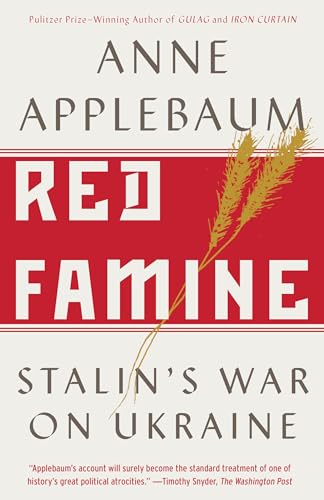
NEW YORK TIMES BESTSELLER • A revelatory history of one of Stalin's greatest crimes, the consequences of which still resonate today, as Russia has placed Ukrainian independence in its sights once more—from the author of the Pulitzer Prize-winning Gulag and the National Book Award finalist Iron Curtain.
"With searing clarity, Red Famine demonstrates the horrific consequences of a campaign to eradicate 'backwardness' when undertaken by a regime in a state of war with its own people." —The Economist
In 1929 Stalin launched his policy of agricultural collectivization—in effect a second Russian revolution—which forced millions of peasants off their land and onto collective farms. The result was a catastrophic famine, the most lethal in European history. At least five million people died between 1931 and 1933 in the USSR. But instead of sending relief the Soviet state made use of the catastrophe to rid itself of a political problem. In Red Famine, Anne Applebaum argues that more than three million of those dead were Ukrainians who perished not because they were accidental victims of a bad policy but because the state deliberately set out to kill them. Devastating and definitive, Red Famine captures the horror of ordinary people struggling to survive extraordinary evil.
Applebaum’s compulsively readable narrative recalls one of the worst crimes of the twentieth century, and shows how it may foreshadow a new threat to the political order in the twenty-first.
Die Inhaltsangabe kann sich auf eine andere Ausgabe dieses Titels beziehen.
Über die Autorin bzw. den Autor
ANNE APPLEBAUM is a columnist for The Washington Post, a Professor of Practice at the London School of Economics, and a contributor to The New York Review of Books. Her previous books include Iron Curtain, winner of the Cundill Prize and a finalist for the National Book Award, and Gulag, winner of the Pulitzer Prize for Nonfiction and a finalist for three other major prizes. She lives in Poland with her husband, Radek Sikorski, a Polish politician, and their two children.
Von der hinteren Coverseite
From the author of the Pulitzer Prize-winning Gulag and the National Book Award finalist Iron Curtain, a revelatory history of one of Stalin’s greatest crimes―the consequences of which still resonate today
In 1929 Stalin launched his policy of agricultural collectivization―in effect a second Russian revolution―which forced millions of peasants off their land and onto collective farms. The result was a catastrophic famine, the most lethal in European history. At least five million people died between 1931 and 1933 in the USSR. But instead of sending relief the Soviet state made use of the catastrophe to rid itself of a political problem. In Red Famine, Anne Applebaum argues that more than three million of those dead were Ukrainians who perished not because they were accidental victims of a bad policy but because the state deliberately set out to kill them. Devastating and definitive, Red Famine captures the horror of ordinary people struggling to survive extraordinary evil.
Today, Russia, the successor to the Soviet Union, has placed Ukrainian independence in its sights once more. Applebaum’s compulsively readable narrative recalls one of the worst crimes of the twentieth century, and shows how it may foreshadow a new threat to the political order in the twenty-first.
Aus dem Klappentext
From the author of the Pulitzer Prize-winning Gulag and the National Book Award finalist Iron Curtain, a revelatory history of one of Stalin’s greatest crimes―the consequences of which still resonate today In 1929 Stalin launched his policy of agricultural collectivization―in effect a second Russian revolution―which forced millions of peasants off their land and onto collective farms. The result was a catastrophic famine, the most lethal in European history. At least five million people died between 1931 and 1933 in the USSR. But instead of sending relief the Soviet state made use of the catastrophe to rid itself of a political problem. In Red Famine, Anne Applebaum argues that more than three million of those dead were Ukrainians who perished not because they were accidental victims of a bad policy but because the state deliberately set out to kill them. Devastating and definitive, Red Famine captures the horror of ordinary people struggling to survive extraordinary evil. Today, Russia, the successor to the Soviet Union, has placed Ukrainian independence in its sights once more. Applebaum’s compulsively readable narrative recalls one of the worst crimes of the twentieth century, and shows how it may foreshadow a new threat to the political order in the twenty-first.
Auszug. © Genehmigter Nachdruck. Alle Rechte vorbehalten.
INTRODUCTION
The Ukrainian Question
For centuries, the geography of Ukraine shaped the destiny of Ukraine. The Carpathian Mountains marked the border in the southwest, but the gentle forests and fields in the northwestern part of the country could not stop invading armies, and neither could the wide open steppe in the east. All of Ukraine’s great cities—Dnipropetrovsk and Odessa, Donetsk and Kharkiv, Poltava and Cherkasy and of course Kyiv, the ancient capital—lie in the East European Plain, a flatland that stretches across most of the country. Nikolai Gogol, a Ukrainian who wrote in Russian, once observed that the Dnieper River flows through the centre of Ukraine and forms a basin. From there “the rivers all branch out from the centre; not a single one of them flows along the border or serves as a natural border with neighbouring nations.” This fact had political consequences: “Had there been a natural border of mountains or sea on one side, the people who settled here would have carried on their political way of life and would have formed a separate nation.”
The absence of natural borders helps explain why Ukrainians failed, until the late twentieth century, to establish a sovereign Ukrainian state. By the late Middle Ages, there was a distinct Ukrainian language, with Slavic roots, related to but distinct from both Polish and Russian, much as Italian is related to but distinct from Spanish or French. Ukrainians had their own food, their own customs and local traditions, their own villains, heroes and legends. Like other European nations, Ukraine’s sense of identity sharpened during the eighteenth and nineteenth centuries. But for most of its history the territory we now call Ukraine was, like Ireland or Slovakia, a colony that formed part of other European land empires.
Ukraine—the word means “borderland” in both Russian and Polish—belongedto the Russian empire between the eighteenth and twentieth centuries. Prior to that, the same lands belonged to Poland, or rather the Polish-Lithuanian Commonwealth, which inherited them in 1569 from the Grand Duchy of Lithuania. Earlier still, Ukrainian lands lay at the heart of Kyivan Rus’, the medieval state in the ninth century formed by Slavic tribes and a Viking nobility, and, in the memories of the region, an almost mythical kingdom that Russians, Belarusians and Ukrainians all claim as their ancestor.
Over many centuries, imperial armies battled over Ukraine, sometimes with Ukrainian-speaking troops on both sides of the front lines. Polish hussars fought Turkish janissaries for control of what is now the Ukrainian town of Khotyn in 1621. The troops of the Russian tsar fought those of the Austro-Hungarian emperor in 1914 in Galicia. Hitler’s armies fought against Stalin’s in Kyiv, Lviv, Odessa and Sevastopol between 1941 and 1945.
The battle for control of Ukrainian territory always had an intellectual component as well. Ever since Europeans began to debate the meaning of nations and nationalism, historians, writers, journalists, poets and ethnographers have argued over the extent of Ukraine and the nature of the Ukrainians. From the time of their first contacts in the early Middle Ages, Poles always acknowledged that the Ukrainians were linguistically and culturally separate from themselves, even when they were part of the same state. Many of the Ukrainians who accepted Polish aristocratic titles in the sixteenth and seventeenth centuries remained Orthodox Christians, not Roman Catholics; Ukrainian peasants spoke a language that the Poles called “Ruthenian,” and were always described as having different customs, different music, different food.
Although at their imperial zenith they were more reluctant to acknowledge it, Muscovites also felt instinctively that Ukraine, which they sometimes called “southern Russia” or “little Russia,” differed from their northern homeland too. An early Russian traveller, Prince Ivan Dolgorukov, wrote in 1810 of the moment when his party finally “entered the borders of the Ukraine. My thoughts turned to [Bohdan] Khmelnytsky and [Ivan] Mazepa”—early Ukrainian national leaders—“and the alleys of trees disappeared . . . everywhere, without exception, there were clay huts, and there was no other accommodation.” The historian Serhiy Bilenky has observed that nineteenth-century Russians often had the same paternalistic attitude to Ukraine that northern Europeans at the time had towards Italy. Ukraine was an idealized, alternative nation, more primitive and at the same time more authentic, more emotional, more poetic than Russia.4 Poles also remained nostalgic for “their” Ukrainian lands long after they had been lost, making them the subject of romantic poetry and fiction.
Yet even while acknowledging the differences, both Poles and Russians also sought at times to undermine or deny the existence of a Ukrainian nation. “The history of Little Russia is like a tributary entering the main river of Russian history,” wrote Vissarion Belinsky, a leading theorist of nineteenth-century Russian nationalism. “Little Russians were always a tribe and never a people and still less—a state.” Russian scholars and bureaucrats treated the Ukrainian language as “a dialect, or half a dialect, or a mode of speech of the all-Russian language, in one word a patois, and as such had no right to an independent existence.” Unofficially, Russian writers used it to indicate colloquial or peasant speech. Polish writers, meanwhile, tended to stress the “emptiness” of the territory to the east, often describing the Ukrainian lands as an “uncivilized frontier, into which they brought culture and state formations.” The Poles used the expression dzikie pola, “wild fields,” to describe the empty lands of eastern Ukraine, a region that functioned, in their national imagination, much as the Wild West did in America.
Solid economic reasons lay behind these attitudes. The Greek historian Herodotus himself wrote about Ukraine’s famous “black earth,” the rich soil that is especially fertile in the lower part of the Dnieper River basin: “No better crops grow anywhere than along its banks, and where grain is not sown, the grass is the most luxuriant in the world.” The black-earth district encompasses about two-thirds of modern Ukraine—spreading from there into Russia and Kazakhstan—and, along with a relatively mild climate, makes it possible for Ukraine to produce two harvests every year. “Winter wheat” is planted in the autumn, and harvested in July and August; spring grains are planted in April and May, and harvested in October and November. The crops yielded by Ukraine’s exceptionally fertile land have long inspired ambitious traders. From the late Middle Ages, Polish merchants had brought Ukrainian grain northwards into the trade routes of the Baltic Sea. Polish princes and nobles set up what were, in modern parlance, early enterprise zones, offering exemptions from tax and military service to peasants who were willing to farm and develop Ukrainian land. The desire to hold on to such valuable property often lay behind the colonialist arguments: neither the Poles nor the Russians wanted to concedethat their agricultural breadbasket had an independent identity.
Nevertheless, quite apart from what their neighbours thought, a separate and distinct Ukrainian identity did take shape in the territories that now form modern Ukraine. From the end of the Middle Ages onwards, the people of this region shared a sense of who they were, often, though not always, defining themselves in opposition to occupying foreigners, whether Polish or...
„Über diesen Titel“ kann sich auf eine andere Ausgabe dieses Titels beziehen.
Suchergebnisse für Red Famine: Stalin's War on Ukraine

Foto des Verkäufers
Red Famine: Stalin's War on Ukraine
Anbieter: 3Brothers Bookstore, Egg harbor township, NJ, USA
Verkäuferbewertung 5 von 5 Sternen

Zustand: very_good. Cover may have light wear, pages in very good condition and binding is sturdy; may have other light shelf wear or creases. May have notes or highlighting. Bestandsnummer des Verkäufers EVV.0804170886.VG
Gebraucht kaufen
EUR 6,83
Versand gratis
Versand innerhalb von USA
Versand innerhalb von USA
Anzahl: 1 verfügbar
Beispielbild für diese ISBN
Red Famine: Stalin's War on Ukraine
Anbieter: HPB-Ruby, Dallas, TX, USA
Verkäuferbewertung 5 von 5 Sternen
Paperback. Zustand: Very Good. Connecting readers with great books since 1972! Used books may not include companion materials, and may have some shelf wear or limited writing. We ship orders daily and Customer Service is our top priority! Bestandsnummer des Verkäufers S_472413490
Gebraucht kaufen
EUR 4,82
EUR 3,21 Versand
Versand innerhalb von USA
Versand innerhalb von USA
Anzahl: 1 verfügbar
Beispielbild für diese ISBN
Red Famine: Stalin's War on Ukraine
Anbieter: HPB-Diamond, Dallas, TX, USA
Verkäuferbewertung 5 von 5 Sternen
Paperback. Zustand: Very Good. Connecting readers with great books since 1972! Used books may not include companion materials, and may have some shelf wear or limited writing. We ship orders daily and Customer Service is our top priority! Bestandsnummer des Verkäufers S_466323491
Gebraucht kaufen
EUR 4,82
EUR 3,21 Versand
Versand innerhalb von USA
Versand innerhalb von USA
Anzahl: 1 verfügbar
Beispielbild für diese ISBN
Red Famine: Stalin's War on Ukraine
Anbieter: Symbilbooks, Longwood, FL, USA
Verkäuferbewertung 4 von 5 Sternen

Zustand: Used: Very Good. Very good condition. No highlighting, writing or marks of any kind. Clean covers and tight binding. Only slight wear to corners and spine-ends. Edges good, no scuffs, dings or tears. Bestandsnummer des Verkäufers redfamine-mce32
Gebraucht kaufen
EUR 4,41
EUR 4,28 Versand
Versand innerhalb von USA
Versand innerhalb von USA
Anzahl: 1 verfügbar
Beispielbild für diese ISBN
Red Famine: Stalin's War on Ukraine
Anbieter: HPB Inc., Dallas, TX, USA
Verkäuferbewertung 5 von 5 Sternen
Paperback. Zustand: Very Good. Connecting readers with great books since 1972! Used books may not include companion materials, and may have some shelf wear or limited writing. We ship orders daily and Customer Service is our top priority! Bestandsnummer des Verkäufers S_477935415
Gebraucht kaufen
EUR 5,98
EUR 3,21 Versand
Versand innerhalb von USA
Versand innerhalb von USA
Anzahl: 1 verfügbar
Foto des Verkäufers
Red Famine: Stalin's War on Ukraine
Anbieter: Goodwill of Greater Milwaukee and Chicago, Racine, WI, USA
Verkäuferbewertung 5 von 5 Sternen
Zustand: acceptable. Book is considered to be in acceptable condition. The actual cover image may not match the stock photo. Book may have one or more of the following defects: noticeable wear on the cover dust jacket or spine; curved, dog eared or creased page s ; writing or highlighting inside or on the edges; sticker s or other adhesive on cover; CD DVD may not be included; and book may be a former library copy. Bestandsnummer des Verkäufers SEWV.0804170886.A
Gebraucht kaufen
EUR 8,35
EUR 2,57 Versand
Versand innerhalb von USA
Versand innerhalb von USA
Anzahl: 1 verfügbar
Foto des Verkäufers
Red Famine : Stalin's War on Ukraine
Anbieter: GreatBookPrices, Columbia, MD, USA
Verkäuferbewertung 5 von 5 Sternen
Zustand: good. May show signs of wear, highlighting, writing, and previous use. This item may be a former library book with typical markings. No guarantee on products that contain supplements Your satisfaction is 100% guaranteed. Twenty-five year bookseller with shipments to over fifty million happy customers. Bestandsnummer des Verkäufers 32722582-5
Gebraucht kaufen
EUR 8,77
EUR 2,26 Versand
Versand innerhalb von USA
Versand innerhalb von USA
Anzahl: 3 verfügbar
Beispielbild für diese ISBN
Red Famine: Stalin's War on Uk
Anbieter: World of Books (was SecondSale), Montgomery, IL, USA
Verkäuferbewertung 5 von 5 Sternen
Zustand: Very Good. Item in very good condition! Textbooks may not include supplemental items i.e. CDs, access codes etc. Bestandsnummer des Verkäufers 00108678762
Gebraucht kaufen
EUR 11,11
Versand gratis
Versand innerhalb von USA
Versand innerhalb von USA
Anzahl: 1 verfügbar
Beispielbild für diese ISBN
Red Famine: Stalin's War on Uk
Anbieter: World of Books (was SecondSale), Montgomery, IL, USA
Verkäuferbewertung 5 von 5 Sternen
Zustand: Good. Item in good condition. Textbooks may not include supplemental items i.e. CDs, access codes etc. Bestandsnummer des Verkäufers 00107741056
Gebraucht kaufen
EUR 11,11
Versand gratis
Versand innerhalb von USA
Versand innerhalb von USA
Anzahl: 3 verfügbar
Foto des Verkäufers
Red Famine: Stalin's War on Ukraine
Anbieter: EdmondDantes Bookseller, Minneapolis, MN, USA
Verkäuferbewertung 5 von 5 Sternen
Soft cover. Zustand: Very Good. Trade Paperback with only minor reading wear; book is clean, unmarked. In stock. Ships from MN, USA. Bestandsnummer des Verkäufers 020298
Gebraucht kaufen
EUR 8,80
EUR 3,84 Versand
Versand innerhalb von USA
Versand innerhalb von USA
Anzahl: 1 verfügbar