
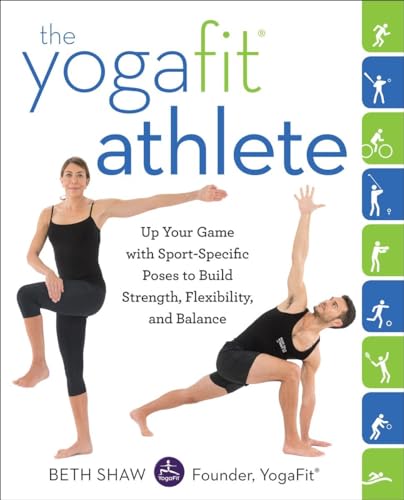
The YogaFit Athlete: Up Your Game with Sport-Specific Poses to Build Strength, Flexibility, and Balance - Softcover
Inhaltsangabe
Bring the strength and breathing power of yoga to the sports you love—and seriously up your game!
Yoga routines designed specifically for swimming, running, cycling, golf, tennis, baseball, football, volleyball, basketball, skiing, snowboarding, weight lifting, kickboxing, boxing, CrossFit, and more!
“Your body can either help you achieve your goals or get in the way of you living your best life. By practicing yoga and meditation, you can make your body work with you, not against you.”—Beth Shaw
Whether you’re a professional athlete, a weekend warrior, or a pick-up game enthusiast, yoga can dramatically affect your athletic performance and improve your alignment, balance, core stability, strength, flexibility, agility, endurance, lung capacity, and mobility. In this motivating and practical guide, celebrated fitness expert Beth Shaw provides short, sport-specific yoga routines designed to help counter tight muscles, overuse injuries, and musculature imbalances. By adding a quick yoga routine to any workout, you will increase your overall strength and health, and achieve your personal best.
Inside you’ll find
• fully illustrated, sport-specific yoga routines that engage the core, enhance your play, and reduce the risk of injury
• essential warm-up and cool-down movements to complement any athletic endeavor
• simple breathing exercises to steady your breath and calm your nerves during competition
• meditation techniques to help clear your mind and bring laser focus to your goals
• guided imagery and visualization exercises to improve performance
• strategies for coaching yourself and others
Die Inhaltsangabe kann sich auf eine andere Ausgabe dieses Titels beziehen.
Über die Autorin bzw. den Autor
Beth Shaw is the president and founder of the world-renowned YogaFit® training systems, the largest yoga school in the world, as well as the author of YogaLean and Beth Shaw’s YogaFit and the creator of more than a hundred bestselling yoga and fitness DVDs and CDs. Shaw works with the NFL as well as many sports teams and athletes. A sought-after international presenter, Shaw travels the world spreading the message of health and wellness. She lives in Los Angeles, California.
Auszug. © Genehmigter Nachdruck. Alle Rechte vorbehalten.
I.
The Fundamentals of the YogaFit Approach
Chapter 1
Gaining Physical and Mental, Strength Through YogaFit
The impact of yoga is never purely physical. Asanas, if correctly practiced, bridge the divide between the physical and the mental spheres. Yoga stems the feelings of pain, fatigue, doubt, confusion, indifference, laziness, self-delusion, and despair that assail us from time to time. . . . Yoga illuminates your life. If you practice sincerely, with seriousness and honesty, its light will spread to all aspects of your life.
—B.K.S. Iyengar
Overall body strength is a building block of success regardless of your sport or athletic activity. No amount of weight lifting with free weights will give you the strength that is achieved by holding up your own body weight in yoga. (Though adding some weights to your yoga practice each week is a fantastic idea and combination—see part III for poses that include light weights.) Consistent practice of the various yoga poses builds strength and improves lean muscle mass. Through specific poses, you can concentrate on muscle groups that are underutilized or stretch out your overtrained and maxed-out muscles. Which muscles you need to strengthen and which you need to stretch and rest varies from sport to sport, so you can and should adapt your yoga practice to serve your specific athletic needs.
Physical strength will improve your endurance, surely something to be prized in sports such as cross-country or triathlons. But it’s not just physical power that guides an athlete over the long haul; mental endurance is also key. Part 5 of this book gives you specific techniques for harnessing the power of your own mind. When you learn to tune in to your body and mind, everything can be a meditation—sports included. Yoga helps you learn how to pace yourself and focus on the moment, not on how long it’s going to take to finish. It also develops a powerful foundation in your core, which is essentially the nucleus of your balance and movement.
Almost everything you do in life activates your core, and almost everything in yoga works on your core strength. When core stability is enhanced, it reinforces the supportive but otherwise underdeveloped muscles surrounding the more utilized muscles, creating a more balanced and optimal strength. Strong and stabilized core muscles in turn help with overall performance. Yoga helps strengthen all of the stabilizing muscles that are vital in protecting your joints and spine, among other things. People tend to miss these in other physical workouts, but your new yoga practice will bring them to life in order to enhance your body’s overall functioning.
The core guides your balance, and your ability to balance through different movements can make or break your game. After all, balance is necessary whether you are shifting your feet closer together or farther apart, lowering your body to the earth, standing tall, jumping, swinging, or generating force. If your balance is on point, it gives you a solid ground to work from and helps maximize movements and prevent falls and injuries. Many of the poses in the sport-specific sections of this book work your core; I have also included a stand-alone section of core poses so that you will be sure to get some core engagement.
If you play tennis or golf, you know the value of range of motion. With improved joint and muscular flexibility—gained through yoga poses and stretching—your body’s overall structure is improved, and your joint and muscle pliancy will foster greater range of motion or an increase in the performance latitude for a particular movement or series of movements. For example, a swimmer with supple shoulder and hip joints is able to capture and pull more water than a swimmer with a more limited range of motion. The result is more forward movement per stroke as well as enhanced muscular economy.
There is some dispute about the advisability of excessive stretching (for runners in particular), but I remain a huge advocate for when it is done after a workout, finding that the more I work to maintain my flexibility (something that wanes with age), the less likely I am to suffer from an injury caused by an overuse of or a strain to the muscles.
Intense engagement in sports can be a huge strain on the body, and it is important to balance that with rest and recovery. Restorative yoga helps your body recover from any particular strain on the body, whether it’s an injury or some other physical ailment. Yoga helps put athletes back together after a tough game or workout. By slowing down, you are allowing the body to heal and to tell you where it’s tight and where future injuries may be brewing. Yoga also elongates all of the muscles that athletes spend so long contracting, so it is a great counteraction.
To quell the mind of your own mental chatter and of that around you is not easy, especially in a high-pressure moment. Yoga improves your control over that noise to create a center of focus and to promote serenity by silencing surrounding pressures, both internally and externally. When your mind learns to move with ease and stop forcing movements, you will prevent injuries and your body will open with your mind, increasing your flexibility, both mentally and physically.
the fundamentals of the yogafit approach
At YogaFit, we teach what we call “The Essence,” which is comprised of seven areas of focus intended to help you be safe and comfortable on the mat. As much as adhering to the Essence components will help you on the yoga mat itself, I think you’ll find that there are off-the-mat benefits too. As you embark on the sport-specific poses later in the book, keep these seven components in mind:
1.Breathe
Most often, we are just passively breathing, unaware and disconnected. The goal of taking specific time and focus to breathe, as in a yoga class, is to be deliberate or purposeful with your breath. Mindful breathing calls attention to your breath quality and how it affects your body and psyche; quick and shallow versus slow and deep, for example. YogaFit emphasizes deep diaphragmatic and controlled breath to improve your quality of breathing. In turn, as you improve, you not only reap the health benefits (such as reducing stress and symptoms triggered by stress), but you can improve oxygen efficiency.
Professional athletes are often tested for their CO2 maximum. This test measures the amount of oxygen used by the whole body in a specified amount of time (milliliters of oxygen per minute per kilogram of body weight). This information helps to determine optimal training levels and performance potential. With specific training, and in order to improve performance, an athlete will gradually push their anaerobic threshold (or lactate threshold), which is the exercise intensity at which lactic acid starts to accumulate in the bloodstream. Full diaphragmatic breath helps to improve or maximize lung capacity, which aids in more efficient breathing, meaning the efficient use of oxygen that helps us reach optimal performance.
Oxygen fuels strength, movement, and cardiovascular endurance. Oxygen is the “what,” the air you breathe in rest and during activity. Your CO2 Max is the “how,” a measurement of how your body utilizes the air you breathe in and converts it to energy. A strong and efficient CO2 Max will enable you to perform longer while maximizing the oxygen you take in with each breath. Work on the breath ability, and your CO2 measurement will improve.
Breath is also an innate tool to keep you calm and focused. When you inhale and let it go, it slows down the central and respiratory systems and helps shed nervous energy,...
„Über diesen Titel“ kann sich auf eine andere Ausgabe dieses Titels beziehen.
Suchergebnisse für The YogaFit Athlete: Up Your Game with Sport-Specific...

Beispielbild für diese ISBN
The YogaFit Athlete: Up Your Game with Sport-Specific Poses to Build Strength, Flexibility, and Balance
Anbieter: World of Books (was SecondSale), Montgomery, IL, USA
Verkäuferbewertung 5 von 5 Sternen

Zustand: Very Good. Item in very good condition! Textbooks may not include supplemental items i.e. CDs, access codes etc. Bestandsnummer des Verkäufers 00101258741
Gebraucht kaufen
EUR 4,14
Versand gratis
Versand innerhalb von USA
Versand innerhalb von USA
Anzahl: 1 verfügbar
Beispielbild für diese ISBN
The YogaFit Athlete: Up Your Game with Sport-Specific Poses to Build Strength, Flexibility, and Balance
Anbieter: Gulf Coast Books, Cypress, TX, USA
Verkäuferbewertung 5 von 5 Sternen
paperback. Zustand: Fair. Bestandsnummer des Verkäufers 0804178577-4-35269598
Gebraucht kaufen
EUR 4,15
Versand gratis
Versand innerhalb von USA
Versand innerhalb von USA
Anzahl: 1 verfügbar
Foto des Verkäufers
The YogaFit Athlete: Up Your Game with Sport-Specific Poses to Build Strength, Flexibility, and Balance
Anbieter: Reliant Bookstore, El Dorado, KS, USA
Verkäuferbewertung 5 von 5 Sternen
Zustand: acceptable. This book is a well used but readable copy. Integrity of the book is still intact with no missing pages. May have notes or highlighting. Cover image on the book may vary from photo. Ships out quickly in a secure plastic mailer. Bestandsnummer des Verkäufers 56JR8Y0004HI_ns
Gebraucht kaufen
EUR 4,43
Versand gratis
Versand innerhalb von USA
Versand innerhalb von USA
Anzahl: 1 verfügbar
Foto des Verkäufers
The YogaFit Athlete: Up Your Game with Sport-Specific Poses to Build Strength, Flexibility, and Balance
Anbieter: Greenworld Books, Arlington, TX, USA
Verkäuferbewertung 5 von 5 Sternen
Zustand: very_good. Fast Free Shipping â" Very Good condition book with a firm cover and clean pages. Shows normal use and some light wear or limited notes markings. A solid, nice copy to enjoy. Bestandsnummer des Verkäufers GWV.0804178577.VG
Gebraucht kaufen
EUR 4,81
Versand gratis
Versand innerhalb von USA
Versand innerhalb von USA
Anzahl: 1 verfügbar
Beispielbild für diese ISBN
The YogaFit Athlete : Up Your Game with Sport-Specific Poses to Build Strength, Flexibility, and Balance
Verlag:
Random House Publishing Group, 2016
ISBN 10: 0804178577
ISBN 13: 9780804178570
Gebraucht
Softcover
Erstausgabe
Anbieter: Better World Books, Mishawaka, IN, USA
Verkäuferbewertung 5 von 5 Sternen
Zustand: Good. 1st Edition. Former library copy. Pages intact with minimal writing/highlighting. The binding may be loose and creased. Dust jackets/supplements are not included. Includes library markings. Stock photo provided. Product includes identifying sticker. Better World Books: Buy Books. Do Good. Bestandsnummer des Verkäufers GRP97416721
Gebraucht kaufen
EUR 6,19
Versand gratis
Versand innerhalb von USA
Versand innerhalb von USA
Anzahl: 2 verfügbar
Beispielbild für diese ISBN
The YogaFit Athlete : Up Your Game with Sport-Specific Poses to Build Strength, Flexibility, and Balance
Verlag:
Random House Publishing Group, 2016
ISBN 10: 0804178577
ISBN 13: 9780804178570
Gebraucht
Softcover
Erstausgabe
Anbieter: Better World Books, Mishawaka, IN, USA
Verkäuferbewertung 5 von 5 Sternen
Zustand: Very Good. 1st Edition. Former library copy. Pages intact with possible writing/highlighting. Binding strong with minor wear. Dust jackets/supplements may not be included. Includes library markings. Stock photo provided. Product includes identifying sticker. Better World Books: Buy Books. Do Good. Bestandsnummer des Verkäufers 13288422-6
Gebraucht kaufen
EUR 6,19
Versand gratis
Versand innerhalb von USA
Versand innerhalb von USA
Anzahl: 2 verfügbar
Beispielbild für diese ISBN
The Yogafit Athlete: Up Your Game with Sport-Specific Poses to Build Strength, Flexibility, and Balance
Anbieter: ThriftBooks-Reno, Reno, NV, USA
Verkäuferbewertung 5 von 5 Sternen
Paperback. Zustand: Very Good. No Jacket. Former library book; May have limited writing in cover pages. Pages are unmarked. ~ ThriftBooks: Read More, Spend Less. Bestandsnummer des Verkäufers G0804178577I4N10
Gebraucht kaufen
EUR 7,34
Versand gratis
Versand innerhalb von USA
Versand innerhalb von USA
Anzahl: 1 verfügbar
Beispielbild für diese ISBN
The Yogafit Athlete: Up Your Game with Sport-Specific Poses to Build Strength, Flexibility, and Balance
Anbieter: ThriftBooks-Dallas, Dallas, TX, USA
Verkäuferbewertung 5 von 5 Sternen
Paperback. Zustand: Very Good. No Jacket. May have limited writing in cover pages. Pages are unmarked. ~ ThriftBooks: Read More, Spend Less. Bestandsnummer des Verkäufers G0804178577I4N00
Gebraucht kaufen
EUR 7,35
Versand gratis
Versand innerhalb von USA
Versand innerhalb von USA
Anzahl: 1 verfügbar
Beispielbild für diese ISBN
The Yogafit Athlete: Up Your Game with Sport-Specific Poses to Build Strength, Flexibility, and Balance
Anbieter: ThriftBooks-Atlanta, AUSTELL, GA, USA
Verkäuferbewertung 5 von 5 Sternen
Paperback. Zustand: Very Good. No Jacket. Former library book; May have limited writing in cover pages. Pages are unmarked. ~ ThriftBooks: Read More, Spend Less. Bestandsnummer des Verkäufers G0804178577I4N10
Gebraucht kaufen
EUR 7,35
Versand gratis
Versand innerhalb von USA
Versand innerhalb von USA
Anzahl: 1 verfügbar
Beispielbild für diese ISBN
The Yogafit Athlete: Up Your Game with Sport-Specific Poses to Build Strength, Flexibility, and Balance
Anbieter: ThriftBooks-Dallas, Dallas, TX, USA
Verkäuferbewertung 5 von 5 Sternen
Paperback. Zustand: Good. No Jacket. Pages can have notes/highlighting. Spine may show signs of wear. ~ ThriftBooks: Read More, Spend Less. Bestandsnummer des Verkäufers G0804178577I3N00
Gebraucht kaufen
EUR 7,35
Versand gratis
Versand innerhalb von USA
Versand innerhalb von USA
Anzahl: 1 verfügbar