
Verwandte Artikel zu The Truth According to Us (Random House Large Print)
Inhaltsangabe
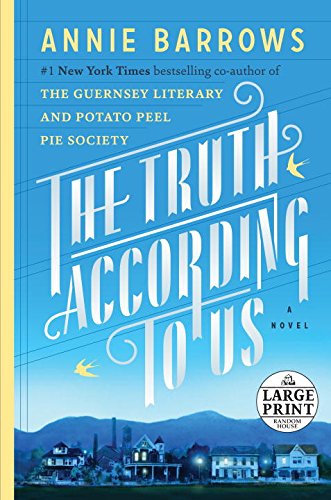
NEW YORK TIMES BESTSELLER • From the co-author of The Guernsey Literary and Potato Peel Pie Society comes a wise, witty, and exuberant novel, perfect for fans of Lee Smith, that illuminates the power of loyalty and forgiveness, memory and truth, and the courage it takes to do what’s right.
Annie Barrows once again evokes the charm and eccentricity of a small town filled with extraordinary characters. Her new novel, The Truth According to Us, brings to life an inquisitive young girl, her beloved aunt, and the alluring visitor who changes the course of their destiny forever.
In the summer of 1938, Layla Beck’s father, a United States senator, cuts off her allowance and demands that she find employment on the Federal Writers’ Project, a New Deal jobs program. Within days, Layla finds herself far from her accustomed social whirl, assigned to cover the history of the remote mill town of Macedonia, West Virginia, and destined, in her opinion, to go completely mad with boredom. But once she secures a room in the home of the unconventional Romeyn family, she is drawn into their complex world and soon discovers that the truth of the town is entangled in the thorny past of the Romeyn dynasty.
At the Romeyn house, twelve-year-old Willa is desperate to learn everything in her quest to acquire her favorite virtues of ferocity and devotion—a search that leads her into a thicket of mysteries, including the questionable business that occupies her charismatic father and the reason her adored aunt Jottie remains unmarried. Layla’s arrival strikes a match to the family veneer, bringing to light buried secrets that will tell a new tale about the Romeyns. As Willa peels back the layers of her family’s past, and Layla delves deeper into town legend, everyone involved is transformed—and their personal histories completely rewritten.
Praise for The Truth According to Us
“As delightfully eccentric as Guernsey yet refreshingly different . . . an epic but intimate family novel with richly imagined characters . . . Willa’s indomitable spirit, keen sense of adventure and innate intelligence reminded me of two other motherless girls in literature: Scout Finch in Harper Lee’s To Kill a Mockingbird and Flavia de Luce in Alan Bradley’s big-hearted British mystery series.”—The Washington Post
“The Truth According to Us has all the characteristics of a great summer read: A plot that makes you want to keep turning the pages; a setting that makes you feel like you’re inhabiting another time and place; and characters who become people you’re sad to leave behind—and thus who always stay with you.”—Miami Herald
“It takes a brave author to make the heroine of a new novel an observant and feisty girl . . . like Scout Finch in To Kill a Mockingbird. . . . But Barrows . . . has created a believable and touching character in Willa.”—USA Today
“[A] heartwarming coming-of-age novel [that] sparkles with folksy depictions of a tight-knit family and life in a small town . . . full of richly drawn, memorable characters.”—The Seattle Times
“A big, juicy family saga with warm humor and tragic twists . . . The story gets more and more absorbing as it moves briskly along.”—St. Louis Post-Dispatch
“Annie Barrows leaves no doubt that she is a storyteller of rare caliber, with wisdom and insight to spare. Every page rings like a bell.”—Paula McLain, author of The Paris Wife
From the Hardcover edition.
Die Inhaltsangabe kann sich auf eine andere Ausgabe dieses Titels beziehen.
Über die Autorin bzw. den Autor
Annie Barrows is the co-author, with her aunt Mary Ann Shaffer, of The Guernsey Literary and Potato Peel Pie Society, a runaway New York Times bestseller that was named one of the ten best books of the year by Time and USA Today. She is also the author of the children’s series Ivy and Bean as well as The Magic Half and its sequel, Magic in the Mix. She lives in Berkeley, California.
Auszug. © Genehmigter Nachdruck. Alle Rechte vorbehalten.
1
In 1938, the year I was twelve, my hometown of Macedonia, West Virginia, celebrated its sesquicentennial, a word I thought had to do with fruit for the longest time. In school, we commemorated the occasion as we commemorated most occasions, with tableaux, one for each of the major events in Macedonia’s history. There weren’t many, hardly enough to stretch out across eight grades, but the teachers eked them out the best they could. If it hadn’t been for the War Between the States, I don’t know what they would have done. When Virginia seceded from the Union, western Virginia got mad and seceded right back into it, all except four little counties, one of them ours, that stuck out their tongues at West Virginia and declared themselves part of the Confederacy, a piece of sass with long consequences in the way of road-paving and school desks.
Tucked up in a crook between the Potomac and the Shenandoah, Macedonia was a junction for generals and railroads alike, and by the time Lee hung up his sword at Appomattox, the town had changed hands forty-seven times, six of them in one day. Our teachers dearly loved to get up a scene of the townspeople stuffing their Confederate flags up the chimney as the Union troops marched in and yanking them back down again as the troops departed. The fourth-, fifth-, and sixth-graders got the war scenes, and the seventh- and eighth-graders got the short end of the stick, because not a thing happened in Macedonia after 1865, except the roundhouse blowing up and the American Everlasting Hosiery Company opening its doors. Half the town worked in that mill and the other half wished it did, but there was not much about the American Everlasting Hosiery Company that looked good in a tableau. Sometimes the teachers gave up and killed two birds with one stone by making the seventh-graders march across the stage, waving socks, while the eighth-graders sang “The Star-Spangled Banner” behind them. In 1938, though, the eighth grade hit pay dirt, because Mrs. Roosevelt drove through town. She stopped at the square, took a drink from our sulfur-spring water fountain, made a face, and drove away. That was plenty for a tableau, except that instead of making a face, the eighth-grade Mrs. Roosevelt said, “The people of Macedonia are lucky to receive the benefits of healthful mineral water.” My sister Bird and I laughed so hard we got sent into the hall.
Once the curtain had clunked down on our tableaux and we’d been herded back into our classrooms, I supposed that Macedonia’s sesquicentennial festivities were concluded. Hadn’t we just covered one hundred and fifty years of history in twenty-three minutes flat? We had. But not a week later came the Decoration Day parade, and that, I realized later, was the real beginning of the sesquicentennial. Later still, I realized that everything began that day. Everything that was to heave itself free of its foundations over the course of the summer began to rattle lightly on the morning of the parade. That was when I first heard of Layla Beck, when I began to wonder about my father, and when I noticed I was being lied to and decided to leave my childhood behind. I have since wondered, of course, how my life—and my father’s and my aunt Jottie’s, too—would have been different if I’d decided to stay at home that morning. This is what’s called the enigma of history, and it can drive you out of your mind if you let it.
Jottie and I were packed tight on the sidewalk, together with everyone else in town, to watch the parade. Usually it wasn’t much, the Decoration Day parade, just a matter of assorted veterans looking grim and the high school marching band. But this year, in honor of the sesquicentennial, we’d been promised an extra-fancy show, a real spectacle. And that was what we got: The United Daughters of the Confederacy flounced out first, with the Ladies of the Grand Army of the Republic hot on their heels. Then the Rotary band struck up with patriotic tunes, which was a lot to manage on four trumpets and had a terrible effect on the pony brigade. The veterans marched along, a pair of girls in skimpy outfits flung batons in the air, just exactly like a movie parade, except that only one of them could catch. We even had a float, The Apple Princess and Her Blossoms, smiling on the back of a truck. Out came the mayor, waving from his big green car, and behind him was Mr. Parker Davies, who had got himself up in a sword and knee pants to look like General Magnus Hamilton, the founder of Macedonia, which put me in mind of a question I had always wanted to ask. I nudged my aunt Jottie. “How come he called it Macedonia?”
She tilted her dark eyes down to mine. “The General was a great admirer of the Macedonian virtues.”
“Huh.” That was news to me. “What are they, the Macedonian virtues?”
“Don’t say huh. Ferocity and devotion.” The Apple Princess joggled by. It was Elsie Averill in a white dress. A lady standing just behind me leaned forward for a better look, and a big whiff of Jungle Gardenia went up my nose.
I squeezed closer to Jottie. “Did he have them?” I asked.
Jottie’s eyes followed Elsie for a bit. “Did he have what?” she murmured.
“Jottie!” I recalled her. “Did General Hamilton have the Macedonian virtues?”
“The General?” She lifted one eyebrow. “The General once chopped off a soldier’s toes to keep the poor man from deserting. You tell me, Willa: Is that ferocity, devotion, or just plain crazy?”
I eyed Mr. Parker Davies, imagining his bloodied sword raised high, a little toe speared on the point. That was ferocity, I was pretty sure. “Do I have them?” I asked hopefully.
Jottie smiled. “Ferocity and devotion? You want those?”
“They’re virtues, aren’t they?” I asked.
“They surely are. Ferocity, devotion, and a nickel will get you a cup of coffee at the Pickus Café.” I made a face at her, and she laughed. The parade passed by, turned around on itself, and straggled back up Prince Street.
I thought maybe I had a chance at devotion.
Now the Macedonia Chamber of Commerce made the turn and marched by, eight men in identical tan hats and overcoats. They looked like a set of matching boy dolls, only embarrassed. Jottie chuckled and flapped her little flag. “Hooray!” she cheered. “Hooray for our brave boys in the Chamber of Commerce!”
They pretended they didn’t hear, all except one. “Jottie?” he said, swiveling around. Jottie drew in a sharp breath, and I saw two spots of pink appear on her cheeks. She started to put up her hand, let it drop, and then changed her mind and lifted it in a little wave. That set him up; now he started smiling like crazy, and even though the parade was moving again, he called out to her, “I was hoping I might see you today, Jottie, I was thinking I might—”
A man behind bumped into him then, and he had to walk on, but he kept turning around to wave at her as he went.
“Who was that?” I asked. Nothing happened, so I gave her a poke. “Who was that, Jottie?”
“Sol,” she said. “Sol McKubin.” She opened her purse and rummaged inside. “I had a handkerchief in here this morning.”
And that would have been that, if I hadn’t heard a low laugh behind me. It was Mrs. Jungle Gardenia. “Shoo-oo, good thing old Felix ain’t here,” she hooted softly to herself.
What? I whirled around, wondering who she was and how she knew my father.
She didn’t look like...
„Über diesen Titel“ kann sich auf eine andere Ausgabe dieses Titels beziehen.
Suchergebnisse für The Truth According to Us (Random House Large Print)

Foto des Verkäufers
The Truth According to Us: A Novel
Verlag:
Random House Large Print, 2015
ISBN 10: 0804194939
ISBN 13: 9780804194938
Gebraucht
Softcover
Anbieter: 3Brothers Bookstore, Egg harbor township, NJ, USA
Verkäuferbewertung 5 von 5 Sternen

Zustand: good. Books may contain some notes and highlighting. Supplements such as Access Codes, Cd's Dust Jackets, etc. are not guaranteed with used book purchases. Bestandsnummer des Verkäufers EVV.0804194939.G
Gebraucht kaufen
EUR 4,78
Versand gratis
Versand innerhalb von USA
Versand innerhalb von USA
Anzahl: 1 verfügbar
Beispielbild für diese ISBN
The Truth According to Us: A Novel (Random House Large Print)
Verlag:
Random House Large Print, 2015
ISBN 10: 0804194939
ISBN 13: 9780804194938
Gebraucht
paperback
Anbieter: Once Upon A Time Books, Siloam Springs, AR, USA
Verkäuferbewertung 4 von 5 Sternen

paperback. Zustand: Acceptable. This is a used book. It may contain highlighting/underlining and/or the book may show heavier signs of wear . It may also be ex-library or without dustjacket. This is a used book. It may contain highlighting/underlining and/or the book may show heavier signs of wear . It may also be ex-library or without dustjacket. Bestandsnummer des Verkäufers mon0003575160
Gebraucht kaufen
EUR 2,70
EUR 3,47 Versand
Versand innerhalb von USA
Versand innerhalb von USA
Anzahl: 1 verfügbar
Beispielbild für diese ISBN
The Truth According to Us: A Novel
Verlag:
Random House Large Print, 2015
ISBN 10: 0804194939
ISBN 13: 9780804194938
Gebraucht
Paperback
Anbieter: ThriftBooks-Reno, Reno, NV, USA
Verkäuferbewertung 5 von 5 Sternen
Paperback. Zustand: Very Good. No Jacket. Former library book; May have limited writing in cover pages. Pages are unmarked. ~ ThriftBooks: Read More, Spend Less. Bestandsnummer des Verkäufers G0804194939I4N10
Gebraucht kaufen
EUR 6,30
Versand gratis
Versand innerhalb von USA
Versand innerhalb von USA
Anzahl: 1 verfügbar
Beispielbild für diese ISBN
The Truth According to Us: A Novel
Verlag:
Random House Large Print, 2015
ISBN 10: 0804194939
ISBN 13: 9780804194938
Gebraucht
Paperback
Anbieter: ThriftBooks-Atlanta, AUSTELL, GA, USA
Verkäuferbewertung 5 von 5 Sternen
Paperback. Zustand: Good. No Jacket. Pages can have notes/highlighting. Spine may show signs of wear. ~ ThriftBooks: Read More, Spend Less. Bestandsnummer des Verkäufers G0804194939I3N00
Gebraucht kaufen
EUR 6,32
Versand gratis
Versand innerhalb von USA
Versand innerhalb von USA
Anzahl: 1 verfügbar
Beispielbild für diese ISBN
The Truth According to Us: A Novel
Verlag:
Random House Large Print, 2015
ISBN 10: 0804194939
ISBN 13: 9780804194938
Gebraucht
Paperback
Anbieter: ThriftBooks-Dallas, Dallas, TX, USA
Verkäuferbewertung 5 von 5 Sternen
Paperback. Zustand: Good. No Jacket. Former library book; Pages can have notes/highlighting. Spine may show signs of wear. ~ ThriftBooks: Read More, Spend Less. Bestandsnummer des Verkäufers G0804194939I3N10
Gebraucht kaufen
EUR 6,32
Versand gratis
Versand innerhalb von USA
Versand innerhalb von USA
Anzahl: 1 verfügbar
Beispielbild für diese ISBN
The Truth According to Us: A Novel
Verlag:
Random House Large Print, 2015
ISBN 10: 0804194939
ISBN 13: 9780804194938
Gebraucht
Paperback
Anbieter: ThriftBooks-Dallas, Dallas, TX, USA
Verkäuferbewertung 5 von 5 Sternen
Paperback. Zustand: Good. No Jacket. Pages can have notes/highlighting. Spine may show signs of wear. ~ ThriftBooks: Read More, Spend Less. Bestandsnummer des Verkäufers G0804194939I3N00
Gebraucht kaufen
EUR 6,32
Versand gratis
Versand innerhalb von USA
Versand innerhalb von USA
Anzahl: 1 verfügbar
Beispielbild für diese ISBN
The Truth According to Us: A Novel
Verlag:
Random House Large Print, 2015
ISBN 10: 0804194939
ISBN 13: 9780804194938
Gebraucht
Paperback
Anbieter: ThriftBooks-Dallas, Dallas, TX, USA
Verkäuferbewertung 5 von 5 Sternen
Paperback. Zustand: Very Good. No Jacket. Former library book; May have limited writing in cover pages. Pages are unmarked. ~ ThriftBooks: Read More, Spend Less. Bestandsnummer des Verkäufers G0804194939I4N10
Gebraucht kaufen
EUR 6,32
Versand gratis
Versand innerhalb von USA
Versand innerhalb von USA
Anzahl: 1 verfügbar
Beispielbild für diese ISBN
The Truth According to Us: A Novel
Verlag:
Random House Large Print, 2015
ISBN 10: 0804194939
ISBN 13: 9780804194938
Gebraucht
Paperback
Anbieter: ThriftBooks-Atlanta, AUSTELL, GA, USA
Verkäuferbewertung 5 von 5 Sternen
Paperback. Zustand: Very Good. No Jacket. Former library book; May have limited writing in cover pages. Pages are unmarked. ~ ThriftBooks: Read More, Spend Less. Bestandsnummer des Verkäufers G0804194939I4N10
Gebraucht kaufen
EUR 6,32
Versand gratis
Versand innerhalb von USA
Versand innerhalb von USA
Anzahl: 1 verfügbar
Beispielbild für diese ISBN
Truth According to Us
Anbieter: Better World Books, Mishawaka, IN, USA
Verkäuferbewertung 5 von 5 Sternen
Zustand: Very Good. Lrg. Former library copy. Pages intact with possible writing/highlighting. Binding strong with minor wear. Dust jackets/supplements may not be included. Includes library markings. Stock photo provided. Product includes identifying sticker. Better World Books: Buy Books. Do Good. Bestandsnummer des Verkäufers GRP96028256
Gebraucht kaufen
EUR 6,99
Versand gratis
Versand innerhalb von USA
Versand innerhalb von USA
Anzahl: 1 verfügbar
Beispielbild für diese ISBN
Truth According to Us
Anbieter: Better World Books, Mishawaka, IN, USA
Verkäuferbewertung 5 von 5 Sternen
Zustand: Good. Lrg. Former library copy. Pages intact with minimal writing/highlighting. The binding may be loose and creased. Dust jackets/supplements are not included. Includes library markings. Stock photo provided. Product includes identifying sticker. Better World Books: Buy Books. Do Good. Bestandsnummer des Verkäufers GRP89320229
Gebraucht kaufen
EUR 6,99
Versand gratis
Versand innerhalb von USA
Versand innerhalb von USA
Anzahl: 1 verfügbar