
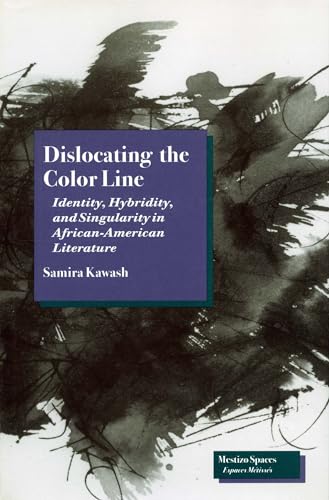
Dislocating the Color Line: Identity, Hybridity, and Singularity in African-American Narrative (Mestizo Spaces/Espaces Metisses) - Softcover
Inhaltsangabe
Inquiries into the meaning and force of race in American culture have largely focused on questions of identity and difference—What does it mean to have a racial identity? What constitutes racial difference? Such questions assume the basic principle of racial division, which todays seems to be becoming an increasingly bitter and seemingly irreparable chasm between black and white.
This book confronts this contemporary problem by shifting the focus of analysis from understanding differences to analyzing division. It provides a historical context for the recent resurgence of racial division by tracing the path of the color line as it appears in the narrative writings of African-Americans in the nineteenth and twentieth centuries. In readings of slave narratives, "passing novels," and the writings of Charles Chesnutt and Zora Neale Hurston, the author asks: What is the work of division? How does division work?
The history of the color line in the United States is coeval with that of the nation. The author suggests that throughout this history, the color line has not functioned simply to name biological or cultural difference, but more important, it has served as a principle of division, classification, and order. In this way, the color line marks the inseparability of knowledge and power in a racially demarcated society. The author shows how, from the time of slavery to today, the color line has figured as the locus of such central tenets of American political life as citizenship, subjectivity, community, law, freedom, and justice.
This book seeks not only to understand, but also to bring critical pressure on the interpretations, practices, and assumptions that correspond to and buttress representations of racial difference. The work of dislocating the color line lies in uncovering the uncertainty, the incoherency, and the discontinuity that the common sense of the color line masks, while at the same time elucidating the pressures that transform the contingent relations of the color line into common sense.
Die Inhaltsangabe kann sich auf eine andere Ausgabe dieses Titels beziehen.
Über die Autorin bzw. den Autor
Samira Kawash is Assistant Professor of English at Rutgers University.
Von der hinteren Coverseite
Inquiries into the meaning and force of race in American culture have largely focused on questions of identity and difference—What does it mean to have a racial identity? What constitutes racial difference? Such questions assume the basic principle of racial division, which todays seems to be becoming an increasingly bitter and seemingly irreparable chasm between black and white.
This book confronts this contemporary problem by shifting the focus of analysis from understanding differences to analyzing division. It provides a historical context for the recent resurgence of racial division by tracing the path of the color line as it appears in the narrative writings of African-Americans in the nineteenth and twentieth centuries. In readings of slave narratives, "passing novels," and the writings of Charles Chesnutt and Zora Neale Hurston, the author asks: What is the work of division? How does division work?
The history of the color line in the United States is coeval with that of the nation. The author suggests that throughout this history, the color line has not functioned simply to name biological or cultural difference, but more important, it has served as a principle of division, classification, and order. In this way, the color line marks the inseparability of knowledge and power in a racially demarcated society. The author shows how, from the time of slavery to today, the color line has figured as the locus of such central tenets of American political life as citizenship, subjectivity, community, law, freedom, and justice.
This book seeks not only to understand, but also to bring critical pressure on the interpretations, practices, and assumptions that correspond to and buttress representations of racial difference. The work of dislocating the color line lies in uncovering the uncertainty, the incoherency, and the discontinuity that the common sense of the color line masks, while at the same time elucidating the pressures that transform the contingent relations of the color line into common sense.
This book confronts this contemporary problem by shifting the focus of analysis from understanding differences to analyzing division. It provides a historical context for the recent resurgence of racial division by tracing the path of the color line as it appears in the narrative writings of African-Americans in the nineteenth and twentieth centuries. In readings of slave narratives, "passing novels," and the writings of Charles Chesnutt and Zora Neale Hurston, the author asks: What is the work of division? How does division work?
The history of the color line in the United States is coeval with that of the nation. The author suggests that throughout this history, the color line has not functioned simply to name biological or cultural difference, but more important, it has served as a principle of division, classification, and order. In this way, the color line marks the inseparability of knowledge and power in a racially demarcated society. The author shows how, from the time of slavery to today, the color line has figured as the locus of such central tenets of American political life as citizenship, subjectivity, community, law, freedom, and justice.
This book seeks not only to understand, but also to bring critical pressure on the interpretations, practices, and assumptions that correspond to and buttress representations of racial difference. The work of dislocating the color line lies in uncovering the uncertainty, the incoherency, and the discontinuity that the common sense of the color line masks, while at the same time elucidating the pressures that transform the contingent relations of the color line into common sense.
Aus dem Klappentext
Inquiries into the meaning and force of race in American culture have largely focused on questions of identity and difference What does it mean to have a racial identity? What constitutes racial difference? Such questions assume the basic principle of racial division, which todays seems to be becoming an increasingly bitter and seemingly irreparable chasm between black and white.
This book confronts this contemporary problem by shifting the focus of analysis from understanding differences to analyzing division. It provides a historical context for the recent resurgence of racial division by tracing the path of the color line as it appears in the narrative writings of African-Americans in the nineteenth and twentieth centuries. In readings of slave narratives, "passing novels," and the writings of Charles Chesnutt and Zora Neale Hurston, the author asks: What is the work of division? How does division work?
The history of the color line in the United States is coeval with that of the nation. The author suggests that throughout this history, the color line has not functioned simply to name biological or cultural difference, but more important, it has served as a principle of division, classification, and order. In this way, the color line marks the inseparability of knowledge and power in a racially demarcated society. The author shows how, from the time of slavery to today, the color line has figured as the locus of such central tenets of American political life as citizenship, subjectivity, community, law, freedom, and justice.
This book seeks not only to understand, but also to bring critical pressure on the interpretations, practices, and assumptions that correspond to and buttress representations of racial difference. The work of dislocating the color line lies in uncovering the uncertainty, the incoherency, and the discontinuity that the common sense of the color line masks, while at the same time elucidating the pressures that transform the contingent relations of the color line into common sense.
This book confronts this contemporary problem by shifting the focus of analysis from understanding differences to analyzing division. It provides a historical context for the recent resurgence of racial division by tracing the path of the color line as it appears in the narrative writings of African-Americans in the nineteenth and twentieth centuries. In readings of slave narratives, "passing novels," and the writings of Charles Chesnutt and Zora Neale Hurston, the author asks: What is the work of division? How does division work?
The history of the color line in the United States is coeval with that of the nation. The author suggests that throughout this history, the color line has not functioned simply to name biological or cultural difference, but more important, it has served as a principle of division, classification, and order. In this way, the color line marks the inseparability of knowledge and power in a racially demarcated society. The author shows how, from the time of slavery to today, the color line has figured as the locus of such central tenets of American political life as citizenship, subjectivity, community, law, freedom, and justice.
This book seeks not only to understand, but also to bring critical pressure on the interpretations, practices, and assumptions that correspond to and buttress representations of racial difference. The work of dislocating the color line lies in uncovering the uncertainty, the incoherency, and the discontinuity that the common sense of the color line masks, while at the same time elucidating the pressures that transform the contingent relations of the color line into common sense.
„Über diesen Titel“ kann sich auf eine andere Ausgabe dieses Titels beziehen.
Weitere beliebte Ausgaben desselben Titels

Suchergebnisse für Dislocating the Color Line: Identity, Hybridity, and...

Beispielbild für diese ISBN
Dislocating the Color Line : Identity, Hybridity, and Singularity in African-American Narrative
Verlag:
Stanford University Press, 1997
ISBN 10: 0804727759
ISBN 13: 9780804727754
Gebraucht
Softcover
Anbieter: Better World Books, Mishawaka, IN, USA
Verkäuferbewertung 5 von 5 Sternen

Zustand: Very Good. Pages intact with possible writing/highlighting. Binding strong with minor wear. Dust jackets/supplements may not be included. Stock photo provided. Product includes identifying sticker. Better World Books: Buy Books. Do Good. Bestandsnummer des Verkäufers 8670458-6
Gebraucht kaufen
EUR 9,93
Versand gratis
Versand innerhalb von USA
Versand innerhalb von USA
Anzahl: 1 verfügbar
Beispielbild für diese ISBN
Dislocating the Color Line: Identity, Hybridity, and Singularity in African-American Narrative (Mestizo Spaces / Espaces Mà tissà s)
Verlag:
Stanford University Press, 1997
ISBN 10: 0804727759
ISBN 13: 9780804727754
Gebraucht
paperback
Anbieter: HPB-Movies, Dallas, TX, USA
Verkäuferbewertung 4 von 5 Sternen

paperback. Zustand: Very Good. Connecting readers with great books since 1972! Used books may not include companion materials, and may have some shelf wear or limited writing. We ship orders daily and Customer Service is our top priority! Bestandsnummer des Verkäufers S_439957107
Gebraucht kaufen
EUR 6,72
EUR 3,27 Versand
Versand innerhalb von USA
Versand innerhalb von USA
Anzahl: 1 verfügbar
Beispielbild für diese ISBN
Dislocating the Color Line: Identity, Hybridity, and Singularity in African-American Narrative (Mestizo Spaces / Espaces Métissés)
Verlag:
Stanford University Press, Stanford, CA, 1997
ISBN 10: 0804727759
ISBN 13: 9780804727754
Gebraucht
Trade Paperback
Anbieter: Smith Family Bookstore Downtown, Eugene, OR, USA
Verkäuferbewertung 4 von 5 Sternen
Trade Paperback. Zustand: Very Good. Text clean and unmarked. Binding tight. Covers have light wear. Edges of pages have light wear. Bestandsnummer des Verkäufers 5050493
Gebraucht kaufen
EUR 14,83
EUR 5,19 Versand
Versand innerhalb von USA
Versand innerhalb von USA
Anzahl: 1 verfügbar
Foto des Verkäufers
Dislocating the Color Line: Identity, Hybridity, and Singularity in African-American Narrative (Mestizo Spaces / Espaces Métissés)
Verlag:
Stanford University Press, 1997
ISBN 10: 0804727759
ISBN 13: 9780804727754
Gebraucht
Softcover
Anbieter: WeBuyBooks, Rossendale, LANCS, Vereinigtes Königreich
Verkäuferbewertung 5 von 5 Sternen
Zustand: Very Good. Most items will be dispatched the same or the next working day. A copy that has been read, but is in excellent condition. Pages are intact and not marred by notes or highlighting. The spine remains undamaged. Bestandsnummer des Verkäufers wbs8598765218
Gebraucht kaufen
EUR 13,83
EUR 6,83 Versand
Versand von Vereinigtes Königreich nach USA
Versand von Vereinigtes Königreich nach USA
Anzahl: 1 verfügbar
Foto des Verkäufers
Dislocating the Color Line : Identity, Hybridity, and Singularity in African-American Narrative
Anbieter: GreatBookPrices, Columbia, MD, USA
Verkäuferbewertung 5 von 5 Sternen
Zustand: New. Bestandsnummer des Verkäufers 252537-n
Neu kaufen
EUR 24,37
EUR 2,30 Versand
Versand innerhalb von USA
Versand innerhalb von USA
Anzahl: Mehr als 20 verfügbar
Foto des Verkäufers
Dislocating the Color Line: Identity, Hybridity, and Singularity in African-American Narrative (Paperback or Softback)
Verlag:
Stanford University Press 6/1/1997, 1997
ISBN 10: 0804727759
ISBN 13: 9780804727754
Neu
Paperback or Softback
Anbieter: BargainBookStores, Grand Rapids, MI, USA
Verkäuferbewertung 5 von 5 Sternen
Paperback or Softback. Zustand: New. Dislocating the Color Line: Identity, Hybridity, and Singularity in African-American Narrative. Book. Bestandsnummer des Verkäufers BBS-9780804727754
Foto des Verkäufers
Dislocating the Color Line : Identity, Hybridity, and Singularity in African-American Narrative
Verlag:
Stanford University Press, 1997
ISBN 10: 0804727759
ISBN 13: 9780804727754
Gebraucht
Softcover
Anbieter: GreatBookPrices, Columbia, MD, USA
Verkäuferbewertung 5 von 5 Sternen
Zustand: As New. Unread book in perfect condition. Bestandsnummer des Verkäufers 252537
Gebraucht kaufen
EUR 26,83
EUR 2,30 Versand
Versand innerhalb von USA
Versand innerhalb von USA
Anzahl: Mehr als 20 verfügbar
Beispielbild für diese ISBN
Dislocating the Color Line - Identity, Hybridity, and Singularity in African-American Narrative
Anbieter: PBShop.store UK, Fairford, GLOS, Vereinigtes Königreich
Verkäuferbewertung 4 von 5 Sternen
PAP. Zustand: New. New Book. Shipped from UK. Established seller since 2000. Bestandsnummer des Verkäufers FW-9780804727754
Neu kaufen
EUR 25,60
EUR 4,79 Versand
Versand von Vereinigtes Königreich nach USA
Versand von Vereinigtes Königreich nach USA
Anzahl: 15 verfügbar
Foto des Verkäufers
Dislocating the Color Line: Identity, Hybridity, and Singularity in African-American Narrative Mestizo Spaces/Espaces Metisses
Verlag:
Stanford University Press, 1997
ISBN 10: 0804727759
ISBN 13: 9780804727754
Gebraucht
Broschiert
Anbieter: books4less (Versandantiquariat Petra Gros GmbH & Co. KG), Welling, Deutschland
Verkäuferbewertung 5 von 5 Sternen
Broschiert. Zustand: Gut. 266 Seiten Der Erhaltungszustand des hier angebotenen Werks ist trotz seiner Bibliotheksnutzung sehr sauber und kann entsprechende Merkmale aufweisen (Rückenschild, Instituts-Stempel.). In ENGLISCHER Sprache. Sprache: Englisch Gewicht in Gramm: 405. Bestandsnummer des Verkäufers 2148744
Gebraucht kaufen
EUR 22,95
EUR 12,95 Versand
Versand von Deutschland nach USA
Versand von Deutschland nach USA
Anzahl: 1 verfügbar
Beispielbild für diese ISBN
Dislocating the Color Line - Identity, Hybridity, and Singularity in African-American Narrative (eng)
Anbieter: Brook Bookstore On Demand, Napoli, NA, Italien
Verkäuferbewertung 4 von 5 Sternen
Zustand: new. Bestandsnummer des Verkäufers ddaa648926e8b3313cfb47b4bd9801a9
Neu kaufen
EUR 30,81
EUR 5,50 Versand
Versand von Italien nach USA
Versand von Italien nach USA
Anzahl: Mehr als 20 verfügbar