
Verwandte Artikel zu The End of the Poem: Studies in Poetics (Meridian Series)
The End of the Poem: Studies in Poetics (Meridian Series) - Hardcover
Buch 2 von 33: Meridian: Crossing Aesthetics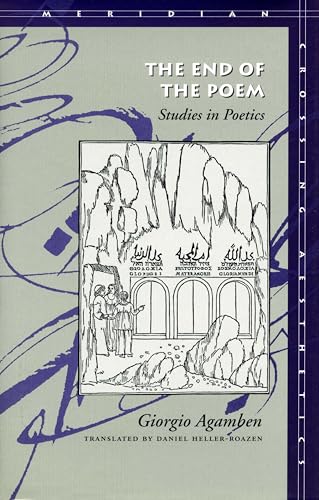
Inhaltsangabe
This book, by one of Italy's most important and original contemporary philosophers, represents a broad, general, and ambitious undertaking-nothing less than an attempt to rethink the nature of poetic language and to rearticulate relationships among theology, poetry, and philosophy in a tradition of literature initiated by Dante.
The author presents "literature" as a set of formal or linguistic genres that discuss or develop theological issues at a certain distance from the discourse of theology. This distance begins to appear in Virgil and Ovid, but it becomes decisive in Dante and in his decision to write in the vernacular. His vernacular Italian reaches back through classical allusion to the Latin that was in his day the language of theology, but it does so with a difference. It is no accident that in the Commedia Virgil is Dante's guide.
The book opens with a discussion of just how Dante's poem is a "comedy," and it concludes with a discussion of the "ends of poetry" in a variety of senses: enjambment at the ends of lines, the concluding lines of poems, and the end of poetry as a mode of writing this sort of literature. Of course, to have poetry "end" does not mean that people stop writing it, but that literature passes into a period in which it is concerned with its own ending, with its own bounds and limits, historical and otherwise.
Though most of the essays make specific reference to various authors of the Italian literary tradition (including Dante, Polifilo, Pascoli, Delfini, and Caproni), they transcend the confines of Italian literature and engage several other literary and philosophical authors (Plato, Aristotle, the Stoics, Boethius, the Provençal poets, Mallarmé, and Hölderlin, among others).
Die Inhaltsangabe kann sich auf eine andere Ausgabe dieses Titels beziehen.
Über die Autorin bzw. den Autor
Giorgio Agamben teaches philosophy at the University of Verona. Among his books is Homo Sacer: Sovereign Power and Bare Life (Stanford, 1998).
Von der hinteren Coverseite
This book, by one of Italy’s most important and original contemporary philosophers, represents a broad, general, and ambitious undertaking—nothing less than an attempt to rethink the nature of poetic language and to rearticulate relationships among theology, poetry, and philosophy in a tradition of literature initiated by Dante.
The author presents “literature” as a set of formal or linguistic genres that discuss or develop theological issues at a certain distance from the discourse of theology. This distance begins to appear in Virgil and Ovid, but it becomes decisive in Dante and in his decision to write in the vernacular. His vernacular Italian reaches back through classical allusion to the Latin that was in his day the language of theology, but it does so with a difference. It is no accident that in the Commedia Virgil is Dante’s guide.
The book opens with a discussion of just how Dante’s poem is a “comedy,” and it concludes with a discussion of the “ends of poetry” in a variety of senses: enjambment at the ends of lines, the concluding lines of poems, and the end of poetry as a mode of writing this sort of literature. Of course, to have poetry “end” does not mean that people stop writing it, but that literature passes into a period in which it is concerned with its own ending, with its own bounds and limits, historical and otherwise.
Though most of the essays make specific reference to various authors of the Italian literary tradition (including Dante, Polifilo, Pascoli, Delfini, and Caproni), they transcend the confines of Italian literature and engage several other literary and philosophical authors (Plato, Aristotle, the Stoics, Boethius, the Provençal poets, Mallarmé, and Hölderlin, among others).
Aus dem Klappentext
This book, by one of Italy s most important and original contemporary philosophers, represents a broad, general, and ambitious undertaking nothing less than an attempt to rethink the nature of poetic language and to rearticulate relationships among theology, poetry, and philosophy in a tradition of literature initiated by Dante.
The author presents literature as a set of formal or linguistic genres that discuss or develop theological issues at a certain distance from the discourse of theology. This distance begins to appear in Virgil and Ovid, but it becomes decisive in Dante and in his decision to write in the vernacular. His vernacular Italian reaches back through classical allusion to the Latin that was in his day the language of theology, but it does so with a difference. It is no accident that in the Commedia Virgil is Dante s guide.
The book opens with a discussion of just how Dante s poem is a comedy, and it concludes with a discussion of the ends of poetry in a variety of senses: enjambment at the ends of lines, the concluding lines of poems, and the end of poetry as a mode of writing this sort of literature. Of course, to have poetry end does not mean that people stop writing it, but that literature passes into a period in which it is concerned with its own ending, with its own bounds and limits, historical and otherwise.
Though most of the essays make specific reference to various authors of the Italian literary tradition (including Dante, Polifilo, Pascoli, Delfini, and Caproni), they transcend the confines of Italian literature and engage several other literary and philosophical authors (Plato, Aristotle, the Stoics, Boethius, the Provençal poets, Mallarmé, and Hölderlin, among others).
„Über diesen Titel“ kann sich auf eine andere Ausgabe dieses Titels beziehen.
Suchergebnisse für The End of the Poem: Studies in Poetics (Meridian Series)

Beispielbild für diese ISBN
The End of the Poem: Studies in Poetics
Verlag:
Stanford University Press, 1999
ISBN 10: 0804730210
ISBN 13: 9780804730211
Gebraucht
Hardcover
Anbieter: Moe's Books, Berkeley, CA, USA
Verkäuferbewertung 5 von 5 Sternen

hardcover. Zustand: very good. Zustand des Schutzumschlags: very good. Bestandsnummer des Verkäufers 1117808
Gebraucht kaufen
EUR 27,69
EUR 5,83 Versand
Versand innerhalb von USA
Versand innerhalb von USA
Anzahl: 1 verfügbar
Beispielbild für diese ISBN
The End of the Poem - Studies in Poetics (eng)
Anbieter: Brook Bookstore On Demand, Napoli, NA, Italien
Verkäuferbewertung 5 von 5 Sternen
Zustand: new. Bestandsnummer des Verkäufers acc1f83212569b934295d2816133e16a
Neu kaufen
EUR 90,31
EUR 5,50 Versand
Versand von Italien nach USA
Versand von Italien nach USA
Anzahl: Mehr als 20 verfügbar
Foto des Verkäufers
End of the Poem : Studies in Poetics
Anbieter: GreatBookPrices, Columbia, MD, USA
Verkäuferbewertung 5 von 5 Sternen
Zustand: New. Bestandsnummer des Verkäufers 4899236-n
Neu kaufen
EUR 99,04
EUR 2,37 Versand
Versand innerhalb von USA
Versand innerhalb von USA
Anzahl: Mehr als 20 verfügbar
Beispielbild für diese ISBN
The End of the Poem
Anbieter: PBShop.store UK, Fairford, GLOS, Vereinigtes Königreich
Verkäuferbewertung 5 von 5 Sternen
HRD. Zustand: New. New Book. Shipped from UK. Established seller since 2000. Bestandsnummer des Verkäufers FW-9780804730211
Neu kaufen
EUR 103,94
EUR 4,99 Versand
Versand von Vereinigtes Königreich nach USA
Versand von Vereinigtes Königreich nach USA
Anzahl: 15 verfügbar
Foto des Verkäufers
The End of the Poem
Verlag:
Stanford University Press, US, 1999
ISBN 10: 0804730210
ISBN 13: 9780804730211
Neu
Hardcover
Anbieter: Rarewaves USA, HEBRON, KY, USA
Verkäuferbewertung 5 von 5 Sternen
Hardback. Zustand: New. This book, by one of Italy's most important and original contemporary philosophers, represents a broad, general, and ambitious undertaking-nothing less than an attempt to rethink the nature of poetic language and to rearticulate relationships among theology, poetry, and philosophy in a tradition of literature initiated by Dante. The author presents "literature" as a set of formal or linguistic genres that discuss or develop theological issues at a certain distance from the discourse of theology. This distance begins to appear in Virgil and Ovid, but it becomes decisive in Dante and in his decision to write in the vernacular. His vernacular Italian reaches back through classical allusion to the Latin that was in his day the language of theology, but it does so with a difference. It is no accident that in the Commedia Virgil is Dante's guide. The book opens with a discussion of just how Dante's poem is a "comedy," and it concludes with a discussion of the "ends of poetry" in a variety of senses: enjambment at the ends of lines, the concluding lines of poems, and the end of poetry as a mode of writing this sort of literature. Of course, to have poetry "end" does not mean that people stop writing it, but that literature passes into a period in which it is concerned with its own ending, with its own bounds and limits, historical and otherwise. Though most of the essays make specific reference to various authors of the Italian literary tradition (including Dante, Polifilo, Pascoli, Delfini, and Caproni), they transcend the confines of Italian literature and engage several other literary and philosophical authors (Plato, Aristotle, the Stoics, Boethius, the Provençal poets, Mallarmé, and Hölderlin, among others). Bestandsnummer des Verkäufers LU-9780804730211
Neu kaufen
EUR 110,37
Versand gratis
Versand innerhalb von USA
Versand innerhalb von USA
Anzahl: Mehr als 20 verfügbar
Foto des Verkäufers
End of the Poem : Studies in Poetics
Verlag:
Stanford University Press, 1999
ISBN 10: 0804730210
ISBN 13: 9780804730211
Gebraucht
Hardcover
Anbieter: GreatBookPrices, Columbia, MD, USA
Verkäuferbewertung 5 von 5 Sternen
Zustand: As New. Unread book in perfect condition. Bestandsnummer des Verkäufers 4899236
Gebraucht kaufen
EUR 117,61
EUR 2,37 Versand
Versand innerhalb von USA
Versand innerhalb von USA
Anzahl: Mehr als 20 verfügbar
Beispielbild für diese ISBN
The End of the Poem: Studies in Poetics
Anbieter: THE SAINT BOOKSTORE, Southport, Vereinigtes Königreich
Verkäuferbewertung 5 von 5 Sternen
Hardback. Zustand: New. New copy - Usually dispatched within 4 working days. Bestandsnummer des Verkäufers B9780804730211
Neu kaufen
EUR 105,48
EUR 14,99 Versand
Versand von Vereinigtes Königreich nach USA
Versand von Vereinigtes Königreich nach USA
Anzahl: Mehr als 20 verfügbar
Foto des Verkäufers
The End of the Poem
Verlag:
Stanford University Press Jun 1999, 1999
ISBN 10: 0804730210
ISBN 13: 9780804730211
Neu
Hardcover
Anbieter: BuchWeltWeit Ludwig Meier e.K., Bergisch Gladbach, Deutschland
Verkäuferbewertung 5 von 5 Sternen
Buch. Zustand: Neu. This item is printed on demand - it takes 3-4 days longer - Neuware -This book, by one of Italy's most important and original contemporary philosophers, represents a broad, general, and ambitious undertaking-nothing less than an attempt to rethink the nature of poetic language and to rearticulate relationships among theology, poetry, and philosophy in a tradition of literature initiated by Dante. The author presents 'literature' as a set of formal or linguistic genres that discuss or develop theological issues at a certain distance from the discourse of theology. This distance begins to appear in Virgil and Ovid, but it becomes decisive in Dante and in his decision to write in the vernacular. His vernacular Italian reaches back through classical allusion to the Latin that was in his day the language of theology, but it does so with a difference. It is no accident that in the Commedia Virgil is Dante's guide. The book opens with a discussion of just how Dante's poem is a 'comedy,' and it concludes with a discussion of the 'ends of poetry' in a variety of senses: enjambment at the ends of lines, the concluding lines of poems, and the end of poetry as a mode of writing this sort of literature. Of course, to have poetry 'end' does not mean that people stop writing it, but that literature passes into a period in which it is concerned with its own ending, with its own bounds and limits, historical and otherwise. Though most of the essays make specific reference to various authors of the Italian literary tradition (including Dante, Polifilo, Pascoli, Delfini, and Caproni), they transcend the confines of Italian literature and engage several other literary and philosophical authors (Plato, Aristotle, the Stoics, Boethius, the Provençal poets, Mallarmé, and Hölderlin, among others). 164 pp. Englisch. Bestandsnummer des Verkäufers 9780804730211
Neu kaufen
EUR 98,44
EUR 23,00 Versand
Versand von Deutschland nach USA
Versand von Deutschland nach USA
Anzahl: 2 verfügbar
Beispielbild für diese ISBN
The End of the Poem Studies in Poetics
Print-on-DemandAnbieter: Revaluation Books, Exeter, Vereinigtes Königreich
Verkäuferbewertung 5 von 5 Sternen
Hardcover. Zustand: Brand New. 1st edition. 148 pages. 9.25x6.00x0.75 inches. In Stock. This item is printed on demand. Bestandsnummer des Verkäufers __0804730210
Neu kaufen
EUR 109,66
EUR 12,00 Versand
Versand von Vereinigtes Königreich nach USA
Versand von Vereinigtes Königreich nach USA
Anzahl: 2 verfügbar
Foto des Verkäufers
End of the Poem : Studies in Poetics
Anbieter: GreatBookPricesUK, Woodford Green, Vereinigtes Königreich
Verkäuferbewertung 5 von 5 Sternen
Zustand: New. Bestandsnummer des Verkäufers 4899236-n
Neu kaufen
EUR 103,93
EUR 18,00 Versand
Versand von Vereinigtes Königreich nach USA
Versand von Vereinigtes Königreich nach USA
Anzahl: Mehr als 20 verfügbar