
Verwandte Artikel zu The End of the Poem: Studies in Poetics (Meridian Series)
The End of the Poem: Studies in Poetics (Meridian Series) - Softcover
Buch 2 von 33: Meridian: Crossing Aesthetics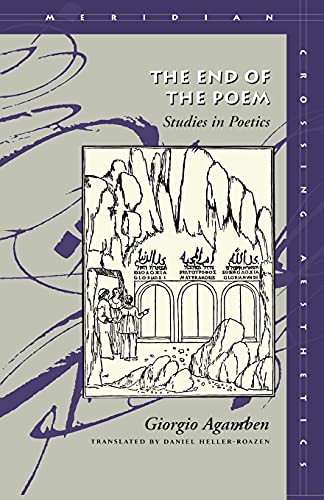
Inhaltsangabe
This book, by one of Italy's most important and original contemporary philosophers, represents a broad, general, and ambitious undertaking-nothing less than an attempt to rethink the nature of poetic language and to rearticulate relationships among theology, poetry, and philosophy in a tradition of literature initiated by Dante.
The author presents "literature" as a set of formal or linguistic genres that discuss or develop theological issues at a certain distance from the discourse of theology. This distance begins to appear in Virgil and Ovid, but it becomes decisive in Dante and in his decision to write in the vernacular. His vernacular Italian reaches back through classical allusion to the Latin that was in his day the language of theology, but it does so with a difference. It is no accident that in the Commedia Virgil is Dante's guide.
The book opens with a discussion of just how Dante's poem is a "comedy," and it concludes with a discussion of the "ends of poetry" in a variety of senses: enjambment at the ends of lines, the concluding lines of poems, and the end of poetry as a mode of writing this sort of literature. Of course, to have poetry "end" does not mean that people stop writing it, but that literature passes into a period in which it is concerned with its own ending, with its own bounds and limits, historical and otherwise.
Though most of the essays make specific reference to various authors of the Italian literary tradition (including Dante, Polifilo, Pascoli, Delfini, and Caproni), they transcend the confines of Italian literature and engage several other literary and philosophical authors (Plato, Aristotle, the Stoics, Boethius, the Provençal poets, Mallarmé, and Hölderlin, among others).
Die Inhaltsangabe kann sich auf eine andere Ausgabe dieses Titels beziehen.
Über die Autorin bzw. den Autor
Giorgio Agamben teaches philosophy at the University of Verona. Among his books is Homo Sacer: Sovereign Power and Bare Life (Stanford, 1998).
Von der hinteren Coverseite
This book, by one of Italy’s most important and original contemporary philosophers, represents a broad, general, and ambitious undertaking—nothing less than an attempt to rethink the nature of poetic language and to rearticulate relationships among theology, poetry, and philosophy in a tradition of literature initiated by Dante.
The author presents “literature” as a set of formal or linguistic genres that discuss or develop theological issues at a certain distance from the discourse of theology. This distance begins to appear in Virgil and Ovid, but it becomes decisive in Dante and in his decision to write in the vernacular. His vernacular Italian reaches back through classical allusion to the Latin that was in his day the language of theology, but it does so with a difference. It is no accident that in the Commedia Virgil is Dante’s guide.
The book opens with a discussion of just how Dante’s poem is a “comedy,” and it concludes with a discussion of the “ends of poetry” in a variety of senses: enjambment at the ends of lines, the concluding lines of poems, and the end of poetry as a mode of writing this sort of literature. Of course, to have poetry “end” does not mean that people stop writing it, but that literature passes into a period in which it is concerned with its own ending, with its own bounds and limits, historical and otherwise.
Though most of the essays make specific reference to various authors of the Italian literary tradition (including Dante, Polifilo, Pascoli, Delfini, and Caproni), they transcend the confines of Italian literature and engage several other literary and philosophical authors (Plato, Aristotle, the Stoics, Boethius, the Provençal poets, Mallarmé, and Hölderlin, among others).
The author presents “literature” as a set of formal or linguistic genres that discuss or develop theological issues at a certain distance from the discourse of theology. This distance begins to appear in Virgil and Ovid, but it becomes decisive in Dante and in his decision to write in the vernacular. His vernacular Italian reaches back through classical allusion to the Latin that was in his day the language of theology, but it does so with a difference. It is no accident that in the Commedia Virgil is Dante’s guide.
The book opens with a discussion of just how Dante’s poem is a “comedy,” and it concludes with a discussion of the “ends of poetry” in a variety of senses: enjambment at the ends of lines, the concluding lines of poems, and the end of poetry as a mode of writing this sort of literature. Of course, to have poetry “end” does not mean that people stop writing it, but that literature passes into a period in which it is concerned with its own ending, with its own bounds and limits, historical and otherwise.
Though most of the essays make specific reference to various authors of the Italian literary tradition (including Dante, Polifilo, Pascoli, Delfini, and Caproni), they transcend the confines of Italian literature and engage several other literary and philosophical authors (Plato, Aristotle, the Stoics, Boethius, the Provençal poets, Mallarmé, and Hölderlin, among others).
Aus dem Klappentext
This book, by one of Italys most important and original contemporary philosophers, represents a broad, general, and ambitious undertakingnothing less than an attempt to rethink the nature of poetic language and to rearticulate relationships among theology, poetry, and philosophy in a tradition of literature initiated by Dante.
The author presents literature as a set of formal or linguistic genres that discuss or develop theological issues at a certain distance from the discourse of theology. This distance begins to appear in Virgil and Ovid, but it becomes decisive in Dante and in his decision to write in the vernacular. His vernacular Italian reaches back through classical allusion to the Latin that was in his day the language of theology, but it does so with a difference. It is no accident that in the Commedia Virgil is Dantes guide.
The book opens with a discussion of just how Dantes poem is a comedy, and it concludes with a discussion of the ends of poetry in a variety of senses: enjambment at the ends of lines, the concluding lines of poems, and the end of poetry as a mode of writing this sort of literature. Of course, to have poetry end does not mean that people stop writing it, but that literature passes into a period in which it is concerned with its own ending, with its own bounds and limits, historical and otherwise.
Though most of the essays make specific reference to various authors of the Italian literary tradition (including Dante, Polifilo, Pascoli, Delfini, and Caproni), they transcend the confines of Italian literature and engage several other literary and philosophical authors (Plato, Aristotle, the Stoics, Boethius, the Provençal poets, Mallarmé, and Hölderlin, among others).
The author presents literature as a set of formal or linguistic genres that discuss or develop theological issues at a certain distance from the discourse of theology. This distance begins to appear in Virgil and Ovid, but it becomes decisive in Dante and in his decision to write in the vernacular. His vernacular Italian reaches back through classical allusion to the Latin that was in his day the language of theology, but it does so with a difference. It is no accident that in the Commedia Virgil is Dantes guide.
The book opens with a discussion of just how Dantes poem is a comedy, and it concludes with a discussion of the ends of poetry in a variety of senses: enjambment at the ends of lines, the concluding lines of poems, and the end of poetry as a mode of writing this sort of literature. Of course, to have poetry end does not mean that people stop writing it, but that literature passes into a period in which it is concerned with its own ending, with its own bounds and limits, historical and otherwise.
Though most of the essays make specific reference to various authors of the Italian literary tradition (including Dante, Polifilo, Pascoli, Delfini, and Caproni), they transcend the confines of Italian literature and engage several other literary and philosophical authors (Plato, Aristotle, the Stoics, Boethius, the Provençal poets, Mallarmé, and Hölderlin, among others).
Auszug. © Genehmigter Nachdruck. Alle Rechte vorbehalten.
THE END OF THE POEM
Studies in PoeticsBy Giorgio AgambenStanford University Press
Copyright © 1999 Board of Trustees of the Leland Stanford Junior UniversityAll right reserved.
ISBN: 978-0-8047-3022-8
Contents
Preface........................................................xi 1 Comedy.....................................................1 2 Corn: From Anatomy to Poetics..............................23 3 The Dream of Language......................................43 4 Pascoli and the Thought of the Voice.......................62 5 The Dictation of Poetry....................................76 6 Expropriated Manner........................................87 7 The Celebration of the Hidden Treasure.....................102 8 The End of the Poem........................................109AppendixA An Enigma Concerning the Basque Woman........................119B The Hunt for Language........................................124C The Just Do Not Feed on Light................................126D Taking Leave of Tragedy......................................130Notes..........................................................135
Chapter One
Comedy
1. THE PROBLEM
1. The aim of this essay is the critical assessment of an event that can be chronologically dated at the beginning of the fourteenth century but that, by virtue of its still exerting a profound influence on Italian culture, can be said to have never ceased to take place. This event is the decision of a poet to abandon his own "tragic" poetic project for a "comic" poem. This decision translates into an extremely famous incipit, which one of the author's letters states as follows: "Here begins the Comedy of Dante Alighieri, a Florentine by birth, not by disposition" (Incipit comoedia Dantis Alagherii florentini natione non moribus). The turn registered by these words is so little a question internal to Dante scholarship that it can even be said that here, for the first time, we find one of the traits that most tenaciously characterizes Italian culture: its essential pertinence to the comic sphere and consequent refutation of tragedy.
The fact that even a few years after the author's death the reasons for the comic title appeared problematic and incoherent to the oldest commentators bears witness to the extent to which this turn hides a historical knot whose repression cannot easily be brought to consciousness. All the more surprising is the poverty of modern critical literature on the subject. That a scholar such as Pio Rajna (who so influenced later studies) could reach such obviously insufficient conclusions as those with which his study of the poem's title ends is something that cannot be explained even by Italian culture's lack of contact with its own origins. Even Erich Auerbach, the author of such penetrating works on Dante's style, does not succeed in explaining the poem's incipit in satisfying terms. "Dante," he writes, referring to the ancient theory of the separation of styles, "never freed himself completely from these views; otherwise he would not have called his great work a comedy in clearest opposition to the term alta tragedia which he applied to Virgil's Aeneid." And, concerning Dante's letter to Cangrande, Auerbach writes:
It is not easy to see how Dante, after having found this formula and after having completed the Comedy, could still have expressed himself upon its character with the pedantry exhibited in the passage from the letter to Cangrande just referred to. However, so great was the prestige of the classical tradition, obscured as it still was by pedantic schematization, so strong was the predilection for fixed theoretical classifications of a kind which we can but consider absurd, that such a possibility cannot be gainsaid after all.
As far as explanations for Dante's choice of title are concerned, in a certain sense modern criticism has not progressed beyond Benvenuto da Imola's observations or the suggestions with which Boccaccio ends his commentary on the title of the poem. "What," Boccaccio asks,
will we then say of the objections that have been made against it? On the grounds that the author was a most prudent man, I believe that he would have had in mind not the parts contained in comedy but its entirety, and that he named his book on the basis of this entirety, so to speak. And from what one can infer from Plautus and Terence, who were comic poets, the entirety of comedy is this: comedy has a turbulent principle, is full of noise and discord, and ends finally in peace and tranquillity. The present book altogether conforms to this model. Thus the author begins with woes and infernal troubles and ends it in the peace and glory enjoyed by the blessed in their eternal life. And this certainly suffices to explain how the said title suits this book.
The methodological principle that we follow in this study is that our ignorance of an author's motivations in no way authorizes the presumption that they are incoherent or faulty. We hold that until proven otherwise, Dante, as "a most prudent man" (oculatissimo uomo), could not have chosen his incipit lightly or superficially. On the contrary, precisely the fact that the comic title appears discordant with respect to what we know of the ideas of the poet and his age brings us to claim that it was carefully considered.
2. A precise study of the passages in which Dante speaks of comedy and tragedy demonstrates that this claim is textually founded.
We thus know that to Dante's eyes, the poetic project that gave birth to the great songs of the Rime seemed eminently tragic. In De vulgari eloquentia, he explicitly states that the tragic style is the highest of all styles and the only one appropriate to the ultimate objects of poetry: "well-being, love and virtue" (salus, amor et virtus). A little later he defines the song [canzone], the supreme poetic genre, as
a connected series of equal stanzas in the tragic style, without a refrain, and focused on a single theme, as I have shown when I wrote "Donne che avete intelletto d'amore." If I say "a connected series in the tragic style," it is because, were the style of the stanza comic, we would use the diminutive and call it a canzonetta.
(iaequalium stantiarum sine responsorio tragica coniugatio, ut nos ostendimus cum dicimus "Donne che avete intelletto d'amore." Quod autem dicimus tragica coniugatio, est quia cum comice fiat hec coniugatio, cantilenam vocamus per diminutionem.)
The poem's comic title therefore above all implies a rupture and a turn with respect to Dante's own past and poetic itinerary, a genuine "categorical revolution" that as such cannot have been decided upon without conscious and vital motivation. In a passage of the letter to Cangrande, Dante seems implicitly to affirm such an awareness of reasons for his choice. With a definition that formally repeats commonplaces of medieval lexicography, Dante here introduces a discussion that cannot be found in any of his known sources. "Now comedy is a certain kind of poetical narration," he writes, "which differs from all others" (Et est comoedia genus quoddam potice narrationis ab omnibus aliis differens). This privileged situation of the comic genre, which has no counterpart in either medieval or late ancient sources, presupposes an intention on the poet's part to alter semantically the term "comedy" in a sense that certainly...
„Über diesen Titel“ kann sich auf eine andere Ausgabe dieses Titels beziehen.
Suchergebnisse für The End of the Poem: Studies in Poetics (Meridian Series)

Beispielbild für diese ISBN
The End of the Poem. Studies in Poetics
Verlag:
Stanford Univ. Press, Stanford, CA, 1999
ISBN 10: 0804730229
ISBN 13: 9780804730228
Gebraucht
Paperback
Anbieter: Valley Books, AMHERST, MA, USA
Verkäuferbewertung 4 von 5 Sternen

Paperback. Zustand: Fine. 148pp, Photos sent on request. Size: 8vo - over 7¾" - 9¾" tall. Bestandsnummer des Verkäufers 092617
Gebraucht kaufen
EUR 14,12
EUR 5,22 Versand
Versand innerhalb von USA
Versand innerhalb von USA
Anzahl: 1 verfügbar
Foto des Verkäufers
End of the Poem : Studies in Poetics
Anbieter: GreatBookPrices, Columbia, MD, USA
Verkäuferbewertung 5 von 5 Sternen

Zustand: New. Bestandsnummer des Verkäufers 252425-n
Neu kaufen
EUR 20,91
EUR 2,30 Versand
Versand innerhalb von USA
Versand innerhalb von USA
Anzahl: Mehr als 20 verfügbar
Foto des Verkäufers
The End of the Poem: Studies in Poetics (Paperback or Softback)
Verlag:
Stanford University Press 6/1/1999, 1999
ISBN 10: 0804730229
ISBN 13: 9780804730228
Neu
Paperback or Softback
Anbieter: BargainBookStores, Grand Rapids, MI, USA
Verkäuferbewertung 5 von 5 Sternen
Paperback or Softback. Zustand: New. The End of the Poem: Studies in Poetics. Book. Bestandsnummer des Verkäufers BBS-9780804730228
Foto des Verkäufers
The End of the Poem
Verlag:
Stanford University Press, US, 1999
ISBN 10: 0804730229
ISBN 13: 9780804730228
Neu
Paperback
Anbieter: Rarewaves USA, HEBRON, KY, USA
Verkäuferbewertung 5 von 5 Sternen
Paperback. Zustand: New. This book, by one of Italy's most important and original contemporary philosophers, represents a broad, general, and ambitious undertaking-nothing less than an attempt to rethink the nature of poetic language and to rearticulate relationships among theology, poetry, and philosophy in a tradition of literature initiated by Dante. The author presents "literature" as a set of formal or linguistic genres that discuss or develop theological issues at a certain distance from the discourse of theology. This distance begins to appear in Virgil and Ovid, but it becomes decisive in Dante and in his decision to write in the vernacular. His vernacular Italian reaches back through classical allusion to the Latin that was in his day the language of theology, but it does so with a difference. It is no accident that in the Commedia Virgil is Dante's guide. The book opens with a discussion of just how Dante's poem is a "comedy," and it concludes with a discussion of the "ends of poetry" in a variety of senses: enjambment at the ends of lines, the concluding lines of poems, and the end of poetry as a mode of writing this sort of literature. Of course, to have poetry "end" does not mean that people stop writing it, but that literature passes into a period in which it is concerned with its own ending, with its own bounds and limits, historical and otherwise. Though most of the essays make specific reference to various authors of the Italian literary tradition (including Dante, Polifilo, Pascoli, Delfini, and Caproni), they transcend the confines of Italian literature and engage several other literary and philosophical authors (Plato, Aristotle, the Stoics, Boethius, the Provençal poets, Mallarmé, and Hölderlin, among others). Bestandsnummer des Verkäufers LU-9780804730228
Neu kaufen
EUR 23,34
Versand gratis
Versand innerhalb von USA
Versand innerhalb von USA
Anzahl: Mehr als 20 verfügbar
Beispielbild für diese ISBN
The End of the Poem: Studies in Poetics (Meridian: Crossing Aesthetics)
Verlag:
Stanford University Press, 1999
ISBN 10: 0804730229
ISBN 13: 9780804730228
Gebraucht
Soft cover
Erstausgabe
Anbieter: Jackson Street Booksellers, Omaha, NE, USA
Verkäuferbewertung 5 von 5 Sternen
Soft cover. Zustand: Fine. 1st Edition. Fine copy in softcover. Grey spine with white titles. 8vo. Bestandsnummer des Verkäufers 050248
Gebraucht kaufen
EUR 17,93
EUR 5,66 Versand
Versand innerhalb von USA
Versand innerhalb von USA
Anzahl: 1 verfügbar
Foto des Verkäufers
End of the Poem : Studies in Poetics
Verlag:
Stanford University Press, 1999
ISBN 10: 0804730229
ISBN 13: 9780804730228
Gebraucht
Softcover
Anbieter: GreatBookPrices, Columbia, MD, USA
Verkäuferbewertung 5 von 5 Sternen
Zustand: As New. Unread book in perfect condition. Bestandsnummer des Verkäufers 252425
Gebraucht kaufen
EUR 22,81
EUR 2,30 Versand
Versand innerhalb von USA
Versand innerhalb von USA
Anzahl: Mehr als 20 verfügbar
Beispielbild für diese ISBN
The End of the Poem: Studies in Poetics (Meridian: Crossing Aesthetics)
Anbieter: California Books, Miami, FL, USA
Verkäuferbewertung 5 von 5 Sternen
Zustand: New. Bestandsnummer des Verkäufers I-9780804730228
Neu kaufen
EUR 25,11
Versand gratis
Versand innerhalb von USA
Versand innerhalb von USA
Anzahl: Mehr als 20 verfügbar
Foto des Verkäufers
The End of the Poem
Verlag:
Stanford University Press, US, 1999
ISBN 10: 0804730229
ISBN 13: 9780804730228
Neu
Paperback
Anbieter: Rarewaves.com USA, London, LONDO, Vereinigtes Königreich
Verkäuferbewertung 5 von 5 Sternen
Paperback. Zustand: New. This book, by one of Italy's most important and original contemporary philosophers, represents a broad, general, and ambitious undertaking-nothing less than an attempt to rethink the nature of poetic language and to rearticulate relationships among theology, poetry, and philosophy in a tradition of literature initiated by Dante. The author presents "literature" as a set of formal or linguistic genres that discuss or develop theological issues at a certain distance from the discourse of theology. This distance begins to appear in Virgil and Ovid, but it becomes decisive in Dante and in his decision to write in the vernacular. His vernacular Italian reaches back through classical allusion to the Latin that was in his day the language of theology, but it does so with a difference. It is no accident that in the Commedia Virgil is Dante's guide. The book opens with a discussion of just how Dante's poem is a "comedy," and it concludes with a discussion of the "ends of poetry" in a variety of senses: enjambment at the ends of lines, the concluding lines of poems, and the end of poetry as a mode of writing this sort of literature. Of course, to have poetry "end" does not mean that people stop writing it, but that literature passes into a period in which it is concerned with its own ending, with its own bounds and limits, historical and otherwise. Though most of the essays make specific reference to various authors of the Italian literary tradition (including Dante, Polifilo, Pascoli, Delfini, and Caproni), they transcend the confines of Italian literature and engage several other literary and philosophical authors (Plato, Aristotle, the Stoics, Boethius, the Provençal poets, Mallarmé, and Hölderlin, among others). Bestandsnummer des Verkäufers LU-9780804730228
Neu kaufen
EUR 28,73
Versand gratis
Versand von Vereinigtes Königreich nach USA
Versand von Vereinigtes Königreich nach USA
Anzahl: Mehr als 20 verfügbar
Beispielbild für diese ISBN
The End Of The Poem Studies In Poetics (Pb 1999)
Anbieter: Romtrade Corp., STERLING HEIGHTS, MI, USA
Verkäuferbewertung 5 von 5 Sternen
Zustand: New. This is a Brand-new US Edition. This Item may be shipped from US or any other country as we have multiple locations worldwide. Bestandsnummer des Verkäufers ABBB-50037
Beispielbild für diese ISBN
The End Of The Poem Studies In Poetics (Pb 1999)
Anbieter: Basi6 International, Irving, TX, USA
Verkäuferbewertung 5 von 5 Sternen
Zustand: Brand New. New. US edition. Expediting shipping for all USA and Europe orders excluding PO Box. Excellent Customer Service. Bestandsnummer des Verkäufers ABEOCT25-119725