
Verwandte Artikel zu Dialectic of Enlightenment: Philosophical Fragments...
Dialectic of Enlightenment: Philosophical Fragments (Cultural Memory in the Present) - Softcover
Buch 203 von 213: Cultural Memory in the Present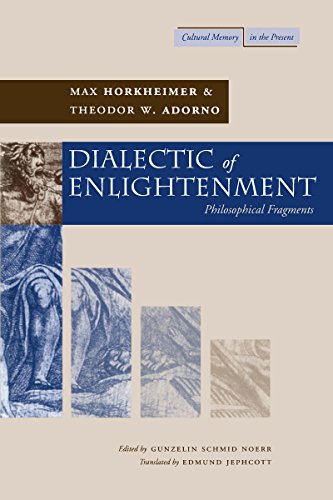
Inhaltsangabe
Dialectic of Enlightenment is undoubtedly the most influential publication of the Frankfurt School of Critical Theory. Written during the Second World War and circulated privately, it appeared in a printed edition in Amsterdam in 1947. "What we had set out to do," the authors write in the Preface, "was nothing less than to explain why humanity, instead of entering a truly human state, is sinking into a new kind of barbarism."
Yet the work goes far beyond a mere critique of contemporary events. Historically remote developments, indeed, the birth of Western history and of subjectivity itself out of the struggle against natural forces, as represented in myths, are connected in a wide arch to the most threatening experiences of the present.
The book consists in five chapters, at first glance unconnected, together with a number of shorter notes. The various analyses concern such phenomena as the detachment of science from practical life, formalized morality, the manipulative nature of entertainment culture, and a paranoid behavioral structure, expressed in aggressive anti-Semitism, that marks the limits of enlightenment. The authors perceive a common element in these phenomena, the tendency toward self-destruction of the guiding criteria inherent in enlightenment thought from the beginning. Using historical analyses to elucidate the present, they show, against the background of a prehistory of subjectivity, why the National Socialist terror was not an aberration of modern history but was rooted deeply in the fundamental characteristics of Western civilization.
Adorno and Horkheimer see the self-destruction of Western reason as grounded in a historical and fateful dialectic between the domination of external nature and society. They trace enlightenment, which split these spheres apart, back to its mythical roots. Enlightenment and myth, therefore, are not irreconcilable opposites, but dialectically mediated qualities of both real and intellectual life. "Myth is already enlightenment, and enlightenment reverts to mythology." This paradox is the fundamental thesis of the book.
This new translation, based on the text in the complete edition of the works of Max Horkheimer, contains textual variants, commentary upon them, and an editorial discussion of the position of this work in the development of Critical Theory.
Die Inhaltsangabe kann sich auf eine andere Ausgabe dieses Titels beziehen.
Über die Autorinnen und Autoren
Max Horkheimer and Theodor W. Adorno were two influential members of the Frankfurt School of Critical Theory.
Max Horkheimer and Theodor W. Adorno were two influential members of the Frankfurt School of Critical Theory.
Von der hinteren Coverseite
Dialectic of Enlightenment is undoubtedly the most influential publication of the Frankfurt School of Critical Theory. Written during the Second World War and circulated privately, it appeared in a printed edition in Amsterdam in 1947. "What we had set out to do," the authors write in the Preface, "was nothing less than to explain why humanity, instead of entering a truly human state, is sinking into a new kind of barbarism."
Yet the work goes far beyond a mere critique of contemporary events. Historically remote developments, indeed, the birth of Western history and of subjectivity itself out of the struggle against natural forces, as represented in myths, are connected in a wide arch to the most threatening experiences of the present.
The book consists in five chapters, at first glance unconnected, together with a number of shorter notes. The various analyses concern such phenomena as the detachment of science from practical life, formalized morality, the manipulative nature of entertainment culture, and a paranoid behavioral structure, expressed in aggressive anti-Semitism, that marks the limits of enlightenment. The authors perceive a common element in these phenomena, the tendency toward self-destruction of the guiding criteria inherent in enlightenment thought from the beginning. Using historical analyses to elucidate the present, they show, against the background of a prehistory of subjectivity, why the National Socialist terror was not an aberration of modern history but was rooted deeply in the fundamental characteristics of Western civilization.
Adorno and Horkheimer see the self-destruction of Western reason as grounded in a historical and fateful dialectic between the domination of external nature and society. They trace enlightenment, which split these spheres apart, back to its mythical roots. Enlightenment and myth, therefore, are not irreconcilable opposites, but dialectically mediated qualities of both real and intellectual life. "Myth is already enlightenment, and enlightenment reverts to mythology." This paradox is the fundamental thesis of the book.
This new translation, based on the text in the complete edition of the works of Max Horkheimer, contains textual variants, commentary upon them, and an editorial discussion of the position of this work in the development of Critical Theory.
Yet the work goes far beyond a mere critique of contemporary events. Historically remote developments, indeed, the birth of Western history and of subjectivity itself out of the struggle against natural forces, as represented in myths, are connected in a wide arch to the most threatening experiences of the present.
The book consists in five chapters, at first glance unconnected, together with a number of shorter notes. The various analyses concern such phenomena as the detachment of science from practical life, formalized morality, the manipulative nature of entertainment culture, and a paranoid behavioral structure, expressed in aggressive anti-Semitism, that marks the limits of enlightenment. The authors perceive a common element in these phenomena, the tendency toward self-destruction of the guiding criteria inherent in enlightenment thought from the beginning. Using historical analyses to elucidate the present, they show, against the background of a prehistory of subjectivity, why the National Socialist terror was not an aberration of modern history but was rooted deeply in the fundamental characteristics of Western civilization.
Adorno and Horkheimer see the self-destruction of Western reason as grounded in a historical and fateful dialectic between the domination of external nature and society. They trace enlightenment, which split these spheres apart, back to its mythical roots. Enlightenment and myth, therefore, are not irreconcilable opposites, but dialectically mediated qualities of both real and intellectual life. "Myth is already enlightenment, and enlightenment reverts to mythology." This paradox is the fundamental thesis of the book.
This new translation, based on the text in the complete edition of the works of Max Horkheimer, contains textual variants, commentary upon them, and an editorial discussion of the position of this work in the development of Critical Theory.
Aus dem Klappentext
Dialectic of Enlightenment is undoubtedly the most influential publication of the Frankfurt School of Critical Theory. Written during the Second World War and circulated privately, it appeared in a printed edition in Amsterdam in 1947. "What we had set out to do," the authors write in the Preface, "was nothing less than to explain why humanity, instead of entering a truly human state, is sinking into a new kind of barbarism."
Yet the work goes far beyond a mere critique of contemporary events. Historically remote developments, indeed, the birth of Western history and of subjectivity itself out of the struggle against natural forces, as represented in myths, are connected in a wide arch to the most threatening experiences of the present.
The book consists in five chapters, at first glance unconnected, together with a number of shorter notes. The various analyses concern such phenomena as the detachment of science from practical life, formalized morality, the manipulative nature of entertainment culture, and a paranoid behavioral structure, expressed in aggressive anti-Semitism, that marks the limits of enlightenment. The authors perceive a common element in these phenomena, the tendency toward self-destruction of the guiding criteria inherent in enlightenment thought from the beginning. Using historical analyses to elucidate the present, they show, against the background of a prehistory of subjectivity, why the National Socialist terror was not an aberration of modern history but was rooted deeply in the fundamental characteristics of Western civilization.
Adorno and Horkheimer see the self-destruction of Western reason as grounded in a historical and fateful dialectic between the domination of external nature and society. They trace enlightenment, which split these spheres apart, back to its mythical roots. Enlightenment and myth, therefore, are not irreconcilable opposites, but dialectically mediated qualities of both real and intellectual life. "Myth is already enlightenment, and enlightenment reverts to mythology." This paradox is the fundamental thesis of the book.
This new translation, based on the text in the complete edition of the works of Max Horkheimer, contains textual variants, commentary upon them, and an editorial discussion of the position of this work in the development of Critical Theory.
Yet the work goes far beyond a mere critique of contemporary events. Historically remote developments, indeed, the birth of Western history and of subjectivity itself out of the struggle against natural forces, as represented in myths, are connected in a wide arch to the most threatening experiences of the present.
The book consists in five chapters, at first glance unconnected, together with a number of shorter notes. The various analyses concern such phenomena as the detachment of science from practical life, formalized morality, the manipulative nature of entertainment culture, and a paranoid behavioral structure, expressed in aggressive anti-Semitism, that marks the limits of enlightenment. The authors perceive a common element in these phenomena, the tendency toward self-destruction of the guiding criteria inherent in enlightenment thought from the beginning. Using historical analyses to elucidate the present, they show, against the background of a prehistory of subjectivity, why the National Socialist terror was not an aberration of modern history but was rooted deeply in the fundamental characteristics of Western civilization.
Adorno and Horkheimer see the self-destruction of Western reason as grounded in a historical and fateful dialectic between the domination of external nature and society. They trace enlightenment, which split these spheres apart, back to its mythical roots. Enlightenment and myth, therefore, are not irreconcilable opposites, but dialectically mediated qualities of both real and intellectual life. "Myth is already enlightenment, and enlightenment reverts to mythology." This paradox is the fundamental thesis of the book.
This new translation, based on the text in the complete edition of the works of Max Horkheimer, contains textual variants, commentary upon them, and an editorial discussion of the position of this work in the development of Critical Theory.
Auszug. © Genehmigter Nachdruck. Alle Rechte vorbehalten.
DIALECTIC OF ENLIGHTENMENT
Philosophical Fragments
By Max Horkheimer, THEODOR W. ADORNO, Gunzelin Schmid Noerr, Edmund JephcottStanford University Press
Copyright ©1987 S. Fishcher Verlag GmbH, Frankfurt
All rights reserved.
ISBN: 978-0-8047-3633-6All rights reserved.
Contents
| Preface to the New Edition (1969).......................................... | xi |
| Preface to the Italian Edition (1962/1966)................................. | xiii |
| Preface (1944 and 1947).................................................... | xiv |
| The Concept of Enlightenment............................................... | 1 |
| Excursus I: Odysseus or Myth and Enlightenment............................. | 35 |
| Excursus II: Juliette or Enlightenment and Morality........................ | 63 |
| The Culture Industry: Enlightenment as Mass Deception...................... | 94 |
| Elements of Anti-Semitism: Limits of Enlightenment......................... | 137 |
| Notes and Sketches......................................................... | 173 |
| Editor's Afterword......................................................... | 217 |
| The Disappearance of Class History in "Dialectic of Enlightenment": A Commentary on the Textual Variants (1944 and 1947), by Willem van Reijen and Jan Bransen............................................................ | 248 |
| Notes...................................................................... | 253 |
Excerpt
CHAPTER 1
The Concept of Enlightenment
Enlightenment, understood in the widest sense as the advance ofthought, has always aimed at liberating human beings from fear andinstalling them as masters. Yet the wholly enlightened earth is radiant withtriumphant calamity. Enlightenment's program was the disenchantmentof the world. It wanted to dispel myths, to overthrow fantasy with knowledge.Bacon, "the father of experimental philosophy," brought these motifstogether. He despised the exponents of tradition, who substituted belieffor knowledge and were as unwilling to doubt as they were reckless insupplying answers. All this, he said, stood in the way of "the happy matchbetween the mind of man and the nature of things," with the result thathumanity was unable to use its knowledge for the betterment of its condition.Such inventions as had been made—Bacon cites printing, artillery,and the compass—had been arrived at more by chance than by systematicenquiry into nature. Knowledge obtained through such enquiry wouldnot only be exempt from the influence of wealth and power but wouldestablish man as the master of nature:
Therefore, no doubt, the sovereignty of man lieth hid in knowledge; wherein manythings are reserved, which kings with their treasure cannot buy, nor with their forcecommand; their spials and intelligencers can give no news of them, their seamenand discoverers cannot sail where they grow: now we govern nature in opinions,but we are thrall unto her in necessity: but if we would be led by her in invention,we should command her by action.
Although not a mathematician, Bacon well understood the scientific temperwhich was to come after him. The "happy match" between humanunderstanding and the nature of things that he envisaged is a patriarchalone: the mind, conquering superstition, is to rule over disenchantednature. Knowledge, which is power, knows no limits, either in its enslavementof creation or in its deference to worldly masters. Just as it serves allthe purposes of the bourgeois economy both in factories and on the battlefield,it is at the disposal of entrepreneurs regardless of their origins.Kings control technology no more directly than do merchants: it is asdemocratic as the economic system with which it evolved. Technology isthe essence of this knowledge. It aims to produce neither concepts norimages, nor the joy of understanding, but method, exploitation of thelabor of others, capital. The "many things" which, according to Bacon,knowledge still held in store are themselves mere instruments: the radio asa sublimated printing press, the dive bomber as a more effective form ofartillery, remote control as a more reliable compass. What human beingsseek to learn from nature is how to use it to dominate wholly both it andhuman beings. Nothing else counts. Ruthless toward itself, the Enlightenmenthas eradicated the last remnant of its own self-awareness. Onlythought which does violence to itself is hard enough to shatter myths.Faced by the present triumph of the factual mentality, Bacon's nominalistcredo would have smacked of metaphysics and would have been convictedof the same vanity for which he criticized scholasticism. Power andknowledge are synonymous. For Bacon as for Luther, "knowledge thattendeth but to satisfaction, is but as a courtesan, which is for pleasure, andnot for fruit or generation." Its concern is not "satisfaction, which men calltruth," but "operation," the effective procedure. The "true end, scope oroffice of knowledge" does not consist in "any plausible, delectable, reverendor admired discourse, or any satisfactory arguments, but in effectingand working, and in discovery of particulars not revealed before, for thebetter endowment and help of man's life." There shall be neither mysterynor any desire to reveal mystery.
The disenchantment of the world means the extirpation of animism.Xenophanes mocked the multiplicity of gods because they resembled theircreators, men, in all their idiosyncrasies and faults, and the latest logicdenounces the words of language, which bear the stamp of impressions, ascounterfeit coin that would be better replaced by neutral counters. Theworld becomes chaos, and synthesis salvation. No difference is said to existbetween the totemic animal, the dreams of the spirit-seer, and the absoluteIdea. On their way toward modern science human beings have discardedmeaning. The concept is replaced by the formula, the cause by rules andprobability. Causality was only the last philosophical concept on which scientificcriticism tested its strength, because it alone of the old ideas stillstood in the way of such criticism, the latest secular form of the creativeprinciple. To define substance and quality, activity and suffering, being andexistence in terms appropriate to the time has been a concern of philosophysince Bacon; but science could manage without such categories. Theywere left behind as idola theatri of the old metaphysics and even in theirtime were monuments to entities and powers from prehistory. In that distanttime life and death had been interpreted and interwoven in myths.The categories by which Western philosophy defined its timeless order ofnature marked out the positions which had once been occupied by Ocnusand Persephone, Ariadne and Nereus. The moment of transition is recordedin the pre-Socratic cosmologies. The moist, the undivided, the air andfire which they take to be the primal stuff of nature are early rationalizationsprecipitated from the mythical vision. Just as the images of generationfrom water and earth, that had come to the Greeks from the Nile, wereconverted by these cosmologies into Hylozoic principles and elements, thewhole ambiguous profusion of mythical demons was intellectualized to becomethe pure form of ontological entities. Even the patriarchal gods ofOlympus were finally assimilated by the philosophical logos as the PlatonicForms. But the Enlightenment...
„Über diesen Titel“ kann sich auf eine andere Ausgabe dieses Titels beziehen.
Suchergebnisse für Dialectic of Enlightenment: Philosophical Fragments...

Foto des Verkäufers
Dialectic of Enlightenment (Cultural Memory in the Present)
Verlag:
Stanford University Press, 2007
ISBN 10: 0804736332
ISBN 13: 9780804736336
Gebraucht
Softcover
Anbieter: Dream Books Co., Denver, CO, USA
Verkäuferbewertung 5 von 5 Sternen

Zustand: good. Gently used with minimal wear on the corners and cover. A few pages may contain light highlighting or writing, but the text remains fully legible. Dust jacket may be missing, and supplemental materials like CDs or codes may not be included. May be ex-library with library markings. Ships promptly! Bestandsnummer des Verkäufers DBV.0804736332.G
Gebraucht kaufen
EUR 15,97
Versand gratis
Versand innerhalb von USA
Versand innerhalb von USA
Anzahl: 1 verfügbar
Beispielbild für diese ISBN
Dialectic of Enlightenment (Cultural Memory in the Present)
Verlag:
Stanford University Press, 2007
ISBN 10: 0804736332
ISBN 13: 9780804736336
Gebraucht
Paperback
Anbieter: HPB-Red, Dallas, TX, USA
Verkäuferbewertung 5 von 5 Sternen
Paperback. Zustand: Acceptable. Connecting readers with great books since 1972. Used textbooks may not include companion materials such as access codes, etc. May have condition issues including wear and notes/highlighting. We ship orders daily and Customer Service is our top priority! Bestandsnummer des Verkäufers S_484880469
Gebraucht kaufen
EUR 14,37
EUR 3,35 Versand
Versand innerhalb von USA
Versand innerhalb von USA
Anzahl: 1 verfügbar
Beispielbild für diese ISBN
Dialectic of Enlightenment (Cultural Memory in the Present)
Verlag:
Stanford University Press, 2007
ISBN 10: 0804736332
ISBN 13: 9780804736336
Gebraucht
Paperback
Anbieter: HPB-Red, Dallas, TX, USA
Verkäuferbewertung 5 von 5 Sternen
Paperback. Zustand: Good. Connecting readers with great books since 1972! Used textbooks may not include companion materials such as access codes, etc. May have some wear or writing/highlighting. We ship orders daily and Customer Service is our top priority! Bestandsnummer des Verkäufers S_484764655
Gebraucht kaufen
EUR 15,54
EUR 3,35 Versand
Versand innerhalb von USA
Versand innerhalb von USA
Anzahl: 1 verfügbar
Beispielbild für diese ISBN
Dialectic of Enlightenment (Cultural Memory in the Present)
Verlag:
Stanford University Press, 2002
ISBN 10: 0804736332
ISBN 13: 9780804736336
Gebraucht
Soft cover
Erstausgabe
Anbieter: H&G Antiquarian Books, Sheboygan, WI, USA
Verkäuferbewertung 5 von 5 Sternen
Soft cover. Zustand: Very Good. 1st Edition. 2002 Original Printing, book, cover and text in very good condition, binding tight and square, spine not creased, text clean with underling and marginalia in one chapter only no names no stamps 282 pages. Bestandsnummer des Verkäufers 023498
Gebraucht kaufen
EUR 13,79
EUR 5,27 Versand
Versand innerhalb von USA
Versand innerhalb von USA
Anzahl: 1 verfügbar
Beispielbild für diese ISBN
Dialectic of Enlightenment (Cultural Memory in the Present)
Verlag:
Stanford University Press, 2007
ISBN 10: 0804736332
ISBN 13: 9780804736336
Gebraucht
Paperback
Anbieter: Textbook Bookie, Little Rock, AR, USA
Verkäuferbewertung 5 von 5 Sternen
Paperback. Zustand: Good. Book in Good condition. Bestandsnummer des Verkäufers 9780804736336-good
Gebraucht kaufen
EUR 17,46
EUR 3,79 Versand
Versand innerhalb von USA
Versand innerhalb von USA
Anzahl: 1 verfügbar
Foto des Verkäufers
Dialectic of Enlightenment: Philosophical Fragments
Verlag:
Stanford University Press, Stanford, CA, 2002
ISBN 10: 0804736332
ISBN 13: 9780804736336
Gebraucht
Paperback
Anbieter: Book Booth, Berea, OH, USA
Verkäuferbewertung 5 von 5 Sternen
Paperback. Zustand: Good. Underlining & notes to text; binding tight; minor wear to covers. 282 pages. Size: 6" x 9". Bestandsnummer des Verkäufers S78-061294
Gebraucht kaufen
EUR 16,55
EUR 5,27 Versand
Versand innerhalb von USA
Versand innerhalb von USA
Anzahl: 1 verfügbar
Beispielbild für diese ISBN
Dialectic of Enlightenment
Verlag:
Stanford University Press, 2007
ISBN 10: 0804736332
ISBN 13: 9780804736336
Gebraucht
Paperback
Anbieter: World of Books (was SecondSale), Montgomery, IL, USA
Verkäuferbewertung 5 von 5 Sternen
Paperback. Zustand: Very Good. This is a new, improved translation of the most influential publication of the Frankfurt School of Critical Theory. Adorno and Horkheimer aimed "to explain why humanity, instead of entering a truly human state, is sinking into a new kind of barbarism.". Bestandsnummer des Verkäufers 00109547327
Gebraucht kaufen
EUR 26,17
Versand gratis
Versand innerhalb von USA
Versand innerhalb von USA
Anzahl: 1 verfügbar
Foto des Verkäufers
Dialectic of Enlightenment (Paperback or Softback)
Verlag:
Stanford University Press 3/1/2002, 2002
ISBN 10: 0804736332
ISBN 13: 9780804736336
Neu
Paperback or Softback
Anbieter: BargainBookStores, Grand Rapids, MI, USA
Verkäuferbewertung 5 von 5 Sternen
Paperback or Softback. Zustand: New. Dialectic of Enlightenment. Book. Bestandsnummer des Verkäufers BBS-9780804736336
Beispielbild für diese ISBN
Dialectic of Enlightenment
Verlag:
Stanford University Press, 2007
ISBN 10: 0804736332
ISBN 13: 9780804736336
Gebraucht
Paperback
Anbieter: World of Books Inc, Montgomery, IL, USA
Verkäuferbewertung 4 von 5 Sternen

Paperback. Zustand: Very Good. This is a new, improved translation of the most influential publication of the Frankfurt School of Critical Theory. Adorno and Horkheimer aimed "to explain why humanity, instead of entering a truly human state, is sinking into a new kind of barbarism.". Bestandsnummer des Verkäufers CIN0804736332VG
Gebraucht kaufen
EUR 28,01
Versand gratis
Versand innerhalb von USA
Versand innerhalb von USA
Anzahl: 1 verfügbar
Foto des Verkäufers
Dialectic of Enlightenment
Verlag:
Stanford University Press, US, 2007
ISBN 10: 0804736332
ISBN 13: 9780804736336
Neu
Paperback
Anbieter: Rarewaves USA, HEBRON, KY, USA
Verkäuferbewertung 5 von 5 Sternen
Paperback. Zustand: New. Dialectic of Enlightenment is undoubtedly the most influential publication of the Frankfurt School of Critical Theory. Written during the Second World War and circulated privately, it appeared in a printed edition in Amsterdam in 1947. "What we had set out to do," the authors write in the Preface, "was nothing less than to explain why humanity, instead of entering a truly human state, is sinking into a new kind of barbarism." Yet the work goes far beyond a mere critique of contemporary events. Historically remote developments, indeed, the birth of Western history and of subjectivity itself out of the struggle against natural forces, as represented in myths, are connected in a wide arch to the most threatening experiences of the present. The book consists in five chapters, at first glance unconnected, together with a number of shorter notes. The various analyses concern such phenomena as the detachment of science from practical life, formalized morality, the manipulative nature of entertainment culture, and a paranoid behavioral structure, expressed in aggressive anti-Semitism, that marks the limits of enlightenment. The authors perceive a common element in these phenomena, the tendency toward self-destruction of the guiding criteria inherent in enlightenment thought from the beginning. Using historical analyses to elucidate the present, they show, against the background of a prehistory of subjectivity, why the National Socialist terror was not an aberration of modern history but was rooted deeply in the fundamental characteristics of Western civilization. Adorno and Horkheimer see the self-destruction of Western reason as grounded in a historical and fateful dialectic between the domination of external nature and society. They trace enlightenment, which split these spheres apart, back to its mythical roots. Enlightenment and myth, therefore, are not irreconcilable opposites, but dialectically mediated qualities of both real and intellectual life. "Myth is already enlightenment, and enlightenment reverts to mythology." This paradox is the fundamental thesis of the book. This new translation, based on the text in the complete edition of the works of Max Horkheimer, contains textual variants, commentary upon them, and an editorial discussion of the position of this work in the development of Critical Theory. Bestandsnummer des Verkäufers LU-9780804736336
Neu kaufen
EUR 29,21
Versand gratis
Versand innerhalb von USA
Versand innerhalb von USA
Anzahl: Mehr als 20 verfügbar