
Verwandte Artikel zu Reading Derrida / Thinking Paul: On Justice (Cultural...
Reading Derrida / Thinking Paul: On Justice (Cultural Memory in the Present) - Softcover
Buch 83 von 213: Cultural Memory in the Present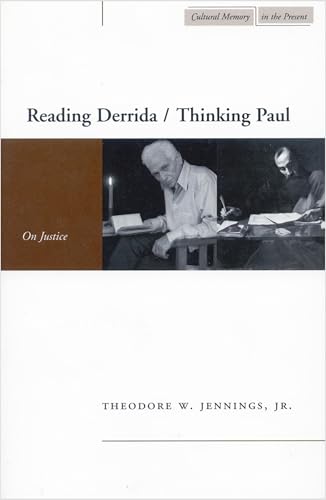
Inhaltsangabe
This book explores the interweaving of several of Derrida's characteristic concerns with themes that Paul explores in Romans. It argues that the central concern of Romans is with the question of justice, a justice that must be thought outside of law on the basis of grace or gift. The many perplexities that arise from thus trying to think justice outside of law are clarified by reading Derrida on such themes as justice and law, gift and exchange, duty and debt, hospitality, cosmopolitanism, and pardon.
This interweaving of Paul and Derrida shows that Paul may be read as a thinker who wrestles with real problems that are of concern to anyone who thinks. It also shows that Derrida, far from being the enemy of theological reflection, is himself a necessary companion to the thinking of the biblical theologian. Against the grain of what passes for common wisdom this book argues that both Derrida and Paul are indispensable guides to a new way of thinking about justice.
Die Inhaltsangabe kann sich auf eine andere Ausgabe dieses Titels beziehen.
Über die Autorin bzw. den Autor
Theodore W. Jennings, Jr., is Professor of Biblical and Constructive Theology at the Chicago Theological Seminary. He is the author, most recently, of The Insurrection of the Crucified (2003) and The Man Jesus Loved (2003).
Von der hinteren Coverseite
This book explores the interweaving of several of Derrida’s characteristic concerns with themes that Paul explores in Romans. It argues that the central concern of Romans is with the question of justice, a justice that must be thought outside of law on the basis of grace or gift. The many perplexities that arise from thus trying to think justice outside of law are clarified by reading Derrida on such themes as justice and law, gift and exchange, duty and debt, hospitality, cosmopolitanism, and pardon.
This interweaving of Paul and Derrida shows that Paul may be read as a thinker who wrestles with real problems that are of concern to anyone who thinks. It also shows that Derrida, far from being the enemy of theological reflection, is himself a necessary companion to the thinking of the biblical theologian. Against the grain of what passes for common wisdom this book argues that both Derrida and Paul are indispensable guides to a new way of thinking about justice.
This interweaving of Paul and Derrida shows that Paul may be read as a thinker who wrestles with real problems that are of concern to anyone who thinks. It also shows that Derrida, far from being the enemy of theological reflection, is himself a necessary companion to the thinking of the biblical theologian. Against the grain of what passes for common wisdom this book argues that both Derrida and Paul are indispensable guides to a new way of thinking about justice.
Aus dem Klappentext
This book explores the interweaving of several of Derrida s characteristic concerns with themes that Paul explores in Romans. It argues that the central concern of Romans is with the question of justice, a justice that must be thought outside of law on the basis of grace or gift. The many perplexities that arise from thus trying to think justice outside of law are clarified by reading Derrida on such themes as justice and law, gift and exchange, duty and debt, hospitality, cosmopolitanism, and pardon.
This interweaving of Paul and Derrida shows that Paul may be read as a thinker who wrestles with real problems that are of concern to anyone who thinks. It also shows that Derrida, far from being the enemy of theological reflection, is himself a necessary companion to the thinking of the biblical theologian. Against the grain of what passes for common wisdom this book argues that both Derrida and Paul are indispensable guides to a new way of thinking about justice.
This interweaving of Paul and Derrida shows that Paul may be read as a thinker who wrestles with real problems that are of concern to anyone who thinks. It also shows that Derrida, far from being the enemy of theological reflection, is himself a necessary companion to the thinking of the biblical theologian. Against the grain of what passes for common wisdom this book argues that both Derrida and Paul are indispensable guides to a new way of thinking about justice.
Auszug. © Genehmigter Nachdruck. Alle Rechte vorbehalten.
READING DERRIDA / THINKING PAUL
On JusticeBy Theodore W. Jennings, Jr.STANFORD UNIVERSITY PRESS
Copyright © 2006 Board of Trustees of the Leland Stanford Junior UniversityAll right reserved.
ISBN: 978-0-8047-5268-8
Contents
Preface..............................................................xi1 Introduction.......................................................12 Justice Beyond the Law.............................................193 Force, Violence, and the Cross.....................................544 Justice as Gift....................................................785 Duty Beyond Debt and/or the Obedience of Faith.....................966 Hospitality, Ethics, and Politics..................................1097 Pardon.............................................................1288 Conclusion.........................................................157Notes................................................................177Bibliography.........................................................211Index................................................................217
Chapter One
Introduction
The reading of Paul's letter to the Romans has largely been restricted to a confessional/ecclesiastical ghetto of doctrinal interest. As a consequence, Paul's concern for the question of justice has been transformed into a question of interior or private righteousness. This has been accompanied, especially in the Protestant era of exegesis, by a "forensic" view of justification that has severed justification from justice and turned "salvation" into a private affair between the believer and God. As a result, Levinas can suppose that the complex of doctrines thus derived make explicable the history of Christian/western atrocity, including the Holocaust. The God of this reading cares for belief instead of justice, and remedy for crime is found not in restitution and transformation on the plane of the ethical or political, but in the virtuality of an imagined relation to an indulgent divine.
Until recently the thought of Derrida has been associated in the minds of its critics with a nihilistic evisceration of ethical and sociopolitical "norms" that make it also irrelevant for issues of ethics and justice. More recently, it has become less easy to ignore the ethical and political significance of deconstruction. In a sense, Derrida has been more fortunate than Paul in that he has been able to fight back against his interpreters.
In this chapter, I wish to demonstrate several ways that a reading of Derrida may help to rethink some of the issues with which Paul was concerned, especially in his letter to those who were then living in the capital of the empire, Rome. The task, then, of this essay, or thought experiment, is to determine how some of the issues with which Paul is wrestling in Romans are illuminated by a reading of Derrida. I will maintain that Derrida's reflections on justice, law, gift, duty, debt, welcome, and cosmopolitanism, among others, provide clarification of key issues in Paul's letter to the Romans and, moreover, help to make intelligible some of the tensions, ambiguities, or ambivalences in Paul's thought that have often puzzled interpreters of Romans.
I will begin with indicating some of the ways in which Paul may be rescued from the dogmatic confinement in which his theological "friends" have imprisoned him. This prepares the way for opening this text through an engagement with the thought of a contemporary philosopher whose concerns, I will argue, often intersect those of Paul. In order to set the stage for this reflection, it will be necessary to show that both Paul and Derrida are concerned with the question of justice. Because each has been interpreted in ways that either deny or conceal this concern, it will be important to suggest at least the initial plausibility of focusing on this theme in their respective work. In addition, I will also point to some of the ways in which Derrida's writings do at least occasionally make explicit reference to Paul, even though these references do not generally touch on the themes of most importance for this essay.
Having thus prepared the ground for a substantive discussion, I will turn to what seems to me to be the crux of the issue to which both Paul and Derrida respond: the relation and tension between the claim of justice and the demands of the law. I will show that some of the distinctions and reflections introduced by Derrida help to clarify the problem with which Paul is wrestling, namely the possibility and necessity of justice "outside the law."
But on what basis is a distinction possible between justice and law? In particular, what is it about law, law as such or in general, positive law or moral law, that makes it both necessary to justice and yet fundamentally at odds with the claim for justice? For Paul, this issue seems to come to a head with the condemnation and execution of God's messiah, that is, with the one who is the bearer of the divine justice. For Derrida, following Benjamin, the interior deconstruction of law relative to justice comes to a head in that which exposes the violence inherent in the foundation and perpetuation of law. This enables us to think the cross in relation to the problematic of justice and law.
But if law does not itself serve as the basis of justice, how then does justice come to be in some sense thinkable? For Paul, the contrary of law (but not of justice), I will argue, is grace. In the contemporary world no one has done as much to clarify the meaning of grace/gift as Derrida. Accordingly, I will suggest that the impossible possibility of grace/gift as this has been reflected on by Derrida helps again to think what it is that Paul is struggling to say.
The problem with gift, however, as Derrida has shown, is that it falls inexorably back into a logic of exchange that abolishes or threatens to abolish its character as gift. Ineluctably, our thinking of gift returns us to the sphere of debt in which no gift is possible. This insight helps at least to make clear certain tensions in Paul's thought as he struggles to go beyond debt and work and exchange in a thinking of the gift and of a response adequate or appropriate to the gift (beyond what he calls "works"). It is precisely in this context that Derrida has dealt often with the question of a duty beyond debt, a theme that Paul also engages in his reference to a love of the neighbor that "owes no one anything" and which "fulfils the law."
It is within this same context of explicating the significance of gift for justice that Paul is also drawn to the theme of a welcoming of the other, a theme much more exhaustively explored by Derrida in his many reflections on hospitality. In this connection, the more recent work of Derrida has focused on the question of a certain cosmopolitanism that he identifies as basic to the question of international politics today and that he also finds to be rooted in the reflections of a certain Paul, the Paul of Ephesians. We will see to what extent this theme itself is also based in some of Paul's reflections in Romans.
Toward the end of these reflections, we will turn to a theme that has increasingly occupied the attention of Derrida, that of forgiveness. This will enable us once again to address the problem that justification in Paul has often been understood as merely forgiveness and so has been severed from the question of justice. Derrida's reflections on forgiveness may help us get a fix on the limits of this notion in Paul and on its subordination to, or facilitation of, the...
„Über diesen Titel“ kann sich auf eine andere Ausgabe dieses Titels beziehen.
Suchergebnisse für Reading Derrida / Thinking Paul: On Justice (Cultural...

Foto des Verkäufers
Reading Derrida / Thinking Paul: On Justice (Cultural Memory in the Present)
Verlag:
Stanford University Press, 2005
ISBN 10: 0804752680
ISBN 13: 9780804752688
Gebraucht
Softcover
Anbieter: Zoom Books East, Glendale Heights, IL, USA
Verkäuferbewertung 5 von 5 Sternen

Zustand: very_good. Book is in very good condition and may include minimal underlining highlighting. The book can also include "From the library of" labels. May not contain miscellaneous items toys, dvds, etc. . We offer 100% money back guarantee and 24 7 customer service. Bestandsnummer des Verkäufers ZEV.0804752680.VG
Gebraucht kaufen
EUR 5,21
Versand gratis
Versand innerhalb von USA
Versand innerhalb von USA
Anzahl: 1 verfügbar
Foto des Verkäufers
Reading Derrida / Thinking Paul: On Justice (Cultural Memory in the Present)
Verlag:
Stanford University Press, 2005
ISBN 10: 0804752680
ISBN 13: 9780804752688
Gebraucht
Softcover
Anbieter: -OnTimeBooks-, Phoenix, AZ, USA
Verkäuferbewertung 5 von 5 Sternen
Zustand: good. A copy that has been read, remains in good condition. All pages are intact, and the cover is intact. The spine and cover show signs of wear. Pages can include notes and highlighting and show signs of wear, and the copy can include "From the library of" labels or previous owner inscriptions. 100% GUARANTEE! Shipped with delivery confirmation, if you're not satisfied with purchase please return item! Ships via media mail. Bestandsnummer des Verkäufers OTV.0804752680.G
Gebraucht kaufen
EUR 6,16
Versand gratis
Versand innerhalb von USA
Versand innerhalb von USA
Anzahl: 1 verfügbar
Beispielbild für diese ISBN
Reading Derrida / Thinking Paul: On Justice (Cultural Memory in the Present)
Verlag:
Stanford University Press, 2005
ISBN 10: 0804752680
ISBN 13: 9780804752688
Gebraucht
Paperback
Anbieter: Midtown Scholar Bookstore, Harrisburg, PA, USA
Verkäuferbewertung 5 von 5 Sternen
Paperback. Zustand: Good. Good - Bumped and creased book with tears to the extremities, but not affecting the text block, may have remainder mark or previous owner's name - GOOD PAPERBACK Standard-sized. Bestandsnummer des Verkäufers M0804752680Z3
Gebraucht kaufen
EUR 3,53
EUR 5,24 Versand
Versand innerhalb von USA
Versand innerhalb von USA
Anzahl: 1 verfügbar
Beispielbild für diese ISBN
Reading Derrida / Thinking Paul : On Justice
Verlag:
Stanford University Press, 2005
ISBN 10: 0804752680
ISBN 13: 9780804752688
Gebraucht
Softcover
Anbieter: Better World Books, Mishawaka, IN, USA
Verkäuferbewertung 5 von 5 Sternen
Zustand: Good. 1 Edition. Former library copy. Pages intact with minimal writing/highlighting. The binding may be loose and creased. Dust jackets/supplements are not included. Includes library markings. Stock photo provided. Product includes identifying sticker. Better World Books: Buy Books. Do Good. Bestandsnummer des Verkäufers GRP88605488
Gebraucht kaufen
EUR 9,90
Versand gratis
Versand innerhalb von USA
Versand innerhalb von USA
Anzahl: 1 verfügbar
Beispielbild für diese ISBN
Reading Derrida / Thinking Paul: On Justice
Verlag:
Stanford University Press, 2006
ISBN 10: 0804752680
ISBN 13: 9780804752688
Gebraucht
Softcover
Anbieter: Windows Booksellers, Eugene, OR, USA
Verkäuferbewertung 5 von 5 Sternen
Paperback. Moderate to heavy red penciling, faint scent of cigarette smoke, stained and smudged wrappers. 219 pp. Bestandsnummer des Verkäufers 731241
Gebraucht kaufen
EUR 10,80
EUR 6,55 Versand
Versand innerhalb von USA
Versand innerhalb von USA
Anzahl: 1 verfügbar
Beispielbild für diese ISBN
Reading Derrida / Thinking Paul: On Justice
Verlag:
Stanford University Press, Stanford, 2006
ISBN 10: 0804752680
ISBN 13: 9780804752688
Gebraucht
softcover
Anbieter: Abacus Bookshop, Pittsford, NY, USA
Verkäuferbewertung 5 von 5 Sternen
softcover. Zustand: Fine copy. Later prt. 8vo, 219 pp., Cultural Memory in the Present series. Bestandsnummer des Verkäufers 102654
Gebraucht kaufen
EUR 17,99
EUR 3,49 Versand
Versand innerhalb von USA
Versand innerhalb von USA
Anzahl: 1 verfügbar
Beispielbild für diese ISBN
Reading Derrida / Thinking Paul: On Justice
Verlag:
Stanford University Press, 2006
ISBN 10: 0804752680
ISBN 13: 9780804752688
Gebraucht
Hardcover
Anbieter: Windows Booksellers, Eugene, OR, USA
Verkäuferbewertung 5 von 5 Sternen
Hardcover, no dust jacket. Very good. 219 pages. 219 pp. Bestandsnummer des Verkäufers 500988
Gebraucht kaufen
EUR 15,30
EUR 6,55 Versand
Versand innerhalb von USA
Versand innerhalb von USA
Anzahl: 1 verfügbar
Beispielbild für diese ISBN
Reading Derrida/thinking Paul : On Justice
Anbieter: GreatBookPrices, Columbia, MD, USA
Verkäuferbewertung 5 von 5 Sternen
Zustand: New. Bestandsnummer des Verkäufers 3495343-n
Neu kaufen
EUR 20,98
EUR 2,31 Versand
Versand innerhalb von USA
Versand innerhalb von USA
Anzahl: Mehr als 20 verfügbar
Foto des Verkäufers
Reading Derrida/Thinking Paul: On Justice (Paperback or Softback)
Verlag:
Stanford University Press 10/31/2005, 2005
ISBN 10: 0804752680
ISBN 13: 9780804752688
Neu
Paperback or Softback
Anbieter: BargainBookStores, Grand Rapids, MI, USA
Verkäuferbewertung 5 von 5 Sternen
Paperback or Softback. Zustand: New. Reading Derrida/Thinking Paul: On Justice. Book. Bestandsnummer des Verkäufers BBS-9780804752688
Foto des Verkäufers
Reading Derrida / Thinking Paul
Verlag:
Stanford University Press, US, 2005
ISBN 10: 0804752680
ISBN 13: 9780804752688
Neu
Paperback
Anbieter: Rarewaves USA, HEBRON, KY, USA
Verkäuferbewertung 5 von 5 Sternen
Paperback. Zustand: New. This book explores the interweaving of several of Derrida's characteristic concerns with themes that Paul explores in Romans. It argues that the central concern of Romans is with the question of justice, a justice that must be thought outside of law on the basis of grace or gift. The many perplexities that arise from thus trying to think justice outside of law are clarified by reading Derrida on such themes as justice and law, gift and exchange, duty and debt, hospitality, cosmopolitanism, and pardon. This interweaving of Paul and Derrida shows that Paul may be read as a thinker who wrestles with real problems that are of concern to anyone who thinks. It also shows that Derrida, far from being the enemy of theological reflection, is himself a necessary companion to the thinking of the biblical theologian. Against the grain of what passes for common wisdom this book argues that both Derrida and Paul are indispensable guides to a new way of thinking about justice. Bestandsnummer des Verkäufers LU-9780804752688
Neu kaufen
EUR 24,24
Versand gratis
Versand innerhalb von USA
Versand innerhalb von USA
Anzahl: Mehr als 20 verfügbar