
Verwandte Artikel zu Bootstrapping Democracy: Transforming Local Governance...
Inhaltsangabe
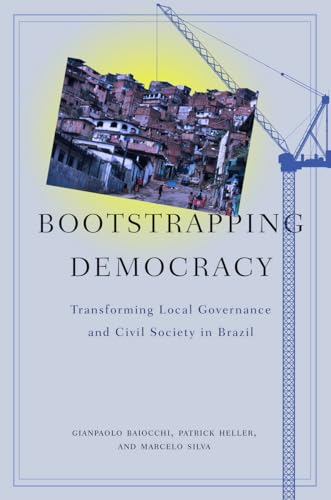
Despite increasing interest in how involvement in local government can improve governance and lead to civic renewal, questions remain about participation's real impact. This book investigates participatory budgeting-a mainstay now of World Bank, UNDP, and USAID development programs-to ask whether its reforms truly make a difference in deepening democracy and empowering civil society. Looking closely at eight cities in Brazil, comparing those that carried out participatory budgeting reforms between 1997 and 2000 with those that did not, the authors examine whether and how institutional reforms take effect.
Bootstrapping Democracy highlights the importance of local-level innovations and democratic advances, charting a middle path between those who theorize that globalization hollows out democracy and those who celebrate globalization as a means of fostering democratic values. Uncovering the state's role in creating an "associational environment," it reveals the contradictory ways institutional reforms shape the democratic capabilities of civil society and how outcomes are conditioned by relations between the state and civil society.
Die Inhaltsangabe kann sich auf eine andere Ausgabe dieses Titels beziehen.
Über die Autorinnen und Autoren
Gianpaolo Baiocchi is Associate Professor of Sociology at Brown University. He is the author of Militants and Citizens: The Politics of Participatory Democracy in Porto Alegre (Stanford University Press, 2005) and Radicals in Power: The Workers' Party and Experiments in Urban Democracy in Brazil(2003). Patrick Heller is Associate Professor of Sociology at Brown University. He is the coauthor of Social Democracy in the Global Periphery: Origins and Prospects (2007) and author of The Labor Development: Workers and the Transformation of Capitalism in Kerala, India (1999). Marcelo Kunrath Silva is Associate Professor of Sociology and Rural Sociology at the Federal University of Rio Grande do Sul, Brazil.
Gianpaolo Baiocchi is Associate Professor of Sociology at Brown University. He is the author of Militants and Citizens: The Politics of Participatory Democracy in Porto Alegre (Stanford University Press, 2005) and Radicals in Power: The Workers' Party and Experiments in Urban Democracy in Brazil(2003).Patrick Heller is Associate Professor of Sociology at Brown University. He is the coauthor of Social Democracy in the Global Periphery: Origins and Prospects (2007) and author of The Labor Development: Workers and the Transformation of Capitalism in Kerala, India (1999).Marcelo Kunrath Silva is Associate Professor of Sociology and Rural Sociology at the Federal University of Rio Grande do Sul, Brazil.
Auszug. © Genehmigter Nachdruck. Alle Rechte vorbehalten.
Bootstrapping Democracy
TRANSFORMING LOCAL GOVERNANCE AND CIVIL SOCIETY IN BRAZILBy Gianpaolo Baiocchi Patrick Heller Marcelo K. SilvaStanford University Press
Copyright © 2011 the Board of Trustees of the Leland Stanford Junior UniversityAll right reserved.
ISBN: 978-0-8047-6056-0
Contents
List of Illustrations..................................................................ixPreface................................................................................xiAcronyms and Terms.....................................................................xvIntroduction Evaluating Participatory Democracy.......................................11 Civil Society and the Local State: Toward a Relational Framework.....................182 The Emergence of Local Democracy in Brazil...........................................393 Assessing the Impact of Participatory Budgeting......................................594 Representation by Design.............................................................805 Making Space for Civil Society.......................................................107Conclusion Bootstrapping Participatory Democracy......................................142Appendix...............................................................................167Notes..................................................................................173Bibliography...........................................................................181Index..................................................................................197
Chapter One
CIVIL SOCIETY AND THE LOCAL STATE Toward a Relational Framework
Although the concept of civil society has a long and complicated history in political theory, it is only in recent decades that it has become an object of sustained empirical interest. After a first revival in the late 1980s driven by the waves of democratization in Eastern Europe and Latin America (Kaldor 2004), and subsequent world events like the World Social Forum, the idea of civil society has continued to animate a variety of scholarship on the potentials and pitfalls of associational life. Civil society has been referred to as a "millennial idea" (Comaroff and Comaroff 2001), and its rediscovery marks a turning point in political sociology. Somers has argued that for much of the twentieth century, political sociology worked with the assumption that there were "only two essential towering protagonists of social organization that forged the modern world: the modern administrative state and the market economy" (1995, 230). It has now become commonplace to theorize civil society as a necessary third leg of modernity providing a necessary complement to the market and the state. As Somers argues, "It has been called a 'third' space of popular social movements and collective mobilization, of informal networks and associations, and of community solidarities that sustain a participatory public life symbolized not by the sovereign individualism of the market or by the state" (1995, 230).
Certain scholarly works, such as the 1989 English translation of Habermas's The Public Sphere and the publication of Putnam, Leonardi, and Nanetti's Making Democracy Work, have been particularly influential in shaping the debate and most notably in reconceptualizing democracy from the vantage point of civil society. Our toolkit for understanding democratization has been expanded to include concepts such as the "public sphere" and "citizenship," concepts that have been specifically developed to highlight how political practices are culturally specific to peoples, places, and issues (Dagnino 1998; Mahajan 1999).
We find the problematic that has emerged around civil society to be as exciting as it is confusing, however. The civil society literature has made a strong case that different patterns of association can substantively improve the quality of democracy, but any such general claim is subject to five important qualifications. First, as many critics have noted, the normative ideal of civil society—rights-bearing citizens who achieve a degree of democratic governance through deliberation—is often substituted for the actual practices in civil society. In this celebratory view of civil society, the democratizing effects of civil society are taken for granted rather than demonstrated. Second, while the literature has had much to say about the mobilizational capacity of civil society, it has had little to say about how civil society can effectively engage the state and influence public policy. While civil society actors may be good at problematizing new issues, mobilizing previously marginalized populations, and in some cases even transforming societal norms, we know little about when and how such efforts are effectively scaled-up into institutional practices that can sustain a new political equilibrium. Third, most of the literature has focused on national civil societies or transnational networks, and far too little research has focused on local civil societies. Fourth, even though it is widely recognized that there is enormous variation in the configuration of actual civil societies, efforts to develop useful typologies have barely gotten beyond highly descriptive terms such as "vibrant," "thick," and "effervescent." Fifth, many recent treatments of civil society have tempered the celebratory view by emphasizing the extent to which many aspects of associational life are artifactual, that is, based on the institutional context in which they are embedded. We find this criticism to be basically sound (indeed, it is confirmed by the findings in this book), but we caution that the emphasis in this artifactual literature (for example, Armony 2004) has often swung to the other extreme of the celebratory literature in its emphasis on how civil society is constrained or hemmed in by social and state power. Between these two extremes, there have been few attempts to examine how institutional designs and reforms might actually encourage and strengthen citizen participation, that is, how civil society itself might become more or less democratic as a result of its interaction with institutions of the state.
TOWARD A RELATIONAL ACCOUNT OF CIVIL SOCIETY
"Follow the actors!"—Bruno Latour
Following the call of scholars like Mamdani (1996) who urge us to look at "actually existing civil societies," in this book we offer what we have come to think of as a "middle-way," or a sociologically realistic account of civil society. Drawing on the relational tradition in sociology, we propose to move beyond what we call the "institutional-associational divide," the divide between those who emphasize formal institutions and those who emphasize society-side factors, or roughly speaking, the divide between political science and sociology. The relational tools we deploy here both illuminate spaces in the interstices of society and state and expose the centrality of relationships across those divides in shaping practices on both sides. But our account is also a "middle-way" account in the sense that it relies on and dialogues with normative political theory while it is also informed by sociologically realistic accounts of inequality and power. We thus develop a deontologized account of civil society, one that rejects the confusion of the empirical with the romantic, but nonetheless holds it up to the critical gaze of normative theory. Concretely situated in the sociological literature, this means drawing on authors who are attentive to power dynamics within civil society and...
„Über diesen Titel“ kann sich auf eine andere Ausgabe dieses Titels beziehen.
Suchergebnisse für Bootstrapping Democracy: Transforming Local Governance...

Beispielbild für diese ISBN
Bootstrapping Democracy: Transforming Local Governance and Civil Society in Brazil
Verlag:
Stanford University Press, 2011
ISBN 10: 080476056X
ISBN 13: 9780804760560
Gebraucht
Softcover
Anbieter: World of Books (was SecondSale), Montgomery, IL, USA
Verkäuferbewertung 5 von 5 Sternen

Zustand: Very Good. Item in very good condition! Textbooks may not include supplemental items i.e. CDs, access codes etc. Bestandsnummer des Verkäufers 00084237978
Gebraucht kaufen
EUR 6,27
Versand gratis
Versand innerhalb von USA
Versand innerhalb von USA
Anzahl: 1 verfügbar
Beispielbild für diese ISBN
Bootstrapping Democracy: Transforming Local Governance and Civil Society in Brazil
Verlag:
Stanford University Press, 2011
ISBN 10: 080476056X
ISBN 13: 9780804760560
Gebraucht
Paperback
Anbieter: ThriftBooks-Dallas, Dallas, TX, USA
Verkäuferbewertung 5 von 5 Sternen
Paperback. Zustand: Very Good. No Jacket. May have limited writing in cover pages. Pages are unmarked. ~ ThriftBooks: Read More, Spend Less. Bestandsnummer des Verkäufers G080476056XI4N00
Gebraucht kaufen
EUR 6,29
Versand gratis
Versand innerhalb von USA
Versand innerhalb von USA
Anzahl: 1 verfügbar
Beispielbild für diese ISBN
Bootstrapping Democracy: Transforming Local Governance and Civil Society in Brazil
Verlag:
Stanford University Press, 2011
ISBN 10: 080476056X
ISBN 13: 9780804760560
Gebraucht
Paperback
Anbieter: World of Books Inc, Montgomery, IL, USA
Verkäuferbewertung 4 von 5 Sternen

Paperback. Zustand: Very Good. This book investigates participatory budgeting-a mainstay now of World Bank, UNDP, and USAID development programs-to ask whether its reforms truly make a difference in deepening democracy and empowering civil society. Bestandsnummer des Verkäufers CIN080476056XVG
Gebraucht kaufen
EUR 8,11
Versand gratis
Versand innerhalb von USA
Versand innerhalb von USA
Anzahl: 1 verfügbar
Beispielbild für diese ISBN
Bootstrapping Democracy : Transforming Local Governance and Civil Society in Brazil
Verlag:
Stanford University Press, 2011
ISBN 10: 080476056X
ISBN 13: 9780804760560
Gebraucht
Softcover
Anbieter: Better World Books: West, Reno, NV, USA
Verkäuferbewertung 5 von 5 Sternen
Zustand: Very Good. Pages intact with possible writing/highlighting. Binding strong with minor wear. Dust jackets/supplements may not be included. Stock photo provided. Product includes identifying sticker. Better World Books: Buy Books. Do Good. Bestandsnummer des Verkäufers 5446325-6
Gebraucht kaufen
EUR 8,35
Versand gratis
Versand innerhalb von USA
Versand innerhalb von USA
Anzahl: 1 verfügbar
Beispielbild für diese ISBN
Bootstrapping Democracy: Transforming Local Governance and Civil Society in Brazil
Verlag:
Stanford University Press, 2011
ISBN 10: 080476056X
ISBN 13: 9780804760560
Gebraucht
paperback
Anbieter: Midtown Scholar Bookstore, Harrisburg, PA, USA
Verkäuferbewertung 5 von 5 Sternen
paperback. Zustand: Very Good. Very Good - Crisp, clean, unread book with some shelfwear/edgewear, may have a remainder mark - NICE PAPERBACK Standard-sized. Bestandsnummer des Verkäufers M080476056XZ2
Gebraucht kaufen
EUR 4,03
EUR 5,36 Versand
Versand innerhalb von USA
Versand innerhalb von USA
Anzahl: 1 verfügbar
Beispielbild für diese ISBN
Bootstrapping Democracy : Transforming Local Governance and Civil Society in Brazil
Anbieter: GreatBookPrices, Columbia, MD, USA
Verkäuferbewertung 5 von 5 Sternen
Zustand: New. Bestandsnummer des Verkäufers 12831261-n
Neu kaufen
EUR 22,38
EUR 2,36 Versand
Versand innerhalb von USA
Versand innerhalb von USA
Anzahl: Mehr als 20 verfügbar
Beispielbild für diese ISBN
Bootstrapping Democracy: Transforming Local Governance and Civil Society in Brazil
Anbieter: California Books, Miami, FL, USA
Verkäuferbewertung 5 von 5 Sternen
Zustand: New. Bestandsnummer des Verkäufers I-9780804760560
Neu kaufen
EUR 24,82
Versand gratis
Versand innerhalb von USA
Versand innerhalb von USA
Anzahl: Mehr als 20 verfügbar
Foto des Verkäufers
Bootstrapping Democracy : Transforming Local Governance and Civil Society in Brazil
Verlag:
Stanford University Press, 2011
ISBN 10: 080476056X
ISBN 13: 9780804760560
Gebraucht
Softcover
Anbieter: GreatBookPrices, Columbia, MD, USA
Verkäuferbewertung 5 von 5 Sternen
Zustand: As New. Unread book in perfect condition. Bestandsnummer des Verkäufers 12831261
Gebraucht kaufen
EUR 22,66
EUR 2,36 Versand
Versand innerhalb von USA
Versand innerhalb von USA
Anzahl: Mehr als 20 verfügbar
Beispielbild für diese ISBN
Bootstrapping Democracy
Anbieter: PBShop.store UK, Fairford, GLOS, Vereinigtes Königreich
Verkäuferbewertung 5 von 5 Sternen
PAP. Zustand: New. New Book. Shipped from UK. Established seller since 2000. Bestandsnummer des Verkäufers FW-9780804760560
Neu kaufen
EUR 23,54
EUR 4,92 Versand
Versand von Vereinigtes Königreich nach USA
Versand von Vereinigtes Königreich nach USA
Anzahl: 15 verfügbar
Beispielbild für diese ISBN
Bootstrapping Democracy - Transforming Local Governance and Civil Society in Brazil (eng)
Anbieter: Brook Bookstore On Demand, Napoli, NA, Italien
Verkäuferbewertung 5 von 5 Sternen
Zustand: new. Bestandsnummer des Verkäufers 340d1001824ea1f90fc87451a97e4712
Neu kaufen
EUR 26,86
EUR 5,50 Versand
Versand von Italien nach USA
Versand von Italien nach USA
Anzahl: Mehr als 20 verfügbar