
Verwandte Artikel zu Multidirectional Memory: Remembering the Holocaust...
Multidirectional Memory: Remembering the Holocaust in the Age of Decolonization (Cultural Memory in the Present) - Softcover
Buch 128 von 213: Cultural Memory in the Present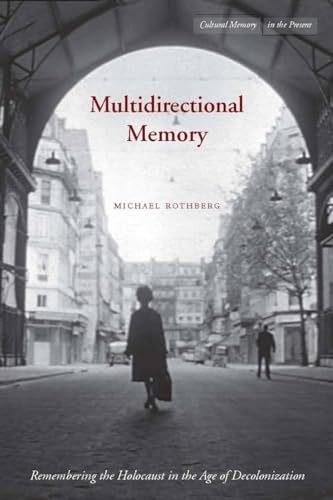
Inhaltsangabe
Multidirectional Memory brings together Holocaust studies and postcolonial studies for the first time. Employing a comparative and interdisciplinary approach, the book makes a twofold argument about Holocaust memory in a global age by situating it in the unexpected context of decolonization. On the one hand, it demonstrates how the Holocaust has enabled the articulation of other histories of victimization at the same time that it has been declared "unique" among human-perpetrated horrors. On the other, it uncovers the more surprising and seldom acknowledged fact that public memory of the Holocaust emerged in part thanks to postwar events that seem at first to have little to do with it. In particular, Multidirectional Memory highlights how ongoing processes of decolonization and movements for civil rights in the Caribbean, Africa, Europe, the United States, and elsewhere unexpectedly galvanized memory of the Holocaust.
Rothberg engages with both well-known and non-canonical intellectuals, writers, and filmmakers, including Hannah Arendt, Aimé Césaire, Charlotte Delbo, W.E.B. Du Bois, Marguerite Duras, Michael Haneke, Jean Rouch, and William Gardner Smith.
Rothberg engages with both well-known and non-canonical intellectuals, writers, and filmmakers, including Hannah Arendt, Aimé Césaire, Charlotte Delbo, W.E.B. Du Bois, Marguerite Duras, Michael Haneke, Jean Rouch, and William Gardner Smith.
Die Inhaltsangabe kann sich auf eine andere Ausgabe dieses Titels beziehen.
Über die Autorinnen und Autoren
Michael Rothberg is Professor of English and Director of the Unit for Criticism and Interpretive Theory at the University of Illinois at Urbana-Champaign. He is the author of Traumatic Realism: The Demands of Holocaust Representation (2000).
Michael Rothberg is Professor of English and Director of the Unit for Criticism and Interpretive Theory at the University of Illinois at Urbana-Champaign. He is the author of Traumatic Realism: The Demands of Holocaust Representation (2000).
Auszug. © Genehmigter Nachdruck. Alle Rechte vorbehalten.
MULTIDIRECTIONAL MEMORY
Remembering the Holocaust in the Age of DecolonizationBy Michael RothbergSTANFORD UNIVERSITY PRESS
Copyright © 2009 Board of Trustees of the Leland Stanford Junior UniversityAll right reserved.
ISBN: 978-0-8047-6218-2
Contents
List of Illustrations........................................................................................................................xiAcknowledgments..............................................................................................................................xiii1 Introduction: Theorizing Multidirectional Memory in a Transnational Age...................................................................12 At the Limits of Eurocentrism: Hannah Arendt's The Origins of Totalitarianism.............................................................333 "Un Choc en Retour": Aimé Césaire's Discourses on Colonialism and Genocide......................................................664 W. E. B. Du Bois in Warsaw: Holocaust Memory and the Color Line...........................................................................1115 Anachronistic Aesthetics: André Schwarz-Bart and Caryl Phillips on the Ruins of Memory...............................................1356 The Work of Testimony in the Age of Decolonization: Chronicle of a Summer and the Emergence of the Holocaust Survivor.....................1757 The Counterpublic Witness: Charlotte Delbo's Les belles lettres...........................................................................1998 A Tale of Three Ghettos: Race, Gender, and "Universality" After October 17, 1961..........................................................2279 Hidden Children: The Ethics of Multigenerational Memory After 1961........................................................................267Epilogue: Multidirectional Memory in an Age of Occupations..................................................................................309Notes........................................................................................................................................315Index........................................................................................................................................365
Chapter One
Introduction: Theorizing Multidirectional Memory in a Transnational Age
Beyond Competitive Memory
In a characteristically provocative essay on the relationship between racism and anti-Semitism in contemporary America, the literary critic Walter Benn Michaels considers the seemingly incompatible legacies of slavery and the Nazi genocide in the United States:
Why is there a federally funded U.S. Holocaust Museum on the Mall in Washington, DC? ... The difficulty of coming up with a satisfactory answer to this question has produced a certain exasperation among African Americans, memorably expressed by the notorious black racist Khalid Muhammad when, in the wake of a visit to the U.S. Holocaust Memorial Museum, he told an audience at Howard University on 3 April 1994 that "the black holocaust was 100 times worse than the so-called Jew Holocaust. You say you lost six million. We question that, but ... we lost 600 million. Schindler's List," as Muhammad put it, "is really a swindler's list." The force of these remarks consists not in the absurd Holocaust denial but in the point—made precisely by his visit to the Holocaust Museum—that commemoration of the Nazi murder of the Jews on the Mall was in fact another kind of Holocaust denial. Why should what the Germans did to the Jews be treated as a crucial event in American history, especially when, given the absence of any commemoration of American racism on the Mall, what Americans did to Black people is not?
In this passage Michaels takes up one of the most agonizing problems of contemporary multicultural societies: how to think about the relationship between different social groups' histories of victimization. This problem, as Michaels recognizes, also fundamentally concerns collective memory, the relationship that such groups establish between their past and their present circumstances. A series of questions central to this book emerges at this point: What happens when different histories confront each other in the public sphere? Does the remembrance of one history erase others from view? When memories of slavery and colonialism bump up against memories of the Holocaust in contemporary multicultural societies, must a competition of victims ensue?
Michaels's stance toward his example in his essay on anti-Semitism and racism is somewhat cagey; he acknowledges Muhammad's racism and the "absurd" nature of his Holocaust denial, yet he seems simultaneously to embrace a fundamental feature of Muhammad's argument. Like Muhammad, Michaels implies that collective memory obeys a logic of scarcity: if a Holocaust Museum sits on the Mall in Washington (or just off of it, as is the actual case), then Holocaust memory must literally be crowding the memory of African American history out of the public space of American collective consciousness. There are plenty of legitimate ways to engage critically with the fact and function of the U.S. Holocaust Memorial Museum, and there is certainly a great need to engage with the ongoing fact of American racism, but Michaels's argument begs some important questions: Does collective memory really work like real-estate development? Must the claims of memory always be calculated according to their relevance for national history? Is "commemoration of the Nazi murder of the Jews" really a form of "Holocaust denial"?
Although few people would put the matter in such controversial terms, many other commentators, both inside and outside the academy, share the understanding of memory and identity articulated by Michaels. This study is motivated by a sense of the urgency of the vexing issues that Michaels raises, but it challenges the widely held ideas about the nature of collective memory and its links to group identity that undergird Michaels's provocations. Like Michaels and, indeed, Muhammad, many people assume that the public sphere in which collective memories are articulated is a scarce resource and that the interaction of different collective memories within that sphere takes the form of a zero-sum struggle for preeminence. Because many of these same commentators also believe that a direct line runs between remembrance of the past and the formation of identity in the present, they understand the articulation of the past in collective memory as a struggle for recognition in which there can only be winners and losers, a struggle that is thus closely allied with the potential for deadly violence. While there can be no doubt that many manifestations of contemporary violence, including war and genocide, are in part the product of resentful memories and conflicting views of the past, I argue that the conceptual framework through which commentators and ordinary citizens have addressed the relationship between memory, identity, and violence is flawed. Against the framework that understands collective memory as competitive memory—as a zero-sum struggle over scarce resources-I suggest that we consider memory as multidirectional: as subject to ongoing negotiation, cross-referencing, and borrowing; as productive and not privative. This shift in perspective allows us to see that while Muhammad and Michaels both speak of Holocaust memory as if it blocks memory of slavery and colonialism from...
„Über diesen Titel“ kann sich auf eine andere Ausgabe dieses Titels beziehen.
Suchergebnisse für Multidirectional Memory: Remembering the Holocaust...

Foto des Verkäufers
Multidirectional Memory: Remembering the Holocaust in the Age of Decolonization (Cultural Memory in the Present)
Verlag:
Stanford University Press, 2009
ISBN 10: 080476218X
ISBN 13: 9780804762182
Gebraucht
paperback
Anbieter: WeBuyBooks, Rossendale, LANCS, Vereinigtes Königreich
Verkäuferbewertung 5 von 5 Sternen

paperback. Zustand: Good. Most items will be dispatched the same or the next working day. A copy that has been read but remains in clean condition. All of the pages are intact and the cover is intact and the spine may show signs of wear. The book may have minor markings which are not specifically mentioned. Bestandsnummer des Verkäufers rev5123238755
Gebraucht kaufen
EUR 16,87
EUR 8,26 Versand
Versand von Vereinigtes Königreich nach USA
Versand von Vereinigtes Königreich nach USA
Anzahl: 1 verfügbar
Foto des Verkäufers
Multidirectional Memory: Remembering the Holocaust in the Age of Decolonization (Paperback or Softback)
Verlag:
Stanford University Press 7/1/2009, 2009
ISBN 10: 080476218X
ISBN 13: 9780804762182
Neu
Paperback or Softback
Anbieter: BargainBookStores, Grand Rapids, MI, USA
Verkäuferbewertung 5 von 5 Sternen
Paperback or Softback. Zustand: New. Multidirectional Memory: Remembering the Holocaust in the Age of Decolonization. Book. Bestandsnummer des Verkäufers BBS-9780804762182
Beispielbild für diese ISBN
Multidirectional Memory: Remembering the Holocaust in the Age of Decolonization
Anbieter: California Books, Miami, FL, USA
Verkäuferbewertung 5 von 5 Sternen
Zustand: New. Bestandsnummer des Verkäufers I-9780804762182
Neu kaufen
EUR 29,42
Versand gratis
Versand innerhalb von USA
Versand innerhalb von USA
Anzahl: Mehr als 20 verfügbar
Beispielbild für diese ISBN
Multidirectional Memory
Anbieter: PBShop.store UK, Fairford, GLOS, Vereinigtes Königreich
Verkäuferbewertung 5 von 5 Sternen
PAP. Zustand: New. New Book. Shipped from UK. Established seller since 2000. Bestandsnummer des Verkäufers FW-9780804762182
Neu kaufen
EUR 26,35
EUR 5,93 Versand
Versand von Vereinigtes Königreich nach USA
Versand von Vereinigtes Königreich nach USA
Anzahl: 15 verfügbar
Beispielbild für diese ISBN
Multidirectional Memory (Paperback)
Verlag:
Stanford University Press, Palo Alto, 2009
ISBN 10: 080476218X
ISBN 13: 9780804762182
Neu
Paperback
Anbieter: Grand Eagle Retail, Bensenville, IL, USA
Verkäuferbewertung 5 von 5 Sternen
Paperback. Zustand: new. Paperback. Multidirectional Memory brings together Holocaust studies and postcolonial studies for the first time. Employing a comparative and interdisciplinary approach, the book makes a twofold argument about Holocaust memory in a global age by situating it in the unexpected context of decolonization. On the one hand, it demonstrates how the Holocaust has enabled the articulation of other histories of victimization at the same time that it has been declared "unique" among human-perpetrated horrors. On the other, it uncovers the more surprising and seldom acknowledged fact that public memory of the Holocaust emerged in part thanks to postwar events that seem at first to have little to do with it. In particular, Multidirectional Memory highlights how ongoing processes of decolonization and movements for civil rights in the Caribbean, Africa, Europe, the United States, and elsewhere unexpectedly galvanized memory of the Holocaust. Rothberg engages with both well-known and non-canonical intellectuals, writers, and filmmakers, including Hannah Arendt, Aime Cesaire, Charlotte Delbo, W.E.B. Du Bois, Marguerite Duras, Michael Haneke, Jean Rouch, and William Gardner Smith. Multidirectional Memory brings together Holocaust studies and postcolonial studies for the first time to put forward a new theory of cultural memory and uncover an unacknowledged tradition of exchange between the legacies of genocide and colonialism. This item is printed on demand. Shipping may be from multiple locations in the US or from the UK, depending on stock availability. Bestandsnummer des Verkäufers 9780804762182
Beispielbild für diese ISBN
Multidirectional Memory: Remembering the Holocaust in the Age of Decolonization (Cultural Memory in the Present)
Verlag:
Stanford University Press, 2009
ISBN 10: 080476218X
ISBN 13: 9780804762182
Gebraucht
Paperback
Anbieter: Ed's Editions LLC, ABAA, West Columbia, SC, USA
Verkäuferbewertung 5 von 5 Sternen
Paperback. Zustand: Very Good. Clean, has a good binding, no marks or notations. Light edgewear including rubbing at corners. Pages are bright. TP HS. Bestandsnummer des Verkäufers 198542
Gebraucht kaufen
EUR 27,58
EUR 5,36 Versand
Versand innerhalb von USA
Versand innerhalb von USA
Anzahl: 1 verfügbar
Beispielbild für diese ISBN
Multidirectional Memory - Remembering the Holocaust in the Age of Decolonization (eng)
Anbieter: Brook Bookstore On Demand, Napoli, NA, Italien
Verkäuferbewertung 5 von 5 Sternen
Zustand: new. Bestandsnummer des Verkäufers d33f945be86d3a33e500dff9b9bf9e4a
Neu kaufen
EUR 31,33
EUR 6,80 Versand
Versand von Italien nach USA
Versand von Italien nach USA
Anzahl: Mehr als 20 verfügbar
Foto des Verkäufers
Multidirectional Memory
Verlag:
Stanford University Press, US, 2009
ISBN 10: 080476218X
ISBN 13: 9780804762182
Neu
Paperback
Anbieter: Rarewaves.com USA, London, LONDO, Vereinigtes Königreich
Verkäuferbewertung 5 von 5 Sternen
Paperback. Zustand: New. Multidirectional Memory brings together Holocaust studies and postcolonial studies for the first time. Employing a comparative and interdisciplinary approach, the book makes a twofold argument about Holocaust memory in a global age by situating it in the unexpected context of decolonization. On the one hand, it demonstrates how the Holocaust has enabled the articulation of other histories of victimization at the same time that it has been declared "unique" among human-perpetrated horrors. On the other, it uncovers the more surprising and seldom acknowledged fact that public memory of the Holocaust emerged in part thanks to postwar events that seem at first to have little to do with it. In particular, Multidirectional Memory highlights how ongoing processes of decolonization and movements for civil rights in the Caribbean, Africa, Europe, the United States, and elsewhere unexpectedly galvanized memory of the Holocaust. Rothberg engages with both well-known and non-canonical intellectuals, writers, and filmmakers, including Hannah Arendt, Aimé Césaire, Charlotte Delbo, W.E.B. Du Bois, Marguerite Duras, Michael Haneke, Jean Rouch, and William Gardner Smith. Bestandsnummer des Verkäufers LU-9780804762182
Neu kaufen
EUR 39,88
Versand gratis
Versand von Vereinigtes Königreich nach USA
Versand von Vereinigtes Königreich nach USA
Anzahl: Mehr als 20 verfügbar
Beispielbild für diese ISBN
Multidirectional Memory: Remembering the Holocaust in the Age of Decolonization (Cultural Memory in the Present)
Anbieter: Majestic Books, Hounslow, Vereinigtes Königreich
Verkäuferbewertung 4 von 5 Sternen

Zustand: New. pp. 408. Bestandsnummer des Verkäufers 7990378
Neu kaufen
EUR 35,24
EUR 7,68 Versand
Versand von Vereinigtes Königreich nach USA
Versand von Vereinigtes Königreich nach USA
Anzahl: 3 verfügbar
Beispielbild für diese ISBN
Multidirectional Memory: Remembering the Holocaust in the Age of Decolonization
Anbieter: Kennys Bookshop and Art Galleries Ltd., Galway, GY, Irland
Verkäuferbewertung 5 von 5 Sternen
Zustand: New. Multidirectional Memory brings together Holocaust studies and postcolonial studies for the first time to put forward a new theory of cultural memory and uncover an unacknowledged tradition of exchange between the legacies of genocide and colonialism. Series: Cultural Memory in the Present. Num Pages: 408 pages, 10 illustrations. BIC Classification: HBTZ1. Category: (U) Tertiary Education (US: College). Dimension: 153 x 230 x 22. Weight in Grams: 562. . 2009. Paperback. . . . . Bestandsnummer des Verkäufers V9780804762182
Neu kaufen
EUR 33,58
EUR 9,50 Versand
Versand von Irland nach USA
Versand von Irland nach USA
Anzahl: Mehr als 20 verfügbar