
Verwandte Artikel zu For Love of the Father: A Psychoanalytic Study of Religious...
For Love of the Father: A Psychoanalytic Study of Religious Terrorism (Meridian: Crossing Aesthetics) - Softcover
Buch 13 von 33: Meridian: Crossing Aesthetics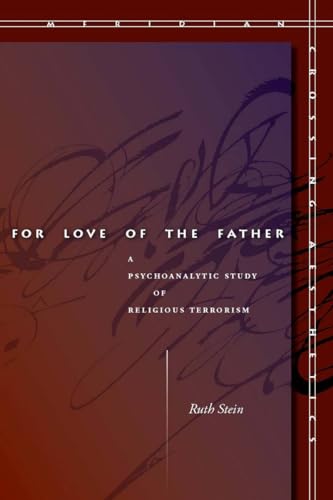
Inhaltsangabe
Ruth Stein's pioneering study explains suicidal terrorism from a psychoanalytic perspective. She argues that most Islamic extremists undertake destructive and self-destructive actions not out of blind hatred, nor even for political gain, but to achieve an explosive merger with a transcendent awesome Father, God. The extremist is thus motivated more by his love for God than his hatred of the infidel. The contemporary Islamic terrorist kills "God's enemies" to express his intoxication with and complete submission to the God-idea. Stein further shows that this same leitmotif of filial submission and sacrifice runs through patriarchal monotheism in general.
Die Inhaltsangabe kann sich auf eine andere Ausgabe dieses Titels beziehen.
Über die Autorin bzw. den Autor
Ruth Stein is Associate Professor in New York University's Postdoctoral Program in Psychotherapy and Psychoanalysis and a clinical psychologist and psychoanalyst. She is the author of Psychoanalytic Theories of Affect (1991; 1999).
Auszug. © Genehmigter Nachdruck. Alle Rechte vorbehalten.
FOR LOVE OF THE FATHER
A Psychoanalytic Study of Religious TerrorismBy Ruth SteinStanford University Press
Copyright © 2010 Board of Trustees of the Leland Stanford Junior UniversityAll right reserved.
ISBN: 978-0-8047-6305-9
Contents
Acknowledgments...................................................................................xiPreface...........................................................................................xvIntroduction......................................................................................11 Evil as Love and as Liberation: The Mind of a Suicidal Religious Terrorist.....................212 Fundamentalism as Vertical Mystical Homoeros...................................................453 Purification as Violence.......................................................................614 Regression to the Father: Clinical Narratives and Theoretical Reflections......................745 The Triadic Structure of Evil..................................................................102Appendix A: Mohammed Atta's Letter................................................................143Appendix B: From Dr. Ali Shariati's After Shahadat................................................149Notes.............................................................................................157References........................................................................................191Index.............................................................................................211
Chapter One
Evil as Love and as LiberationThe Mind of a Suicidal Religious Terrorist
The letter to the hijackers that was found in Mohammed Atta's luggage in the car that was left at Logan Airport before the World Trade Center attack is a striking document. A highly revelatory testimony, it may provide us with some understanding of how the mind of a suicide killer works. As psychoanalysis, indeed society, faces the emergence of new kinds of mass-destructive attacks on human beings, we must seek whatever additional knowledge we can about the states of mind that are conducive to such attacks. In particular, I believe, we should try to comprehend the mentality behind intensely religious self-sacrifice. We need to learn more about the psychodynamic issues involved in a decision that caused (and may go on causing) horrible suffering and grief to masses of people. We need to inquire what are the themes linked with and explanatory of this kind of evil.
In their anthology of studies by religious theorists and political scientists who authenticated and translated the letter from the Arabic, Hans Kippenberg and Tilman Seidenstricker describe the letter as a collection of rituals. The purpose of the letter and the mandated rituals, in their view, was to transform a young Muslim into a warrior, instilling spiritual motives that create inner peace, fearlessness, obeisance, and lack of feeling during the killing. But the letter is more than a document tracing the initiation and transformation of a man into a warrior. Had it only been a means of contacting and fortifying the minds of terrorists about to commit an act of mass destruction, we would expect such a document to be filled with a raging rhetoric of hate, a cry to destruction and annihilation. Instead, we hear a voice that reassures, calms, calls for restraint and thoughtful control, and appeals for a heightened consciousness in its readers. One might say that this is the voice of a wise father, instructing his sons in the steps they are to take on a mission of great importance, and reminding them of the attitude suited to accomplishing that mission. The letter calls for the terrorists to wash and perfume their bodies; to clean and to polish their knives; to be serene, confident, patient, and smiling; and to remember and renew their intentions. It reminds them that the task before them demands their attentiveness and, even more, their devoted adherence to God.
The letter frequently mentions love of God and God's satisfaction with the act to be accomplished. Essentially, it details some things that have to be done in order for the terrorists to gain entry into God's eternal paradise. We know that these acts involve the murder of human beings, those who are considered the enemies of God, as well as the self-annihilation of the terrorists themselves, who are going to be tools for the elimination of other humans. But the letter does not spell this out. While doing the work of killing and destruction, the doer, God's faithful servant, must remember to make supplications to God wherever he finds himself and whatever he does. Basically, the letter describes a ritual at the end of which the supplicant is to receive God's approval by doing what pleases God-purifying the world of contaminating infidels. Again, this is not mentioned in the letter. What is indeed stressed is that, if one is to merge with God, the most elevated Being human thought can envision, one has to perform the act accurately and mindfully.
How can we explain the tone of the letter? Can it teach us something about the state of mind in which the terrorists were steeped, either by themselves or by others (by special "training," including the formulating and reading of the letter we are studying)? What is the mental atmosphere of anticipating and preparing for such a destruction of other and self? What is the place and role of a smiling, calm, confident state of mind with which one passes from life into death, a state of mind so diametrically inverse to the turmoil, terror, and rage that would be the expected accompaniments to committing such destruction?
The Son's Supplicating Love for the Father
I have always been deeply impressed by the intimate, loving discourse a believer holds with God while praying and supplicating. Particularly poignant to me is the theme of a son praying to his God-father. One can practically hear the sweet plaintive murmur of the Psalmist, "My God, so numerous became those who hunt me, so many are those who stand over me, who say to my soul, you have no redemption in God, and You, my God, giveth back to me my breath and saveth me with Thy love." And one is riveted not only by the music but also by the lyrics of Jesus Christ's love songs to God in Bach's Passion According to St. Matthew, "Dein Mund hat mich gelabet mit Milch und ser Kost" (Your mouth has fed and replenished me with milk and the sweetest nourishment). Both the psalm and St. Matthew are profound works of great beauty and inspiration, where joy and pain intertwine.
The letter to the terrorists does not speak of hatred. It is past hatred. Absurdly and perversely, it is about love. It is about love of God. We can palpably sense the confident intimacy of a son close to his father and the seeking of a love that is given as promised and no longer withheld. If this feeling is sustained inside one, it does not have to be demonstrated externally. The letter is a reminder: "Everywhere you go say that prayer and smile and be calm, for God is with the believers. And the angels protect you without you feeling anything"; and, "You should feel complete tranquility, because the time between you and your marriage [in heaven] is very short." Inasmuch as nothing further is said about that marriage, and particularly whom one will marry (the famous paradisiacal virgins are not mentioned at this point), the idea that the marriage is that of the son(s) to God does not sound absurd at all.
The thought that there might be a root affinity between the theme of...
„Über diesen Titel“ kann sich auf eine andere Ausgabe dieses Titels beziehen.
Suchergebnisse für For Love of the Father: A Psychoanalytic Study of Religious...

Beispielbild für diese ISBN
For Love of the Father: A Psychoanalytic Study of Religious Terrorism (Meridian: Crossing Aesthetics)
Verlag:
Stanford University Press, 2009
ISBN 10: 0804763054
ISBN 13: 9780804763059
Gebraucht
paperback
Anbieter: HPB-Red, Dallas, TX, USA
Verkäuferbewertung 5 von 5 Sternen

paperback. Zustand: Good. Connecting readers with great books since 1972! Used textbooks may not include companion materials such as access codes, etc. May have some wear or writing/highlighting. We ship orders daily and Customer Service is our top priority! Bestandsnummer des Verkäufers S_394223616
Gebraucht kaufen
EUR 10,68
EUR 3,27 Versand
Versand innerhalb von USA
Versand innerhalb von USA
Anzahl: 1 verfügbar
Beispielbild für diese ISBN
For Love of the Father: A Psychoanalytic Study of Religious Terrorism (Meridian: Crossing Aesthetics)
Verlag:
Stanford University Press, 2009
ISBN 10: 0804763054
ISBN 13: 9780804763059
Gebraucht
Soft cover
Erstausgabe
Anbieter: FITZ BOOKS AND WAFFLES, Buffalo, NY, USA
Verkäuferbewertung 5 von 5 Sternen
Soft cover. Zustand: Near Fine. 1st Edition. No marks, creases or blemishes. Appears unread. Minimal wear. Bestandsnummer des Verkäufers 005327
Gebraucht kaufen
EUR 13,46
EUR 3,49 Versand
Versand innerhalb von USA
Versand innerhalb von USA
Anzahl: 1 verfügbar
Beispielbild für diese ISBN
For Love of the Father: A Psychoanalytic Study of Religious Terrorism (Meridian: Crossing Aesthetics)
Verlag:
Stanford University Press, 2009
ISBN 10: 0804763054
ISBN 13: 9780804763059
Gebraucht
paperback
Anbieter: Evergreen Goodwill, Seattle, WA, USA
Verkäuferbewertung 5 von 5 Sternen
paperback. Zustand: Acceptable. Bestandsnummer des Verkäufers mon0000801306
Gebraucht kaufen
EUR 18,36
EUR 3,48 Versand
Versand innerhalb von USA
Versand innerhalb von USA
Anzahl: 1 verfügbar
Beispielbild für diese ISBN
For Love of the Father : A Psychoanalytic Study of Religious Terrorism
Anbieter: GreatBookPrices, Columbia, MD, USA
Verkäuferbewertung 5 von 5 Sternen
Zustand: New. Bestandsnummer des Verkäufers 6648902-n
Neu kaufen
EUR 22,75
EUR 2,30 Versand
Versand innerhalb von USA
Versand innerhalb von USA
Anzahl: Mehr als 20 verfügbar
Beispielbild für diese ISBN
For Love of the Father: A Psychoanalytic Study of Religious Terrorism (Meridian: Crossing Aesthetics)
Anbieter: California Books, Miami, FL, USA
Verkäuferbewertung 4 von 5 Sternen

Zustand: New. Bestandsnummer des Verkäufers I-9780804763059
Neu kaufen
EUR 25,13
Versand gratis
Versand innerhalb von USA
Versand innerhalb von USA
Anzahl: Mehr als 20 verfügbar
Foto des Verkäufers
For Love of the Father : A Psychoanalytic Study of Religious Terrorism
Verlag:
Stanford University Press, 2009
ISBN 10: 0804763054
ISBN 13: 9780804763059
Gebraucht
Softcover
Anbieter: GreatBookPrices, Columbia, MD, USA
Verkäuferbewertung 5 von 5 Sternen
Zustand: As New. Unread book in perfect condition. Bestandsnummer des Verkäufers 6648902
Gebraucht kaufen
EUR 22,95
EUR 2,30 Versand
Versand innerhalb von USA
Versand innerhalb von USA
Anzahl: Mehr als 20 verfügbar
Foto des Verkäufers
For Love of the Father
Verlag:
Stanford University Press, US, 2009
ISBN 10: 0804763054
ISBN 13: 9780804763059
Neu
Paperback
Anbieter: Rarewaves USA, HEBRON, KY, USA
Verkäuferbewertung 5 von 5 Sternen
Paperback. Zustand: New. Ruth Stein's pioneering study explains suicidal terrorism from a psychoanalytic perspective. She argues that most Islamic extremists undertake destructive and self-destructive actions not out of blind hatred, nor even for political gain, but to achieve an explosive merger with a transcendent awesome Father, God. The extremist is thus motivated more by his love for God than his hatred of the infidel. The contemporary Islamic terrorist kills "God's enemies" to express his intoxication with and complete submission to the God-idea. Stein further shows that this same leitmotif of filial submission and sacrifice runs through patriarchal monotheism in general. Bestandsnummer des Verkäufers LU-9780804763059
Neu kaufen
EUR 25,67
Versand gratis
Versand innerhalb von USA
Versand innerhalb von USA
Anzahl: Mehr als 20 verfügbar
Beispielbild für diese ISBN
For Love of the Father
Anbieter: PBShop.store UK, Fairford, GLOS, Vereinigtes Königreich
Verkäuferbewertung 5 von 5 Sternen
PAP. Zustand: New. New Book. Shipped from UK. Established seller since 2000. Bestandsnummer des Verkäufers FW-9780804763059
Neu kaufen
EUR 24,63
EUR 4,84 Versand
Versand von Vereinigtes Königreich nach USA
Versand von Vereinigtes Königreich nach USA
Anzahl: 15 verfügbar
Beispielbild für diese ISBN
For Love of the Father - A Psychoanalytic Study of Religious Terrorism (eng)
Anbieter: Brook Bookstore On Demand, Napoli, NA, Italien
Verkäuferbewertung 5 von 5 Sternen
Zustand: new. Bestandsnummer des Verkäufers a4e6d9af2e2f867a48177bd878254b4b
Neu kaufen
EUR 27,95
EUR 5,50 Versand
Versand von Italien nach USA
Versand von Italien nach USA
Anzahl: Mehr als 20 verfügbar
Beispielbild für diese ISBN
For Love of the Father: A Psychoanalytic Study of Religious Terrorism
Verlag:
Stanford University Press, 2010
ISBN 10: 0804763054
ISBN 13: 9780804763059
Gebraucht
Softcover
Anbieter: Anybook.com, Lincoln, Vereinigtes Königreich
Verkäuferbewertung 5 von 5 Sternen
Zustand: Good. This is an ex-library book and may have the usual library/used-book markings inside.This book has soft covers. In good all round condition. Please note the Image in this listing is a stock photo and may not match the covers of the actual item,450grams, ISBN:9780804763059. Bestandsnummer des Verkäufers 3978933
Gebraucht kaufen
EUR 19,02
EUR 15,83 Versand
Versand von Vereinigtes Königreich nach USA
Versand von Vereinigtes Königreich nach USA
Anzahl: 1 verfügbar