
Verwandte Artikel zu Hyperconflict: Globalization and Insecurity
Inhaltsangabe
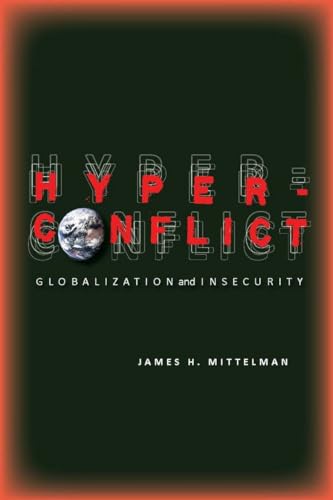
This book addresses two questions that are crucial to the human condition in the twenty-first century: does globalization promote security or fuel insecurity? And what are the implications for world order? Coming to grips with these matters requires building a bridge between the geoeconomics and geopolitics of globalization, one that extends to the geostrategic realm. Yet few analysts have sought to span this gulf.
Filling the void, Mittelman identifies systemic drivers of global security and insecurity and demonstrates how the intense interaction between them heightens insecurity at a world level. The emergent confluence he labels hyperconflict—a structure characterized by a reorganization of political violence, a growing climate of fear, and increasing instability at a world level. Ultimately, his assessment offers an "early warning" to enable prevention of a gathering storm of hyperconflict, and the establishment of enduring peace.
Filling the void, Mittelman identifies systemic drivers of global security and insecurity and demonstrates how the intense interaction between them heightens insecurity at a world level. The emergent confluence he labels hyperconflict—a structure characterized by a reorganization of political violence, a growing climate of fear, and increasing instability at a world level. Ultimately, his assessment offers an "early warning" to enable prevention of a gathering storm of hyperconflict, and the establishment of enduring peace.
Die Inhaltsangabe kann sich auf eine andere Ausgabe dieses Titels beziehen.
Über die Autorinnen und Autoren
James H. Mittelman is University Professor of International Affairs at American University. His recent books include Whither Globalization? The Vortex of Knowledge and Ideology (Routledge, 2004) and The Globalization Syndrome: Transformation and Resistance (Princeton University Press, 2000).
James H. Mittelman is University Professor of International Affairs at American University. His recent books include Whither Globalization? The Vortex of Knowledge and Ideology (Routledge, 2004) and The Globalization Syndrome: Transformation and Resistance (Princeton University Press, 2000).
Auszug. © Genehmigter Nachdruck. Alle Rechte vorbehalten.
Hyperconflict
GLOBALIZATION AND INSECURITYBy James H. MittelmanSTANFORD SECURITY STUDIES
Copyright © 2010 the Board of Trustees of the Leland Stanford Junior UniversityAll right reserved.
ISBN: 978-0-8047-6376-9
Contents
Acknowledgments......................................................................................ixPreface..............................................................................................xiForeword, by Richard Falk............................................................................xviiAbbreviations........................................................................................xxiii1 Prelude............................................................................................12 Preliminary Answers................................................................................263 Coercive Globalization.............................................................................524 Conflict 1: Multilateral Agreement on Investment...................................................675 Conflict 2: Asian Debacle..........................................................................856 Conflict 3: Battles of Seattle (Coauthored with Jacob Stump)......................................1177 Conflict 4: 9/11 and the "Global War on Terror" (Coauthored with Priya Dixit).....................1388 Postnational Security..............................................................................159Epilogue.............................................................................................187Notes................................................................................................205References...........................................................................................211Index................................................................................................241
Chapter One
PRELUDE
The chief concern of this book is the relationship between globalization and security or insecurity. There are two central questions: How are they connected? And what are the implications for world order?
I want to map the debates among policymakers and scholars on these issues and develop a single concept called hyperconflict. It does not cut against the findings of empirical studies, which painstakingly show that in recent decades, the frequency of armed conflict has decreased or, some say, remained level. Instead, my core argument is that a novel pattern is forming. Insecurity is being globalized in an emergent configuration of hyperconflict, a galaxy of conflicts in historical motion. In other words, globalization is propelling a unique confluence of forces that portends hyperconflict. There is a reorganization of political violence, pervasive uncertainty marked by a rising climate of fear, changing structures of armed and other forms of conflict that are not necessarily in the hands of governments or their agents, and growing instability at the world level. The objective in this work is to show concretely how and why this is occurring, and what it means for future world order.
DEBATES AND VISIONS OF WAR AND PEACE
In the contemporary phase of globalization, the period from the 1970s, transnational processes rapidly slice across national territory and are also implanted inside this space. States seek to benefit from them as well as protect their citizens from threats such as global crime and pandemics brought by these transformations. The quandary is that while globalization erodes the principle of territoriality, the imperative of national security affirms the salience of homeland jurisdiction. These forces pull in opposite directions, altering the balance between security and insecurity. In this uneasy correlation of the old and the new, the national and the global blend, though not seamlessly.
In coming to grips with this shift, an oft-stated view is that globalizing processes are prone to peace because the expansion of commerce favors cooperation. It is also said that the spread of democracy fosters peace. Added to this, technological advances, particularly in communications and transportation, increase awareness and can be a spur to building commonality around the world.
Yet many of the same global structures that convey knowledge and other commodities may heighten insecurity and conflict. The Internet, the ease of travel, and financial networks enable the contagion of violence, as with cross-border criminal and terrorist organizations. Modifying the scale of action and the scope of cooperation or conflict, globalization empowers certain political actors, such as transnational advocacy networks and local civil society groups. It also reduces regulatory barriers and lowers the cost of transactions—for example, for flows of weapons and certain types of attacks. With contemporary globalization, the cost advantage now works in favor of nonstate actors. They can convert devastating strikes, such as the ones on September 11, 2001, at a price estimated at $250,000, into a multibillion dollar toll for damage and redress (Robb 2007, 31). According to Joseph Stiglitz and Linda Bilmes's calculations (2008), the overall cost of the follow-up to 9/11, the Iraq conflict, is even higher: three trillion dollars or more.
Lurking behind these factors are the deep drivers of security and insecurity, detailed in the ensuing pages. One is intensified competition that agglomerates markets. Another thrust is the amassing of power, the lead actor being the U.S. state. It, in turn, selectively induces and seeks to manage a diffusion of power that extends beyond state power. But how can the analyst bridge these geoeconomic and geopolitical realms?
To grapple with these big issues, one can trudge back over two hundred years to Immanuel Kant's philosophical writings about the quest for eternal peace. Putting forward seminal ideas about the connections between war and peace, he, like all great theorists, transcended his time and inspired thinkers to the present day. Critically, Kant's Perpetual Peace ([1795] 1948) offered a vision of a federation of republican states that would stave off new wars. To ensure security among themselves, states would give up lawless freedom and would agree to an expanding union based on cosmopolitan norms and world law. Renouncing a utopian perspective, Kant called for balancing morality and interests, subject to various approximations, an aspiration that was to be gradually realized by a universal order.
Striving for perpetual peace is a matter pursued by other authors mindful of the historical links between order and war. Whereas a Kantian position stresses the normative foundations of action, Marxist dialectics identify material power as the ground for protracted conflict. Both Kant and Marx knew that struggles between self-interested groups are the stuff of history—in the Marxist schema, entailing class war and ultimately the atrophy of the state. The one more ideational than the other, these sage observers were cosmopolitans who sought the means to curb the bitter antagonisms that afflict society and are used to sanctify war. These renowned thinkers understood the perils of outbreaks of war as a way to build lasting peace, later enshrined in slogans such as "the war to end all wars."
Inspired by the economic historian Charles Beard, the idea "perpetual war for perpetual peace" depicted the foreign policies of the United States in the run-up to World War II. Beard (1946, 1948) reproached Presidents Franklin D. Roosevelt and Harry Truman for...
„Über diesen Titel“ kann sich auf eine andere Ausgabe dieses Titels beziehen.
Suchergebnisse für Hyperconflict: Globalization and Insecurity

Beispielbild für diese ISBN
Hyperconflict : Globalization and Insecurity
Verlag:
Stanford University Press, 2010
ISBN 10: 0804763763
ISBN 13: 9780804763769
Gebraucht
Softcover
Anbieter: Better World Books, Mishawaka, IN, USA
Verkäuferbewertung 5 von 5 Sternen

Zustand: Good. Former library copy. Pages intact with minimal writing/highlighting. The binding may be loose and creased. Dust jackets/supplements are not included. Includes library markings. Stock photo provided. Product includes identifying sticker. Better World Books: Buy Books. Do Good. Bestandsnummer des Verkäufers 4438275-6
Gebraucht kaufen
EUR 14,42
Versand gratis
Versand innerhalb von USA
Versand innerhalb von USA
Anzahl: 1 verfügbar
Beispielbild für diese ISBN
Hyperconflict: Globalization and Insecurity
Verlag:
Stanford Security Studies, 2010
ISBN 10: 0804763763
ISBN 13: 9780804763769
Gebraucht
paperback
Anbieter: Midtown Scholar Bookstore, Harrisburg, PA, USA
Verkäuferbewertung 5 von 5 Sternen
paperback. Zustand: Good. Good - Bumped and creased book with tears to the extremities, but not affecting the text block, may have remainder mark or previous owner's name - GOOD PAPERBACK Standard-sized. Bestandsnummer des Verkäufers M0804763763Z3
Gebraucht kaufen
EUR 9,36
EUR 5,36 Versand
Versand innerhalb von USA
Versand innerhalb von USA
Anzahl: 1 verfügbar
Foto des Verkäufers
Hyperconflict : Globalization and Insecurity
Verlag:
Stanford Security Studies, 2010
ISBN 10: 0804763763
ISBN 13: 9780804763769
Gebraucht
Softcover
Anbieter: GreatBookPrices, Columbia, MD, USA
Verkäuferbewertung 5 von 5 Sternen
Zustand: good. May show signs of wear, highlighting, writing, and previous use. This item may be a former library book with typical markings. No guarantee on products that contain supplements Your satisfaction is 100% guaranteed. Twenty-five year bookseller with shipments to over fifty million happy customers. Bestandsnummer des Verkäufers 8459329-5
Gebraucht kaufen
EUR 12,44
EUR 2,36 Versand
Versand innerhalb von USA
Versand innerhalb von USA
Anzahl: 5 verfügbar
Beispielbild für diese ISBN
Hyperconflict: Globalization and Insecurity
Verlag:
Stanford Security Studies, 2010
ISBN 10: 0804763763
ISBN 13: 9780804763769
Gebraucht
paperback
Erstausgabe
Anbieter: Textbooks_Source, Columbia, MO, USA
Verkäuferbewertung 5 von 5 Sternen
paperback. Zustand: Good. 1st Edition. Ships in a BOX from Central Missouri! May not include working access code. Will not include dust jacket. Has used sticker(s) and some writing or highlighting. UPS shipping for most packages, (Priority Mail for AK/HI/APO/PO Boxes). Bestandsnummer des Verkäufers 001027789U
Gebraucht kaufen
EUR 13,40
EUR 3,56 Versand
Versand innerhalb von USA
Versand innerhalb von USA
Anzahl: 8 verfügbar
Beispielbild für diese ISBN
Hyperconflict : Globalization and Insecurity
Anbieter: GreatBookPrices, Columbia, MD, USA
Verkäuferbewertung 5 von 5 Sternen
Zustand: New. Bestandsnummer des Verkäufers 8459329-n
Neu kaufen
EUR 26,06
EUR 2,36 Versand
Versand innerhalb von USA
Versand innerhalb von USA
Anzahl: 3 verfügbar
Foto des Verkäufers
Hyperconflict
Verlag:
Stanford University Press, US, 2010
ISBN 10: 0804763763
ISBN 13: 9780804763769
Neu
Paperback
Anbieter: Rarewaves USA, HEBRON, KY, USA
Verkäuferbewertung 5 von 5 Sternen
Paperback. Zustand: New. This book addresses two questions that are crucial to the human condition in the twenty-first century: does globalization promote security or fuel insecurity? And what are the implications for world order? Coming to grips with these matters requires building a bridge between the geoeconomics and geopolitics of globalization, one that extends to the geostrategic realm. Yet few analysts have sought to span this gulf. Filling the void, Mittelman identifies systemic drivers of global security and insecurity and demonstrates how the intense interaction between them heightens insecurity at a world level. The emergent confluence he labels hyperconflict-a structure characterized by a reorganization of political violence, a growing climate of fear, and increasing instability at a world level. Ultimately, his assessment offers an "early warning" to enable prevention of a gathering storm of hyperconflict, and the establishment of enduring peace. Bestandsnummer des Verkäufers LU-9780804763769
Neu kaufen
EUR 29,25
Versand gratis
Versand innerhalb von USA
Versand innerhalb von USA
Anzahl: Mehr als 20 verfügbar
Foto des Verkäufers
Hyperconflict : Globalization and Insecurity
Verlag:
Stanford Security Studies, 2010
ISBN 10: 0804763763
ISBN 13: 9780804763769
Gebraucht
Softcover
Anbieter: GreatBookPrices, Columbia, MD, USA
Verkäuferbewertung 5 von 5 Sternen
Zustand: As New. Unread book in perfect condition. Bestandsnummer des Verkäufers 8459329
Gebraucht kaufen
EUR 28,05
EUR 2,36 Versand
Versand innerhalb von USA
Versand innerhalb von USA
Anzahl: 3 verfügbar
Beispielbild für diese ISBN
Hyperconflict: Globalization and Insecurity
Anbieter: California Books, Miami, FL, USA
Verkäuferbewertung 5 von 5 Sternen
Zustand: New. Bestandsnummer des Verkäufers I-9780804763769
Neu kaufen
EUR 28,50
EUR 2,68 Versand
Versand innerhalb von USA
Versand innerhalb von USA
Anzahl: Mehr als 20 verfügbar
Foto des Verkäufers
Hyperconflict
Verlag:
Stanford University Press, US, 2010
ISBN 10: 0804763763
ISBN 13: 9780804763769
Neu
Paperback
Anbieter: Rarewaves.com USA, London, LONDO, Vereinigtes Königreich
Verkäuferbewertung 5 von 5 Sternen
Paperback. Zustand: New. This book addresses two questions that are crucial to the human condition in the twenty-first century: does globalization promote security or fuel insecurity? And what are the implications for world order? Coming to grips with these matters requires building a bridge between the geoeconomics and geopolitics of globalization, one that extends to the geostrategic realm. Yet few analysts have sought to span this gulf. Filling the void, Mittelman identifies systemic drivers of global security and insecurity and demonstrates how the intense interaction between them heightens insecurity at a world level. The emergent confluence he labels hyperconflict-a structure characterized by a reorganization of political violence, a growing climate of fear, and increasing instability at a world level. Ultimately, his assessment offers an "early warning" to enable prevention of a gathering storm of hyperconflict, and the establishment of enduring peace. Bestandsnummer des Verkäufers LU-9780804763769
Neu kaufen
EUR 31,74
Versand gratis
Versand von Vereinigtes Königreich nach USA
Versand von Vereinigtes Königreich nach USA
Anzahl: 2 verfügbar
Beispielbild für diese ISBN
Hyperconflict
Anbieter: PBShop.store UK, Fairford, GLOS, Vereinigtes Königreich
Verkäuferbewertung 5 von 5 Sternen
PAP. Zustand: New. New Book. Shipped from UK. Established seller since 2000. Bestandsnummer des Verkäufers FW-9780804763769
Neu kaufen
EUR 29,27
EUR 4,97 Versand
Versand von Vereinigtes Königreich nach USA
Versand von Vereinigtes Königreich nach USA
Anzahl: 3 verfügbar