
Verwandte Artikel zu Economic Evolution and Revolution in Historical Time
Inhaltsangabe
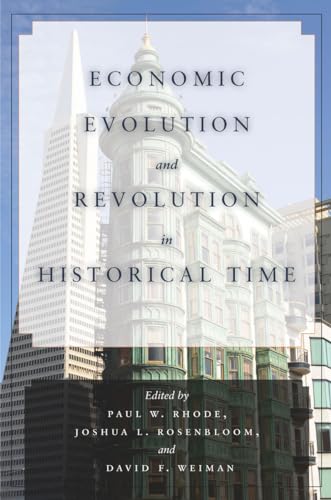
This book challenges the static, ahistorical models on which Economics continues to rely. These models presume that markets operate on a "frictionless" plane where abstract forces play out independent of their institutional and spatial contexts, and of the influences of the past. In reality, at any point in time exogenous factors are themselves outcomes of complex historical processes. They are shaped by institutional and spatial contexts, which are "carriers of history," including past economic dynamics and market outcomes.
To examine the connections between gradual, evolutionary change and more dramatic, revolutionary shifts the text takes on a wide array of historically salient economic questions—ranging from how formative, European encounters reconfigured the political economies of indigenous populations in Africa, the Americas, and Australia to how the rise and fall of the New Deal order reconfigured labor market institutions and outcomes in the twentieth century United States. These explorations are joined by a common focus on formative institutions, spatial structures, and market processes. Through historically informed economic analyses, contributors recognize the myriad interdependencies among these three frames, as well as their distinct logics and temporal rhythms.
To examine the connections between gradual, evolutionary change and more dramatic, revolutionary shifts the text takes on a wide array of historically salient economic questions—ranging from how formative, European encounters reconfigured the political economies of indigenous populations in Africa, the Americas, and Australia to how the rise and fall of the New Deal order reconfigured labor market institutions and outcomes in the twentieth century United States. These explorations are joined by a common focus on formative institutions, spatial structures, and market processes. Through historically informed economic analyses, contributors recognize the myriad interdependencies among these three frames, as well as their distinct logics and temporal rhythms.
Die Inhaltsangabe kann sich auf eine andere Ausgabe dieses Titels beziehen.
Über die Autorinnen und Autoren
Paul W. Rhode is Professor of Economics at the University of Michigan and serves as a Research Associate at the National Bureau of Economic Research. Joshua L. Rosenbloom is Professor of Economics and Associate Vice Provost for Research and Graduate Studies at the University of Kansas. He is a Research Associate at the National Bureau of Economic Research. David F. Weiman is Alena Wels Hirschorn '58 Professor of Economics at Barnard College, Columbia University. He is an affiliated member of the History Department, and a Faculty Fellow of the Institute for Social and Economic Research and Policy at Columbia University.
Paul W. Rhode is Professor of Economics at the University of Michigan and serves as a Research Associate at the National Bureau of Economic Research. Joshua L. Rosenbloom is Professor of Economics and Associate Vice Provost for Research and Graduate Studies at the University of Kansas. He is a Research Associate at the National Bureau of Economic Research. David F. Weiman is Alena Wels Hirschorn '58 Professor of Economics at Barnard College, Columbia University. He is an affiliated member of the History Department, and a Faculty Fellow of the Institute for Social and Economic Research and Policy at Columbia University.
Auszug. © Genehmigter Nachdruck. Alle Rechte vorbehalten.
ECONOMIC EVOLUTION AND REVOLUTION IN HISTORICAL TIME
Stanford University Press
Copyright © 2011 the Board of Trustees of the Leland Stanford Junior UniversityAll right reserved.
ISBN: 978-0-8047-7185-6
Contents
Contributors...............................................................................................................................................................................ixEditors' Introduction......................................................................................................................................................................xv1 The Stanford Tradition in Economic History Gavin Wright.................................................................................................................................1PART ONE EVOLUTIONARY PROCESSES IN ECONOMICS..............................................................................................................................................232 Natural Resources and Economic Outcomes Karen Clay......................................................................................................................................273 The Institutionalization of Science in Eu rope, 1650–1850 George Grantham.........................................................................................................514 The Fundamental Impact of the Slave Trade on African Economies Warren C. Whatley and Rob Gillezeau......................................................................................865 Similar Societies, Different Solutions: U.S. Indian Policy in Light of Australian Policy toward Aboriginal Peoples Leonard A. Carlson...................................................111PART TWO SPATIAL PROCESSES AND COMPARATIVE DEVELOPMENT....................................................................................................................................1376 Financial Market and Industry Structure: A Comparison of the Banking and Textile Industries in Boston and Philadelphia in the Early Nineteenth Century Ta-Chen Wang.....................1417 Railroads and the Rise of the Factory: Evidence for the United States, 1850– 1870 Jeremy Atack, Michael Haines, and Robert A. Margo...............................................1628 Productivity Growth and the Regional Dynamics of Antebellum Southern Development Alan L. Olmstead and Paul W. Rhode.....................................................................1809 Banking on the Periphery: The Cotton South, Systemic Seasonality, and the Limits of National Banking Reform Scott A. Redenius and David F. Weiman.......................................21410 Rural Credit and Mobility in India Susan Wolcott.......................................................................................................................................243PART THREE REVOLUTION IN LABOR MARKETS....................................................................................................................................................27311 Labor-Market Regimes in U.S. Economic History Joshua L. Rosenbloom and William A. Sundstrom............................................................................................27712 The Political Economy of Progress: Lessons from the Causes and Consequences of the New Deal Robert K. Fleck............................................................................31113 Teachers and Tipping Points: Historical Origins of the Teacher Quality Crisis Stacey M. Jones..........................................................................................33614 In equality and Institutions in Twentieth- Century America Frank Levy and Peter Temin..................................................................................................35715 The Unexpected Long-Run Impact of the Minimum Wage: An Educational Cascade Richard Sutch...............................................................................................38716 America's First Culinary Revolution, or How a Girl from Gopher Prairie Came to Dine on Eggs Fooyung Susan B. Carter....................................................................419Appendix: Selected Publications of Gavin Wright............................................................................................................................................447Index......................................................................................................................................................................................451
Chapter One
The Stanford Tradition in Economic History GAVIN WRIGHT
STANFORD UNIVERSITY HAS a long and distinguished tradition in economic history, many elements of which are richly on display in the present volume. The purpose of this essay is to offer a brief synopsis of this backstory and to point out some of the linkages between these contributions and the Stanford tradition. It may be hoped that non-Stanford participants and readers will forgive the mea sure of chauvinistic exaggeration inevitably associated with such an exercise. Certainly Stanford has no monopoly or exclusive claim to any of the ideas discussed here. But identifying intellectual legacies and continuities is part of the historical craft and as such needs no apology. If the effort helps future practitioners to motivate and frame issues pertaining to historical economics, then perhaps it will have some redeeming social value beyond mere nostalgia.
To quote from the letter we send to prospective graduate students: "The hallmark of the Stanford tradition may be summarized in the expression 'History Matters,' which is to say that we think of ourselves as active participants in the discipline of economics, upholding the view that historical events and processes make a difference for economic outcomes." We sometimes trace our heritage back to Thorstein Veblen, who taught at Stanford from 1906 to 1909 and is often identified as the founder of institutional economics. But unlike many earlier institutionalisms, economic history at Stanford has never been "anti-economics." We accept economics as the parent discipline but insist that good practice should consider the historical context within which economic processes occur. In this way, Stanford economic history dissents not just from unhistorical economics but from approaches to historical research that make no such methodological distinction—sometimes referred to as "applied economics with old data." This case was articulated in Veblen's time by Frederick Jackson Turner, in his 1910 presidential address to the American Historical Association:
The economic historian is in danger of making his analysis and his statement on the basis of present conditions and then passing to history for justificatory appendixes to his conclusions.... In fact the pathway of history is strewn with the wrecks of the "known and acknowledged truths" of economic law, due not only to defective analysis and imperfect statistics, but also to the lack of critical historical methods, to insufficient historical-mindedness on the part of the economist, to failure to give due attention to the relativity and transiency of the conditions from which his laws were deduced. (Turner 1911, pp. 231–232)
The challenge has been to transmute this largely negative critique into a positive agenda for historical research that meets the standards and informs the understanding of both parent disciplines. It should be evident in what follows that the Stanford tradition in economic history does not offer a standardized methodological recipe. Good...
„Über diesen Titel“ kann sich auf eine andere Ausgabe dieses Titels beziehen.
Suchergebnisse für Economic Evolution and Revolution in Historical Time

Beispielbild für diese ISBN
Economic Evolution and Revolution in Historical Time
Verlag:
Stanford Economics and Finance, 2011
ISBN 10: 0804771855
ISBN 13: 9780804771856
Gebraucht
Hardcover
Anbieter: Midtown Scholar Bookstore, Harrisburg, PA, USA
Verkäuferbewertung 5 von 5 Sternen

Hardcover. Zustand: Good. Torn/worn dj. Good hardcover with some shelfwear; may have previous owner's name inside. Standard-sized. Bestandsnummer des Verkäufers mon0000266844
Gebraucht kaufen
EUR 43,12
EUR 5,33 Versand
Versand innerhalb von USA
Versand innerhalb von USA
Anzahl: 1 verfügbar
Foto des Verkäufers
Economic Evolution and Revolution in Historical Time
Verlag:
Stanford Economics and Finance, 2011
ISBN 10: 0804771855
ISBN 13: 9780804771856
Neu
Hardcover
Anbieter: GreatBookPrices, Columbia, MD, USA
Verkäuferbewertung 5 von 5 Sternen
Zustand: New. Bestandsnummer des Verkäufers 12327175-n
Neu kaufen
EUR 95,37
EUR 2,35 Versand
Versand innerhalb von USA
Versand innerhalb von USA
Anzahl: Mehr als 20 verfügbar
Foto des Verkäufers
Economic Evolution and Revolution in Historical Time
Verlag:
Stanford University Press, US, 2011
ISBN 10: 0804771855
ISBN 13: 9780804771856
Neu
Hardcover
Anbieter: Rarewaves USA, HEBRON, KY, USA
Verkäuferbewertung 5 von 5 Sternen
Hardback. Zustand: New. This book challenges the static, ahistorical models on which Economics continues to rely. These models presume that markets operate on a "frictionless" plane where abstract forces play out independent of their institutional and spatial contexts, and of the influences of the past. In reality, at any point in time exogenous factors are themselves outcomes of complex historical processes. They are shaped by institutional and spatial contexts, which are "carriers of history," including past economic dynamics and market outcomes. To examine the connections between gradual, evolutionary change and more dramatic, revolutionary shifts the text takes on a wide array of historically salient economic questions-ranging from how formative, European encounters reconfigured the political economies of indigenous populations in Africa, the Americas, and Australia to how the rise and fall of the New Deal order reconfigured labor market institutions and outcomes in the twentieth century United States. These explorations are joined by a common focus on formative institutions, spatial structures, and market processes. Through historically informed economic analyses, contributors recognize the myriad interdependencies among these three frames, as well as their distinct logics and temporal rhythms. Bestandsnummer des Verkäufers LU-9780804771856
Neu kaufen
EUR 97,78
Versand gratis
Versand innerhalb von USA
Versand innerhalb von USA
Anzahl: Mehr als 20 verfügbar
Foto des Verkäufers
Economic Evolution and Revolution in Historical Time
Verlag:
Stanford Economics and Finance, 2011
ISBN 10: 0804771855
ISBN 13: 9780804771856
Gebraucht
Hardcover
Anbieter: GreatBookPrices, Columbia, MD, USA
Verkäuferbewertung 5 von 5 Sternen
Zustand: As New. Unread book in perfect condition. Bestandsnummer des Verkäufers 12327175
Gebraucht kaufen
EUR 102,66
EUR 2,35 Versand
Versand innerhalb von USA
Versand innerhalb von USA
Anzahl: Mehr als 20 verfügbar
Beispielbild für diese ISBN
Economic Evolution and Revolution in Historical Time
Verlag:
Stanford Economics and Finance, 2011
ISBN 10: 0804771855
ISBN 13: 9780804771856
Neu
Hardcover
Anbieter: GreatBookPricesUK, Woodford Green, Vereinigtes Königreich
Verkäuferbewertung 5 von 5 Sternen
Zustand: New. Bestandsnummer des Verkäufers 12327175-n
Neu kaufen
EUR 104,58
EUR 17,65 Versand
Versand von Vereinigtes Königreich nach USA
Versand von Vereinigtes Königreich nach USA
Anzahl: Mehr als 20 verfügbar
Foto des Verkäufers
Economic Evolution and Revolution in Historical Time
Verlag:
Stanford Economics and Finance, 2011
ISBN 10: 0804771855
ISBN 13: 9780804771856
Gebraucht
Hardcover
Anbieter: GreatBookPricesUK, Woodford Green, Vereinigtes Königreich
Verkäuferbewertung 5 von 5 Sternen
Zustand: As New. Unread book in perfect condition. Bestandsnummer des Verkäufers 12327175
Gebraucht kaufen
EUR 110,61
EUR 17,65 Versand
Versand von Vereinigtes Königreich nach USA
Versand von Vereinigtes Königreich nach USA
Anzahl: Mehr als 20 verfügbar
Foto des Verkäufers
Economic Evolution and Revolution in Historical Time
Anbieter: moluna, Greven, Deutschland
Verkäuferbewertung 5 von 5 Sternen
Gebunden. Zustand: New. This collection brings together leading economic historians to examine the connections between gradual, evolutionary change and more dramatic, revolutionary shifts in economic institutions.Über den AutorrnrnPaul W. Rhode is Professor of. Bestandsnummer des Verkäufers 595015959
Neu kaufen
EUR 98,79
EUR 48,99 Versand
Versand von Deutschland nach USA
Versand von Deutschland nach USA
Anzahl: Mehr als 20 verfügbar
Beispielbild für diese ISBN
Economic Evolution and Revolution in Historical Time
Verlag:
Stanford Econimics and Finance, 2011
ISBN 10: 0804771855
ISBN 13: 9780804771856
Neu
Hardcover
Anbieter: Revaluation Books, Exeter, Vereinigtes Königreich
Verkäuferbewertung 5 von 5 Sternen
Hardcover. Zustand: Brand New. 488 pages. 9.00x6.25x1.50 inches. In Stock. Bestandsnummer des Verkäufers x-0804771855
Neu kaufen
EUR 133,40
EUR 14,71 Versand
Versand von Vereinigtes Königreich nach USA
Versand von Vereinigtes Königreich nach USA
Anzahl: 2 verfügbar
Foto des Verkäufers
Economic Evolution and Revolution in Historical Time
Verlag:
Stanford University Press, US, 2011
ISBN 10: 0804771855
ISBN 13: 9780804771856
Neu
Hardcover
Anbieter: Rarewaves USA United, HEBRON, KY, USA
Verkäuferbewertung 5 von 5 Sternen
Hardback. Zustand: New. This book challenges the static, ahistorical models on which Economics continues to rely. These models presume that markets operate on a "frictionless" plane where abstract forces play out independent of their institutional and spatial contexts, and of the influences of the past. In reality, at any point in time exogenous factors are themselves outcomes of complex historical processes. They are shaped by institutional and spatial contexts, which are "carriers of history," including past economic dynamics and market outcomes. To examine the connections between gradual, evolutionary change and more dramatic, revolutionary shifts the text takes on a wide array of historically salient economic questions-ranging from how formative, European encounters reconfigured the political economies of indigenous populations in Africa, the Americas, and Australia to how the rise and fall of the New Deal order reconfigured labor market institutions and outcomes in the twentieth century United States. These explorations are joined by a common focus on formative institutions, spatial structures, and market processes. Through historically informed economic analyses, contributors recognize the myriad interdependencies among these three frames, as well as their distinct logics and temporal rhythms. Bestandsnummer des Verkäufers LU-9780804771856
Neu kaufen
EUR 104,60
EUR 44,44 Versand
Versand innerhalb von USA
Versand innerhalb von USA
Anzahl: Mehr als 20 verfügbar
Foto des Verkäufers
Economic Evolution and Revolution in Historical Time
Verlag:
Stanford University Press Jan 2011, 2011
ISBN 10: 0804771855
ISBN 13: 9780804771856
Neu
Hardcover
Anbieter: AHA-BUCH GmbH, Einbeck, Deutschland
Verkäuferbewertung 5 von 5 Sternen
Buch. Zustand: Neu. Neuware - This book challenges the static, ahistorical models on which Economics continues to rely. These models presume that markets operate on a 'frictionless' plane where abstract forces play out independent of their institutional and spatial contexts, and of the influences of the past. In reality, at any point in time exogenous factors are themselves outcomes of complex historical processes. They are shaped by institutional and spatial contexts, which are 'carriers of history,' including past economic dynamics and market outcomes. To examine the connections between gradual, evolutionary change and more dramatic, revolutionary shifts the text takes on a wide array of historically salient economic questions-ranging from how formative, European encounters reconfigured the political economies of indigenous populations in Africa, the Americas, and Australia to how the rise and fall of the New Deal order reconfigured labor market institutions and outcomes in the twentieth century United States. These explorations are joined by a common focus on formative institutions, spatial structures, and market processes. Through historically informed economic analyses, contributors recognize the myriad interdependencies among these three frames, as well as their distinct logics and temporal rhythms. Bestandsnummer des Verkäufers 9780804771856
Neu kaufen
EUR 134,60
EUR 35,00 Versand
Versand von Deutschland nach USA
Versand von Deutschland nach USA
Anzahl: 2 verfügbar