
Verwandte Artikel zu More Than Money: Five Forms of Capital to Create Wealth...
Inhaltsangabe
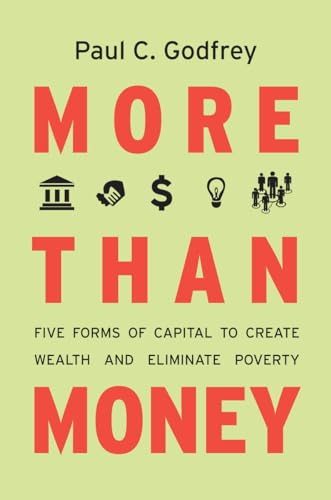
Is poverty inevitable? No, says author Paul Godfrey. More than Money shows how organizations can win the fight against poverty and create prosperity for people at the base of the pyramid in the developing and developed world.
This book presents a novel framework that shows how five types of interrelated capital-institutional, human, social, organizational, and physical-enable development and sustainable growth. In addition to a widely-applicable model, Godfrey provides principles to guide application. Core chapters articulate each specific form of capital and provide examples of how it contributes to the triple bottom line. Not just a theoretical examination of poverty, More than Money delivers timely advice to organizations that produce goods and services, implement policies, and create meaningful change on the ground. This book will guide social innovators and entrepreneurs in business, government, and civil society settings as they create a vision, assemble a team of strong partners, and effectively measure social innovation.
Die Inhaltsangabe kann sich auf eine andere Ausgabe dieses Titels beziehen.
Über die Autorinnen und Autoren
Paul C. Godfrey is Professor of Strategy and Associate Academic Director of the Melvin J. Ballard Center for Economic Self-Reliance at Brigham Young University's Marriott School of Management, where he helps students and practitioners translate organization and economic theory into action that reduces poverty. He has recently pursued projects in Ghana, the Navajo Nation, and with disadvantaged populations in the United States.
Paul C. Godfrey is Professor of Strategy and Associate Academic Director of the Melvin J. Ballard Center for Economic Self-Reliance at Brigham Young University's Marriott School of Management, where he helps students and practitioners translate organization and economic theory into action that reduces poverty. He has recently pursued projects in Ghana, the Navajo Nation, and with disadvantaged populations in the United States.
Auszug. © Genehmigter Nachdruck. Alle Rechte vorbehalten.
MORE THAN MONEY
FIVE FORMS OF CAPITAL TO CREATE WEALTH AND ELIMINATE POVERTY
By Paul C. GodfreyStanford University Press
Copyright © 2014 Board of Trustees of the Leland Stanford Junior University
All rights reserved.
ISBN: 978-0-8047-8280-7All rights reserved.
Contents
| Acknowledgments............................................................ | ix |
| Introduction: Eliminating, Not Alleviating Poverty......................... | 1 |
| 1 More than Money.......................................................... | 5 |
| 2 Self-Reliance: The Mechanism that Eliminates Poverty..................... | 21 |
| PART I: THE FIVE TYPES OF CAPITAL.......................................... | |
| 3 Institutional Capital: Yarn-Dyed Cloth................................... | 43 |
| 4 Social Capital: A Double-edged Sword..................................... | 62 |
| 5 Human Capital: The Heart of the Matter................................... | 81 |
| 6 Organizational Capital: Power from Simple Machines....................... | 100 |
| 7 Physical Capital: The Last Puzzle Piece.................................. | 121 |
| PART II: CREATING EFFECTIVE ORGANIZATIONS.................................. | |
| 8 Mission and Vision: Leading the Fight with Values........................ | 143 |
| 9 Ecosystems of Development: Systems to Fight a System..................... | 158 |
| 10 Measuring Impact: Are We Winning?....................................... | 173 |
| 11 Eudemonia: Human Flourishing and the End of Poverty..................... | 188 |
| Notes...................................................................... | 201 |
| Index...................................................................... | 219 |
CHAPTER 1
MORE THAN MONEY
There are a thousand hacking at the branches of evil to one who isstriking at the root.
—Henry David Thoreau
IT'S NOT ABOUT THE MONEY! In the global wars on poverty money has servedas both the primary weapon and chief foot soldier for both academics andpractitioners. If we deploy the right amount to the right place at the righttime, the right things would happen, poverty would abate, and misery giveway to human happiness. Development economists, business scholars, socialentrepreneurs, and thought leaders all trumpet the right amount and mix ofinvestment and spending by government, businesses, and consumers, as criticalto meaningful gains by the world's poor.
I like Thoreau's observation. Most of the billions, or trillions, of dollarsthrown at the poverty problem ends up in the branches—alleviating thesymptoms of poverty—but little gets at the root and creates lasting prosperityfor individuals. Money doesn't eliminate poverty. Money fails, primarily,because it does little to develop or encourage self-reliance; I'll make a case inthese pages that self-reliance leads to a lasting solution to poverty. First, however,let's truly understand the fascination with money as the key to battlingthe curse of poverty.
The focus on money conforms to our conventional wisdom about whatpoverty is, and by implication how it can be overcome. The World Bank'soperating definition of poverty tells us that
Poverty is "pronounced deprivation in well-being." The conventional viewlinks wellbeing primarily to command over commodities, so the poorare those who do not have enough income or consumption to put themabove some adequate minimum threshold. This view sees poverty largelyin monetary terms.
Specialists and lay people alike may intuitively realize that it takes morethan just money to create meaningful change, but requests for aid—often urgent—inmonetary terms often force other critical conversations to the background.The "conventional view"—deeply engrained into our mental mapsof poverty—means that the conversations about strategic solutions quicklydevolve into tactical talk about fund raising, potential donors, and expectedreceipts.
Money also provides a seductively convenient soldier to deploy. When wemove past the simple symptoms of want we begin to see the complex causesof need, and those deeper causes constitute what planners refer to as wickedproblems: ones that defy definition, have multiple causes and potential remedies,and no definite or optimal solution. At one level, writing a check iseasier than finding the causal roots in the quagmire of wicked complexity. Ata deeper level, money-as-the-solution appeals to a deeper belief that moneyis the apparent solution to our own problems, so giving money to the poorshould help them with their problems. Money acts as a quick palliative for thepain of the destitute.
For some, maybe many, money represents not only a convenient way toengage in a worthy cause; it also consoles the conscience. Living lives at or nearthe top of the economic pyramid, our drive for justice, or perhaps our senseof guilt over our abundance, encourages us to do something. But again, doingsomething requires getting our hands dirty and admitting our weakness in theface of an intractable problem. Giving money relieves our feelings of helplessnessand hopelessness. Money becomes a palliative for the pain of the donor.
Money may conform to convention, provide a convenient and consolingway to get involved. What it hasn't shown, at least to date, is a curative effecton poverty. That's a bold claim, one I'll back up in a moment, but it will provehelpful to think more about poverty and the different levels where it exists. Wecan think of two overarching types of poverty, Big P and little p.
Big P poverty describes poverty driven by macrosocial forces and measuredat very aggregate levels. Big P poverty isn't about people, at least not oneswith names and faces; it's about people as statistics and the metalevel forcesthat drive them: famine, ignorance, marital and family institutions, politicaloppression, and war, to name a few. Percentages and aggregates matter in thefight against Big P poverty, the percent of people with clean drinking water,access to sanitation, or secondary education. It's not about whether the Agbetesof Accra or the Walkers of Window Rock have any of those things. Thefocus lies in alleviating—mitigating the effects of—poverty but tacitly framesits underlying causes as intractable.
Little p poverty focuses on individuals and families. It's about the Agbetes,the Walkers, and millions of other people with names, faces, lives, and realneeds. Real people live in corrupt or fragile states; they often lack access toformal educational opportunities or participation in the formal economy. Thecauses of Big P poverty put real people in little p poverty, as do things likephysical or mental handicaps, family dynamics, and personal choices. Fightinglittle p poverty means improving the lives and livelihoods of individuals,one at a time. Little p poverty can be eliminated, individuals and families canmove from poverty to prosperity.
If Big P poverty focuses on statistics, then little p poverty concerns stories,the intimate arcs of individual lives. Slicing poverty into Big P and little p doesmore than provide a memorable metaphor; it highlights that those fighting itwill be more effective when their efforts and...
„Über diesen Titel“ kann sich auf eine andere Ausgabe dieses Titels beziehen.
Suchergebnisse für More Than Money: Five Forms of Capital to Create Wealth...

Beispielbild für diese ISBN
More than Money: Five Forms of Capital to Create Wealth and Eliminate Poverty
Verlag:
Stanford University Press, 2013
ISBN 10: 0804782806
ISBN 13: 9780804782807
Gebraucht
Paperback
Anbieter: Midtown Scholar Bookstore, Harrisburg, PA, USA
Verkäuferbewertung 5 von 5 Sternen

Paperback. Zustand: Acceptable. Acceptable - This is a significantly damaged book. It should be considered a reading copy only. Please order this book only if you are interested in the content and not the condition. May be ex-library. PAPERBACK Standard-sized. Bestandsnummer des Verkäufers M0804782806Z4
Gebraucht kaufen
EUR 10,97
EUR 5,35 Versand
Versand innerhalb von USA
Versand innerhalb von USA
Anzahl: 1 verfügbar
Beispielbild für diese ISBN
More than Money: Five Forms of Capital to Create Wealth and Eliminate Poverty
Verlag:
Stanford University Press, 2013
ISBN 10: 0804782806
ISBN 13: 9780804782807
Gebraucht
Paperback
Anbieter: Midtown Scholar Bookstore, Harrisburg, PA, USA
Verkäuferbewertung 5 von 5 Sternen
Paperback. Zustand: Very Good. Very Good - Crisp, clean, unread book with some shelfwear/edgewear, may have a remainder mark - NICE Standard-sized. Bestandsnummer des Verkäufers M0804782806Z2
Gebraucht kaufen
EUR 10,97
EUR 5,35 Versand
Versand innerhalb von USA
Versand innerhalb von USA
Anzahl: 3 verfügbar
Beispielbild für diese ISBN
More than Money
Anbieter: Majestic Books, Hounslow, Vereinigtes Königreich
Verkäuferbewertung 4 von 5 Sternen

Zustand: New. pp. 264. Bestandsnummer des Verkäufers 58609435
Neu kaufen
EUR 18,72
EUR 7,75 Versand
Versand von Vereinigtes Königreich nach USA
Versand von Vereinigtes Königreich nach USA
Anzahl: 4 verfügbar
Beispielbild für diese ISBN
More than Money
Anbieter: Books Puddle, Woodside, NY, USA
Verkäuferbewertung 4 von 5 Sternen
Zustand: New. pp. 264. Bestandsnummer des Verkäufers 2650983108
Neu kaufen
EUR 23,45
EUR 3,56 Versand
Versand innerhalb von USA
Versand innerhalb von USA
Anzahl: 4 verfügbar
Beispielbild für diese ISBN
More than Money
Anbieter: Biblios, Frankfurt am main, HESSE, Deutschland
Verkäuferbewertung 4 von 5 Sternen
Zustand: New. pp. 264. Bestandsnummer des Verkäufers 1850983118
Neu kaufen
EUR 19,09
EUR 9,95 Versand
Versand von Deutschland nach USA
Versand von Deutschland nach USA
Anzahl: 4 verfügbar
Beispielbild für diese ISBN
2013 PB More than Money: Five Forms of Capital to Create Wealth and Eliminate Poverty
Verlag:
Stanford University Press, 2013
ISBN 10: 0804782806
ISBN 13: 9780804782807
Gebraucht
paperback
Anbieter: Miki Store, San Jose, CA, USA
Verkäuferbewertung 5 von 5 Sternen
paperback. Zustand: Very Good. Pages are crisp and clean, no marking. Cover is verygood. Binding is tight/good. Bestandsnummer des Verkäufers Lc-bs65
Gebraucht kaufen
EUR 25,70
EUR 4,50 Versand
Versand innerhalb von USA
Versand innerhalb von USA
Anzahl: 1 verfügbar
Beispielbild für diese ISBN
More Than Money : Five Forms of Capital to Create Wealth and Eliminate Poverty
Anbieter: GreatBookPrices, Columbia, MD, USA
Verkäuferbewertung 5 von 5 Sternen
Zustand: New. Bestandsnummer des Verkäufers 19914014-n
Neu kaufen
EUR 33,39
EUR 2,35 Versand
Versand innerhalb von USA
Versand innerhalb von USA
Anzahl: 1 verfügbar
Beispielbild für diese ISBN
More Than Money: Five Forms Of Capital To Create Wealth And Eliminate Poverty.
Anbieter: Basi6 International, Irving, TX, USA
Verkäuferbewertung 5 von 5 Sternen
Zustand: Brand New. New. US edition. Expediting shipping for all USA and Europe orders excluding PO Box. Excellent Customer Service. Bestandsnummer des Verkäufers ABEOCT25-119785
Foto des Verkäufers
More Than Money
Verlag:
Stanford University Press, US, 2013
ISBN 10: 0804782806
ISBN 13: 9780804782807
Neu
Paperback
Anbieter: Rarewaves USA, HEBRON, KY, USA
Verkäuferbewertung 5 von 5 Sternen
Paperback. Zustand: New. Is poverty inevitable? No, says author Paul Godfrey. More than Money shows how organizations can win the fight against poverty and create prosperity for people at the base of the pyramid in the developing and developed world. This book presents a novel framework that shows how five types of interrelated capital-institutional, human, social, organizational, and physical-enable development and sustainable growth. In addition to a widely-applicable model, Godfrey provides principles to guide application. Core chapters articulate each specific form of capital and provide examples of how it contributes to the triple bottom line. Not just a theoretical examination of poverty, More than Money delivers timely advice to organizations that produce goods and services, implement policies, and create meaningful change on the ground. This book will guide social innovators and entrepreneurs in business, government, and civil society settings as they create a vision, assemble a team of strong partners, and effectively measure social innovation. Bestandsnummer des Verkäufers LU-9780804782807
Neu kaufen
EUR 36,06
Versand gratis
Versand innerhalb von USA
Versand innerhalb von USA
Anzahl: Mehr als 20 verfügbar
Foto des Verkäufers
More Than Money : Five Forms of Capital to Create Wealth and Eliminate Poverty
Verlag:
Stanford University Press, 2013
ISBN 10: 0804782806
ISBN 13: 9780804782807
Gebraucht
Softcover
Anbieter: GreatBookPrices, Columbia, MD, USA
Verkäuferbewertung 5 von 5 Sternen
Zustand: As New. Unread book in perfect condition. Bestandsnummer des Verkäufers 19914014
Gebraucht kaufen
EUR 33,72
EUR 2,35 Versand
Versand innerhalb von USA
Versand innerhalb von USA
Anzahl: 1 verfügbar