
Verwandte Artikel zu Moscow in Movement: Power and Opposition in Putin's...
Inhaltsangabe
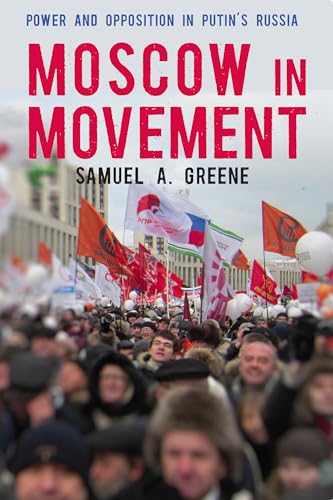
Moscow in Movement is the first exhaustive study of social movements, protest, and the state-society relationship in Vladimir Putin's Russia. Beginning in 2005 and running through the summer of 2013, the book traces the evolution of the relationship between citizens and their state through a series of in-depth case studies, explaining how Russians mobilized to defend human and civil rights, the environment, and individual and group interests: a process that culminated in the dramatic election protests of 2011-2012 and their aftermath. To understand where this surprising mobilization came from, and what it might mean for Russia's political future, the author looks beyond blanket arguments about the impact of low levels of trust, the weight of the Soviet legacy, or authoritarian repression, and finds an active and boisterous citizenry that nevertheless struggles to gain traction against a ruling elite that would prefer to ignore them.
On a broader level, the core argument of this volume is that political elites, by structuring the political arena, exert a decisive influence on the patterns of collective behavior that make up civil society-and the author seeks to test this theory by applying it to observable facts in historical and comparative perspective.
Moscow in Movement will be of interest to anyone looking for a bottom-up, citizens' eye view of recent Russian history, and especially to scholars and students of contemporary Russian politics and society, comparative politics, and sociology.
Die Inhaltsangabe kann sich auf eine andere Ausgabe dieses Titels beziehen.
Über die Autorinnen und Autoren
Samuel A. Greene is Director of King's Russia Institute at King's College London.
Samuel A. Greene is Director of King's Russia Institute at King's College London.
Auszug. © Genehmigter Nachdruck. Alle Rechte vorbehalten.
Moscow in Movement
Power and Opposition in Putin's Russia
By Samuel A. GreeneSTANFORD UNIVERSITY PRESS
Copyright © 2014 Board of Trustees of the Leland Stanford Junior University
All rights reserved.
ISBN: 978-0-8047-9214-1All rights reserved.
Contents
List of Illustrations,
Acknowledgments,
1. The Puzzle of Russian Civil Society: An Introduction,
2. Perspectives on Civil Society,
3. Russia's Potemkin Revolution,
4. Civil Society in Russia: What We Do and Do Not Know,
5. Private Brutality and Public Verdicts: Defending Human Rights in Russia,
6. Our Home Is Russia: Russia's Housing-Rights Movements,
7. Road Rage: Russia's Automotive Rebellion,
8. Seizing the Moment,
9. Conclusions,
Notes,
Works Cited,
Index,
CHAPTER 1
The Puzzle of Russian Civil Society
An Introduction
On Saturday, July 15, 2006, as the leaders of the Group of Eight industrialized democracies gathered in St. Petersburg for their annual summit, attended by aides and throngs of journalists, the city itself was disturbingly quiet. Along the city's elegant main avenue, Nevsky Prospekt, squadrons of riot police in full battle gear stood on every second street corner. Police buses and armored personnel carriers idled on the side streets. There was not a hint of the antiglobalization riots that had plagued other cities unlucky enough to host G8 summits, but the police were ready nonetheless.
On that same morning, three metro stops to the north of Nevsky Prospekt, Petersburgers lazily spilled out of the underground onto Krestovsky Island, one of the city's most beloved parks, occupying almost an entire island in the delta where the Neva River flows into the Gulf of Finland. Jugglers, clowns, and balloon twisters amused children; a small marching band played Strauss; teenagers lounged on benches or skated down the alleyways; and everyone went about the business of enjoying St. Petersburg's short but glorious summer.
Some of those leaving the metro, however, walked straight through the park, the entire length of the island, until they reached the city's old football stadium at the far end. They made their way into a small tent, received a green name tag, and filed through a metal detector to get into the stadium complex. There, they joined several hundred protestors—almost all Russian—who had gathered to show the world that they were not part of the show the Kremlin was putting on for the G8. They wanted nothing to do with a regime that fixed elections, shuttered independent media outlets, jailed political opponents, and continued to call itself a democracy. The Russia that President Vladimir Putin was showing his colleagues from the vantage of a lavishly restored tsarist palace was not their Russia. Theirs was an "Other Russia," a concept born only days earlier at a meeting in an equally lavish Moscow hotel, bringing together opposition leaders from across the political spectrum.
Of those who had been present in Moscow, only one—the longtime human rights activist Lev Ponomarev—came to St. Petersburg. Many of the activists from around the country who had planned to come never made it, having been pulled from planes, trains, and buses along the way. Some had their internal passports confiscated. Others were barricaded in their apartments. Those who did make it to the stadium found themselves surrounded by the Gulf of Finland on three sides and a long, high fence guarded by riot police on the other, with only one gate. The city authorities had banned a planned march from the stadium through the city to the cruiser Aurora, the ship that had launched the 1917 Revolution when it fired on the Winter Palace. Small groups of participants attempted to stage running protests in the city center but were followed by the police as they left the stadium and detained as soon as they emerged from the metro anywhere near Nevsky Prospekt. They would not be a part of the Kremlin's show, but the Kremlin ensured there would be no other.
As the day wore on, the organizers in the stadium gathered the remaining participants to discuss what to do. A few television cameras—all of them foreign—were present and ready to report on whatever the protestors did, if only they could decide on a plan of action. Holding an unsanctioned march was clearly impossible; the police would never let them out of the stadium. Eventually, two proposals were put up for a vote. The first was to march in circles around the stadium track ten times, in a symbolic show of futility. The second was to stage a sit-in at the gates of the stadium in the hopes that the image of sitting protestors behind the iron bars of the fence and surrounded by police would garner at least some publicity. In the end, the protestors selected the second option, climbed out of the stadium, and made their way to the fence. There, they sat down, placards in hand, and began shouting, "Rights aren't given; rights are taken!" and "We need another Russia!"
Bit by bit, the crowd began to dissipate, protestors filing back through the metal detector, pulling off their green name tags, and heading back through the park to the metro. Many of those who forgot to remove the name tags were detained when they reemerged elsewhere in the city, just as a precaution. Pictures of the protest were broadcast in Germany, France, and Italy. In Russia, however, no one noticed. In the park on Krestovsky Island, where the band was still playing Strauss when the last protesters left, a boy asked his father why there were so many police down by the stadium.
"Must be a football game," the father answered. "The police have to keep an eye on the hooligans."
* * *
Until tens and then hundreds of thousands of Russians poured onto the streets of Moscow in December 2011 to protest what they perceived to be a rigged parliamentary election, the foregoing picture was the predominant view of Russian social and political mobilization. Indeed, the idea of the weakness of Russian civil society remains well established and widely accepted. Russians, on the whole, do not organize and are difficult to mobilize, and they do not tend to join movements or participate in public protests (see, for example, Fish 1995; Domrin 2003; McFaul and Treyger 2004). Understanding why something does not occur, however, is perhaps the most difficult task in the social sciences. Some attempts have been made to explain the void of civic mobilization in Russia, predominantly by pointing either to macrolevel social phenomena (low levels of trust and social capital, for example) or macrolevel political phenomena (the resource curse or repression).
When nonlinear events occur—events that our prior conceptions did not allow us to predict, events that seem to be "out of the blue"—the natural tendency is to focus our analysis entirely on the future, to assume that at the moment of the departure from the norm something inherently unforeseeable happened to shift the narrative, and to seek to understand the "new world" in which we have evidently arrived. Indeed, much of what has been written about the Russian protest wave of 2011 and 2012 pointed to purportedly new phenomena—new communication media, new leaders, new wealth, a new global context—as the proximate cause of what prior wisdom had failed to envisage.
Truly understanding where we are, however, requires correcting our understanding of where we were. Even as we look to the future and try to understand what it holds in store, we must ask what recent events tell us about the...
„Über diesen Titel“ kann sich auf eine andere Ausgabe dieses Titels beziehen.
Suchergebnisse für Moscow in Movement: Power and Opposition in Putin's...

Beispielbild für diese ISBN
Moscow in Movement: Power and Opposition in Putin's Russia
Verlag:
Stanford University Press, 2014
ISBN 10: 0804792143
ISBN 13: 9780804792141
Gebraucht
Paperback
Erstausgabe
Anbieter: One Planet Books, Columbia, MO, USA
Verkäuferbewertung 5 von 5 Sternen

Paperback. Zustand: Good. 1st Edition. Ships in a BOX from Central Missouri! May not include working access code. Will not include dust jacket. Has used sticker(s) and some writing and/or highlighting. UPS shipping for most packages, (Priority Mail for AK/HI/APO/PO Boxes). Bestandsnummer des Verkäufers 002003824U
Gebraucht kaufen
EUR 5,41
EUR 3,52 Versand
Versand innerhalb von USA
Versand innerhalb von USA
Anzahl: 1 verfügbar
Beispielbild für diese ISBN
Moscow in Movement : Power and Opposition in Putin's Russia
Verlag:
Stanford University Press, 2014
ISBN 10: 0804792143
ISBN 13: 9780804792141
Gebraucht
Softcover
Anbieter: Better World Books, Mishawaka, IN, USA
Verkäuferbewertung 5 von 5 Sternen
Zustand: Very Good. Pages intact with possible writing/highlighting. Binding strong with minor wear. Dust jackets/supplements may not be included. Stock photo provided. Product includes identifying sticker. Better World Books: Buy Books. Do Good. Bestandsnummer des Verkäufers 5191505-6
Gebraucht kaufen
EUR 9,00
Versand gratis
Versand innerhalb von USA
Versand innerhalb von USA
Anzahl: 3 verfügbar
Beispielbild für diese ISBN
Moscow in Movement : Power and Opposition in Putin's Russia
Verlag:
Stanford University Press, 2014
ISBN 10: 0804792143
ISBN 13: 9780804792141
Gebraucht
Softcover
Anbieter: Better World Books, Mishawaka, IN, USA
Verkäuferbewertung 5 von 5 Sternen
Zustand: Good. Former library copy. Pages intact with minimal writing/highlighting. The binding may be loose and creased. Dust jackets/supplements are not included. Includes library markings. Stock photo provided. Product includes identifying sticker. Better World Books: Buy Books. Do Good. Bestandsnummer des Verkäufers 17379559-6
Gebraucht kaufen
EUR 9,00
Versand gratis
Versand innerhalb von USA
Versand innerhalb von USA
Anzahl: 1 verfügbar
Beispielbild für diese ISBN
Moscow in Movement: Power and Opposition in Putin's Russia
Verlag:
Stanford University Press, 2014
ISBN 10: 0804792143
ISBN 13: 9780804792141
Gebraucht
paperback
Erstausgabe
Anbieter: Textbooks_Source, Columbia, MO, USA
Verkäuferbewertung 5 von 5 Sternen
paperback. Zustand: Good. 1st Edition. Ships in a BOX from Central Missouri! May not include working access code. Will not include dust jacket. Has used sticker(s) and some writing or highlighting. UPS shipping for most packages, (Priority Mail for AK/HI/APO/PO Boxes). Bestandsnummer des Verkäufers 002003824U
Gebraucht kaufen
EUR 10,67
EUR 3,52 Versand
Versand innerhalb von USA
Versand innerhalb von USA
Anzahl: 1 verfügbar
Foto des Verkäufers
Moscow in Movement : Power and Opposition in Putin's Russia
Verlag:
Stanford University Press, 2014
ISBN 10: 0804792143
ISBN 13: 9780804792141
Gebraucht
Softcover
Anbieter: GreatBookPrices, Columbia, MD, USA
Verkäuferbewertung 5 von 5 Sternen
Zustand: good. May show signs of wear, highlighting, writing, and previous use. This item may be a former library book with typical markings. No guarantee on products that contain supplements Your satisfaction is 100% guaranteed. Twenty-five year bookseller with shipments to over fifty million happy customers. Bestandsnummer des Verkäufers 21599482-5
Gebraucht kaufen
EUR 13,71
EUR 2,33 Versand
Versand innerhalb von USA
Versand innerhalb von USA
Anzahl: 1 verfügbar
Beispielbild für diese ISBN
Moscow in Movement : Power and Opposition in Putin's Russia
Anbieter: GreatBookPrices, Columbia, MD, USA
Verkäuferbewertung 5 von 5 Sternen
Zustand: New. Bestandsnummer des Verkäufers 21599482-n
Neu kaufen
EUR 25,78
EUR 2,33 Versand
Versand innerhalb von USA
Versand innerhalb von USA
Anzahl: Mehr als 20 verfügbar
Beispielbild für diese ISBN
Moscow in Movement: Power and Opposition in Putin's Russia
Anbieter: California Books, Miami, FL, USA
Verkäuferbewertung 5 von 5 Sternen
Zustand: New. Bestandsnummer des Verkäufers I-9780804792141
Neu kaufen
EUR 28,19
Versand gratis
Versand innerhalb von USA
Versand innerhalb von USA
Anzahl: Mehr als 20 verfügbar
Beispielbild für diese ISBN
Moscow in Movement: Power and Opposition in Putin's Russia
Verlag:
Stanford University Press, 2014
ISBN 10: 0804792143
ISBN 13: 9780804792141
Gebraucht
Paperback
Anbieter: WorldofBooks, Goring-By-Sea, WS, Vereinigtes Königreich
Verkäuferbewertung 5 von 5 Sternen
Paperback. Zustand: Very Good. The book has been read, but is in excellent condition. Pages are intact and not marred by notes or highlighting. The spine remains undamaged. Bestandsnummer des Verkäufers GOR010833986
Gebraucht kaufen
EUR 22,62
EUR 6,56 Versand
Versand von Vereinigtes Königreich nach USA
Versand von Vereinigtes Königreich nach USA
Anzahl: 1 verfügbar
Foto des Verkäufers
Moscow in Movement
Verlag:
Stanford University Press, US, 2014
ISBN 10: 0804792143
ISBN 13: 9780804792141
Neu
Paperback
Anbieter: Rarewaves.com USA, London, LONDO, Vereinigtes Königreich
Verkäuferbewertung 5 von 5 Sternen
Paperback. Zustand: New. Moscow in Movement is the first exhaustive study of social movements, protest, and the state-society relationship in Vladimir Putin's Russia. Beginning in 2005 and running through the summer of 2013, the book traces the evolution of the relationship between citizens and their state through a series of in-depth case studies, explaining how Russians mobilized to defend human and civil rights, the environment, and individual and group interests: a process that culminated in the dramatic election protests of 2011-2012 and their aftermath. To understand where this surprising mobilization came from, and what it might mean for Russia's political future, the author looks beyond blanket arguments about the impact of low levels of trust, the weight of the Soviet legacy, or authoritarian repression, and finds an active and boisterous citizenry that nevertheless struggles to gain traction against a ruling elite that would prefer to ignore them. On a broader level, the core argument of this volume is that political elites, by structuring the political arena, exert a decisive influence on the patterns of collective behavior that make up civil society-and the author seeks to test this theory by applying it to observable facts in historical and comparative perspective. Moscow in Movement will be of interest to anyone looking for a bottom-up, citizens' eye view of recent Russian history, and especially to scholars and students of contemporary Russian politics and society, comparative politics, and sociology. Bestandsnummer des Verkäufers LU-9780804792141
Neu kaufen
EUR 30,47
Versand gratis
Versand von Vereinigtes Königreich nach USA
Versand von Vereinigtes Königreich nach USA
Anzahl: 3 verfügbar
Foto des Verkäufers
Moscow in Movement: Power and Opposition in Putin's Russia
Verlag:
Stanford University Press, 2014
ISBN 10: 0804792143
ISBN 13: 9780804792141
Gebraucht
Softcover
Anbieter: Klondyke, Almere, Niederlande
Verkäuferbewertung 5 von 5 Sternen
Zustand: As New. Bestandsnummer des Verkäufers 270011
Gebraucht kaufen
EUR 12,10
EUR 20,00 Versand
Versand von Niederlande nach USA
Versand von Niederlande nach USA
Anzahl: 1 verfügbar