
Verwandte Artikel zu The End of Intelligence: Espionage and State Power...
Inhaltsangabe
Using espionage as a test case, The End of Intelligence criticizes claims that the recent information revolution has weakened the state, revolutionized warfare, and changed the balance of power between states and non-state actors-and it assesses the potential for realizing any hopes we might have for reforming intelligence and espionage.
Examining espionage, counterintelligence, and covert action, the book argues that, contrary to prevailing views, the information revolution is increasing the power of states relative to non-state actors and threatening privacy more than secrecy. Arguing that intelligence organizations may be taken as the paradigmatic organizations of the information age, author David Tucker shows the limits of information gathering and analysis even in these organizations, where failures at self-knowledge point to broader limits on human knowledge-even in our supposed age of transparency. He argues that, in this complex context, both intuitive judgment and morality remain as important as ever and undervalued by those arguing for the transformative effects of information.
This book will challenge what we think we know about the power of information and the state, and about the likely twenty-first century fate of secrecy and privacy.
Die Inhaltsangabe kann sich auf eine andere Ausgabe dieses Titels beziehen.
Über die Autorinnen und Autoren
David Tucker is a Senior Fellow at the Ashbrook Center, Ashland University. He was formerly an associate professor in the Department of Defense Analysis at the Naval Postgraduate School. He has served in the Office of the Assistant Secretary of Defense for Special Operations and Low-Intensity Conflict and as a Foreign Service officer in Africa and Europe.
David Tucker is a Senior Fellow at the Ashbrook Center, Ashland University. He was formerly an associate professor in the Department of Defense Analysis at the Naval Postgraduate School. He has served in the Office of the Assistant Secretary of Defense for Special Operations and Low-Intensity Conflict and as a Foreign Service officer in Africa and Europe.
Auszug. © Genehmigter Nachdruck. Alle Rechte vorbehalten.
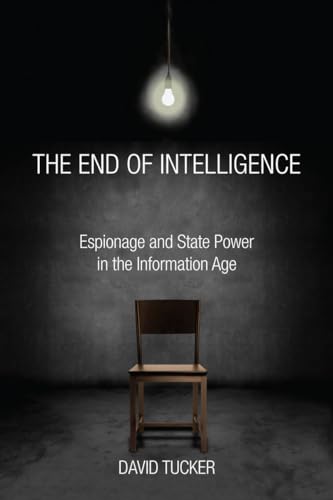
The End of Intelligence
Espionage and State Power in the Information Age
By David TuckerSTANFORD UNIVERSITY PRESS
Copyright © 2014 Board of Trustees of the Leland Stanford Junior University
All rights reserved.
ISBN: 978-0-8047-9265-3All rights reserved.
Contents
Introduction,
1. Intelligence, Information, Power,
2. Espionage,
3. Counterintelligence and Covert Action,
4. Intelligence and Warfare,
5. Intelligence and Irregular Warfare,
6. Principals and Agents,
Conclusion,
Appendices,
A: Surprise and the Importance of an Information Advantage,
B: Information and the Power of Nonstate Actors,
Notes,
Selected Bibliography,
Index,
CHAPTER 1
Intelligence, Information, Power
Intelligence is important because it is information; information is important because, like knowledge, it is power. Consider some examples.
In 1673, Louis XIV declared that he had a right to the revenues of any vacant bishopric in France and that he alone had the right to appoint bishops. This declaration revived and extended a royal prerogative that had been debated for centuries. A few bishops objected to Louis's assertion and extension of these prerogatives. The pope supported the dissenting bishops. The debate turned not on abstract claims of right but on the legal standing of Louis's claim. Legal standing in turn depended on laws, charters, deeds, letters—a mass of legal and historical documents. On one side were the pope's canon lawyers and librarians; on the other, Louis's archivists and advisers. Force was always the ultimate resort, but for many reasons a legal battle was preferable. So Jean Baptiste Colbert, Louis's principal adviser, dispatched an assistant to collect documents from episcopal offices and archives. Analyzing this information, and other information already in the royal archives, Colbert prepared a report for Louis in 1675 justifying the assertion of Louis's right. This report became the basis for royal policy, as well as the principal weapon in the struggle, conducted both in the court of public opinion and the private offices of lawyers, with recalcitrant French clergy and the pope. Ultimately, Louis prevailed.
In this case, information was a power that substituted for physical force. Information could also make the use of physical force possible, however. Warfare in the late seventeenth and eighteenth centuries, as it had for centuries, strained the finances of the state. In fact, wars were fought less often to a decision than to financial exhaustion, with treaties setting in place what arms had managed to achieve, until the antagonists could replenish their funds and fight again. Thus the state that could most efficiently refinance itself had a military advantage because it could dictate the initial action of the next war. In its contest with the France of Louis XIV and his immediate successor, Britain was at the beginning the weaker power but had the advantage of a financial system that allowed it to extract resources more efficiently and effectively from the British population. This was an important reason why it was able to contend with French power and, by the middle of the eighteenth century, defeat it.
The effectiveness of the British financial system derived in large part from an efficient method for gathering and analyzing information. A principal source of British state revenue was the excise tax, a tax on goods produced, bought and sold within Great Britain. To collect this tax, of course, the government had to know what was produced and sold and for how much. The British developed a special information system to track this activity, recruiting only the most competent administrators to do this. In other parts of the government administration one might get a job because of one's name or connections—but not in the Excise Department. The British filled excise positions through competitive examinations that tested mathematical ability, and not just simple matters of addition and subtraction. Those who passed the test and entered the service became what we would now call civil servants, long-term specialized employees of the state whose job it was to collect, store, and analyze detailed information on the minutiae of British economic activity. Gathering that information—how many heads of cheese or casks of port in a shop in Bristol, for example—required that the British develop and regularize unprecedented powers of government inspection. The excise system had its own system of inspectors, enforcement officers, and administrative courts to implement and administer the information system. So intrusive was this power that William Blackstone, certainly not a radical critic of Britain's constitutional system, wrote in his Commentaries on the Laws of England that the excise system was "hardly compatible with the temper of a free nation."
An internal taxation system is not the only way that information can affect military power, of course. It may have a more direct effect. When Caesar decided to invade Britain, he sought to gather information about this unknown island. Among other things, he wanted to know what its topography might be, how many tribes it contained, how they fought, what kind of weapons they used. He also wanted to know the character of the people. The more Caesar knew about the island and its inhabitants, the better he could prepare for his expedition and the more likely that it would succeed. Seeking this knowledge, Caesar consulted traders, who knew little, and his Gallic allies, who knew less. Undeterred, he pressed on. When his forces went ashore in Britain, they were surprised at the resistance they met. The Britons had anticipated the attack. In questioning traders, Caesar had indicated his interest, and some of the traders had informed the Britons. Caesar avoided defeat because of the skill and valor of his soldiers—at a critical moment, the eagle-bearer of the Tenth Legion, rather than lose the eagle in disgrace, cried out to his comrades and charged alone through the surf at the enemy, drawing his legion and then others behind him. Critical as well was Caesar's ability to inform himself of what was happening in the battle and to respond. His means of gathering information as the battle progressed being all but nonexistent, he was dependent entirely on his ability to see and analyze the battle as it unfolded before him.
Caesar's experience invading Britain shows the disadvantage a military force can labor under if it lacks relevant information. For example, not having learned much about Britain's harbors, Caesar's flotilla had to move about the coast in view of British forces before he found a place where he could disembark his troops. This gave the information advantage to the Britons, who watched as Caesar chose his landing site. On the other hand, despite his lack of intelligence, Caesar prevailed. His generalship and the overall quality of the Roman army overcame intelligence deficiencies. Caesar's approach in this instance exemplifies the idea that as long as the Romans continued on the strategic offensive, expanding their empire, thinking themselves invincible, intelligence was less important to them; it became essential when they had reached the limits of their empire, sensed the vulnerability at their borders, and in effect adopted a defensive strategic outlook. The invasion of Britain was in effect an ongoing reconnaissance in force. Conquest was a form of intelligence gathering, rather than something made possible or facilitated by intelligence. Caesar sought information on Britain...
„Über diesen Titel“ kann sich auf eine andere Ausgabe dieses Titels beziehen.
Suchergebnisse für The End of Intelligence: Espionage and State Power...

Beispielbild für diese ISBN
The End of Intelligence: Espionage and State Power in the Information Age
Verlag:
Stanford University Press (edition 1), 2014
ISBN 10: 0804792658
ISBN 13: 9780804792653
Gebraucht
Paperback
Anbieter: BooksRun, Philadelphia, PA, USA
Verkäuferbewertung 5 von 5 Sternen

Paperback. Zustand: Very Good. 1. It's a well-cared-for item that has seen limited use. The item may show minor signs of wear. All the text is legible, with all pages included. It may have slight markings and/or highlighting. Bestandsnummer des Verkäufers 0804792658-11-1
Gebraucht kaufen
EUR 11,36
Versand gratis
Versand innerhalb von USA
Versand innerhalb von USA
Anzahl: 1 verfügbar
Beispielbild für diese ISBN
The End of Intelligence: Espionage and State Power in the Information Age
Verlag:
Stanford University Press, 2014
ISBN 10: 0804792658
ISBN 13: 9780804792653
Gebraucht
Paperback
Anbieter: Midtown Scholar Bookstore, Harrisburg, PA, USA
Verkäuferbewertung 5 von 5 Sternen
Paperback. Zustand: Good. Good - Bumped and creased book with tears to the extremities, but not affecting the text block, may have remainder mark or previous owner's name - GOOD PAPERBACK Standard-sized. Bestandsnummer des Verkäufers M0804792658Z3
Gebraucht kaufen
EUR 9,00
EUR 5,35 Versand
Versand innerhalb von USA
Versand innerhalb von USA
Anzahl: 3 verfügbar
Beispielbild für diese ISBN
The End of Intelligence: Espionage and State Power in the Information Age
Verlag:
Stanford University Press, 2014
ISBN 10: 0804792658
ISBN 13: 9780804792653
Gebraucht
Paperback
Anbieter: Midtown Scholar Bookstore, Harrisburg, PA, USA
Verkäuferbewertung 5 von 5 Sternen
Paperback. Zustand: Very Good. Very Good - Crisp, clean, unread book with some shelfwear/edgewear, may have a remainder mark - NICE Standard-sized. Bestandsnummer des Verkäufers M0804792658Z2
Gebraucht kaufen
EUR 9,13
EUR 5,35 Versand
Versand innerhalb von USA
Versand innerhalb von USA
Anzahl: 8 verfügbar
Beispielbild für diese ISBN
The End of Intelligence: Espionage and State Power in the Information Age
Verlag:
Stanford University Press, 2014
ISBN 10: 0804792658
ISBN 13: 9780804792653
Gebraucht
Paperback
Anbieter: Midtown Scholar Bookstore, Harrisburg, PA, USA
Verkäuferbewertung 5 von 5 Sternen
Paperback. Zustand: Acceptable. Acceptable - This is a significantly damaged book. It should be considered a reading copy only. Please order this book only if you are interested in the content and not the condition. May be ex-library. PAPERBACK Standard-sized. Bestandsnummer des Verkäufers M0804792658Z4
Gebraucht kaufen
EUR 9,23
EUR 5,35 Versand
Versand innerhalb von USA
Versand innerhalb von USA
Anzahl: 2 verfügbar
Beispielbild für diese ISBN
End of Intelligence : Espionage and State Power in the Information Age
Anbieter: GreatBookPrices, Columbia, MD, USA
Verkäuferbewertung 5 von 5 Sternen
Zustand: New. Bestandsnummer des Verkäufers 21599496-n
Neu kaufen
EUR 26,04
EUR 2,35 Versand
Versand innerhalb von USA
Versand innerhalb von USA
Anzahl: Mehr als 20 verfügbar
Beispielbild für diese ISBN
The End of Intelligence: Espionage and State Power in the Information Age
Anbieter: California Books, Miami, FL, USA
Verkäuferbewertung 5 von 5 Sternen
Zustand: New. Bestandsnummer des Verkäufers I-9780804792653
Neu kaufen
EUR 28,47
Versand gratis
Versand innerhalb von USA
Versand innerhalb von USA
Anzahl: Mehr als 20 verfügbar
Foto des Verkäufers
The End of Intelligence
Verlag:
Stanford University Press, US, 2014
ISBN 10: 0804792658
ISBN 13: 9780804792653
Neu
Paperback
Anbieter: Rarewaves USA, HEBRON, KY, USA
Verkäuferbewertung 5 von 5 Sternen
Paperback. Zustand: New. Using espionage as a test case, The End of Intelligence criticizes claims that the recent information revolution has weakened the state, revolutionized warfare, and changed the balance of power between states and non-state actors-and it assesses the potential for realizing any hopes we might have for reforming intelligence and espionage. Examining espionage, counterintelligence, and covert action, the book argues that, contrary to prevailing views, the information revolution is increasing the power of states relative to non-state actors and threatening privacy more than secrecy. Arguing that intelligence organizations may be taken as the paradigmatic organizations of the information age, author David Tucker shows the limits of information gathering and analysis even in these organizations, where failures at self-knowledge point to broader limits on human knowledge-even in our supposed age of transparency. He argues that, in this complex context, both intuitive judgment and morality remain as important as ever and undervalued by those arguing for the transformative effects of information. This book will challenge what we think we know about the power of information and the state, and about the likely twenty-first century fate of secrecy and privacy. Bestandsnummer des Verkäufers LU-9780804792653
Neu kaufen
EUR 28,85
Versand gratis
Versand innerhalb von USA
Versand innerhalb von USA
Anzahl: Mehr als 20 verfügbar
Foto des Verkäufers
End of Intelligence : Espionage and State Power in the Information Age
Verlag:
Stanford University Press, 2014
ISBN 10: 0804792658
ISBN 13: 9780804792653
Gebraucht
Softcover
Anbieter: GreatBookPrices, Columbia, MD, USA
Verkäuferbewertung 5 von 5 Sternen
Zustand: As New. Unread book in perfect condition. Bestandsnummer des Verkäufers 21599496
Gebraucht kaufen
EUR 26,85
EUR 2,35 Versand
Versand innerhalb von USA
Versand innerhalb von USA
Anzahl: Mehr als 20 verfügbar
Beispielbild für diese ISBN
The End of Intelligence
Anbieter: PBShop.store UK, Fairford, GLOS, Vereinigtes Königreich
Verkäuferbewertung 5 von 5 Sternen
PAP. Zustand: New. New Book. Shipped from UK. Established seller since 2000. Bestandsnummer des Verkäufers FW-9780804792653
Neu kaufen
EUR 30,46
EUR 4,94 Versand
Versand von Vereinigtes Königreich nach USA
Versand von Vereinigtes Königreich nach USA
Anzahl: 15 verfügbar
Beispielbild für diese ISBN
The End of Intelligence: Espionage and State Power in the Information Age (eng)
Anbieter: Brook Bookstore On Demand, Napoli, NA, Italien
Verkäuferbewertung 5 von 5 Sternen
Zustand: new. Bestandsnummer des Verkäufers 0bb4c937b8cf52b128d7570c77de28e8
Neu kaufen
EUR 30,80
EUR 5,50 Versand
Versand von Italien nach USA
Versand von Italien nach USA
Anzahl: Mehr als 20 verfügbar