
Verwandte Artikel zu The Book of Three (The Chronicles of Prydain, 1, Band...
The Book of Three (The Chronicles of Prydain, 1, Band 1) - Hardcover
Buch 1 von 5: Chronicles of Pydain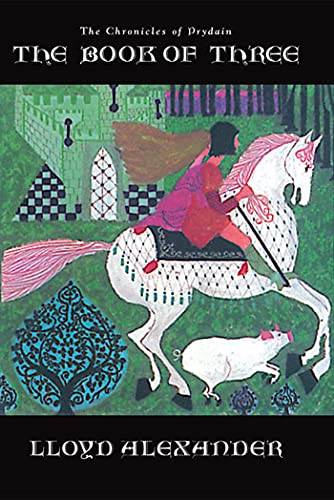
Inhaltsangabe
Since The Book of Three was first published in 1964, young readers have been enthralled by the adventures of Taran the Assistant Pig-keeper and his quest to become a hero. Taran is joined by an engaging cast of characters that includes Eilonwy, the strong-willed and sharp-tongued princess; Fflewddur Fflam, the hyperbole-prone bard; the ever-faithful Gurgi; and the curmudgeonly Doli--all of whom become involved in an epic struggle between good and evil that shapes the fate of the legendary land of Prydain.
Released over a period of five years, Lloyd Alexander's beautifully written tales not only captured children's imaginations but also garnered the highest critical praise. The Black Cauldron was a Newbery Honor Book, and the final volume in the chronicles, The High King, crowned the series by winning the Newbery Medal for "the most distinguished contribution to American literature for children."
Henry Holt is proud to present this classic series to a new generation of young readers. Jackets have been handsomely redesigned while retaining the original art of Caldecott Medal-winning artist Evaline Ness. Each retypeset volume now includes a pronunciation guide prepared by Lloyd Alexander. A companion book of short stories, The Foundling and Other Tales of Prydain, is also available in hardcover for the first time in twenty years.
In their more than thirty years in print, the Chronicles of Prydain have become the standard of excellence in fantasy literature for children. This title has Common Core connections.
Die Inhaltsangabe kann sich auf eine andere Ausgabe dieses Titels beziehen.
Über die Autorin bzw. den Autor
Lloyd Alexander (1924-2007) was the author of more than forty books for children and adults, including the beloved children's fantasy series, the Chronicles of Prydain, one of the most widely read series in the history of fantasy and the inspiration for the animated Disney film, The Black Cauldron. His books have won numerous awards, including the Newbery Medal, the Newbery Honor, and the National Book Award for Juvenile Literature.
Auszug. © Genehmigter Nachdruck. Alle Rechte vorbehalten.
The Book of Three
By Lloyd AlexanderHenry Holt and Co. (BYR)
Copyright © 1999 Lloyd AlexanderAll right reserved.
ISBN: 9780805061321
Book of Three
Author's Note
This chronicle of the Land of Prydain is not a retelling or retranslation of Welsh mythology. Prydain is not Wales--not entirely, at least. The inspiration for it comes from that magnificent land and its legends; but, essentially, Prydain is a country existing only in the imagination.
A few of its inhabitants are drawn from the ancient tales. Gwydion, for example, is a "real" legendary figure. Arawn, the dread Lord of Annuvin, comes from the Mabinogion, the classic collection of Welsh legends, though in Prydain he is considerably more villainous. And there is an authentic mythological basis for Arawn's cauldron, Hen Wen the oracular pig, the old enchanter Dallben, and others. However, Taran the Assistant Pig-Keeper, like Eilonwy of the red-gold hair, was born in my own Prydain.
The geography of Prydain is peculiar to itself. Any resemblance between it and Wales is perhaps not coincidental--but not to be used as a guide for tourists. It is a small land, yet it has room enough for gallantry and humor; and even an Assistant Pig-Keeper there may cherish certain dreams.
The chronicle of Prydain is a fantasy. Such things never happenin real life. Or do they? Most of us are called on to perform tasks far beyond what we can do. Our capabilities seldom match our aspirations, and we are often woefully unprepared. To this extent, we are all Assistant Pig-Keepers at heart.
CHAPTER ONE
The Assistant Pig-Keeper
Taran wanted to make a sword; but Coll, charged with the practical side of his education, decided on horseshoes. And so it had been horseshoes all morning long. Taran's arms ached, soot blackened his face. At last he dropped the hammer and turned to Coll, who was watching him critically.
"Why?" Taran cried. "Why must it be horseshoes? As if we had any horses!"
Coll was stout and round and his great bald head glowed bright pink. "Lucky for the horses," was all he said, glancing at Taran's handiwork.
"I could do better at making a sword," Taran protested. "I know I could." And before Coll could answer, he snatched the tongs, flung a strip of red-hot iron to the anvil, and began hammering away as fast as he could.
"Wait, wait!" cried Coll, "that is not the way to go after it!"
Heedless of Coll, unable even to hear him above the din, Taran pounded harder than ever. Sparks sprayed the air. But the more he pounded, the more the metal twisted and buckled, until, finally, the iron sprang from the tongs and fell to the ground. Taran staredin dismay. With the tongs, he picked up the bent iron and examined it.
"Not quite the blade for a hero," Coll remarked.
"It's ruined," Taran glumly agreed. "It looks like a sick snake," he added ruefully.
"As I tried telling you," said Coll, "you had it all wrong. You must hold the tongs--so. When you strike, the strength must flow from your shoulder and your wrist be loose. You can hear it when you do it right. There is a kind of music in it. Besides," he added, "this is not the metal for weapons."
Coll returned the crooked, half-formed blade to the furnace, where it lost its shape entirely.
"I wish I might have my own sword," Taran sighed, "and you would teach me sword-fighting."
"Wisht!" cried Coll. "Why should you want to know that? We have no battles at Caer Dallben."
"We have no horses, either," objected Taran, "but we're making horseshoes."
"Get on with you," said Coll, unmoved. "That is for practice."
"And so would this be," Taran urged. "Come, teach me the sword-fighting. You must know the art."
Coll's shining head glowed even brighter. A trace of a smile appeared on his face, as though he were savoring something pleasant. "True," he said quietly, "I have held a sword once or twice in my day."
"Teach me now," pleaded Taran. He seized a poker and brandished it, slashing at the air and dancing back and forth over the hard-packed earthen floor. "See," he called, "I know most of it already."
"Hold your hand," chuckled Coll. "If you were to come against me like that, with all your posing and bouncing, I should have you chopped into bits by this time." He hesitated a moment. "Look you," he said quickly, "at least you should know there is a right way and a wrong way to go about it."
He picked up another poker. "Here now," he ordered, with a sooty wink, "stand like a man."
Taran brought up his poker. While Coll shouted instructions, they set to parrying and thrusting, with much banging, clanking, and commotion. For a moment Taran was sure he had the better of Coll, but the old man spun away with amazing lightness of foot. Now it was Taran who strove desperately to ward off Coll's blows.
Abruptly, Coll stopped. So did Taran, his poker poised in mid-air. In the doorway of the forge stood the tall, bent figure of Dallben.
Dallben, master of Caer Dallben, was three hundred and seventy-nine years old. His beard covered so much of his face he seemed always to be peering over a gray cloud. On the little farm, while Taran and Coll saw to the plowing, sowing, weeding, reaping, and all the other tasks of husbandry, Dallben undertook the meditating, an occupation so exhausting he could accomplish it only by lying down and closing his eyes. He meditated an hour and a half following breakfast and again later in the day. The clatter from the forge had roused him from his morning meditation; his robe hung askew over his bony knees.
"Stop that nonsense directly," said Dallben. "I am surprised at you," he added, frowning at Coll. "There is serious work to be done."
"It wasn't Coll," Taran interrupted. "It was I who asked to learn swordplay."
"I did not say I was surprised at you," remarked Dallben. "But perhaps I am, after all. I think you had best come with me."
Taran followed the ancient man out of the forge, across the chicken run, and into the white, thatched cottage. There, in Dallben's chamber, moldering tomes overflowed the sagging shelves and spilled onto the floor amid heaps of iron cook-pots, studded belts, harps with or without strings, and other oddments.
Taran took his place on the wooden bench, as he always did when Dallben was in a mood for giving lessons or reprimands.
"I fully understand," said Dallben, settling himself behind his table, "in the use of weapons, as in everything else, there is a certain skill. But wiser heads than yours will determine when you should learn it."
"I'm sorry," Taran began, "I should not have ..."
"I am not angry," Dallben said, raising a hand. "Only a little sad. Time flies quickly; things always happen sooner than one expects. And yet," he murmured, almost to himself, "it troubles me. I fear the Horned King may have some part in this."
"The Horned King?" asked Taran.
"We shall speak of him later," said Dallben. He drew a ponderous, leather-bound volume toward him, The Book of Three, from which he occasionally read to Taran and which, the boy believed, held in its pages everything anyone could possibly want to know.
"As I have explained to you before," Dallben went on, "--and you have very likely forgotten--Prydain is a land of many cantrevs--of small kingdoms--and many kings. And, of course, their war-leaders who...
„Über diesen Titel“ kann sich auf eine andere Ausgabe dieses Titels beziehen.
Suchergebnisse für The Book of Three (The Chronicles of Prydain, 1, Band...

Beispielbild für diese ISBN
The Book of Three (The Chronicles of Prydain, 1)
Verlag:
Henry Holt and Co. (BYR) (edition Revised), 1999
ISBN 10: 0805061320
ISBN 13: 9780805061321
Gebraucht
Hardcover
Anbieter: BooksRun, Philadelphia, PA, USA
Verkäuferbewertung 5 von 5 Sternen

Hardcover. Zustand: Fair. Revised. The item might be beaten up but readable. May contain markings or highlighting, as well as stains, bent corners, or any other major defect, but the text is not obscured in any way. Bestandsnummer des Verkäufers 0805061320-7-1
Gebraucht kaufen
EUR 6,86
Versand gratis
Versand innerhalb von USA
Versand innerhalb von USA
Anzahl: 1 verfügbar
Beispielbild für diese ISBN
The Book of Three (The Chronicles of Prydain, 1)
Verlag:
Henry Holt and Co. (BYR), 1999
ISBN 10: 0805061320
ISBN 13: 9780805061321
Gebraucht
Hardcover
Anbieter: Evergreen Goodwill, Seattle, WA, USA
Verkäuferbewertung 5 von 5 Sternen
hardcover. Zustand: Good. Bestandsnummer des Verkäufers mon0000391961
Gebraucht kaufen
EUR 3,62
EUR 3,56 Versand
Versand innerhalb von USA
Versand innerhalb von USA
Anzahl: 1 verfügbar
Beispielbild für diese ISBN
The Book of Three (The Chronicles of Prydain, 1)
Verlag:
Henry Holt and Co. (BYR), 1999
ISBN 10: 0805061320
ISBN 13: 9780805061321
Gebraucht
Hardcover
Anbieter: SustainableBooks.com, Amherst, NY, USA
Verkäuferbewertung 5 von 5 Sternen
Zustand: Poor. Book is Poor condition. Good for reading, not pretty to look at! The pages and cover are soiled and/or yellowed, worn throughout. Bestandsnummer des Verkäufers 0805061320-2-6
Gebraucht kaufen
EUR 8,00
Versand gratis
Versand innerhalb von USA
Versand innerhalb von USA
Anzahl: 1 verfügbar
Foto des Verkäufers
The Book of Three (The Chronicles of Prydain, 1)
Verlag:
Henry Holt and Co. (BYR), 1999
ISBN 10: 0805061320
ISBN 13: 9780805061321
Gebraucht
Hardcover
Anbieter: -OnTimeBooks-, Phoenix, AZ, USA
Verkäuferbewertung 5 von 5 Sternen
Zustand: good. A copy that has been read, remains in good condition. All pages are intact, and the cover is intact. The spine and cover show signs of wear. Pages can include notes and highlighting and show signs of wear, and the copy can include "From the library of" labels or previous owner inscriptions. 100% GUARANTEE! Shipped with delivery confirmation, if you're not satisfied with purchase please return item! Ships via media mail. Bestandsnummer des Verkäufers OTV.0805061320.G
Gebraucht kaufen
EUR 8,01
Versand gratis
Versand innerhalb von USA
Versand innerhalb von USA
Anzahl: 1 verfügbar
Foto des Verkäufers
The Book of Three (The Chronicles of Prydain, 1)
Verlag:
Henry Holt and Co. (BYR), 1999
ISBN 10: 0805061320
ISBN 13: 9780805061321
Gebraucht
Hardcover
Anbieter: Greenworld Books, Arlington, TX, USA
Verkäuferbewertung 5 von 5 Sternen
Zustand: very_good. Fast Free Shipping â" Very Good condition book with a firm cover and clean pages. Shows normal use and some light wear or limited notes markings. A solid, nice copy to enjoy. Bestandsnummer des Verkäufers GWV.0805061320.VG
Gebraucht kaufen
EUR 9,12
Versand gratis
Versand innerhalb von USA
Versand innerhalb von USA
Anzahl: 1 verfügbar
Foto des Verkäufers
The Book of Three (The Chronicles of Prydain, 1)
Verlag:
Henry Holt and Co. (BYR), 1999
ISBN 10: 0805061320
ISBN 13: 9780805061321
Gebraucht
Hardcover
Anbieter: Goodwill of Silicon Valley, SAN JOSE, CA, USA
Verkäuferbewertung 4 von 5 Sternen

Zustand: good. Supports Goodwill of Silicon Valley job training programs. The cover and pages are in Good condition! Any other included accessories are also in Good condition showing use. Use can include some highlighting and writing, page and cover creases as well as other types visible wear. Bestandsnummer des Verkäufers GWSVV.0805061320.G
Gebraucht kaufen
EUR 7,56
EUR 3,56 Versand
Versand innerhalb von USA
Versand innerhalb von USA
Anzahl: 1 verfügbar
Beispielbild für diese ISBN
The Book of Three
Anbieter: Better World Books: West, Reno, NV, USA
Verkäuferbewertung 5 von 5 Sternen
Zustand: Good. (rev)99 Edition. Pages intact with minimal writing/highlighting. The binding may be loose and creased. Dust jackets/supplements are not included. Stock photo provided. Product includes identifying sticker. Better World Books: Buy Books. Do Good. Bestandsnummer des Verkäufers 5407119-6
Gebraucht kaufen
EUR 12,48
Versand gratis
Versand innerhalb von USA
Versand innerhalb von USA
Anzahl: 1 verfügbar
Beispielbild für diese ISBN
The Book of Three (The Chronicles of Prydain)
Anbieter: Revaluation Books, Exeter, Vereinigtes Königreich
Verkäuferbewertung 5 von 5 Sternen
Hardcover. Zustand: Brand New. rev. ed edition. 224 pages. 9.75x6.50x0.75 inches. In Stock. Bestandsnummer des Verkäufers 0805061320
Neu kaufen
EUR 67,72
EUR 11,78 Versand
Versand von Vereinigtes Königreich nach USA
Versand von Vereinigtes Königreich nach USA
Anzahl: 1 verfügbar