
Verwandte Artikel zu Tycoons: How Andrew Carnegie, John D. Rockefeller,...
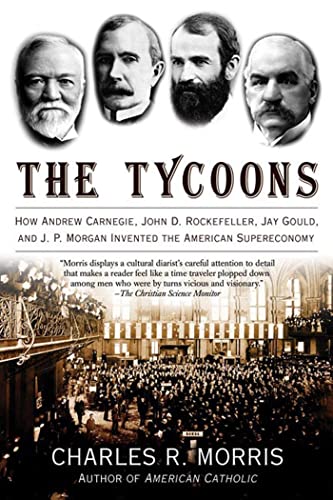
Tycoons: How Andrew Carnegie, John D. Rockefeller, Jay Gould, and J. P. Morgan Invented the American Supereconomy - Softcover
Inhaltsangabe
"Makes a reader feel like a time traveler plopped down among men who were by turns vicious and visionary."
-The Christian Science Monitor
The modern American economy was the creation of four men: Andrew Carnegie, John D. Rockefeller, Jay Gould, and J. P. Morgan. They were the giants of the Gilded Age, a moment of riotous growth that established America as the richest, most inventive, and most productive country on the planet.
Acclaimed author Charles R. Morris vividly brings the men and their times to life. The ruthlessly competitive Carnegie, the imperial Rockefeller, and the provocateur Gould were obsessed with progress, experiment, and speed. They were balanced by Morgan, the gentleman businessman, who fought, instead, for a global trust in American business. Through their antagonism and their verve, they built an industrial behemoth-and a country of middle-class consumers. The Tycoons tells the incredible story of how these four determined men wrenched the economy into the modern age, inventing a nation of full economic participation that could not have been imagined only a few decades earlier.
Die Inhaltsangabe kann sich auf eine andere Ausgabe dieses Titels beziehen.
Über die Autorin bzw. den Autor
Charles R. Morris (1939-2021) was the author of several books including Tycoon, American Catholic and Money, Greed, and Risk. He was a lawyer and banker, and was president of a financial services software company. A regular contributor to the Los Angeles Times, he also wrote for The Wall Street Journal and The Atlantic Monthly.
Auszug. © Genehmigter Nachdruck. Alle Rechte vorbehalten.
The Tycoons
How Andrew Carnegie, John D. Rockefeller, Jay Gould, and J. P. Morgan Invented the American SupereconomyBy Morris, Charles R.Owl Books
Copyright © 2006 Morris, Charles R.All right reserved.
ISBN: 0805081348
Chapter One
Prelude
Abraham Lincoln was pronounced dead shortly after seven o’clock on a rain-soaked Holy Saturday morning, April 15, 1865. It was less than a week after Gen. Robert E. Lee’s surrender at Appomattox. The little group of officials and family gathered around the blood-soaked bed in Will Peterson’s boardinghouse across from Ford’s Theater stood silently for several minutes. Then Mary Lincoln’s pastor, Phineas Gurley, said a short prayer, and a detachment of soldiers was summoned into the room. They placed the body in a military coffin and whisked it through the sodden crowd keeping vigil outside to the hearse that would carry it to the White House.
The autopsy and embalming were performed in the east wing’s second-floor guest room. Edwin Stanton, the volcanic secretary of war, chose the president’s funeral garb and insisted that the undertaker leave the black residue of intracranial bleeding that had formed under Lincoln’s right eye. Construction started almost immediately on a catafalque, modeled after a Masonic “Lodge of Sorrow,” in the first-floor East Room for the public viewing. As the hammering went on through Easter Sunday and the following Monday, a distraught Mary Lincoln pleaded that the blows sounded like pistol shots. The men who carried Lincoln’s body to the first floor on Monday night removed their shoes so as not to disturb Mrs. Lincoln.
There was a public viewing in the East Room on Tuesday. With special trains ferrying tens of thousands of people into the capital, the lines—for the opportunity to file through the darkened room and gaze down for barely a second at the dead president—stretched out for hours. A series of private viewings on Tuesday evening included a delegation of Illinois citizens who had come to demand that Lincoln be buried in his home state; Stanton was planning an interment in Washington. The following morning, six hundred guests packed into the East Room for the funeral service. Even men like Gen. Ulysses S. Grant and Stanton openly wept. Some twenty-five million people attended similar services held more or less simultaneously throughout the United States and Canada.
The massive funeral procession on Wednesday afternoon, before some seventy-five thousand spectators, included detachments of black fighting units and crippled veterans, and, most dramatically, the traditional commander-in-chief’s horse following the hearse, with empty saddle and boots facing backward in the stirrups. It was the same image that so stirred television audiences at John F. Kennedy’s funeral procession a century later.
The procession terminated at the Capitol, where another ornately rendered catafalque awaited the president’s coffin. After lying in state for two days, the body was transferred to a special Baltimore & Ohio railroad car for the first leg of the trip back to Springfield, for Stanton had finally acceded to the Illinoisans’ demands. Adding a final grace note of sadness, Lincoln’s coffin was accompanied by that of his young son, Willie, whom he had adored, and who had died, probably of pneumonia, in 1862. Willie’s little metal coffin was removed from its crypt in Washington and encased in a finer walnut container to rest with his father’s in Springfield.
On the Brink
A stop-action frame of the United States at Lincoln’s death would have caught the mourning nation frozen for the moment in mid-leap, aimed headlong into modernity. The route chosen for Lincoln’s last trip home—up the East Coast to New York, then westward along the Great Lakes to the Midwest and Springfield—itself traced a kind of fault line through the stresses of a society moving rapidly away from its preindustrial roots, roughly tracking the shape of a new American commercial geography.
Most notably, because it was by railroad, the trip took just days, instead of the weeks or months it would have consumed not many years before. The locomotives appear small and quaint today, with their big inverted-bell smokestacks and wood-burning fireboxes. But when they jumped across the Alleghenies in the 1850s, the nation shrank radically; for the first time, the urban East Coast was joined in a single national system with the farmlands and resources of the “Northwest”—the name still used for the states and territories between the original northern colonies and the eastern banks of the Mississippi.
A dozen cities along the route hosted formal funeral ceremonies, all of them vying in the rococo excesses of the catafalques, the funeral orations, and the strutting ranks of portly men in costumes and plumes. The first stop after Washington was Baltimore. Both essentially were the same cities as before the war—the capital, disgracefully enough, a malarial mudhole, although now with an array of almost-finished Greek revival buildings, while Baltimore, a thriving mercantile port, was bloated and bilious from its fat-rich diet of wartime trading.
When the trip first turned inland, however, from Baltimore to Harrisburg, it was traversing a brand-new kind of battle salient. Railroads were coming to understand the profits to be made from the country’s quickening internal trade, and there was an oil boom in the woods of western Pennsylvania. Bucolic little towns like Titusville had turned into hellholes where streams ran black and the air was misted with oil. The wells’ garish night flares flickered over swirling mobs of wildcatters, draymen, prostitutes, and small-time con men, all desperately clawing after their one main chance to get very rich very fast. The Pennsylvania fields were the largest yet discovered, by a huge margin, and within just a few years would supply the illuminating oil for almost the entire civilized world. With stakes like those, the nascent railroad wars would be fierce, often violent, and in a world with no system of law for controlling large corporations, deeply corrupting.
The next stops on the journey, Philadelphia and New York, were both struggling with over-rapid transitions into diversified manufacturing and financial centers. Philadelphia’s machine-made textile industry got a huge boost from wartime blanket contracts. Its famed Franklin Institute, the oldest technical institute in the country, was organized in the 1820s with more than a thousand membership subscriptions to promote scientific manufacturing. The boom in New York—printing, light manufacturing, securities and banking—was bursting the boundaries of Manhattan island, and plans were afoot for a colossal bridge to expand the city’s footprint across the East River into...
„Über diesen Titel“ kann sich auf eine andere Ausgabe dieses Titels beziehen.
Suchergebnisse für Tycoons: How Andrew Carnegie, John D. Rockefeller,...

Foto des Verkäufers
The Tycoons: How Andrew Carnegie, John D. Rockefeller, Jay Gould, and J. P. Morgan Invented the American Supereconomy
Anbieter: Zoom Books East, Glendale Heights, IL, USA
Verkäuferbewertung 5 von 5 Sternen

Zustand: good. Book is in good condition and may include underlining highlighting and minimal wear. The book can also include "From the library of" labels. May not contain miscellaneous items toys, dvds, etc. . We offer 100% money back guarantee and 24 7 customer service. Bestandsnummer des Verkäufers ZEV.0805081348.G
Gebraucht kaufen
EUR 6,55
Versand gratis
Versand innerhalb von USA
Versand innerhalb von USA
Anzahl: 1 verfügbar
Beispielbild für diese ISBN
The Tycoons: How Andrew Carnegie, John D. Rockefeller, Jay Gould, and J. P. Morgan Invented the American Supereconomy
Verlag:
Holt Paperbacks (edition First Edition), 2006
ISBN 10: 0805081348
ISBN 13: 9780805081343
Gebraucht
Paperback
Erstausgabe
Anbieter: BooksRun, Philadelphia, PA, USA
Verkäuferbewertung 5 von 5 Sternen
Paperback. Zustand: Very Good. First Edition. It's a well-cared-for item that has seen limited use. The item may show minor signs of wear. All the text is legible, with all pages included. It may have slight markings and/or highlighting. Bestandsnummer des Verkäufers 0805081348-8-1
Gebraucht kaufen
EUR 6,97
Versand gratis
Versand innerhalb von USA
Versand innerhalb von USA
Anzahl: 1 verfügbar
Beispielbild für diese ISBN
The Tycoons : How Andrew Carnegie, John D. Rockefeller, Jay Gould, and J. P. Morgan Invented the American Supereconomy
Anbieter: Better World Books, Mishawaka, IN, USA
Verkäuferbewertung 5 von 5 Sternen
Zustand: Good. Pages intact with minimal writing/highlighting. The binding may be loose and creased. Dust jackets/supplements are not included. Stock photo provided. Product includes identifying sticker. Better World Books: Buy Books. Do Good. Bestandsnummer des Verkäufers 2504843-6
Gebraucht kaufen
EUR 7,03
Versand gratis
Versand innerhalb von USA
Versand innerhalb von USA
Anzahl: 14 verfügbar
Beispielbild für diese ISBN
The Tycoons : How Andrew Carnegie, John D. Rockefeller, Jay Gould, and J. P. Morgan Invented the American Supereconomy
Anbieter: Better World Books: West, Reno, NV, USA
Verkäuferbewertung 5 von 5 Sternen
Zustand: Very Good. Pages intact with possible writing/highlighting. Binding strong with minor wear. Dust jackets/supplements may not be included. Stock photo provided. Product includes identifying sticker. Better World Books: Buy Books. Do Good. Bestandsnummer des Verkäufers 4051773-6
Gebraucht kaufen
EUR 7,03
Versand gratis
Versand innerhalb von USA
Versand innerhalb von USA
Anzahl: 1 verfügbar
Beispielbild für diese ISBN
The Tycoons: How Andrew Carnegie, John D. Rockefeller, Jay Gould, and J. P. Morgan Invented the American Supereconomy
Anbieter: Campus Bookstore, Denton, TX, USA
Verkäuferbewertung 4 von 5 Sternen

Paperback. Zustand: Good. May contain highlighting/underlining/notes/etc. May have used stickers on cover. Access codes and supplements are not guaranteed to be included with used books. Ships same or next day. Expedited shipping: 3-5 business days, Standard shipping: 4-14 business days. Bestandsnummer des Verkäufers mon0000181335
Gebraucht kaufen
EUR 3,59
EUR 3,47 Versand
Versand innerhalb von USA
Versand innerhalb von USA
Anzahl: 4 verfügbar
Foto des Verkäufers
The Tycoons: How Andrew Carnegie, John D. Rockefeller, Jay Gould, and J. P. Morgan Invented the American Supereconomy
Anbieter: ZBK Books, Carlstadt, NJ, USA
Verkäuferbewertung 5 von 5 Sternen
Zustand: very_good. Fast & Free Shipping â" Very Good condition book with a firm cover and clean pages. Shows normal use and some light wear or limited notes markings. A solid, nice copy to enjoy. Bestandsnummer des Verkäufers ZWV.0805081348.VG
Gebraucht kaufen
EUR 7,16
Versand gratis
Versand innerhalb von USA
Versand innerhalb von USA
Anzahl: 1 verfügbar
Beispielbild für diese ISBN
The Tycoons: How Andrew Carnegie, John D. Rockefeller, Jay Gould, and J. P. Morgan Invented the American Supereconomy
Anbieter: HPB-Diamond, Dallas, TX, USA
Verkäuferbewertung 5 von 5 Sternen
Paperback. Zustand: Very Good. Connecting readers with great books since 1972! Used books may not include companion materials, and may have some shelf wear or limited writing. We ship orders daily and Customer Service is our top priority! Bestandsnummer des Verkäufers S_468629071
Gebraucht kaufen
EUR 4,04
EUR 3,26 Versand
Versand innerhalb von USA
Versand innerhalb von USA
Anzahl: 1 verfügbar
Beispielbild für diese ISBN
The Tycoons: How Andrew Carnegie, John D. Rockefeller, Jay Gould, and J. P. Morgan Invented the American Supereconomy
Anbieter: HPB-Ruby, Dallas, TX, USA
Verkäuferbewertung 5 von 5 Sternen
Paperback. Zustand: Very Good. Connecting readers with great books since 1972! Used books may not include companion materials, and may have some shelf wear or limited writing. We ship orders daily and Customer Service is our top priority! Bestandsnummer des Verkäufers S_468872914
Gebraucht kaufen
EUR 4,04
EUR 3,26 Versand
Versand innerhalb von USA
Versand innerhalb von USA
Anzahl: 1 verfügbar
Beispielbild für diese ISBN
The Tycoons: How Andrew Carnegie, John D. Rockefeller, Jay Gould, and J. P. Morgan Invented the American Supereconomy
Anbieter: HPB-Emerald, Dallas, TX, USA
Verkäuferbewertung 5 von 5 Sternen
Paperback. Zustand: Very Good. Connecting readers with great books since 1972! Used books may not include companion materials, and may have some shelf wear or limited writing. We ship orders daily and Customer Service is our top priority! Bestandsnummer des Verkäufers S_477613258
Gebraucht kaufen
EUR 4,66
EUR 3,26 Versand
Versand innerhalb von USA
Versand innerhalb von USA
Anzahl: 1 verfügbar
Beispielbild für diese ISBN
The Tycoons: How Andrew Carnegie, John D. Rockefeller, Jay Gould, and J. P. Morgan Invented the American Supereconomy
Anbieter: Half Price Books Inc., Dallas, TX, USA
Verkäuferbewertung 5 von 5 Sternen
Paperback. Zustand: Very Good. Connecting readers with great books since 1972! Used books may not include companion materials, and may have some shelf wear or limited writing. We ship orders daily and Customer Service is our top priority! Bestandsnummer des Verkäufers S_475143094
Gebraucht kaufen
EUR 4,68
EUR 3,26 Versand
Versand innerhalb von USA
Versand innerhalb von USA
Anzahl: 1 verfügbar