
Verwandte Artikel zu ARE YOU SOMEBODY?: The Accidental Memoir of a Dublin...
Inhaltsangabe
"You don't want the book to end; it glows with compassion and you want more, more because you know this is a fine wine of a life, richer as it ages."-Frank McCourt, author of Angela's Ashes
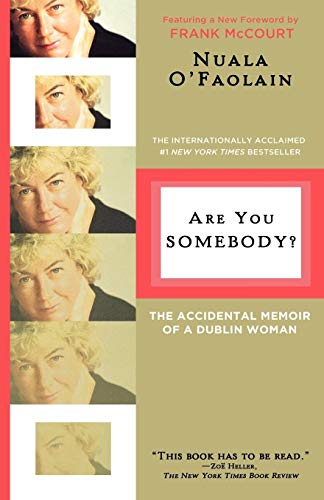
One of nine children born into a penniless North Dublin family, Nuala O'Faolain was saved from a harrowing childhood by her love of books and reading. Though she ultimately became one of Ireland's best-known columnists, her professional success did little to ease her loneliness and longing for a deep connection to the world. Are You Somebody? distills her experiences into a wisdom that can only come from an obstinate refusal to shrink from life.
This commemorative edition of her landmark memoir celebrates O'Faolain's remarkable life and work with a new foreword from Frank McCourt as well as additional archival materials. Strikingly vivid and starkly emotional, Are You Somebody? is, like O'Faolain herself, a singular example of courage, honesty, and bold living.
Die Inhaltsangabe kann sich auf eine andere Ausgabe dieses Titels beziehen.
Über die Autorin bzw. den Autor
Nuala O'Faolain was a waitress, sales clerk, and maid; a university lecturer; a TV producer; and a columnist with The Irish Times. The author of three consecutive New York Times bestsellers, her books include the memoir Almost There, a follow-up to Are You Somebody?, as well as two novels: My Dream of You and The Story of Chicago May. She died in Dublin in 2008.
Auszug. © Genehmigter Nachdruck. Alle Rechte vorbehalten.
Are You Somebody?
The Accidental Memoir of a Dublin Woman
By Nuala O'FaolainHenry Holt and Company
Copyright © 1996 Nuala O'Faolain
All rights reserved.
ISBN: 978-0-8050-8987-5All rights reserved.
CHAPTER 1
When I was in my early thirties and entering a bad period of my life, I was living in London on my own, working as a television producer with the BBC. The man who had absorbed me for ten years, and whom I had once been going to marry, had finally left. I came home one day to the flat in Islington, and there was a note on the table saying Back Tuesday. I knew he wouldn't come back, and he didn't. I didn't really want him to. We were exhausted. But still, I didn't know what to do. I used to sit in my chair every night and read and drink a lot of cheap white wine. I'd say "hello" to the fridge when its motor turned itself on. One New Year's Eve I wished the announcer on Radio Three "A Happy New Year to you, too." I was very depressed. I asked the doctor to send me to a psychiatrist.
The psychiatrist was in an office in a hospital. "Well, now, let's get your name right to begin with," he said cheerfully. "What is your name?" "My name is ... my name is ..." I could not say my name. I cried, as from an ocean of tears, for the rest of the hour. My self was too sorrowful to speak. And I was in the wrong place, in England. My name was a burden to me.
Not that the psychiatrist saw it like that. I only went to him once more, but I did manage to get out a bit about my background and about the way I was living. Eventually he said something that lifted a corner of the fog of unconsciousness. "You are going to great trouble," he said, "and flying in the face of the facts of your life, to re-create your mother's life." Once he said this, I could see it was true. Mammy sat in her chair in a flat in Dublin and read and drank. Before she sat in the chair she was in bed. She might venture shakily down to the pub. Then she would totter home and sit in her chair. Then she went to bed. She had had to work the treadmill of feeding and clothing and cleaning child after child for decades. Now all but one of the nine had gone. My father had moved himself and her and that last one to a flat, and she sat there. She had the money he gave her (never enough to slake her anxieties). She had nothing to do, and there was nothing she wanted to do, except drink and read.
And there was I — half her age, not dependent on anyone, not tired or trapped, with an interesting, well-paid job, with freedom and health and occasional good looks. Yet I was loyally re-creating her wasteland around myself.
One of the stories of my life has been the working out in it of her powerful and damaging example — in everything. Nothing matters except passion, she indicated. It was what had mattered to her, and she more or less sustained a myth of passionate happiness for the first ten years of her marriage. She didn't value any other kind of relationship. She wasn't interested in friendship. If she had thoughts or ideas, she never mentioned them. She was more like a shy animal on the outskirts of the human settlement than a person within it. She read all the time, not to feed reflection but as part of her utter determination to avoid reflection.
What made her? Her father — my grandad — wrote his memoirs, a few pages in pencil, in a lined copybook. He was one of fourteen children on a smallholding, and perhaps because, like his brothers and sisters, he had had to emigrate when he was a boy and there was never a family again, he remembered his childhood home with an abundance of sentiment. "I will try and give you a typical family scene as I saw it in the beginning of the 1890s," he wrote:
Father would enter the kitchen after dark and would start making and mending — a chair, a basket, or some harness. He would always sing at his work, he having a great variety of songs in both English and Irish. The babies would be asleep and the next elders would have their feet washed in a wooden vessel, then follow. After the rosary was said the next elders would retire. Mother would be putting the last thread in her needle. An oil lamp hung before the window and a turf fire in the hearth would be supplemented by a piece of bog deal which cast a light on the dresser so that the jugs and other ware would gleam as if alight. Sometimes, when not engaged in work, Father would pull down the weekly paper and read aloud, mostly the political news — stopping now and then to put his own interpretation on it. Mother, near at hand, would be an eager listener.
My mother, the granddaughter of this ideal pair, was anything but an eager listener. I don't know what happened, down the generations. I don't suppose that history explains it — that the individual person comes out of a vessel into which two jugs called Heredity and Environment have been poured. But perhaps emigration did something to the relationship between women and children. Children were toughened early, sent out into the world with their cardboard suitcases — one minute warm in the tribe, the next minute walking down the steps of some distant railway station into a world they must handle on their own. Under the surface competence, they must have been infantile. Somewhere in the years that fed down into my mother, there were too many children and too few resources. She was the most motherless of women, herself.
Her own mother, in the little account anyone ever gave of her, was angry and energetic, running a tailoress operation in the front room of the red-brick terraced house in Clonliffe Road in Dublin, sewing shrouds late at night for the dead of the parish. Tuberculosis makes you feverish, and she was slowly dying of TB. "She threw a red-hot iron at me," was all my mother ever said — sulkily — about her. "She said I always had my head stuck in a book." But then, one child had already died. One grown-up daughter was dying of TB along with the mother. There were seven more being reared for emigration. It was an ordinary respectable Irish household of the time. The woman of the house never went out, never had money, never stopped having children. My own mother held herself at arm's length from this reality. She grew up with no skills. She didn't know how to make small-talk or cook a breakfast or tie up a parcel or name a tree or flower.
When I knew my grandfather he had long been a widower. He dreamt of champion greyhounds and hobbled up Clonliffe Road to a public bench, where he talked slowly with other patriarchs, other countrymen displaced. I didn't know why my mother feared him. He ate bull's-eyes and read The Saint thrillers. He would say to me from his frowsty bed, "Hand me over those trousers." He'd fumble in the pocket and give me pennies. He sat on the upright chair to put on his long johns, and his penis was like some purply barnacled mineral thing, found on the seabed. He expected his tea and bread-and-butter brought to his chair. He would certainly have denied that the fact that three of his children were ferocious alcoholics had anything to do with him. No one takes responsibility for the big Irish families that in generation after generation are ravaged by alcoholism.
My mother didn't want anything to do with child-rearing or housework. But she had to do it. Because she fell in love with my father, and they married, she was condemned to spend her life as a mother and a homemaker. She was in the wrong job. Sometimes I meet women who remind me of her when I stay in bed-and-breakfasts around the country. They throw sugar on the fire, to get it to light, and wipe surfaces with an old...
„Über diesen Titel“ kann sich auf eine andere Ausgabe dieses Titels beziehen.
Suchergebnisse für ARE YOU SOMEBODY?: The Accidental Memoir of a Dublin...

Beispielbild für diese ISBN
Are You Somebody?: The Accidental Memoir of a Dublin Woman
Anbieter: Tangled Web Mysteries and Oddities, Kennebuunkport, ME, USA
Verkäuferbewertung 5 von 5 Sternen

Paperback. Zustand: Good. Second. . Providing superior service since 2001. Dropshippers heartily welcomed. Bestandsnummer des Verkäufers 117693
Gebraucht kaufen
EUR 0,91
EUR 4,88 Versand
Versand innerhalb von USA
Versand innerhalb von USA
Anzahl: 1 verfügbar
Beispielbild für diese ISBN
Are You Somebody?: The Accidental Memoir of a Dublin Woman
Anbieter: World of Books (was SecondSale), Montgomery, IL, USA
Verkäuferbewertung 5 von 5 Sternen
Paperback. Zustand: Good. "You don't want the book to end; it glows with compassion and you want more, more because you know this is a fine wine of a life, richer as it ages."--Frank McCourt, author of Angela's Ashes One of nine children born into a penniless North Dublin family, Nuala O'Faolain was saved from a harrowing childhood by her love of books and reading. Though she ultimately became one of Ireland's best-known columnists, her professional success did little to ease her loneliness and longing for a deep connection to the world. Are You Somebody? distills her experiences into a wisdom that can only come from an obstinate refusal to shrink from life. This commemorative edition of her landmark memoir celebrates O'Faolain's remarkable life and work with a new foreword from Frank McCourt as well as additional archival materials. Strikingly vivid and starkly emotional, Are You Somebody? is, like O'Faolain herself, a singular example of courage, honesty, and bold living. Bestandsnummer des Verkäufers 00093982786
Gebraucht kaufen
EUR 5,93
Versand gratis
Versand innerhalb von USA
Versand innerhalb von USA
Anzahl: 7 verfügbar
Beispielbild für diese ISBN
Are You Somebody?: The Accidental Memoir of a Dublin Woman
Anbieter: World of Books (was SecondSale), Montgomery, IL, USA
Verkäuferbewertung 5 von 5 Sternen
Zustand: Very Good. Item in very good condition! Textbooks may not include supplemental items i.e. CDs, access codes etc. Bestandsnummer des Verkäufers 00098402078
Gebraucht kaufen
EUR 5,93
Versand gratis
Versand innerhalb von USA
Versand innerhalb von USA
Anzahl: 1 verfügbar
Beispielbild für diese ISBN
Are You Somebody?: The Accidental Memoir of a Dublin Woman
Anbieter: World of Books (was SecondSale), Montgomery, IL, USA
Verkäuferbewertung 5 von 5 Sternen
Zustand: Acceptable. Item in acceptable condition! Textbooks may not include supplemental items i.e. CDs, access codes etc. Bestandsnummer des Verkäufers 00097010232
Gebraucht kaufen
EUR 5,93
Versand gratis
Versand innerhalb von USA
Versand innerhalb von USA
Anzahl: 1 verfügbar
Beispielbild für diese ISBN
ARE YOU SOMEBODY?
Anbieter: Wonder Book, Frederick, MD, USA
Verkäuferbewertung 5 von 5 Sternen
Zustand: As New. Like New condition. A near perfect copy that may have very minor cosmetic defects. Bestandsnummer des Verkäufers N19O-01127
Gebraucht kaufen
EUR 6,40
Versand gratis
Versand innerhalb von USA
Versand innerhalb von USA
Anzahl: 1 verfügbar
Beispielbild für diese ISBN
ARE YOU SOMEBODY?
Anbieter: Wonder Book, Frederick, MD, USA
Verkäuferbewertung 5 von 5 Sternen
Zustand: Very Good. Very Good condition. A copy that may have a few cosmetic defects. May also contain light spine creasing or a few markings such as an owner's name, short gifter's inscription or light stamp. Bestandsnummer des Verkäufers X14I-01512
Gebraucht kaufen
EUR 6,40
Versand gratis
Versand innerhalb von USA
Versand innerhalb von USA
Anzahl: 2 verfügbar
Beispielbild für diese ISBN
Are You Somebody?: The Accidental Memoir of a Dublin Woman
Anbieter: ThriftBooks-Atlanta, AUSTELL, GA, USA
Verkäuferbewertung 5 von 5 Sternen
Paperback. Zustand: Very Good. No Jacket. May have limited writing in cover pages. Pages are unmarked. ~ ThriftBooks: Read More, Spend Less. Bestandsnummer des Verkäufers G080508987XI4N00
Gebraucht kaufen
EUR 6,46
Versand gratis
Versand innerhalb von USA
Versand innerhalb von USA
Anzahl: 1 verfügbar
Beispielbild für diese ISBN
Are You Somebody? : The Accidental Memoir of a Dublin Woman
Anbieter: Better World Books, Mishawaka, IN, USA
Verkäuferbewertung 5 von 5 Sternen
Zustand: Good. Pages intact with minimal writing/highlighting. The binding may be loose and creased. Dust jackets/supplements are not included. Stock photo provided. Product includes identifying sticker. Better World Books: Buy Books. Do Good. Bestandsnummer des Verkäufers 940181-6
Gebraucht kaufen
EUR 6,54
Versand gratis
Versand innerhalb von USA
Versand innerhalb von USA
Anzahl: 1 verfügbar
Beispielbild für diese ISBN
Are You Somebody? : The Accidental Memoir of a Dublin Woman
Anbieter: Better World Books, Mishawaka, IN, USA
Verkäuferbewertung 5 von 5 Sternen
Zustand: Good. Former library copy. Pages intact with minimal writing/highlighting. The binding may be loose and creased. Dust jackets/supplements are not included. Includes library markings. Stock photo provided. Product includes identifying sticker. Better World Books: Buy Books. Do Good. Bestandsnummer des Verkäufers 7517342-6
Gebraucht kaufen
EUR 6,54
Versand gratis
Versand innerhalb von USA
Versand innerhalb von USA
Anzahl: 1 verfügbar
Beispielbild für diese ISBN
Are You Somebody?: The Accidental Memoir of a Dublin Woman
Anbieter: World of Books Inc, Montgomery, IL, USA
Verkäuferbewertung 4 von 5 Sternen

Paperback. Zustand: Good. "You don't want the book to end; it glows with compassion and you want more, more because you know this is a fine wine of a life, richer as it ages."--Frank McCourt, author of Angela's Ashes One of nine children born into a penniless North Dublin family, Nuala O'Faolain was saved from a harrowing childhood by her love of books and reading. Though she ultimately became one of Ireland's best-known columnists, her professional success did little to ease her loneliness and longing for a deep connection to the world. Are You Somebody? distills her experiences into a wisdom that can only come from an obstinate refusal to shrink from life. This commemorative edition of her landmark memoir celebrates O'Faolain's remarkable life and work with a new foreword from Frank McCourt as well as additional archival materials. Strikingly vivid and starkly emotional, Are You Somebody? is, like O'Faolain herself, a singular example of courage, honesty, and bold living. Bestandsnummer des Verkäufers CIN080508987XG
Gebraucht kaufen
EUR 7,76
Versand gratis
Versand innerhalb von USA
Versand innerhalb von USA
Anzahl: 7 verfügbar